Ecuador's Recall Push Against Noboa
A test of democracy as citizens challenge Noboa's mandate
Model Diplomat8 min readLatin America
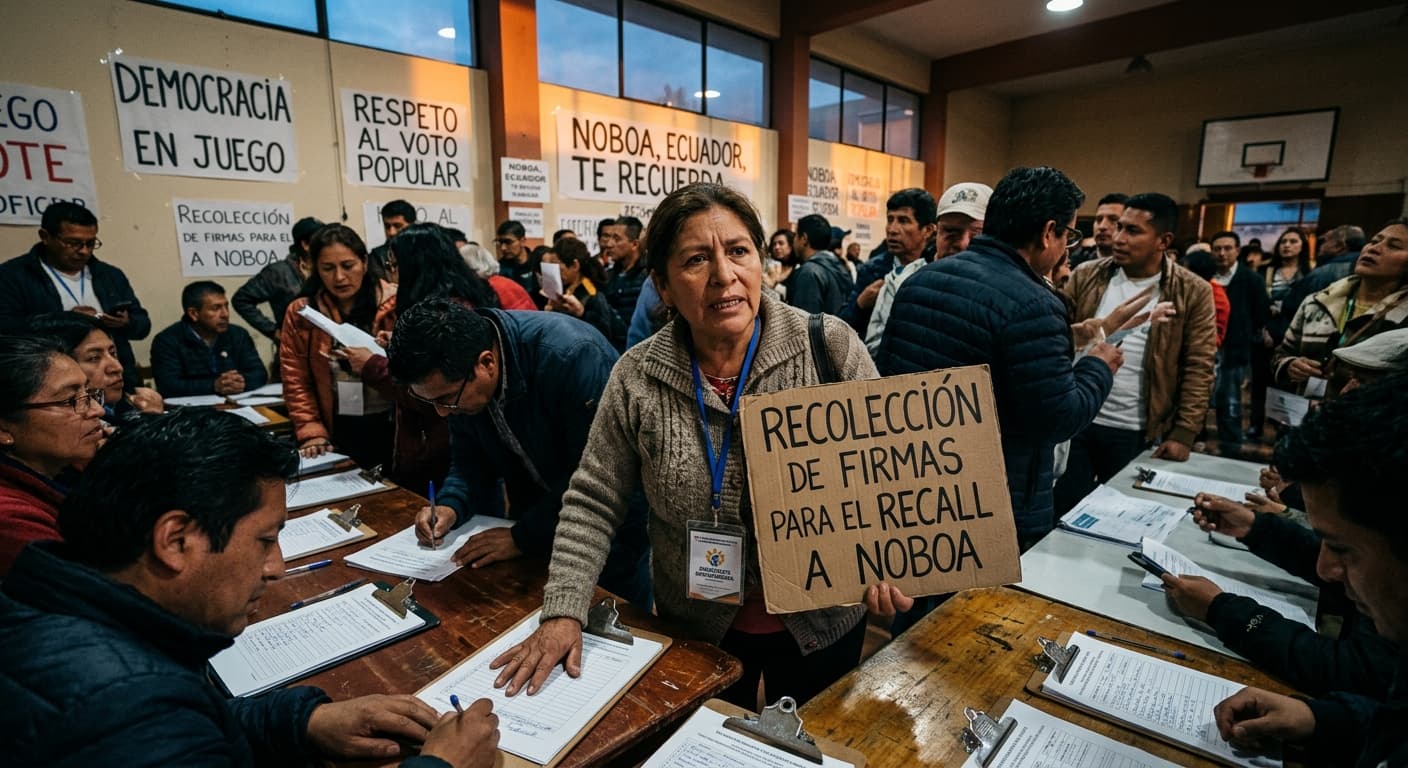
Ecuador's recall push against Noboa turns the CNE into the referee
Ecuadorian unions and indigenous groups have filed two presidential recall petitions against Daniel Noboa. What began as street pressure is now a test of whether the electoral council will let citizens vote — and of Latin America's democratic guardrails.
The recall drive against President Daniel Noboa is not, in strict electoral arithmetic, likely to remove him: no citizen-initiated recall of a sitting Ecuadorian president has ever cleared the 15% signature threshold set by the 2008 Constitution. What matters is that the campaign has moved the terrain of political conflict from the streets to the National Electoral Council (CNE) — turning an unelected regulator into the effective arbiter of whether Noboa's mandate is contestable at all, in the same institutional pattern that broke Guillermo Lasso in 2023 and that increasingly defines post-electoral politics from Quito to La Paz.
Two revocatoria petitions now sit before the CNE. Under the banner Revoca EC, civic organisers have called nationwide vigils on July 11 and 15 outside every provincial delegation of the CNE, demanding the council rule on admissibility and hand over the forms to begin collecting signatures, Prensa Latina reported. Their slogan — La revocatoria va, porque va — is a direct dare to a council the opposition believes is stalling.
From a 12-point landslide to a recall petition in 14 months
The speed of Noboa's political erosion is the story. In April 2025 the 37-year-old banana-fortune heir won reelection with 55.8% of the vote, a decisive 12-point margin over Correísta candidate Luisa González, Al Jazeera reported. Seven months later he lost every question of a self-called referendum: voters rejected a constituent assembly by 61.6% and foreign military bases by 60.6%, according to
BBC News Mundo, which framed the November 16, 2025 vote as an "electoral drubbing" delivered by the same electorate that had reelected him.
Between the two votes, Noboa cut the diesel subsidy on September 12, 2025, pushing prices from $1.80 to $2.80 a gallon and detonating the most sustained indigenous mobilisation since 2019. Al Jazeera documented 18 days of roadblocks and the deployment of 5,000 troops to Quito; the
BBC reported an ambush on a presidential humanitarian convoy in Cotacachi that left 17 soldiers held hostage. Human Rights Watch counted two dead, 473 injured and 206 detained, and warned that Noboa's government had begun labelling the Constitutional Court itself an "enemy of the people," according to
HRW's November 17, 2025 statement.
The recall campaign is the political sequel to those grievances. Its two lead petitioners are precisely the actors Noboa most alienated: former CONAIE president Leonidas Iza, the third-place finisher in February 2025 who commanded the indigenous vote González needed and never fully got, per Al Jazeera's longform account; and FENOCIN, the country's largest peasant-indigenous confederation, joined by the UNE teachers' union and the UGTE.
The legal chokepoint: Article 105 and a weakened CNE
The constitutional stakes are narrower than the street rhetoric suggests. Article 61(6) of Ecuador's 2008 Constitution recognises the right to revoke elected mandates as a citizen prerogative, as codified in the official text hosted by Sciences Po. But Article 105, tightened in 2011 after Rafael Correa engineered reforms to protect his own government, requires signatures from at least 15% of the electoral registry — roughly 2.1 million citizens — collected within 180 days, and prohibits recalls based on "public policy" disagreement.
That threshold is the reason no Ecuadorian president has ever faced a citizen recall vote reach the ballot. As Yanina Welp's peer-reviewed study in International Political Science Review documents, the 2011 amendment collapsed recall activations from 78 processes in 2010–2012 to a handful thereafter — and gave electoral management bodies decisive gatekeeping power over which petitions ever reach signature collection. The CNE, in other words, is the veto point.
Which is exactly why the government moved first. On July 7, 2026, Presidential Legal Secretary Enrique Herrería appeared at the CNE headquarters in Quito to file a formal impugnación against the second petition, Ecuavisa reported. His argument is technical and shrewd: the petitioners, led by FENOCIN president Guido Perugachi, cite Noboa's $5 billion IMF program (2024–2028) as evidence he has abandoned his government plan. Herrería told the CNE that macroeconomic choices "are called public policy, which is the exclusive competence of the Executive," according to the
EFE dispatch carried by ABC Color — which, if the CNE accepts the framing, would gut Article 105's usable grounds. The first petition, filed by Iza and lawyer Washington Andrade, is already in analysis phase.
The council's political independence is, at best, contested. A November 2024 opinion by the Attorney General extended the sitting CNE councillors' mandates indefinitely past their scheduled November 2024 expiry, on the grounds that the Council for Citizen Participation had not designated replacements — a mechanism analysed by Konrad Adenauer Stiftung, which flagged the "political co-optation, lack of independence and weak control of electoral financing" now characterising the CNE and its sister Tribunal Contencioso Electoral. The councillors ruling on Noboa's fate owe their continued tenure to an executive branch appointment loophole.
The regional pattern: recall as the new opposition weapon
What is happening in Ecuador fits a broader Andean template rather than breaking from it. Recall referendums were once a curiosity of Swiss cantonal politics; since Hugo Chávez survived one in Venezuela in 2004, they have become the standard opposition instrument in dollarised or hyper-presidential regimes where impeachment is politically blocked and coups are constitutionally proscribed. Peru saw four presidents cycle through in five years using variants of vacancia. Bolivia's opposition weaponised recall against Evo Morales in 2008. And in Ecuador itself, the Lasso presidency ended in May 2023 via "muerte cruzada" — a mutual-destruction constitutional device, chronicled by BBC Mundo, that dissolved both congress and the presidency to head off impeachment.
Noboa's structural weakness makes him a plausible target for the mechanism even if the arithmetic is prohibitive. His party Acción Democrática Nacional (ADN) holds only 66 of 151 Assembly seats, meaning impeachment is unavailable to the opposition but so is any legislative shield. The Constitutional Court, which Noboa has publicly called "enemy of the people" per BBC Mundo's referendum post-mortem, has repeatedly blocked his security decrees. In that vacuum, the recall — even one destined to fail on signatures — becomes the only remaining institutional pressure point outside the streets.
The Center for Strategic and International Studies argues Ecuador's underlying problem is not any single president but the institutional erosion accelerated by successive governments — an environment where fiscal crisis, a homicide rate that hit 46 per 100,000 in 2023, and elite cooptation of electoral bodies compound. Analysts at
CIDOB in Barcelona noted after the April 2025 election that Noboa had a security mandate but "no economic recovery plan." The IMF program is, in a sense, the plan — and it is precisely what the petitioners cite as breach of contract.
Who wins, who loses
The immediate beneficiary of the recall push is the correísta opposition — not because González will govern, but because every day Noboa is defending his legitimacy is a day he is not governing. Luisa González's Revolución Ciudadana has ridden the fuel-subsidy backlash and the referendum defeat to eclipse ADN in recent polling, according to NPR's post-referendum analysis. CONAIE and FENOCIN, marginalised during the campaign, have reclaimed convening power on the streets.
The clearer loser is the Trump administration's regional strategy. Homeland Security Secretary Kristi Noem visited Ecuador twice in 2025, touring the former Manta military base with Noboa in what NPR described as an "anti-narco terrorism" buildup. That project — a US forward operating location on the Pacific — died at the November 16 ballot box. As Michael Shifter of the Inter-American Dialogue told Al Jazeera, Ecuadorians "prize their sovereignty… very suspicious, very mistrustful of the US administration, especially watching what's going on with blowing up of boats" in the Pacific. A weakened Noboa cannot deliver Ecuador as a security platform even if he wanted to.
The second-order casualty is the region's stock of democratic legitimacy. If the CNE archives the petitions on Herrería's "public policy" argument, opposition forces will read it as executive capture of the electoral authority — the same charge Correa faced from the right in 2013 and Lasso from the left in 2022. If it admits them, Noboa will govern the next 180 days under a signature-collection cloud that markets, the IMF and foreign investors will price. Either path narrows his room for manoeuvre.
What to watch
- CNE ruling on admissibility. The council must decide whether to admit or archive both petitions. Under the Ley Orgánica Electoral, a failure to rule within a "reasonable" window opens the door to a Tribunal Contencioso Electoral appeal — which Revoca EC has already signalled it will file.
- July 11 and 15 mobilisations. The size and geographic spread of the vigils will tell whether recall is a Quito-Sierra phenomenon or has purchase in Guayaquil and the coast, where Noboa's ADN base sits.
- FMI review cycle. The next IMF Article IV review of the $5 billion program is the fiscal metronome. Any further subsidy cuts or VAT changes — Noboa raised VAT from 12% to 15% in 2024, per
Al Jazeera — will feed the second petition's core grievance.
- 2026 homicide data. NPR reported that homicides are "set to hit new records this year." A confirmed record above the 2023 peak of 46 per 100,000 would collapse Noboa's remaining political asset.
Diplomat View
The recall petition against Daniel Noboa will not succeed at the signature stage — the 15% threshold, the 180-day clock, and a CNE composed of executive-friendly councillors make that a near-mathematical impossibility. But the campaign is already winning the fight it can actually win: forcing the CNE to render a decision that will either legitimise Noboa's technocratic-IMF track or brand it, in law, as unappealable public policy immune to citizen review. The forecast: expect the CNE to archive the FENOCIN petition on Herrería's "public policy" argument within 60 days, and admit the Iza petition to signature collection as a pressure-release valve — a split ruling designed to preserve institutional face. That forecast changes if the July 11 vigils draw more than 50,000 in Quito, if the Constitutional Court accepts a parallel amparo from Revoca EC, or if a third opposition petition emerges from urban middle-class organisations outside the indigenous-union axis. The deeper signal for the region: in Ecuador, as in Peru and Bolivia, the presidency has become a job you can lose without an election — and that fact, more than any single ballot, is what defines Latin American democratic stability in 2026.
Discover more
India
UN Expert Albanese: India Violates Law
UN Rapporteur Francesca Albanese accuses India of breaching international law, spotlighting human rights concerns in Kashmir and prompting diplomatic pushback.
US Politics
House Ethics Committee Pushes Sexual Miscond.
The House Ethics Committee has shifted responsibility for sexual harassment settlement records to the Office of Congressional Workplace Rights, complicating disclosure efforts.

US Politics
SNAP Food Assistance Faces Legal Challenges
In 2026, SNAP faces stricter eligibility rules and mounting legal challenges, threatening food assistance for the millions of Americans who rely on the program.

Economics
Fed's Amex AML order puts correspondent banking on notice
Federal Reserve's Amex AML order requires board-level controls and a 90-day plan; OCC fined the bank $350 million over enterprise-wide deficiencies.