ECOWAS Inaugurates $31.6M Abuja HQ
New headquarters symbolizes regional unity amid fractures.
Model Diplomat8 min readWest Africa
ECOWAS Opens $31.6M Abuja HQ as Sahel Fracture Reshapes West Africa
Julius Maada Bio inaugurated the China-funded "Eye of West Africa" on 2 July 2026 — a monument to a bloc that just lost three founding members to the AES.
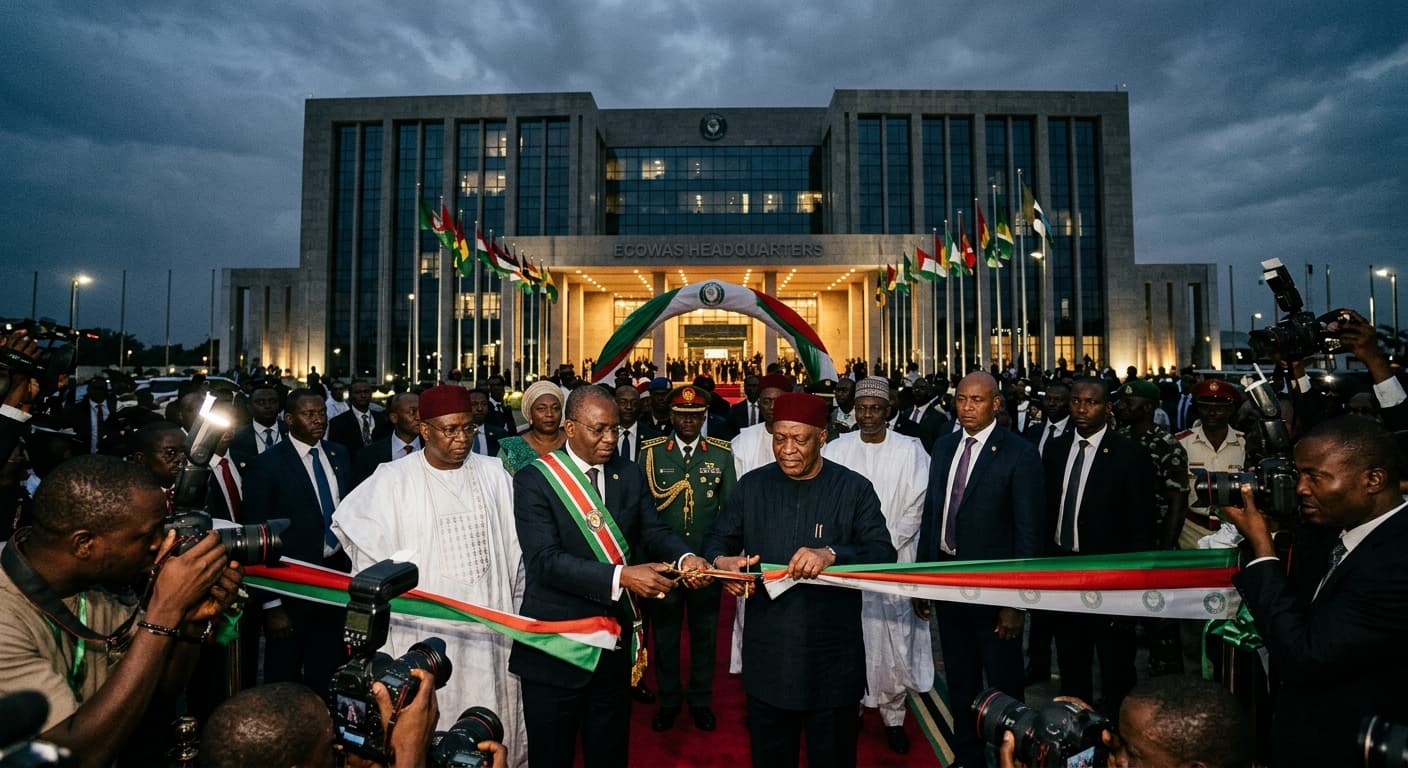
The Economic Community of West African States inaugurated its new $31.6 million China-financed headquarters in Abuja on 2 July 2026 — 18 months after the withdrawal of Mali, Burkina Faso and Niger stripped the bloc of 76 million citizens and nearly half its territory. Sierra Leonean President Julius Maada Bio, chairing the Authority of Heads of State, framed the tower as a symbol of "unity and shared prosperity" for 450 million West Africans. The building says something else: the 12 remaining states, backed by Beijing's cheque book, are betting that a harder institutional core — currency, standby force, single market — can outrun the parallel Sahel architecture rising to their north. That bet is already being tested at the border.
The ceremony, and what it papered over
Bio, who took the ECOWAS chair from Nigeria's Bola Tinubu at the 67th Ordinary Session in June 2025, presided over a ribbon-cutting, a commemorative plaque and the planting of a "Unity Tree" alongside Nigerian officials. In his keynote, published by the Office of the President of Sierra Leone, he thanked President Xi Jinping directly for donating the complex and warned that "the people of West Africa are not waiting for promises. They are waiting for results."
Tinubu, represented by Vice President Kashim Shettima, used the platform to press for regional industrialisation, according to The Trumpet. The rhetoric of renewal was heavy; the subtext was heavier. When ECOWAS was founded on 28 May 1975, all 15 signatories were in the room. On 2 July 2026, three founding members were not — because they are no longer members. The
UN Secretary-General's 50th-anniversary message in May 2025 saluted the bloc's "remarkable strides" while pointedly urging "continued cooperation to preserve hard-won regional gains."
The Abuja tower was commissioned in that gap between preservation and loss.
The fracture behind the façade
The withdrawal of the Alliance of Sahel States (AES) — Mali, Burkina Faso and Niger — took effect on 29 January 2025 after a one-year notice period under Article 91 of the Revised Treaty. Al Jazeera reported the exit as "the culmination of a yearlong process," with the bloc pledging to "keep ECOWAS' doors open." Twelve months on, those doors have not been walked back through.
Instead, the AES has built a parallel institutional stack. According to Al Jazeera's coverage of the December 2025 Bamako summit, the three juntas have launched a common Sahel investment and development bank, a shared news channel, a mutual defence pact, a 5,000-troop joint battalion announced in December 2025, and a proposal for a Sahel penal court after their coordinated withdrawal from the ICC. A common currency is under discussion. Burkina Faso's Ibrahim Traoré now holds the AES rotating chair.
Chatham House characterised the split bluntly in an April 2025 analysis: "the 12 remaining countries of ECOWAS, previously Africa's most integrated grouping, are now faced with a rival regional bloc." The AES has already imposed tariffs on imports from non-member states — including coastal ECOWAS economies like Nigeria — a move the think tank called a "symbolically loaded political gesture" ahead of cost-of-living concerns.
The Manohar Parrikar Institute for Defence Studies and Analyses noted in a July 2025 assessment that Bio's chairmanship began "in the backdrop of an acute regional crisis" — the AES withdrawal, a renewed Sierra Leone–Guinea territorial dispute, and jihadist violence spreading into coastal Benin and Togo. His four stated priorities: constitutional order, security cooperation, economic integration and institutional credibility.
Who benefits from the building
The headquarters is not a gift from Africans to Africa. It is a gift from Beijing, and it fits a pattern.
The Council on Foreign Relations noted that China previously built the African Union headquarters in Addis Ababa in 2012 at a cost of $200 million — a facility that, according to a 2018 Le Monde investigation cited widely, was found to have been bugged. CFR warned in the same commentary that "the new ECOWAS building will be bugged" is a credible assumption. The maintenance contract runs three years post-handover, keeping Chinese engineers inside the complex.
For Beijing, the calculus is straightforward. West Africa hosts substantial Chinese infrastructure lending, mineral offtake agreements in the lithium belt, and a growing arms-supply footprint. Placing the regional secretariat inside a Chinese-built envelope is soft-power leverage at 0.03% of what China spent on the AU headquarters. Bio's public thanks to Xi Jinping — recorded in the official Sierra Leone State House release — is the ribbon on the package.
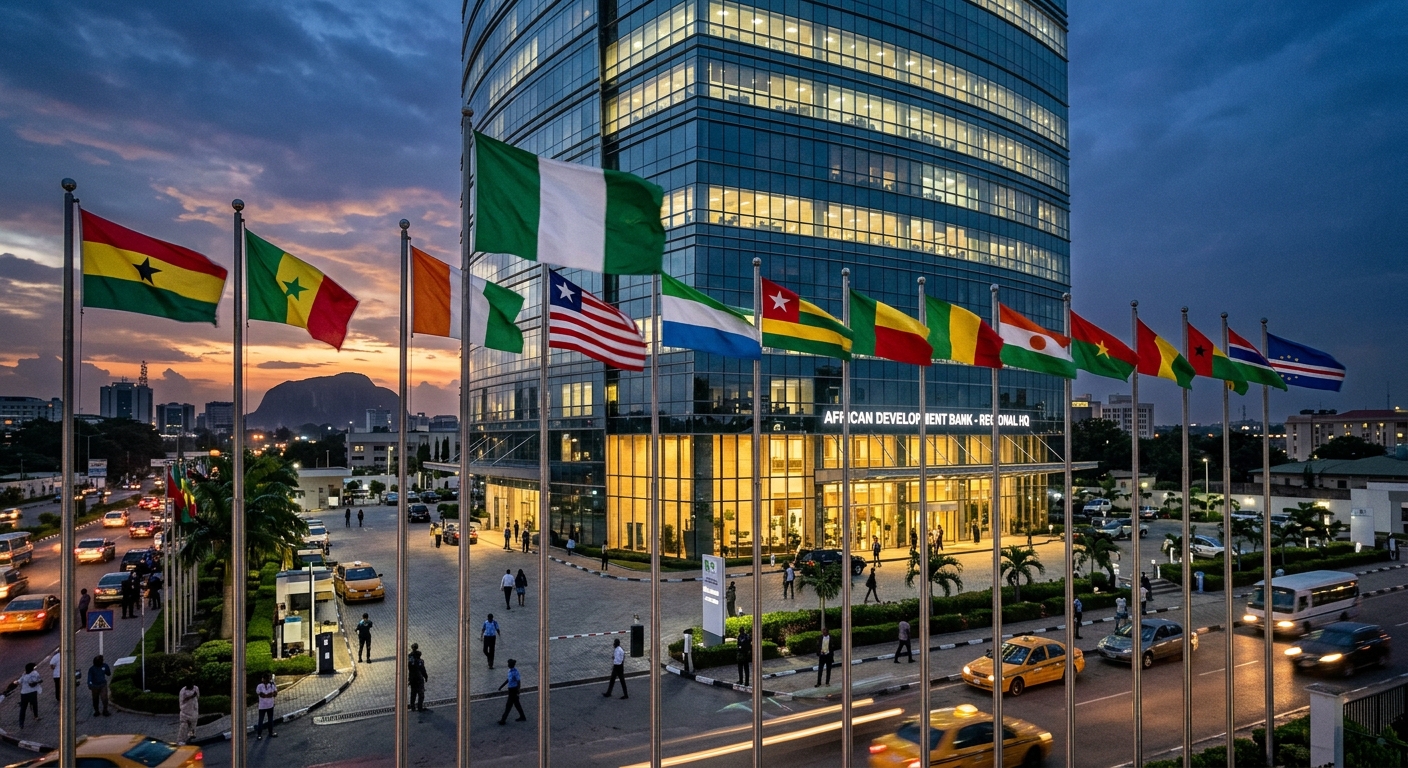
For Abuja, the win is different and larger. Nigeria hosts ECOWAS's administrative headquarters, its Parliament and its Court of Justice. Al Jazeera has noted that "for decades, Nigeria's power in ECOWAS has helped cement its influence not just in the region, but on the continent as a whole." Nigeria provides an estimated 75% of personnel to ECOWAS missions and remains the bloc's largest funder. A consolidated, physically imposing secretariat in Abuja re-anchors that gravitational pull at exactly the moment centrifugal forces are strongest.
Nigeria also underwrites the economic case. Brookings scholars Eswar Prasad and Vera Songwe have documented that Nigeria represents roughly 60–67% of ECOWAS GDP — a share they compare to Germany's role in the eurozone, with all the leverage and liability that implies.
The economics of the split
The MP-IDSA calculates that intraregional trade constitutes roughly 12% of imports and 14% of exports across West Africa — a figure that has been "fairly constant" for two decades. Niger runs a 51% share of intraregional exports because of transit dependence on coastal ports; Mali is a hub for cross-border commerce with Togo, Côte d'Ivoire and Senegal.
That geography is why the AES exit hurts the Sahel more than it hurts Abuja. A peer-reviewed African Development Review paper published in 2026 by Sebego, Ouedraogo and Folawewo modelled the shock and found that "trade diversion effects arising from the exit of the AES countries could increase exports for ECOWAS's three lead economies (Côte d'Ivoire, Ghana, and Nigeria)." The same paper flags marginal declines in tax revenue for Burkina Faso and Mali.
That is the concrete answer to Bio's rhetorical question about who benefits from integration. The three coastal anchors do. The landlocked juntas' citizens, paying import surcharges to move goods across borders they used to cross freely under the ECOWAS Trade Liberalization Scheme, do not.
The single currency — the "Eco" — remains the most ambitious item on the integration agenda. Brookings has tracked five failed launch attempts since 2000; implementation is now tentatively set for 2027. The Institute for Security Studies has argued that
"economics alone isn't holding back" the Eco — the anglophone-francophone divide, and Nigeria's dominance, are the harder problems. With eight WAEMU members already tied to the CFA franc and now three of them (Mali, Burkina Faso, Niger) outside ECOWAS, the monetary map has grown more, not less, tangled.
The security ledger
The Abuja opening arrived four months after ECOWAS defence chiefs met in Freetown and agreed to reactivate the long-dormant regional standby force. Al Jazeera reported that the plan involves mobilising 2,000 soldiers by end-2026 to counter jihadist expansion.
The threat is not abstract. Groups linked to al-Qaeda's Jama'at Nusrat al-Islam wal-Muslimin (JNIM) and Islamic State Sahel Province have pushed south from the Liptako-Gourma tri-border zone into northern Benin, Togo and Ghana. The BBC has noted that the Trump administration has quietly opened a channel to the AES juntas via a March 2026 State Department visit to Bamako, dropping the Biden-era conditionality on democratic transition. That deprives ECOWAS of a Western partner willing to underwrite the "sticks" half of its old carrots-and-sticks approach to coup consolidation.
The 2 July ceremony coincided with an interview published by the Policy Center for the New South, in which ECOWAS Acting Secretary-General Muazu Umaru described a decade of security transformation and the priorities needed to rebuild "a more resilient peace and security architecture." The subtext of the timing was not subtle: the building opens; the standby force mobilises; the region reintegrates on ECOWAS terms.
Diplomat View
The Abuja headquarters is not a monument to unity — it is a fortification. Its function is to make ECOWAS harder to walk out of, and cheaper for the coastal Twelve to run, at the precise moment the AES is proving that walking out is survivable. The load-bearing bet is that Nigeria + Côte d'Ivoire + Ghana + Senegal — 80%+ of remaining GDP — can generate enough gravitational pull through the Eco (2027), the standby force (end-2026) and Vision 2050 to make Bamako, Ouagadougou and Niamey want back in on ECOWAS's terms rather than dictate their own.
Our forecast: the fracture holds through 2027. Three conditions would revise it. First, a security collapse in one AES capital that Russia's Africa Corps cannot arrest — most plausibly Burkina Faso, where JNIM controls large swaths of territory. Second, the Eco actually launching with credible convergence criteria, which would create a monetary carrot the AES juntas cannot match without exiting the CFA franc. Third, a Washington–Moscow deal on the Sahel that leaves the juntas exposed. Absent one of those triggers, expect quiet, technocratic cooperation on food, energy and health — the "de-politicised" agenda Chatham House flagged — but no political reunification. The China-funded tower will be a working headquarters, not a homecoming hall.
What to watch next
- January 2027: Target date for the Eco single-currency launch. Slippage is the base case; a firm timetable would signal seriousness.
- December 2026: Deadline for ECOWAS standby-force initial 2,000-troop mobilisation. Deployment location will reveal whether coastal governments trust the force in-country.
- Mid-2027: Sierra Leone's Bio hands over the ECOWAS chair. Succession — and whether Senegal's Bassirou Diomaye Faye, the bloc's Sahel mediator, takes the gavel — will set the tone of the AES engagement track.
The Bottom Line
ECOWAS built a $31.6 million Chinese-financed home in Abuja because the bloc it once was no longer exists — and the bloc it wants to be needs a harder institutional shell to survive the Sahel breakaway. The real beneficiaries are Nigeria, which retains its regional throne, and Beijing, which buys a permanent seat at West Africa's decision table for less than one-sixth what it paid for the African Union's. The real losers are the citizens of Mali, Burkina Faso and Niger, whose leaders traded a customs union for a confederation and whose grocery bills are now paying the difference.
Discover more
India
Rajnath Singh's Durga Squad for 2026 Polls
Rajnath Singh's Durga Squad promised women's safety in Bengal but has since disappeared from the agenda, revealing BJP's true priorities.

US Politics
SNAP Food Assistance Faces Legal Challenges
In 2026, SNAP faces stricter eligibility rules and mounting legal challenges, threatening food assistance for the millions of Americans who rely on the program.
India
Congress Advocates 33% Women’s Quota
Congress calls for a 33% women's reservation in the existing 543 Lok Sabha seats, countering Modi's plan to expand the house to 850 seats.

Economics
Fed's Amex AML order puts correspondent banking on notice
Federal Reserve's Amex AML order requires board-level controls and a 90-day plan; OCC fined the bank $350 million over enterprise-wide deficiencies.