ECOWAS Double Standard Fuels Sahel Rival Bloc
ECOWAS's selective enforcement hands the Sahel juntas the moral case for a rival order.
Model Diplomat9 min readAfrica
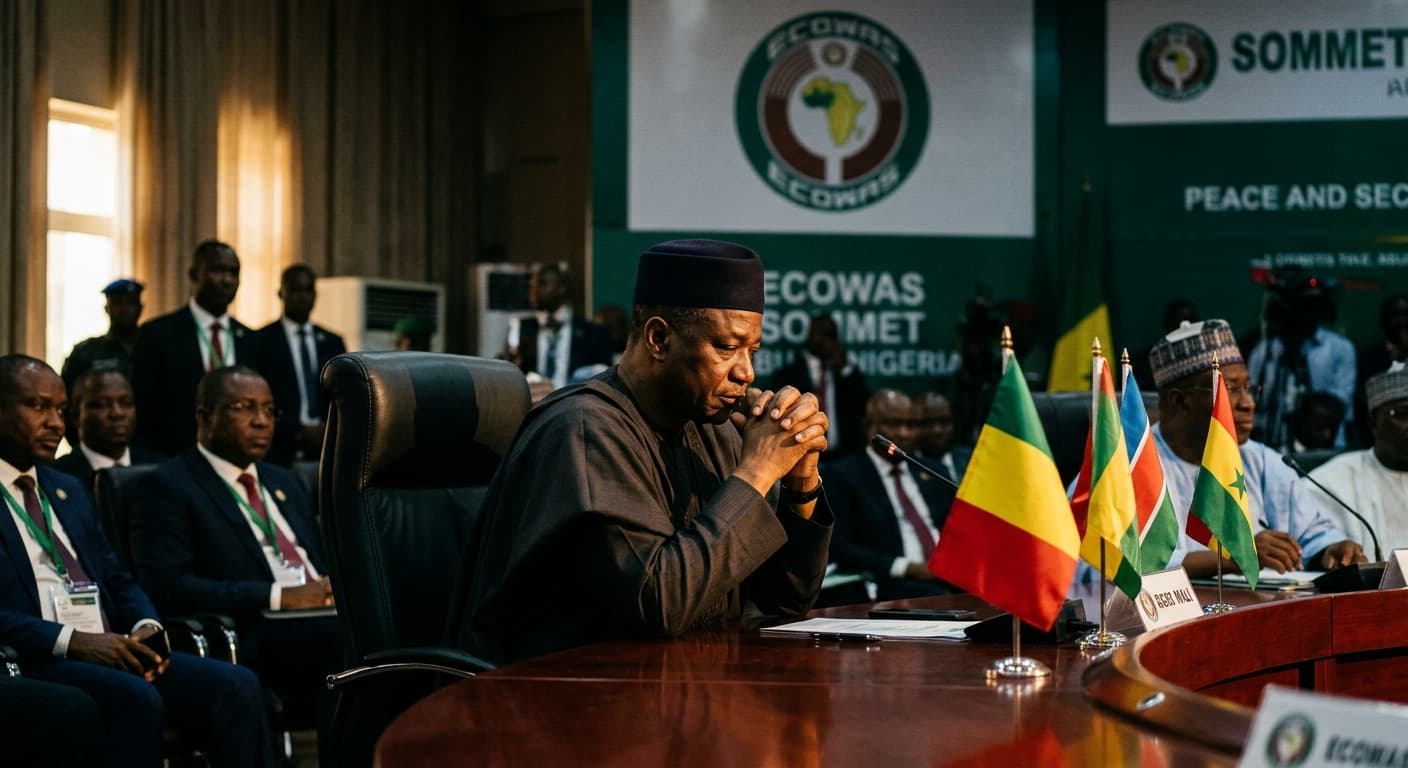
ECOWAS's Double Standard Is Building the Sahel's Rival Order
ECOWAS punishes soldiers who seize power but stays silent when civilian incumbents rewrite constitutions to keep it — and that asymmetry is now the founding charter of the Alliance of Sahel States.
On December 7, 2025, eight soldiers appeared on screens across Benin to declare the fall of President Patrice Talon — and within hours the putsch collapsed, the first time the ECOWAS Standby Force intervened directly to foil a coup. The bloc's success stands in jarring contrast to its silence when incumbents rewrite constitutions to hold power: in the same window, Togo's Faure Gnassingbé installed himself in a term-limit-free premiership and Ivory Coast's Alassane Ouattara won a fourth term with his principal rivals barred. ECOWAS's selective enforcement — punishing soldiers who seize power, shielding civilians who keep it — has hollowed out its own legitimacy and handed the Sahel juntas the moral and political material to build a rival regional architecture.
The double standard, in two cases
The pattern is now stark enough that even former ECOWAS officials concede it. The bloc's 2001 Supplementary Protocol on Democracy and Good Governance declares "zero tolerance" for unconstitutional changes of government, fixes elections on constitutionally set dates, and bars any major vote within six months of a constitutional change, according to a European Parliamentary Research Service briefing. Yet when Togo's parliament rubber-stamped a new constitution in April 2024 and held legislative elections weeks later — a flagrant breach of that six-month rule — ECOWAS issued no complaint, as
BBC News reported. Gnassingbé was sworn in on May 3, 2025 as President of the Council of Ministers, a post with no term limits; protests in Lomé left seven dead in June 2025, per
BBC News.
Ivory Coast's Ouattara has run the same play twice. A 2016 constitutional reset let him claim a "fresh" two-term clock; he won a contested third term in 2020, then a fourth on October 25, 2025 with 89.8% of the vote after the Constitutional Council barred his two principal rivals, former President Laurent Gbagbo and ex-Credit Suisse CEO Tidjane Thiam, as Al Jazeera and
BBC News reported. The opposition branded it a "civilian coup d'état." ECOWAS said nothing of substance. Voter turnout was just 50.1%.
The asymmetry is not new. When Guinea's Alpha Condé rigged a 2020 constitutional referendum to secure a third term — the precise maneuver the protocol was written to prevent — ECOWAS was silent. He was overthrown by Colonel Mamady Doumbouya in September 2021, and crowds flooded Conakry's streets to celebrate, per Chatham House. The coup was the consequence ECOWAS failed to prevent by ignoring the constitutional coup that preceded it.
The legal framework that everyone ignores
The gap between ECOWAS's written rules and its practice is not an oversight — it is the core of the problem. The bloc's foundational instruments are unusually robust for a regional body. Article 4 of the 1993 Revised Treaty commits members to "promotion and consolidation of a democratic system of governance," per the World Bank treaty archive, registered with the
UN Treaty Series. The 2001 Supplementary Protocol, building on the 1999 Lomé Protocol's Article 25(e) that permits military intervention against unconstitutional changes of government, goes further than the African Union's own instruments in codifying civilian multiparty democracy as the regional norm. Article 45 empowers the Authority of Heads of State to impose sanctions and even authorize force to restore an ousted government.
The academic literature is unsparing. A 2025 American Journal of International Law article finds that "the strongest states on the continent, and in West Africa (e.g., Nigeria and Côte d'Ivoire), have tended to avoid accountability," citing ECOWAS's silence on Ouattara's constitutional manipulation to secure a third term — a move "contrary to the then-governing Constitution," per Cambridge University Press. A separate peer-reviewed study notes that when Burkina Faso's Blaise Compaoré moved to scrap term limits in 2014, "neither the AU nor ECOWAS had directly and publicly reacted," even though the move violated the protocol, as
SAGE Journals records. The AU's own ACDEG treats constitutional manipulation as an "illegal means of accessing or maintaining power" drawing "appropriate sanctions" — but Article 23(5) has been invoked approximately zero times against incumbents who obeyed the letter of their own rewritten constitutions.
The result, as scholar Christopher Nyinevi writes, is that ECOWAS and the AU "are not denouncing those who flout laws to hold on to power; they complain only when the military seizes it," per African Security. A Liberian academic study reaches the same conclusion: "AU and ECOWAS courageousness to denounce military coups quickly and openly without regard to constitutional or institutional coups that often provoke popular uprisings serving as the incentives or grounds for military coup is tantamount to the concept of double standards," per
Nebo Sr. in IJRISS. This is not a gap in the rules. It is a gap in enforcement that tracks power.
Why the juntas won the argument
This is the second-order effect that matters most. The AES — the Alliance of Sahel States formed by Mali, Burkina Faso, and Niger after their January 2025 withdrawal from ECOWAS — is not just a security pact. It is a legitimacy project, and ECOWAS's double standard is its founding text.
When the three states announced their withdrawal on January 29, 2025, effective immediately, they accused ECOWAS of being "influenced by foreign powers" and serving interests "foreign to Africa," as Al Jazeera reported. Thousands rallied in Niamey and Ouagadougou in support. The juntas' message: a bloc that sanctions military coups but ignores civilian constitutional coups is not defending democracy — it is defending a club of incumbents.
That framing has traction. Former ECOWAS communications director Adama Gaye told the BBC that the juntas' confederation was a "very big blow" but added, pointedly, that ECOWAS "should make an effort to avoid becoming an institutional laughing-stock, because how can you implement this when most of the other countries claiming to uphold that demand for democracy are not themselves true democracies." A December 2025
Al Jazeera feature on the AES's second confederal summit in Bamako reported the alliance inaugurating a Sahel Investment and Development Bank, a joint military battalion, a shared television channel, and discussions of a common currency and a Sahel penal court — an "alternative architecture, built quickly, deliberately."
The historical parallel is not flattering to ECOWAS. The bloc's own 1990s-era ECOMOG interventions in Liberia and Sierra Leone faced criticism for human rights violations and operational ineffectiveness, but they at least projected the principle that regional actors would act when the international community would not. The AES is now claiming that same mantle — action over talk — while ECOWAS's remaining members appear paralyzed by the fear that any challenge to an incumbent could trigger another exit. "Badly shaken by the decision of three military-run countries to quit Ecowas, remaining member governments are reluctant to challenge the behaviour of others in case they follow suit," as BBC News observed. The result is a ratchet that only tightens in one direction: military coups draw sanctions, constitutional coups draw silence, and each cycle of silence makes the next exit more likely.
Who benefits, who loses
The decisive winner is the AES leadership — Colonel Assimi Goïta, Captain Ibrahim Traoré, and General Abdourahamane Tchiani — whose domestic legitimacy is reinforced every time ECOWAS demonstrates that its governance standards are conditional on whether the offender wears a uniform. They have converted a defensive posture (we seized power because the civilians failed) into an offensive one (we are building an alternative because the regional order is corrupt). The AES confederation treaty signed in Niamey on July 6, 2024, and the Bamako summit's institutional architecture, are the concrete outputs, per Al Jazeera.
The decisive losers are West Africa's citizens. ECOWAS sanctions on Niger blocked trade, cut electricity from Nigeria, and sent food prices surging while preventing medicines from entering the country — costs "borne largely by the citizenry, not the elites," as the ORF analysis notes. When ECOWAS threatened military intervention against Niger in 2023, the threat "galvanised thousands to come out onto the streets in Niamey in support of the junta," as
NPR reported — the opposite of its intended effect. The bloc's tools, designed for a era when juntas lacked popular support and external patrons, now backfire in a context where Russia offers an alternative security partner and the AES offers an alternative institutional home.
Nigeria's President Bola Tinubu, reappointed as ECOWAS chairperson, has presided over the bloc's greatest contraction in its 50-year history. His combative posture on Niger — a 1,600-kilometer border shared with Nigeria — risked spilling conflict into his own territory while Nigeria's military was already stretched by internal crises, as Al Jazeera noted. The mediation mandate given to Senegal's President Bassirou Diomaye Faye — 44, the same generation as the junta leaders, and openly critical of Western influence — is an admission that the old guard's diplomatic toolkit has failed, per
Al Jazeera.
The Benin anomaly and what it reveals
The foiled December 7 coup in Benin is the one data point that complicates the narrative — and it is the one ECOWAS is foregrounding. The Standby Force's direct intervention, credited by Interior Minister Alassane Seidou within hours, was the first time the ESF deployed to preempt a putsch rather than to manage its aftermath, per the ORF analysis. If Benin marks a turning point, it is because the bloc proved it can act decisively when the target is a military conspiracy rather than a constitutional maneuver.
But that distinction is precisely the problem. ECOWAS can deploy force against eight soldiers in a broadcast studio. It cannot — or will not — deploy its political authority against a 59-year-old incumbent who moves his own office to escape term limits, or an 83-year-old who bars his rivals and wins 89.8% of the vote. The Benin success, far from redeeming the bloc, underscores the selectivity: the ESF exists for one type of crisis, and the protocol exists on paper for the other.
Diplomat View
ECOWAS's crisis is not a crisis of norms — the norms are written and ratifiable. It is a crisis of enforcement asymmetry, and the asymmetry is now structurally self-reinforcing. Every constitutional coup that goes unanswered makes the next military coup more likely, because it erodes the public trust in constitutional politics that makes democracy worth defending. Every military coup that draws only sanctions pushes the sanctioned states toward the AES, which now offers institutions, currency, and a counter-narrative. The bloc's remaining members are caught between the fear of driving more exits and the certainty that silence on Togo and Ivory Coast will eventually produce the next Conakry — a city that cheered a coup because the constitutional alternative had been hollowed out.
The forecast is bearable only if two things change. First, ECOWAS must revise the Supplementary Protocol to include automatic, pre-defined sanctions for constitutional manipulation — the revision has been discussed since at least the February 2022 EU-ECOWAS ministerial dialogue, per the EPRS briefing, but "these changes have not been proposed yet." Second, Francophone ECOWAS members must lead discreet re-engagement with the AES on de-politicized issues — monetary affairs, food security, intelligence sharing — while Nigeria exercises its influence quietly rather than through force threats, as
Al Jazeera's Ayodele Owolabi argues. Without both, the ratchet tightens again at the next constitutional manipulation — and the next putsch that follows it.
What to watch:
- July 29, 2026 — The AES's six-month ECOWAS grace period extension expires. Whether any of the three states signals re-engagement, or the split hardens into permanence, turns on whether ECOWAS offers terms that do not require the juntas to concede their core grievance about double standards.
- 2026 ECOWAS summit — The protocol revision on constitutional coups, promised since 2022, may finally be tabled. Whether it includes automatic triggers — or remains discretionary, which means selectively applied — will signal whether the bloc has learned the lesson or is managing the optics.
- Togo's next legislative cycle — Gnassingbé's government has not appointed a cabinet two months into the Fifth Republic, per analyst Paul Amegakpo in
Al Jazeera. If unrest spreads beyond Lomé, or cracks widen in the security apparatus, Togo becomes the next test case — and the next data point in the AES's argument.
The Bottom Line
The bottom line: ECOWAS's crisis is not that it has too few tools — it has a protocol, a standby force, and a treaty. It is that the bloc applies them against the men in fatigues and not against the men in suits, and every West African citizen who watches Togo and Ivory Coast go unanswered learns that the rules are not rules. The AES was built on that lesson. Whether ECOWAS can unlearn it determines whether West Africa has one regional order or two — and whether the next decade's coups come in uniform or in constitutional amendments.
Discover more
US Politics
House Ethics Committee Pushes Sexual Miscond.
The House Ethics Committee has shifted responsibility for sexual harassment settlement records to the Office of Congressional Workplace Rights, complicating disclosure efforts.

International Relations
U.S.–Iran Peace Deal
A narrow US-Iran deal on nuclear and regional issues could reshape Middle East diplomacy, offering a pragmatic path forward despite grand bargain obstacles.
US Politics
Congress Targets AI Chatbot Access for Terror
The House passed the Generative AI Terrorism Risk Assessment Act, focusing on AI's role in terrorism and potential surveillance implications.

Conflict & Security
Drone Warfare Killing Aid Workers at Unprec
Over 1,000 humanitarian workers killed in three years as cheap armed drones collapse legal protections. Gaza, Sudan, Ukraine, and DRC see deliberate targeting of aid convoys and hospitals with zero prosecutions.