ECOWAS Bombs Coups, Welcomes Coup Leaders
ECOWAS bombs coups but welcomes coup leaders as presidents
Model Diplomat5 min readWest Africa
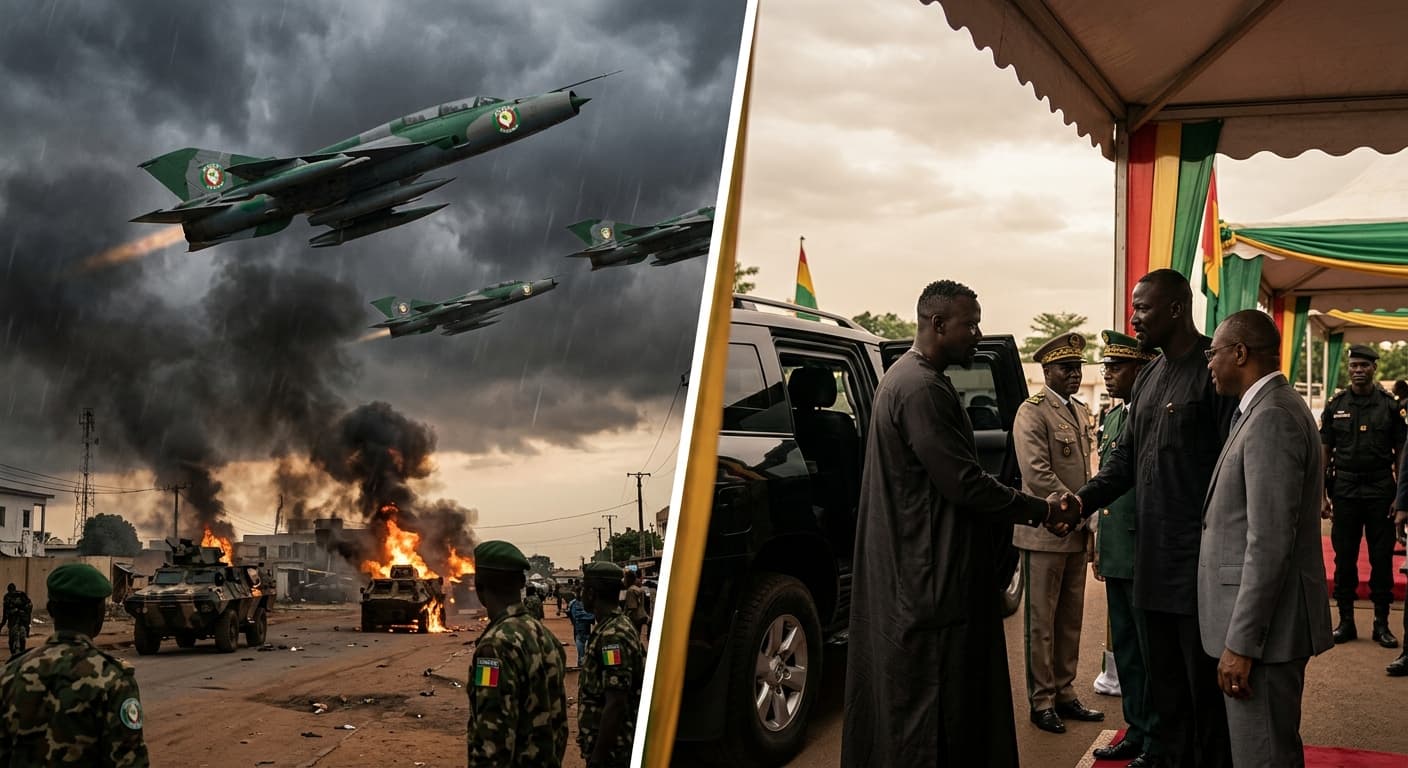
Why ECOWAS Bombs Coups With Jets but Welcomes Coup Leaders as Presidents
On December 7, 2025, ECOWAS deployed Nigerian fighter jets to crush a coup attempt in Benin — then seven weeks later reinstated Guinea, led by a general who had seized power in 2021 and won an 86.7% election after rewriting the constitution. That asymmetry is the recruiting tool the breakaway Sahel alliance uses against the bloc.
On December 7, 2025, eight soldiers seized Benin's state television to announce the fall of President Patrice Talon. Within hours, Nigerian fighter jets bombed their positions and ECOWAS deployed a standby force drawn from Nigeria, Ghana, Ivory Coast and Sierra Leone — the bloc's first kinetic intervention to stop a coup. Seven weeks later, on January 29, 2026, ECOWAS lifted all sanctions on Guinea and reinstated it as a full member, welcoming a president who led the 2021 coup, rewrote the constitution to let himself run, and won 86.7% of the vote against a depleted field. That asymmetry — force against soldiers who topple civilians, an open door for generals and incumbents who launder power grabs through rigged votes — is the governance crisis at the heart of West Africa, and it is the recruiting pitch the breakaway Alliance of Sahel States uses against the bloc.
The norm that everyone signed, no one enforces evenly
ECOWAS's democratic architecture is, on paper, the most developed of any African regional bloc. The 2001 Supplementary Protocol on Democracy and Good Governance (Protocol A/SP1/12/01) declares "zero tolerance for power obtained or maintained by unconstitutional means" and requires that all accessions to power occur through "free, fair and transparent elections," according to the ECOWAS conflict prevention framework. At the continental level, the African Charter on Democracy, Elections and Governance (ACDEG) goes further: Article 23(5) classifies "any amendment or revision of the constitution or legal instruments which is an infringement on the principles of democratic change of government" as an unconstitutional change of government, triggering sanctions, as the
American Journal of International Law notes.
The gap is not in the text. It is in the application. ECOWAS responds forcefully to military coups — suspension, sanctions, and now air strikes — but treats "constitutional coups," incumbents who rewrite the rules to stay, with silence. The result, as an ORF analysis puts it, is that the bloc's own protocol "risks reading like empty words."
The pattern is stark and bipartisan. Guinea's Alpha Condé claimed a third term in 2020 after a contested constitutional referendum that allowed him to run; ECOWAS was "fully supportive of his victory." Côte d'Ivoire's Alassane Ouattara argued a 2016 constitution reset the clock on his two terms, then ran and won in 2020, and sought a fourth term in 2025 — all met with regional silence. Togo's Faure Gnassingbé, in power since 2005, pushed through a 2024 constitutional reform creating a "President of the Council of Ministers" role with unlimited six-year terms for himself; the Institute for Security Studies called it a "constitutional coup," and ECOWAS withdrew its own critical communiqué within a day. A
Brookings analysis identifies Togo, Cameroon, Uganda, Chad and Rwanda among the 13 African states where leaders have evaded or weakened term limits since 2015.
The military-coup response: jets, sanctions, and a split
When soldiers move, ECOWAS moves harder. Mali was suspended in 2020, Burkina Faso in 2022, Guinea in 2021, and Niger in 2023. After the Niger coup, ECOWAS threatened military intervention — Nigerian President Bola Tinubu, the bloc's then-chair, pushed the threat further than any prior ECOWAS stance — and imposed crippling sanctions including border closures, a no-fly zone, and frozen central bank assets, as BBC News reported. The sanctions backfired: rather than submitting, the three states announced withdrawal in January 2024 and formally exited on January 29, 2025, according to an
ECOWAS press statement. The bloc lost 76 million people and more than half its land area.
The three then built the Alliance of Sahel States (AES) into a rival confederation: a 5,000-strong joint force, AES passports, a common investment bank, and a rotating presidency, as Al Jazeera detailed. At the December 2025 Bamako summit, Burkina Faso's Ibrahim Traoré warned of a looming "Black Winter" of external threats, and Niger's Abdourahamane Tchiani declared the AES had "put an end to all occupation forces,"
Al Jazeera reported. The AES's propaganda explicitly frames ECOWAS as a "hypocritical marionette of France and the West," as a
NUPI field report documents from interviews in Abidjan.
Then came Benin. The December 7, 2025 attempt was the first time ECOWAS deployed force in direct response to an ongoing coup — Nigerian jets "took over the airspace to help dislodge the coup plotters from the National TV and a military camp," per BBC News. Some 200 regional soldiers remained for "sweep and clean-up,"
BBC reported. The intervention was praised as a model — but it came against a mutiny that had no popular support and a president who retained control of his own military. It is easier to bomb plotters holed up in a TV station than to sanction a sitting, Western-aligned president who has just claimed a fourth term.
The Doumbouya paradox
Guinea is where the two standards converge into a single contradiction. ECOWAS suspended Guinea in September 2021 after Mamady Doumbouya deposed Condé. It spent four years pressing for a return to civilian rule. Doumbouya delivered — on his own terms. A September 2025 referendum permitted military officers to run for office and extended the presidential term from five to seven years. Doumbouya, who had pledged in 2021 that "neither I nor any member of this transition will be a candidate," ran anyway and won 86.7% of the vote on December 28, 2025, as Al Jazeera and
BBC News reported. He was sworn in on January 18, 2026. Eleven days later, ECOWAS lifted all sanctions and reinstated Guinea.
The ORF analysis makes the point bluntly: "Doumbouya is not simply the newly elected president: he was also the leader of the coup d'état that deposed Condé." ECOWAS sanctioned Niger for the same sequence — a coup, a transition, an election — because Niger refused the bloc's timetable. Guinea played the constitutional game and got readmitted. The lesson AES propagandists draw writes itself: if you seize power and then hold an election ECOWAS can bless, you keep it; if you refuse ECOWAS's terms, you are bombed or starved.
Discover more
US Politics
SNAP Food Assistance Faces Legal Challenges
In 2026, SNAP faces stricter eligibility rules and mounting legal challenges, threatening food assistance for the millions of Americans who rely on the program.
US Politics
House Ethics Committee Pushes Sexual Miscond.
The House Ethics Committee has shifted responsibility for sexual harassment settlement records to the Office of Congressional Workplace Rights, complicating disclosure efforts.
India
Rajnath Singh's Durga Squad for 2026 Polls
Rajnath Singh's Durga Squad promised women's safety in Bengal but has since disappeared from the agenda, revealing BJP's true priorities.

Economics
Fed's Amex AML order puts correspondent banking on notice
Federal Reserve's Amex AML order requires board-level controls and a 90-day plan; OCC fined the bank $350 million over enterprise-wide deficiencies.