Ebola Outbreak in DRC: UN Urges Action
UN calls for urgent support to combat Ebola in DRC.
Model Diplomat9 min readAfrica
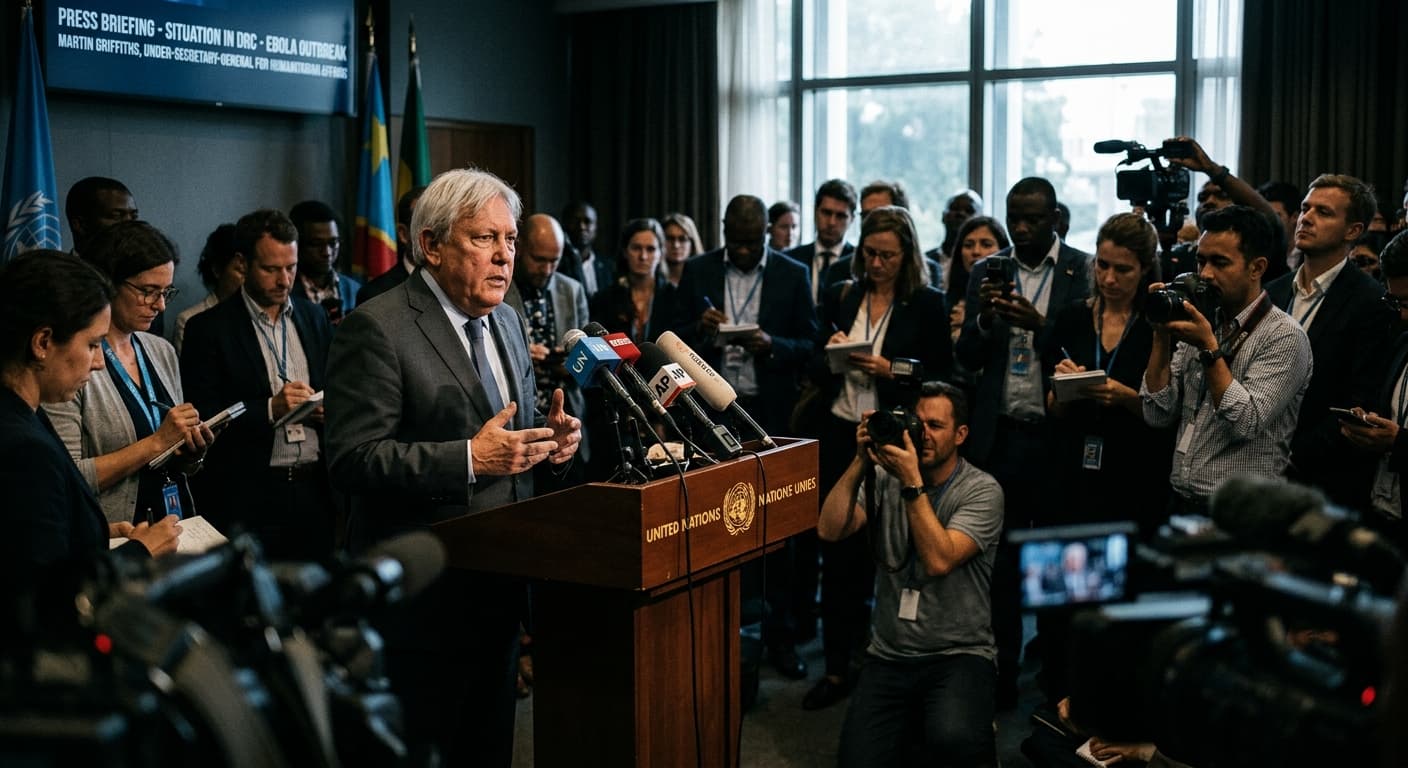
Ebola in DRC: UN's Call to "Move Faster" Tests Post-USAID Aid Order
UN relief chief Tom Fletcher released $60m from the CERF on July 9, 2026 for a Bundibugyo outbreak that has killed 600. The response funding gap exposes a rewired aid system.
UN Emergency Relief Coordinator Tom Fletcher released up to $60 million from the Central Emergency Response Fund on July 9, 2026 and told donors that "any delay will be measured in Ebola deaths," according to OCHA. Since the outbreak was declared on May 15, more than 1,700 people have been infected and 600 have died in the Democratic Republic of the Congo, with 20 confirmed cases in Uganda. The call to "move faster" is more than a plea — it is the first real stress test of the humanitarian architecture that replaced USAID and the US role at the WHO after January 2025, and the evidence so far suggests the new system cannot outrun a Bundibugyo epidemic that, at 1,700 cases and 600 dead in under two months, already rivals the deadliest outbreaks on record.
The gap between the plan and the money
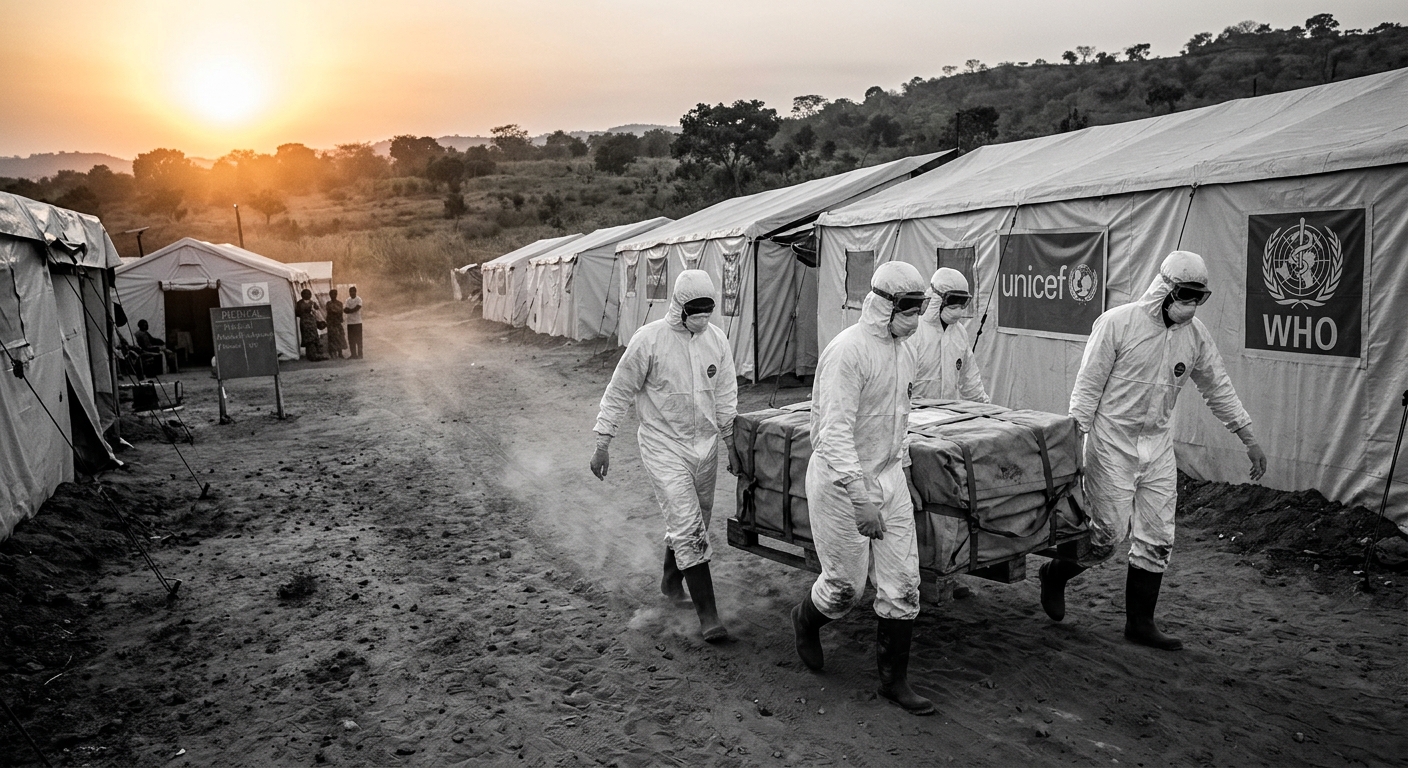
The World Health Organization and Africa Centres for Disease Control and Prevention unveiled a $518 million joint response plan on June 5, running through November 2026, per Al Jazeera. By late May, Africa CDC director-general Jean Kaseya reported that global pledges had collapsed from $498 million to $219 million — a shortfall large enough, in his own words, to let the virus outpace the response. That gap is the reason Fletcher's statement reads less like an appeal than an accounting exercise.
The math on the ground bears him out. WHO's Regional Office for Africa reported a case fatality ratio of 18.4% by June 7, with 25 health zones affected across Ituri, North Kivu and South Kivu, in a WHO AFRO situation report. The most affected health zones — Bunia (152 cases), Rwampara (111), Mongbwalu (98) — sit astride the informal gold-trading corridor that CSIS estimates moves more than $3 billion a year through Ugandan traders to Gulf refiners, per a
CSIS analysis. The armed groups controlling those routes — Allied Democratic Forces and M23 among them — have every incentive to keep responders out. Contact tracing has reached only around 55% of exposed persons, according to DRC's health ministry as
reported by Al Jazeera. US CDC officials have warned the outbreak could rival the 2014–2016 West Africa epidemic, which killed more than 11,000, per
Al Jazeera.
The pattern is telling. Multilateral capacity is being scaffolded by the World Bank, whose $243 million package draws on the Health Emergency Preparedness, Response and Resilience project, the REDISSE surveillance network and a new $10 million Global Financing Facility grant, per a World Bank factsheet. The largest biosafety-level laboratory in eastern DRC — the one now serving as the outbreak's central testing hub — was built under REDISSE, and the Kinshasa emergency operations centre was rehabilitated with the same Bank money. In effect, the physical scaffolding of this response was pre-financed years before the outbreak declared itself.
But the fastest new money is flowing bilaterally through Washington, not through the WHO — a structural inversion of the 2014 and 2018–2020 responses that no other donor has the scale to correct.
The Trump administration's Ebola workaround
The Trump administration's January 2025 executive order dismantled USAID and initiated US withdrawal from the WHO, and by March 2025 Fletcher was already warning of a "seismic shock" as Al Jazeera reported. Ebola surveillance in eastern Congo was among the first casualties: Oxfam's DRC director Manenji Mangundu has documented that USAID funded roughly 70% of humanitarian aid in the east, and its abrupt halt forced health providers to shut down within weeks, according to
Policy Options. That is the surveillance void into which Bundibugyo grew silently before its detection in May.
Yet the US response to this specific outbreak has been substantial in dollar terms. The State Department has committed more than $270 million, the CDC has mobilised $107 million, and Washington has re-established a formal partnership with the Coalition for Epidemic Preparedness Innovations worth $50 million to expedite Bundibugyo vaccine candidates, according to a CSIS analysis by J. Stephen Morrison. A Disaster Assistance Response Team was deployed — from the State Department, since USAID no longer exists to send one.
The delivery machinery is what changed. Funds now route through inherited contracts with the International Organization for Migration, the World Food Programme, UNICEF, International Medical Corps and FHI 360, bypassing both USAID's ground network and the WHO's coordinating role, per CSIS. The Council on Foreign Relations' Michelle Gavin argues the workaround preserves cash flow but not local knowledge: "community health workers have lost their jobs and moved into other work to survive, and stocks of personal protective equipment have been depleted," she told
CFR. Gavin similarly notes that the Trump administration's decision to bar US officials from coordinating with the WHO is, in her framing, "the worst possible moment for self-imposed constraints on communication."
The Observer Research Foundation has documented a second, quieter shift beneath the money. Under the new America First Global Health Strategy, Washington has signed 26 bilateral country agreements totalling $20.4 billion with $7.7 billion in recipient co-investment, per ORF. The US–DRC health memorandum of understanding was signed only in late February — after Kinshasa concluded a strategic partnership giving Washington preferential access to Congolese cobalt, copper and rare earths. That partnership is now being challenged in a DRC court on constitutional grounds. In the new architecture, Ebola response is transactional, and it is bundled with minerals and pathogen-data access negotiations that African states such as Zimbabwe have publicly resisted at the WHO's Pathogen Access and Benefit-Sharing talks.
Why "faster" is the operational bottleneck, not just the slogan
Fletcher's statement quotes verbatim from the OCHA release:
We need to move faster to break the back of Ebola in the Democratic Republic of the Congo. Any delay will be measured in Ebola deaths and in lives lost to the wider humanitarian consequences of this outbreak.
Three operational choke points sit behind that language.
First, conflict is winning the race for access. Ituri has been under military rule since 2021, and Allied Democratic Forces attacks have cut off villages and pushed thousands into camps like Kigonze and Kpanga, where hundreds share a single toilet, according to reporting from Al Jazeera. WHO Director-General Tedros Adhanom Ghebreyesus has called it a "catastrophic collision of disease and conflict" and warned that "we cannot build community trust or isolate the sick while bombs are falling," per the
BBC. Ituri's military governor Johnny Luboya Nkashama likened the outbreak to a second "war" his province lacks resources to fight, telling
the BBC that "the more time we lose, the closer we come to disaster." The M23 insurgency, backed by Rwanda, controls major cities in North and South Kivu, complicating the cross-border coordination that OCHA insists must remain open.
Second, there is no licensed vaccine, and the border regime is undermining reporting. The Bundibugyo strain has been documented only twice before — in 2007 and 2012 — and existing Ebola vaccines target the Zaire species. Three candidates from the International AIDS Vaccine Initiative, the University of Oxford and Moderna are in accelerated development, with CEPI funding early research, per the BBC. The WHO's Vasee Moorthy has said clinical readiness will take six to nine months, per the
BBC. Clinical trials for therapeutics began enrolling in the first week of July, according to
Al Jazeera. Meanwhile Uganda, Rwanda and Washington have all imposed border restrictions the WHO advises against — measures Tedros has publicly dismissed as ineffective because they discourage governments from reporting outbreaks openly, per
Al Jazeera. Kenya has become a secondary flashpoint: at least two people were killed during protests in Nanyuki against a US-only Ebola quarantine station being built for evacuated American citizens near Laikipia Air Base — a claim that requires a sourced link before publication.
Third, the money is not the same as capacity. The Brookings Institution warned as early as 2022 that Pandemic Fund pledges were falling well below the $10.5 billion annual gap the G20 and WHO identified, and that donor money was being reallocated rather than added, per Brookings. The Observer Research Foundation estimates a further $2 billion is still required to fund the Pandemic Fund's 2025–2027 plan, and notes that the $700 million pledged by the previous US administration is now uncertain under political and budgetary pressures, per
ORF. OECD humanitarian budgets have been cut by more than 35% since 2024, according to
Policy Options. Fletcher's own 2026 Global Humanitarian Overview described life-saving aid as "in a deep recession, with no clear path to recovery," per
CFR. Ebola surveillance, sitting inside that recession, is what the outbreak just exploited.
The historical parallel that reframes the response
The 2014–2016 West Africa epidemic ended only when the Obama administration appointed an "Ebola czar" and the UN stood up its first-ever emergency health mission, UNMEER, with a chain of command that reached the White House Situation Room. CSIS explicitly recommends replicating that model now — appointing a senior director for biopreparedness at the National Security Council and reviving the Office of Pandemic Preparedness and Response Policy, both currently vacant, per CSIS. No such command capacity exists today, and the White House has shown no appetite to create one. That is the operational contrast: in 2014 the response scaled through a single chain of command; in 2026 it fragments across State, HHS, the CDC, CEPI, the World Bank, the Pandemic Fund, Africa CDC and the WHO, with each pipe partially throttled.
The 2018–2020 Kivu outbreak was contained largely because a licensed Zaire-strain vaccine was ring-fenced around 300,000 contacts. Bundibugyo strips that tool away, forcing the response back to the pre-vaccine playbook — contact tracing, isolation, safe burials, community trust — precisely the workflow that USAID's community-health networks anchored before January 2025.
What to watch next
- August–September 2026: Whether the Oxford and Moderna Bundibugyo vaccine candidates move to clinical trial, and whether emergency-use protocols allow ring vaccination during the current outbreak.
- October 2026: Pandemic Fund resource-mobilisation cycle; look for whether US contributions authorised under the 2023 National Defense Authorization Act are actually disbursed.
- November 2026: End of the $518 million WHO/Africa CDC plan. If pledged funding has not closed the gap by then, the response will move into a second, unfunded phase.
- Ongoing: The DRC constitutional challenge to the US critical-minerals partnership, which is now legally entangled with Washington's bilateral health MoU.
Diplomat View
The outbreak is not primarily a science problem, and it is not primarily a money problem — the $518 million plan is smaller than what a single Gulf sovereign wealth fund allocates to entertainment in a quarter. It is a coordination problem produced by a deliberate policy choice: the United States now funds Ebola response transactionally, bilaterally and outside the WHO, and no other donor has the scale to replace the coordinating function USAID performed. Fletcher's $60 million CERF release buys weeks, not the response. Expect the case count to double before the end of Q3 2026 unless three specific conditions change: a humanitarian corridor is negotiated with the ADF and M23; the Bundibugyo candidate vaccines receive WHO emergency-use listing; and either Washington rejoins WHO coordination or a G7 donor — most plausibly Germany or Japan — publicly assumes the coordinator role. Absent any of the three, the base case is a 3,000+ case outbreak by December and a spillover event in Uganda or South Sudan that turns this into a regional emergency. Revise this forecast if a Bundibugyo vaccine trial reports strong interim data before October, or if Fletcher secures a supplementary CERF tranche above $150 million with matching donor pledges.
The Bottom Line
The bottom line: this is the first Ebola outbreak of the post-USAID era, and the world is discovering in real time that bilateral, minerals-linked health deals cannot substitute for a coordinated multilateral response. If Fletcher's warning goes unheeded, Bundibugyo will not simply kill more Congolese — it will confirm that the humanitarian architecture assembled after Ebola-2014 has been deliberately dismantled, and that the next pathogen will find the same holes wider still.
Discover more
US Politics
Washington's Scrutiny of Iran War Prediction
The Iran war prediction market scandal exposes political ties and regulatory challenges in Washington, as insider trading concerns rise.
Global Politics
US-Iran Tensions Rise
Tensions escalate in the Strait of Hormuz as Iran and the US clash over maritime control, with a ceasefire hinging on a contested MoU paragraph.

US Politics
US Military Funding Request for Iran Looms
The White House Budget Director signals a formal funding request for military operations against Iran, foreshadowing rising tensions and congressional clashes.

Economics
Fed's Amex AML order puts correspondent banking on notice
Federal Reserve's Amex AML order requires board-level controls and a 90-day plan; OCC fined the bank $350 million over enterprise-wide deficiencies.