Ebola in DRC: Fletcher's $60M Plea
UN's Tom Fletcher calls for urgent Ebola response funding.
Model Diplomat9 min readAfrica
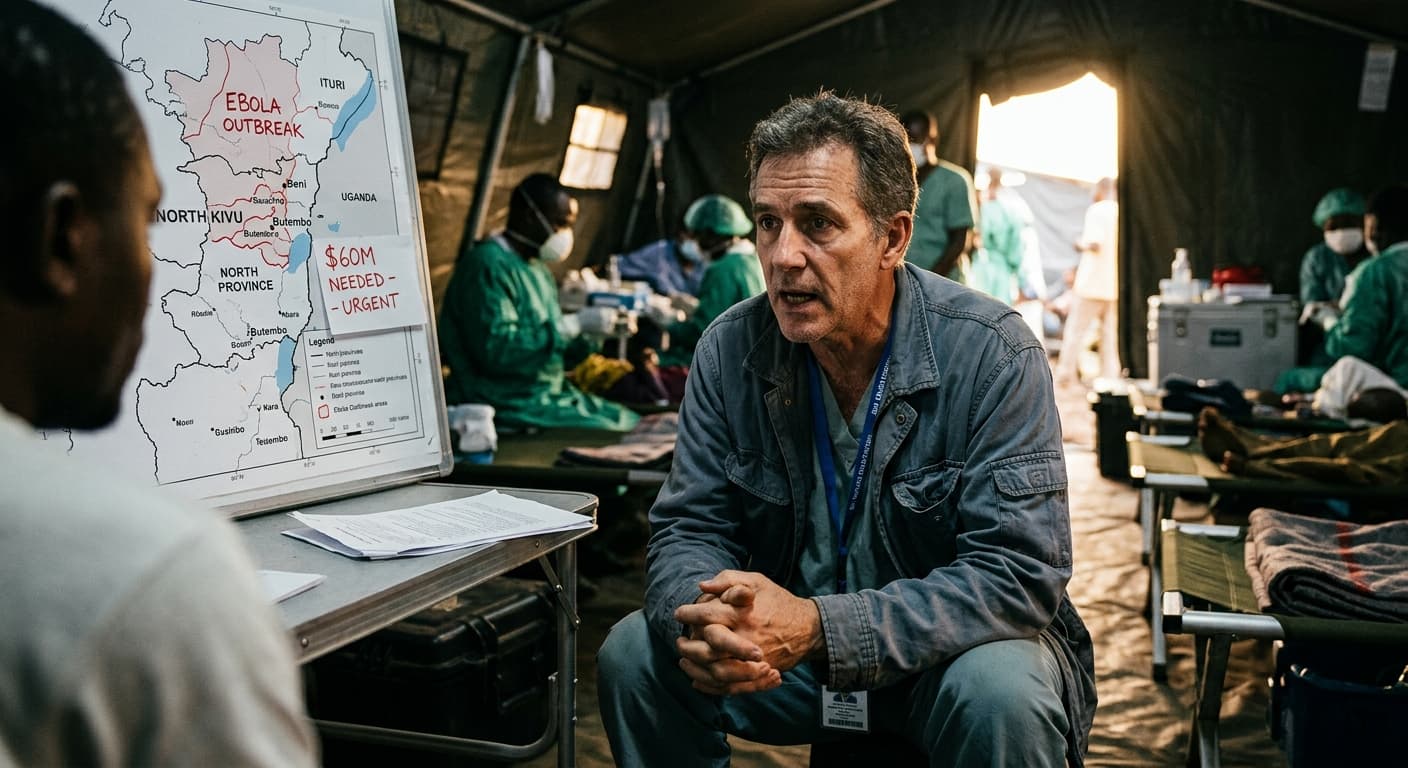
Ebola in DRC: Fletcher's $60M Plea Tests a Post-USAID Order
UN relief chief Tom Fletcher urged faster global action on Ebola in DRC as deaths hit 600. The real story: a dismantled aid system now runs on bilateral mineral deals.
UN emergency relief coordinator Tom Fletcher released up to $60 million from the Central Emergency Response Fund on July 9, 2026, and warned that "any delay will be measured in Ebola deaths" — a plea that lands 55 days into an outbreak the world's disassembled humanitarian architecture was not built to catch. The Bundibugyo strain has killed 600 people in the Democratic Republic of the Congo and infected more than 1,700, yet the $518 million WHO–Africa CDC continental response plan remains only partially financed — exposing how thoroughly the 2025 USAID shutdown, the US withdrawal from the WHO, and a collective 35% cut in OECD humanitarian budgets have rewired who pays, who leads, and, ultimately, who dies.
That is the thesis. What Fletcher is really asking donors to do is prove the multilateral system can still function after being dismantled by its largest single financier — and do it fast enough to matter.
What Fletcher actually said
Fletcher's statement through UN OCHA framed the outbreak as more than a health emergency: "Before Ebola struck, millions were already facing conflict, hunger, displacement, weak basic services and limited healthcare. DRC is one of the world's most complex humanitarian crises. Recent cuts in humanitarian funding have made the response even harder."
He activated the Inter-Agency Standing Committee's System-Wide Scale-Up — the humanitarian sector's highest emergency gear — deployed a Senior Ebola Coordinator to Ituri, and directed CERF money not only to DRC but to preparedness in Uganda, South Sudan and Burundi. The OCHA release confirming the $60 million allocation is the primary document of the day. Fletcher's own words, quoted verbatim:
Donors must ensure that pledged funding reaches responders quickly and flexibly. We must support both the Ebola response and the wider humanitarian operation that vulnerable communities depend on.
The virus is winning the tempo battle. According to Al Jazeera, confirmed deaths in DRC reached 600 on July 9, with Uganda reporting 20 cases and two deaths. The BBC reports that Ituri's military governor Johnny Luboya Nkashama has likened the containment effort to a
second "war" for which the province lacks resources, warning that "the more time we lose, the closer we come to disaster."
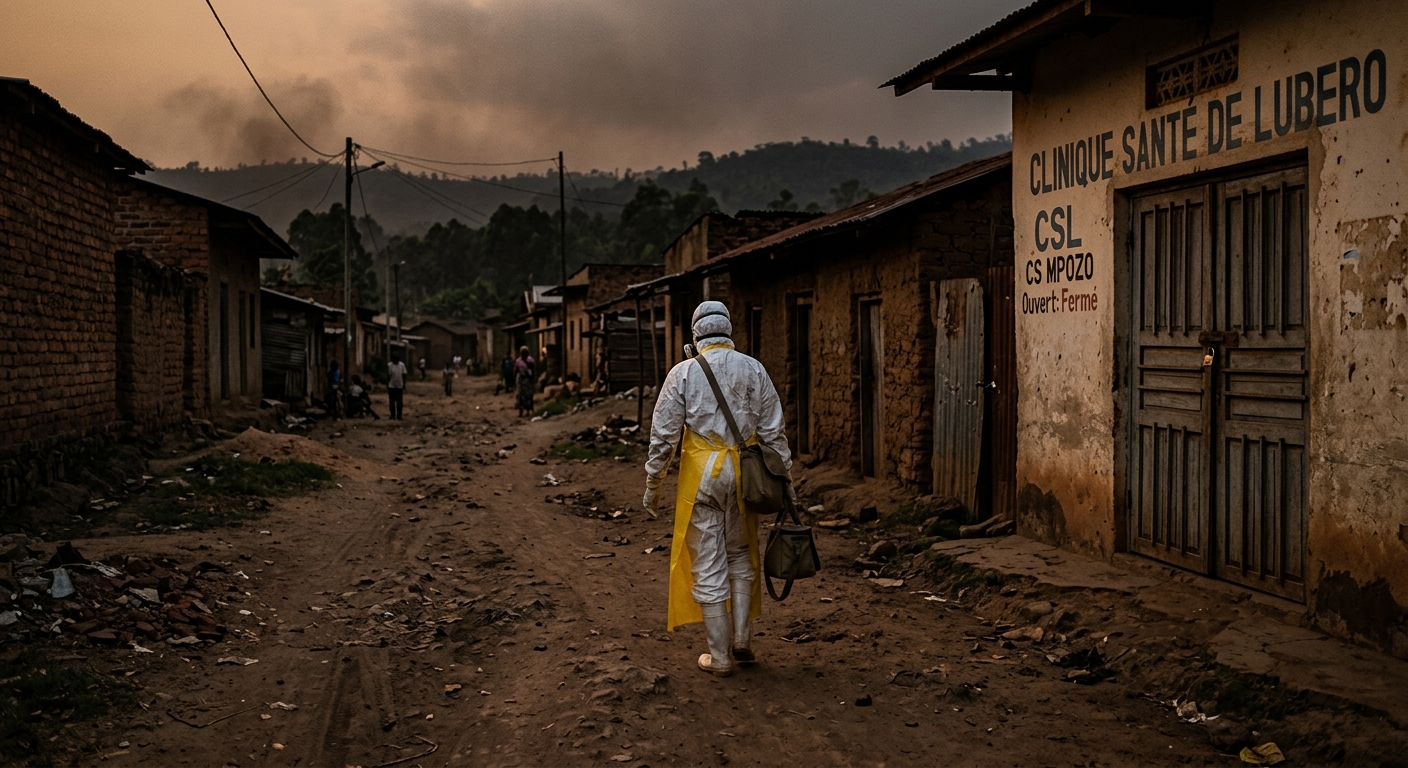
Why this outbreak escaped early — two structural failures
Two failures compressed into one. The first is epidemiological: Bundibugyo is a rare Ebola species last seen in DRC in 2012 and Uganda in 2007. There is no licensed vaccine and no approved therapeutic. WHO adviser Vasee Moorthy told journalists in Geneva that a candidate vaccine would take six to nine months to reach clinical trial-ready status, and Ervebo — the licensed vaccine against the Zaire species — offers only limited cross-protection.
The second is systemic. The Financial Times reported that Ebola had been circulating for weeks in the Mongbwalu gold-mining zone before authorities raised the alarm. The Observer Research Foundation documents that the DRC was the African country
most affected by USAID cuts, which had underwritten roughly 70% of humanitarian operations in eastern DRC before the January 2025 executive order shutting the agency down.
That surveillance gap is not abstract. As Oxfam's DRC country director Manenji Mangundu described in Policy Options, community health workers "lost their jobs and moved into other work to survive" after USAID's closure. Stocks of personal protective equipment were depleted before the outbreak began. The Council on Foreign Relations puts it bluntly: the United States'
eyes and ears on the ground disappeared, along with the informal networks that once flagged unusual clusters of hemorrhagic fever within days.
Layered on top of that: WHO Director-General Tedros Adhanom Ghebreyesus has described Ituri as a catastrophic collision of disease and conflict. M23, the Rwanda-backed insurgency, controls swaths of North and South Kivu. Nearly one million people are displaced in Ituri alone. On July 1, rioters torched an Ebola treatment centre in Bafwabango, and a police officer was killed, according to
BBC Verify's investigation of misinformation-driven attacks — one of a dozen documented incidents of community resistance to burial teams and isolation units. Seventy-five health workers had contracted the virus by mid-June, 17 fatally,
Al Jazeera reported, in a country that already has roughly 11 health workers per 10,000 people — one of the world's lowest ratios.
The Economist warned as early as May that this could become the worst outbreak in a decade; US CDC modelers have privately compared its trajectory to the 2014–2016 West Africa epidemic that killed more than 11,000 people.
The new aid architecture, stress-tested
Here is the non-obvious angle. The response now unfolding is not the muscle-memory operation the world executed in 2018 or 2019 against DRC's tenth outbreak. It is a live experiment in what replaces the old multilateral model — and Fletcher's plea is the first honest audit.
The WHO and Africa CDC launched their $518 million joint plan on June 5, covering June through November 2026. Tedros described it as "a costed plan" backed by UNICEF, UNHCR, WFP, IFRC and FIND, with a joint financial-tracking mechanism to monitor pledges against gaps. The
World Bank Group has mobilised $243 million, drawing on its Health Emergency Preparedness, Response and Resilience Project and the REDISSE regional surveillance network — the same infrastructure that built the biosafety-level laboratory now serving as the outbreak's central testing hub in Bunia and the Kinshasa Emergency Operations Center that coordinates the national response.
But scan the ledger and the composition looks very different from the 2014 West Africa mobilisation. The Center for Strategic and International Studies documents that Washington — despite closing USAID and withdrawing from the WHO — has committed more than $270 million through the State Department plus $107 million from the CDC, and routed $350 million through UN OCHA rather than WHO. CFR's Thomas Bollyky notes on
The President's Inbox that the Trump administration is "working more with bilateral governments and to move away from multilateral institutions" — yet in a crisis, "they seem to have embraced" UNICEF, the International Organization for Migration and local NGOs anyway.
The deeper shift is the linkage. In late February 2026, the US signed a bilateral America First Global Health Strategy memorandum of understanding with DRC — but only after concluding a critical-minerals partnership agreement granting Washington preferential access to Congolese cobalt, coltan and rare earths. ORF documents six such AFGHS bilateral deals worth $20.4 billion collectively, with recipient countries providing $7.7 billion in co-investment. The DRC arrangement is now being challenged in Congolese courts on constitutional grounds, with plaintiffs arguing it hands direct US oversight of the national mining sector.
This is the pivot. Health assistance to Africa's largest Ebola-experienced country is no longer a residual multilateral commitment. It is contingent, transactional and welded to supply-chain access. Fletcher's plea for "flexible" donor funding is diplomatic code for something sharper: do not condition your money on political returns while people are dying. And the Pathogen Access and Benefit-Sharing annex to the WHO Pandemic Agreement — rejected in its most recent draft by African states because it does not oblige pharmaceutical manufacturers to supply vaccines during a PHEIC — sits unresolved in Geneva while DRC is asked to share Bundibugyo sequences into a system that offers no guaranteed reciprocal benefit.
Who is filling the gaps, and who is not
China, widely predicted to inherit the US retreat, has not moved into the vacuum on emergency health response, per Bollyky. Beijing has dispatched medical teams to DRC alongside Uganda but has not underwritten the international architecture — a pattern that mirrors its 1% contribution to the multi-donor trust fund for the 2014 West Africa response, when the United States provided half.
The African Union, by contrast, is showing up. AU member states have pledged nearly $1 billion toward the regional emergency, though far less has actually flowed. South African President Cyril Ramaphosa put down an initial $5 million on the day of the plan's launch. Africa CDC director-general Jean Kaseya says 10% of the $319 million African portion of the response has been secured domestically. The Pandemic Fund has pledged $220.6 million to fill surveillance and preparedness gaps across affected and at-risk countries.
Europe is present but modest. The United Kingdom announced £20 million ($27 million) for frontline health workers, infection control and surveillance, BBC News reported. The European Centre for Disease Prevention and Control has deployed experts via the EU Health Task Force. The Coalition for Epidemic Preparedness Innovations committed $60 million to Bundibugyo vaccine R&D — funding rVSV-Bundibugyo, ChAdOx1 and Moderna's mRNA candidate — with Gavi adding $50 million for high-volume manufacturing.
The pattern is clear: money exists, but it is fragmented across bilateral pipes rather than pooled through a single incident command. The Institute for Security Studies estimates DRC alone needs to raise 2026 health spending to $1.82 billion — $540 million above the pre-outbreak baseline — while forecasting DRC could lose around $700 million in economic activity this year from the outbreak. Uganda faces a $170 million additional bill. That is the arithmetic of a fragmented response: the emergency plan roughly matches what the economies of the region will lose in the same six-month window.
The tempo problem, and what history says
The precedent matters. In the 2014–2016 West Africa outbreak, the US CDC and USAID coordinated the international response through Liberia's Ministry of Health; the multi-donor trust fund cleared $3.6 billion. Under the current architecture, no equivalent coordinating body exists. CSIS is calling for the Trump administration to appoint an "Ebola czar" analogous to the 2014 White House position and fill the vacant Office of Pandemic Preparedness and Response Policy — a tacit admission that the incident-command muscle memory has atrophied.
WHO's own primary technical guidance concedes the tempo gap. Its IRIS brief on financing modalities states the $518 million must be "mobilized jointly from external and domestic sources" — bureaucratic language that pledges are not landing fast enough for operational planning. In the field, cases are being identified in new health zones on a near-daily basis, WHO's head of epidemiology Olivier le Polain
told reporters in mid-June, warning that isolation bed capacity is "far below the anticipated need." Médecins Sans Frontières' DRC director Ewald Stals told the BBC: "We're still far behind having a control on the situation… the virus is still ahead of us."
The historical parallel that most illuminates this moment is not 2014 but 2018–2019 in Kivu — the last time an Ebola outbreak collided with active conflict. That outbreak killed 2,299 and cost roughly $700 million to contain. It was contained because a fully-funded USAID mission, a US CDC forward presence and an integrated WHO Incident Management Support Team acted as a single organism. In 2026, those elements exist in fragments, spread across three or four uncoordinated bilateral pipelines. The second CFR briefing is explicit: "declining humanitarian aid levels globally, the loss of USAID, and the diminished international role of the US CDC — which historically led international Ebola responses — have raised concerns about meeting" the $518 million goal.
Forward look — the catalysts that will decide this
- August 15, 2026: End of the WHO–Africa CDC plan's first three-month cycle. If confirmed cases exceed 3,000 or spread to Kisangani or Goma proper, the outbreak crosses into "worst in a decade" territory.
- September 2026: First candidate vaccine (rVSV-Bundibugyo or ChAdOx1) expected to enter ring-vaccination trials in Ituri if regulatory clearances hold. A delay pushes any vaccine tool into 2027.
- DRC Constitutional Court ruling: An expected decision on the legality of the US–DRC critical-minerals partnership underpinning the AFGHS health MoU. A ruling against would upend the largest single bilateral aid pipeline into the outbreak zone.
- Uganda border reopening: Kampala's closure remains contested; Tedros has publicly urged reopening. Every day the border stays shut disrupts contact tracing across the Ituri–West Nile corridor.
Diplomat View
Fletcher's $60 million is not the story — it is the tell. The real signal is that the world's top humanitarian official had to publicly plead for donors to convert pledges into cash 55 days into a declared PHEIC, in a country whose surveillance system was hollowed out on purpose. Our forecast: this outbreak will be contained, but at a human and financial cost several multiples higher than the 2018–2020 Kivu operation, and it will be contained mostly through African-led response capacity, US bilateral cash tied to mineral access, and residual World Bank engineering — not through the WHO-led coordination architecture of the last decade. What would change this call: a rapid, unconditional US$150 million-plus tranche flowing through Africa CDC's joint tracking mechanism by August 15, or an M23 ceasefire that opens Ituri to sustained humanitarian access. Absent both, expect case counts above 3,000 by October and Bundibugyo established as an endemic risk in the Great Lakes — a permanent tax on a region already paying too many.
Discover more
Global Politics
Xi Jinping Calls China-Russia Ties 'Precious'
Xi Jinping's description of China-Russia ties as 'precious' reflects a strategic imbalance, with Beijing dictating terms in the partnership.
Global Politics
US-Iran Tensions Rise
Tensions escalate in the Strait of Hormuz as Iran and the US clash over maritime control, with a ceasefire hinging on a contested MoU paragraph.

US Politics
White House Pressures Congress for Crypto Leg
The Trump administration's push for the CLARITY Act aims to reshape crypto regulation, impacting trillions in market value and the Trump family's wealth.

Economics
Fed's Amex AML order puts correspondent banking on notice
Federal Reserve's Amex AML order requires board-level controls and a 90-day plan; OCC fined the bank $350 million over enterprise-wide deficiencies.