Duterte's ICC Trial Set for November 2026
Landmark case on drug war opens in The Hague
Model Diplomat7 min readAsia
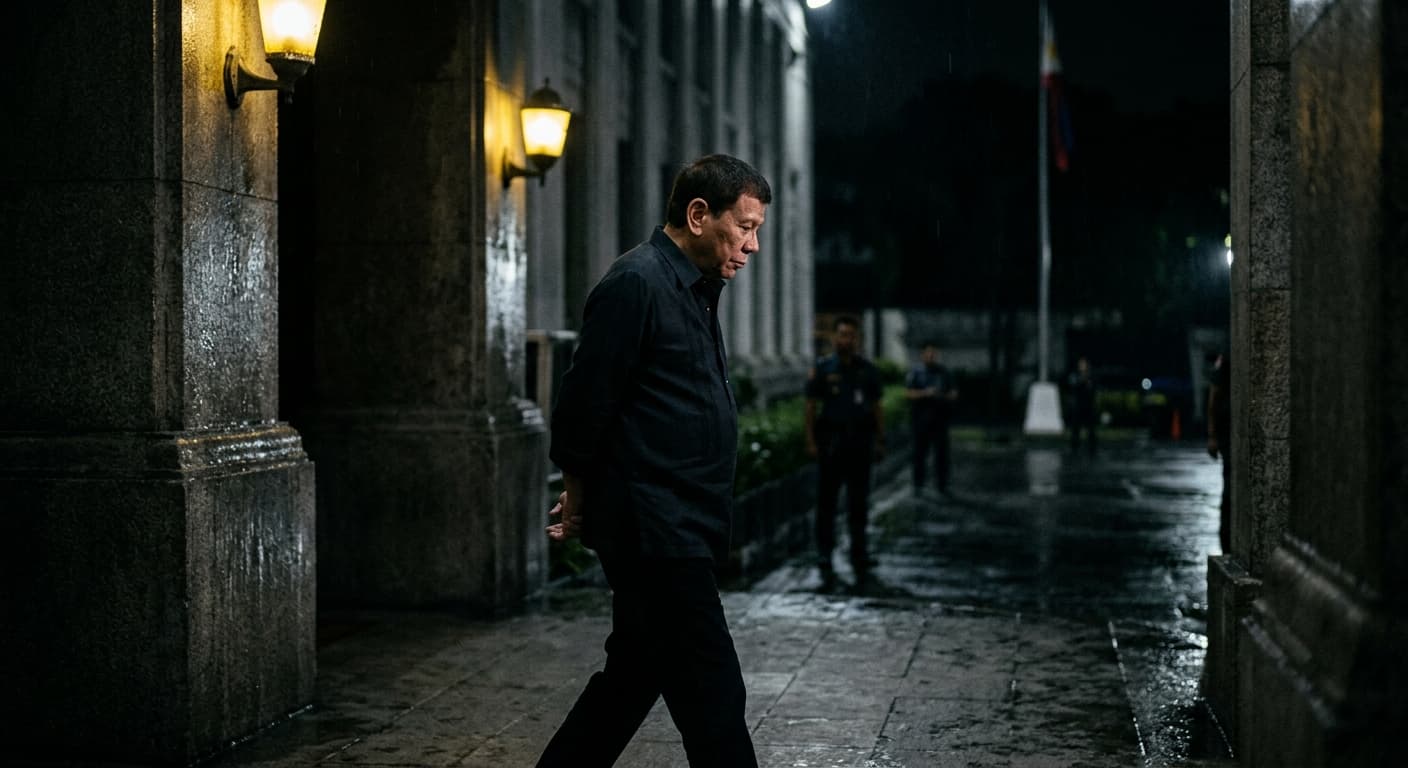
ICC to try Duterte on Nov 30, 2026, in landmark drug-war case
Trial Chamber III has set November 30, 2026 for the opening of the Duterte trial — a case that has already narrowed the exit door for any state trying to escape ICC jurisdiction by leaving the Rome Statute.
The International Criminal Court will open the trial of former Philippine president Rodrigo Roa Duterte on November 30, 2026, in a case whose most durable impact may not be a verdict on the "war on drugs" but a jurisdictional rule that closes the Rome Statute's withdrawal loophole for the next authoritarian who tries it. Trial Chamber III fixed the date after a status conference on May 27, 2026, according to a press release from the International Criminal Court. Duterte, 81, will face three counts of crimes against humanity of murder and attempted murder committed between November 1, 2011 and March 16, 2019 — a period spanning his years as Davao City mayor and as president. He is the first Asian former head of state, and the first head of state of a non-party, to be committed to trial before the Court.

What the Court actually decided
Pre-Trial Chamber I unanimously confirmed all three charges on April 23, 2026, finding "substantial grounds to believe" Duterte was an indirect co-perpetrator of a "common plan" to "neutralise" alleged criminals through murder. The ICC Pre-Trial Chamber I decision frames Duterte as sitting "at the apex" of a machinery that carried out a "widespread and systematic attack against a civilian population." Prosecutors named 76 murder victims and 2 attempted-murder victims across 49 incidents — but told the Chamber the list is "non-exhaustive," a formulation that leaves room to introduce further killings within the same pattern at trial, according to
Human Rights Watch.
The bench for the trial itself is Presiding Judge Joanna Korner of the United Kingdom, Judge Keebong Paek of South Korea, and Judge Nicolas Guillou of France, sworn in on April 24, 2026 per an ICC press release. More than 500 victims have been authorised to participate,
BBC News reported.
The jurisdictional ruling that changes the game
The load-bearing precedent in this case was set the day before the charges were confirmed. On April 22, 2026, the Appeals Chamber ruled by majority that the Philippines' 2019 withdrawal from the Rome Statute does not defeat the Court's jurisdiction over crimes committed while the country was still a state party. The ICC Appeals Chamber judgment held that Article 127(2) of the Statute preserves "the continued consideration of any matter which was already under consideration by the Court" before withdrawal takes effect.
The Chamber's rationale is worth quoting directly:
"It would be incompatible with [the Statute's] object and purpose to enable a State Party to evade its responsibilities under the Statute by depositing a written notice of withdrawal once it discovers that alleged crimes committed on its territory or by its nationals are being examined by the Prosecution."
This is the first time an ICC Appeals Chamber has ruled squarely on the withdrawal-mid-investigation question. Burundi tried the same manoeuvre in 2017; Duterte followed in 2018. The primary text of the appeals judgment (ICC-01/21-01/25-415) treats Article 127 as lex specialis for withdrawals and reads it together with Articles 12 and 13 on jurisdiction. In practical terms: any state whose conduct is already under preliminary examination cannot walk out and take its former officials with it.
That has consequences well beyond Manila. It puts an existing rule under a clear ruling, and it forecloses a defence line that would otherwise have been available to officials of any state weighing withdrawal — a live question after arrest warrants for Israeli and Russian leaders, and after episodic threats of withdrawal from Kenya, the Philippines and, most recently, from members of the Southern African Development Community.
Who benefits, who loses — inside the Philippines
The Duterte case reached The Hague not through international pressure but because Ferdinand Marcos Jr. let it. On March 11, 2025, Philippine authorities arrested Duterte on arrival at Manila's international airport and put him on an ICC-bound aircraft the same day,
BBC News reported. That was a political calculation as much as a legal one: sending Duterte to The Hague let Marcos distance himself from the drug war's excesses without prosecuting them at home, as
Human Rights Watch noted a month before charges were confirmed.
The calculation is not paying off. The Dutertes are winning politically. Rodrigo Duterte was elected mayor of Davao from a Scheveningen cell in May 2025, and Duterte-aligned candidates took at least four of the 12 open Senate seats, according to Al Jazeera. The Philippine Supreme Court then struck down the first impeachment of Vice-President Sara Duterte on July 25, 2025, ruling that the House had violated the constitutional one-year bar on multiple proceedings,
BBC News reported. A fresh impeachment was voted on May 11, 2026 — the same day the ICC unsealed an arrest warrant for Senator Ronald "Bato" Dela Rosa, Duterte's former national police chief, who barricaded himself in the Senate building rather than surrender, per
Al Jazeera.
Dela Rosa is one of eight named co-perpetrators. Others include Senator Christopher "Bong" Go and former justice secretary Vitaliano Aguirre II, according to a February 13, 2026 filing surfaced by Al Jazeera. Justice Secretary Fredderick Vida told reporters on May 15, 2026 that Manila will honour the ICC warrant against Dela Rosa if the Philippine Supreme Court clears it — a conditional commitment that has already delayed transfer, per
Al Jazeera.
The numbers under the case
The prosecution's evidentiary base rests on numbers documented by primary sources. The UN Office of the High Commissioner for Human Rights (OHCHR) reported in June 2020 that at least 8,663 people had been killed since July 2016 in operations marked by "near impunity", and that the Duterte government's rhetoric functioned as "permission to kill." The
ICC prosecution's own June 2021 request cites a range of 12,000 to 30,000 civilians killed once vigilante-style deaths are included. The Philippine Commission on Human Rights has put the figure as high as 27,000. Domestic accountability has produced a total of nine police-officer convictions in the decade since the campaign began, per
Human Rights Watch. Extrajudicial killings continue under Marcos at roughly one a day, according to researchers at the University of Manila cited by
NPR.
The historical parallel — and where it breaks
The obvious comparator is Slobodan Milošević, the first former head of state tried at an international criminal tribunal; he died in custody in 2006 before a verdict. Duterte's defence has already argued he is mentally unfit to stand trial. In January 2026, a Pre-Trial Chamber, relying on medical experts, ruled him fit, according to Amnesty International. He will be 81 when trial opens, and prosecutors have said proceedings will run five days a week — an intensive schedule aimed, in part, at avoiding a Milošević-style outcome.
The other comparator — the al-Bashir litigation over head-of-state immunity — is precisely what this case is not. Duterte is a former head of state; the immunity questions that dogged the Sudan case do not arise. As scholarship in the American Journal of International Law has laid out, the Court has struggled to explain state-cooperation duties against sitting non-party leaders. The Duterte case avoids that trap and instead lets the Court establish a cleaner rule on the temporal reach of jurisdiction after withdrawal — a more portable precedent.
What to watch
- June 23 and July 14, 2026: Trial Chamber III status conferences on disclosure timelines and interpretation capacity, per
The Manila Times.
- Philippine Supreme Court ruling on the Dela Rosa petition: Manila's Justice Department has said transfer to The Hague awaits the Court's word. A negative ruling would trigger a non-cooperation reference and test the outer limit of the Marcos administration's willingness to enforce ICC warrants against sitting senators.
- Sara Duterte's second impeachment trial: The Senate — now sitting after the May 2025 midterms delivered at least four seats to Duterte allies — will decide whether the vice-president can stand in the 2028 presidential election, per
CSIS analysis. Her acquittal would restore the family's line of political succession while the trial in The Hague runs.
- November 30, 2026: Trial opening. Proceedings will run five days a week until the Christmas recess, according to
MindaNews.
The Bottom Line
The Duterte trial's most durable legacy will not be a verdict on 78 named victims — it will be the April 22, 2026 Appeals Chamber ruling that a state cannot escape ICC scrutiny by withdrawing once its conduct is already under examination. That is a rule of general application, and it is the first thing future defence teams from Nairobi to Moscow will read. Inside the Philippines, the political dividend is running the other way: the Dutertes are winning elections while the accountability project is outsourced to The Hague, and domestic prosecutions remain in single digits after a decade and thousands of deaths.
Discover more
India
Rajnath Singh's Durga Squad for 2026 Polls
Rajnath Singh's Durga Squad promised women's safety in Bengal but has since disappeared from the agenda, revealing BJP's true priorities.
US Politics
Virginia's Redistricting Referendum
Virginia's redistricting referendum is drawing a flood of dark money, shaping future elections and the fight for congressional control amid party stakes.
India
700 Activists Accuse PM Modi of MCC Breach
Over 700 activists allege PM Modi breached election code with a televised address attacking opposition parties just before state elections.

Economics
Fed's Amex AML order puts correspondent banking on notice
Federal Reserve's Amex AML order requires board-level controls and a 90-day plan; OCC fined the bank $350 million over enterprise-wide deficiencies.