Duckworth Reopens $14B Taiwan Arms Deal
Senator Duckworth's Taipei visit reshapes US-Taiwan security ties.
Model Diplomat8 min readAsia
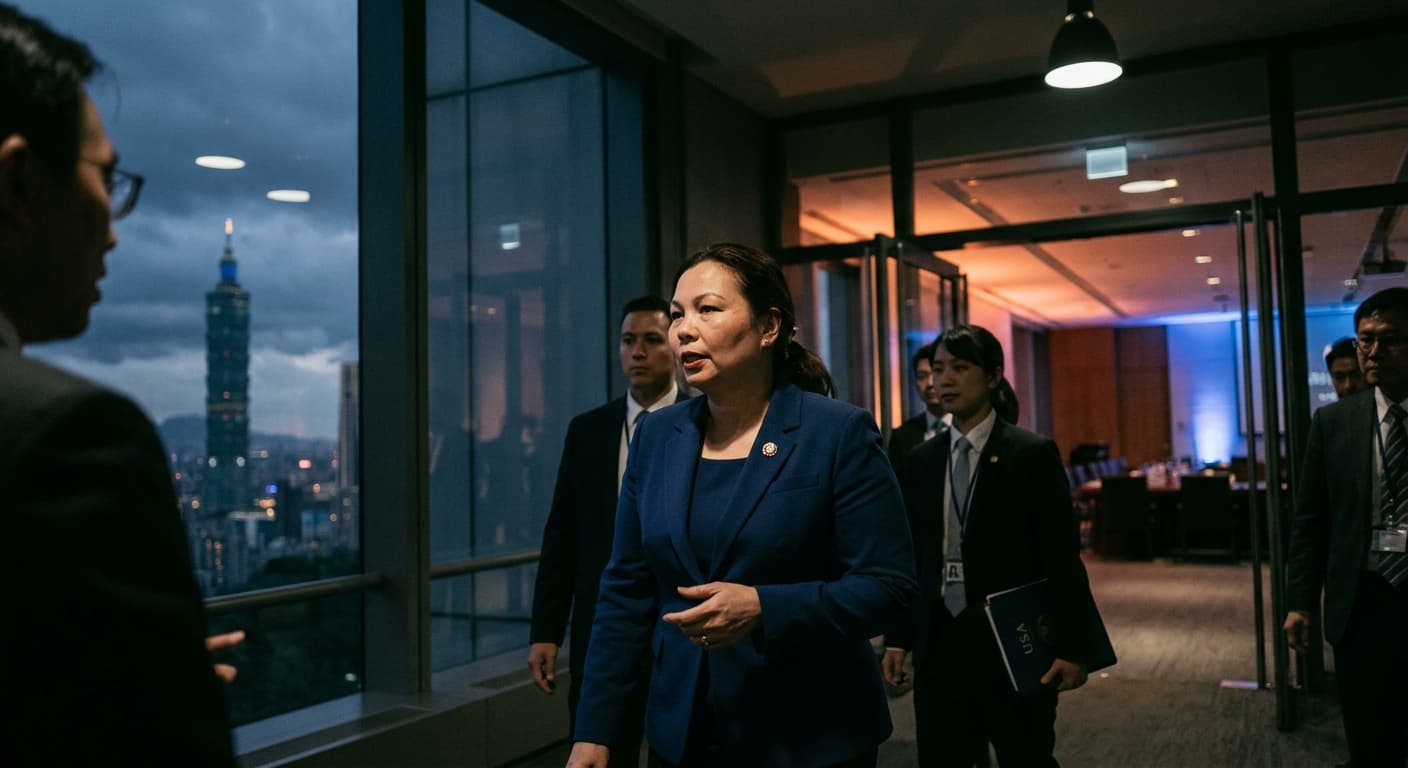
Duckworth Lands in Taipei to Reopen the $14B Taiwan Arms File
Senator Duckworth's July 6–8 Taipei visit reframes US-Taiwan security ties after the Trump-Xi summit and a paused $14 billion arms package.
Senator Tammy Duckworth landed in Taipei on July 6, 2026, as the first US lawmaker to visit Taiwan since Donald Trump's May 14–15 summit with Xi Jinping in Beijing — and her real cargo was not reassurance, but leverage. With the Trump administration holding a congressionally pre-approved $14 billion arms package "in abeyance" and the president publicly calling it a "very good negotiating chip" with Xi, the Illinois Democrat's three-day trip is Congress's opening move to reclaim the Taiwan file from a White House that has begun to bargain it away. The bet in Taipei is simple: the Taiwan Relations Act, not the president, is the operative document — and Article I of the US Constitution outlasts any single administration.
That bet will be tested inside the next 90 days.
Congress moves into the space Trump vacated
Duckworth's trip is the visible edge of a coordinated congressional pushback. In a statement posted from Taipei, she said she was traveling because Trump had "kowtowed" to Xi and "waffled on delivering a critical bipartisan arms package," according to the Taipei Times. The senator, a member of the Senate Foreign Relations Committee and Armed Services Committee, met President William Lai on July 7 and was scheduled to meet Vice President Hsiao Bi-khim and legislative leaders through July 8, per Taiwan's
Ministry of Foreign Affairs.
The backdrop is a fight over what Beijing extracted at the summit. Trump told reporters aboard Air Force One that he and Xi had discussed the Taiwan arms package "in great detail," told Fox News he was "not looking to have somebody go independent," and — asked about the 1982 Six Assurances forbidding prior consultation with Beijing on arms sales — said the 1980s were "a long way," as the BBC reported. Days later, acting Navy Secretary Hung Cao testified that the $14 billion sale had been paused to conserve munitions for Operation Epic Fury against Iran,
Al Jazeera reported. Beijing then began stalling a planned visit by Pentagon policy chief Elbridge Colby until Trump commits on the arms deal, per an FT report cited by the
BBC.
Congress is answering with paper and with travel. On May 21, Senators Jeanne Shaheen, Thom Tillis, Susan Collins and Chris Coons introduced S. Res. 754, reaffirming the Taiwan Relations Act, the Three Communiqués and the Six Assurances as "cornerstones of United States policy regarding Taiwan." Duckworth herself sponsored
S. Res. 657, commending Taiwan on the 30th anniversary of its 1996 direct presidential election — the document Lai singled out in his welcome remarks. And Duckworth is a co-sponsor of the STAND with Taiwan Act,
S. 4065, which would trigger automatic sanctions on Chinese officials and financial institutions if Beijing threatens Taiwan's security.
The message these instruments deliver in unison: the executive branch may pause a sale, but Congress owns the statutory floor. The Taiwan Relations Act of 1979 — codified at 22 U.S.C. Ch. 48 — obliges the United States to "make available to Taiwan such defense articles and defense services…as may be necessary to enable Taiwan to maintain a sufficient self-defense capability." That is not a discretionary phrase. Duckworth's role, per the Congressional Research Service's
primer on Taiwan defense issues, is to remind Taipei — and Beijing — that Congress has already appropriated $1 billion in Taiwan Security Cooperation Initiative funding for FY2026 and $300 million in Foreign Military Financing, alongside the pre-cleared $14 billion.
The $10 trillion number she brought to Taipei
Duckworth's public framing in Taipei fused deterrence to dollars. She warned a Taiwan Strait conflict could cost up to $10 trillion and jeopardize more than 7% of US GDP, according to the Taipei Times. That figure is not rhetorical: it comes from a January 2024
Bloomberg Economics model, now cited by every major think tank. Chatham House translates it into a 10% contraction of global GDP in a full US-China war scenario; a blockade alone would shave 5% — comparable to the 2008–09 financial crisis — with the EU and Southeast Asia hit hardest after Taiwan itself, per the institute's
April 2026 analysis.
Why does the number matter for Duckworth's visit? Because it is the argument that ties Taiwan's defense to constituencies Trump nominally cares about: American manufacturing, semiconductor onshoring, and jobs in swing-state districts that buy from TSMC. When Duckworth tells Lai that US-Taiwan ties "will not be swayed by any single president or party," she is also telling Wall Street analysts, Republican defense hawks, and the Pentagon's Indo-Pacific planners that Congress's calculation of the war's cost dwarfs any deal Trump might extract from Xi on trade.
That framing has a political function. It puts Taiwan back where it sat through four decades — inside a bipartisan security consensus — rather than where Trump has moved it, which is onto the trade-deal ledger. The Center for American Progress called the freeze a "gift to Xi Jinping." Brookings' Ryan Hass argued Trump's summit remarks show him "dangling a concession that Beijing believes it previously has secured," raising rather than reducing the risk of miscalculation — see the institute's
analysis. AEI's Hal Brands, writing from the right, called the pending sale a "litmus test" and warned that "the longer that drags on, the more encouraged China would be to issue new demands," in his
June 2026 op-ed. Across the ideological spectrum, the analytic consensus is that hesitation, not action, is the destabilizing move.
What Beijing is actually buying with the delay
Zoom out and the sequencing tells the story. Xi walked into Beijing with a demand: no announcement of the $14 billion package before the summit. He got it. Xi then walked out with Trump publicly reframing arms sales as consultable with Beijing — a direct puncture of the 1982 assurance codified in resolutions Congress keeps passing, most recently in the pending H.R. 3452 reaffirmation. The Council on Foreign Relations' post-summit read called the meeting a "decent peace" for Beijing at low cost, in its
assessment. Brookings' Patricia Kim, tallying "what Beijing got," listed the arms-sale ambiguity first, in her
companion piece.
The real prize is a September deliverable. Xi is scheduled to visit Washington in September 2026 — his first US trip in years — and Beijing is pressing to keep the arms notification frozen until then. If Trump obliges, he will have negotiated an arms package with Beijing before notifying Congress. That would set a precedent that no future Chinese leader will surrender: any Taiwan sale becomes a bilateral negotiating variable rather than a US-Taiwan bilateral transaction.
This is the leverage math Duckworth is trying to break. Her visit forces two competing narratives into the same news cycle: Trump's transactional ambiguity, and Congress's statutory absolutism. Lai's team knows which one it prefers. In his July 7 remarks, Lai thanked Duckworth for "leading a bipartisan resolution commemorating the 30th anniversary of Taiwan's direct presidential election," and used the setting to restate that Taiwan "will not provoke, will not escalate conflict, but will not under pressure give up national sovereignty" — language he first deployed after the summit, per the BBC.
The Indo-Pacific reads the room
The second-order effects are already visible. Japan is watching the Tomahawk delivery slippage announced alongside the Taiwan pause. South Korea, Australia and the Philippines all have live capability requests dependent on the same US munitions industrial base straining under Iran and Ukraine. The Lowy Institute's July 7 read from Sydney put it bluntly: in the face of Chinese certainty, "America offers confusion." That is a specific charge — allies discounting US extended deterrence — that carries a specific cost. It shows up in defense-budget line items, in decisions about whether to base capability with US supply chains or European ones, and, over the medium term, in nuclear-latency debates in Seoul and Tokyo.
Taipei itself is not waiting. The Legislative Yuan passed a $25 billion special defense budget in May 2026 covering the "Taiwan Dome" air-defense system, and on June 18 the defense ministry proposed another NT$210 billion (~$6.6 billion) for maritime surveillance and small unmanned surface drones, per Al Jazeera. Lai's message is that Taiwan will spend — the constraint is Washington's willingness to sell, and Washington's willingness to keep the 1982 assurances intact.
The AEI's July 2 China & Taiwan Update notes that PLA air and naval activity around Taiwan has held at post-Pelosi "new normal" levels, with no dramatic escalation but no de-escalation either. That, too, is a message: Beijing is content to let ambiguity in Washington do work that its warships once had to.
Diplomat View
Duckworth's visit will not, by itself, force Trump to notify the $14 billion sale. It is not designed to. It is designed to raise the political cost of not notifying — by making the freeze visible to Taipei, to Beijing, and to Republican senators who cosponsored the packages and now watch their leverage drain. The forecast: Trump will notify at least a partial tranche — likely a $3–5 billion slice heavy on air defense — before Xi's September Washington visit, so that he arrives at the summit having neither fully caved nor fully defied Beijing. That is the "sweeten the pill without diluting the medicine" outcome AEI's Brands sketched, and it is the modal path if congressional pressure holds. What would falsify this call: (1) a Trump-Lai phone call that ends without a notification, signaling Trump has accepted Xi's veto on the package; (2) a further pause justified by a resumption of hostilities in Iran; or (3) a Republican fracture in which Foreign Relations Committee chair Jim Risch declines to press. Watch Risch, not Duckworth — he is the swing signal. If a Republican chair joins the Democratic push publicly within the next four weeks, the sale moves. If he stays silent through August, Beijing wins another quarter.
What to watch next
- July 8–15, 2026: Duckworth's closing press availability in Taipei and any follow-on Senate Foreign Relations Committee hearing on the arms pause. Look for named Republican co-signers.
- August 2026: Congressional recess ends; deadline pressure on Trump to notify a tranche before Xi's Washington visit. FY2027 NDAA markup begins, with likely Taiwan-specific amendments from Duckworth and Cornyn on National Guard partnership.
- September 2026: Xi's scheduled state visit to Washington. If Trump arrives having notified nothing, treat that as confirmation that the Six Assurances have been functionally rewritten. If he arrives with a partial notification in hand, the deterrence architecture holds — bruised but intact.
The bottom line: Duckworth did not fly to Taipei to reassure Taiwan. She flew to remind Washington that on the Taiwan file, the White House is a co-equal branch, not the only branch. If the $14 billion package clears before September, historians will mark her three days in Taipei as the moment Congress reasserted itself. If it does not, they will mark it as the last credible warning before the Six Assurances quietly died.
Discover more

India
Yamini Aiyar on Modi's Federalism Shift
Yamini Aiyar critiques Modi's shift from equity-based to performance-based federalism, highlighting implications for India's political landscape.
US Politics
Virginia's Redistricting Referendum
Virginia's redistricting referendum is drawing a flood of dark money, shaping future elections and the fight for congressional control amid party stakes.
Global Politics
Xi Jinping Calls China-Russia Ties 'Precious'
Xi Jinping's description of China-Russia ties as 'precious' reflects a strategic imbalance, with Beijing dictating terms in the partnership.

Conflict & Security
Drone Warfare Killing Aid Workers at Unprec
Over 1,000 humanitarian workers killed in three years as cheap armed drones collapse legal protections. Gaza, Sudan, Ukraine, and DRC see deliberate targeting of aid convoys and hospitals with zero prosecutions.

