Duckworth Advocates for Taiwan Strait Freedom
Senator Duckworth urges naval transits to counter China.
Model Diplomat8 min readAsia
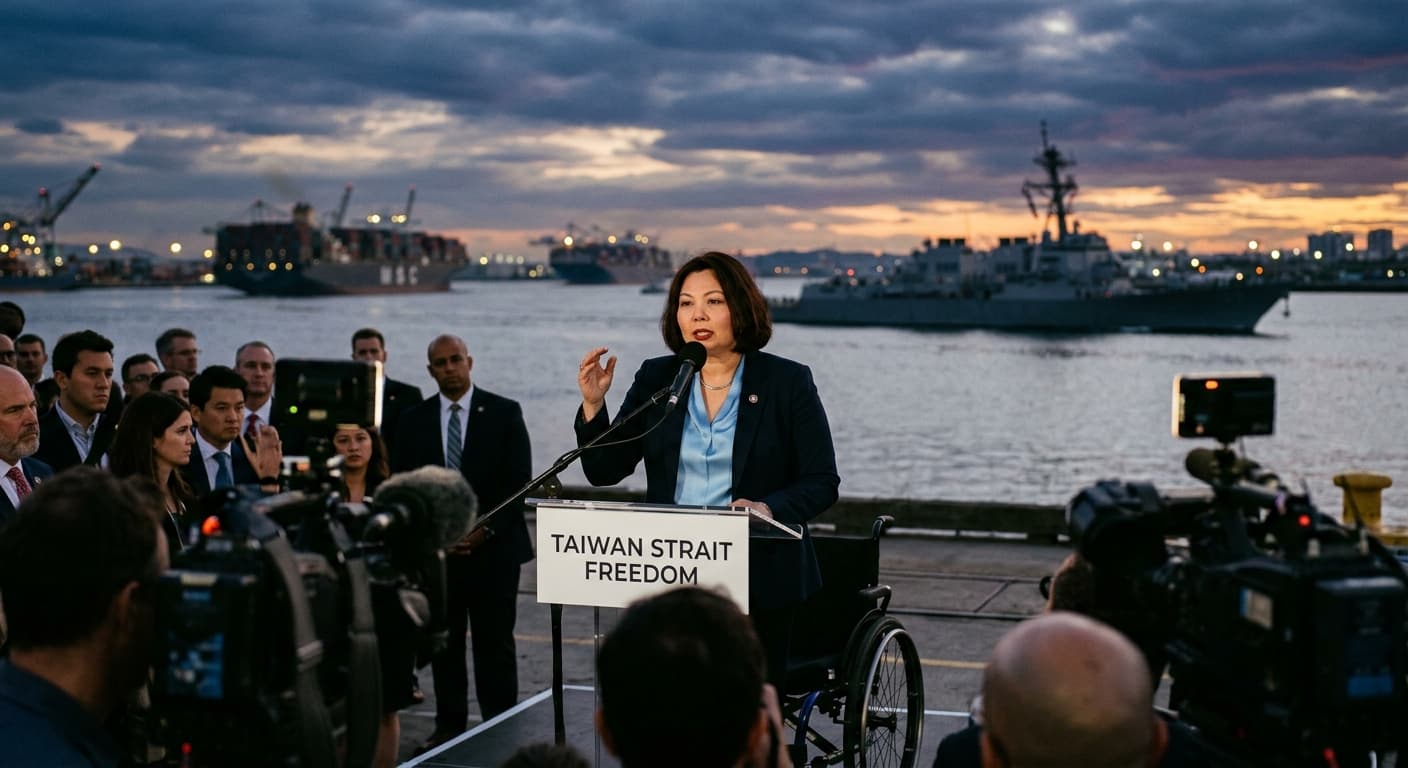
Duckworth Bets on Freedom of Navigation to Blunt China's Lawfare
Senator Tammy Duckworth used the Taipei ocean forum on July 8, 2026 to argue that only sustained transits — not statements — will stop Beijing from converting the Taiwan Strait into internal waters.
Senator Tammy Duckworth (D-Illinois) told a Taipei audience on July 8, 2026 that the only way to stop China from rewriting the rules of the Taiwan Strait is for foreign navies to keep sailing through it — and through every other patch of water Beijing has quietly begun policing. Her warning, delivered at the Taiwan International Ocean Forum forty-eight hours after China fired a submarine-launched ballistic missile from the South China Sea into the South Pacific, reframes the Taiwan question as a lawfare problem, not just a military one. The thesis Duckworth is selling to a hesitant Trump administration is that gray-zone deterrence costs pennies compared with a war it may not want to fight — and that the window to prove it is closing.
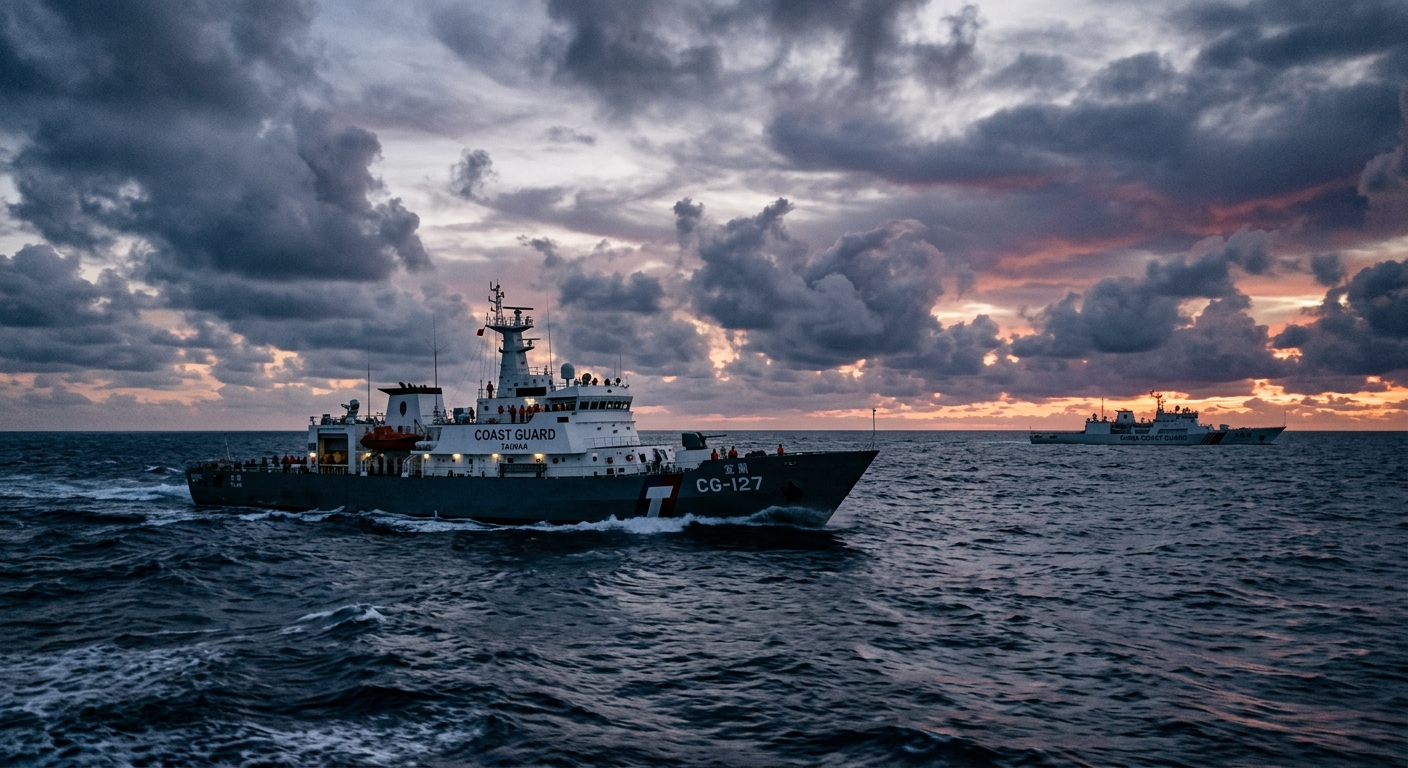
According to Focus Taiwan, Duckworth warned that without coordinated transits, Beijing could eventually require every ship in the Taiwan Strait to register with the China Coast Guard (CCG) before passage. "We cannot allow that to happen," she said. That is not an abstract fear: since early June, CCG vessels have stopped commercial ships east of Taiwan and demanded they declare destinations, an operation Beijing labels "maritime traffic special enforcement."
The visit is a signal to the White House, not just to Beijing
Duckworth is the first U.S. senator to land in Taipei after the May 14–15 Trump-Xi summit in Beijing, and the trip is engineered to counter the message Donald Trump delivered on the way home. According to the BBC, Trump told Fox News after the summit that he was "not looking to have somebody go independent" and confirmed that a roughly $14 billion arms package for
Taiwan was being held "in abeyance" as a "negotiating chip." Xi, according to the same account, warned that if the Taiwan question were "mishandled," the two nations could "have clashes and even conflicts."
The pause is not theoretical. Acting Navy Secretary Hung Cao confirmed to the Senate Appropriations defense subcommittee on May 21 that the sale had been paused, citing munitions needs for the U.S.-Israeli campaign against Iran, Al Jazeera reported. Brookings scholar Ryan Hass wrote in
Trump's dangerous Taiwan gamble that the effect of Trump's summit remarks was to signal "that America's security support for Taiwan was negotiable with China" — a shift, Hass argues, "from deterrence to dealmaking in a domain where there is no deal to be made."
That is the vacuum Duckworth flew into. "Regardless of president or party, Congress' commitment to Taiwan is steadfast," she told the Taipei Times. Her statutory anchor is real. The
Taiwan Relations Act of 1979, codified at 22 U.S.C. §3301, declares it U.S. policy "to provide Taiwan with arms of a defensive character" and to treat any non-peaceful effort to determine Taiwan's future as "a threat to the peace and security of the Western Pacific area." A subsequent statutory finding, preserved in
U.S. Code Title 22, Chapter 48, directs the President to conduct "regular transfers of defense articles" tailored to threats from the PRC and to support Taiwan's asymmetric capabilities. Trump can slow a specific sale, but he cannot unwind that scaffolding without Congress — and Duckworth is signaling Congress will not follow him.
Beijing's lawfare pincer: east of Taiwan, and above it
The novelty of the June 2026 CCG operation is geography. According to a Financial Times report on July 3, Beijing has "stepped up claims over the sea east of Taiwan," pushing enforcement beyond the Strait toward the Philippine Sea.
BBC 中文, citing Chinese state media, reported that between June 6 and 10 the Ministry of Transport dispatched four large-tonnage public-service vessels — including the 10,000-ton Haixun 09 — to conduct a "special maritime traffic law enforcement and sweeping operation" across more than 1,030 nautical miles east of Taiwan, boarding or querying 198 ships and conducting seabed cable sweeps. Chinese state media describe the pattern as "coastal governance" (近海治理) — a phrase that quietly extends China's coastal regime past the first island chain.
That operation converts a decade of documented pressure into an active legal claim. The CSIS Futures Lab found in The Geometry of Coercion that between January 2020 and December 2025 the daily average of distinct CCG vessels in Taiwan's near waters rose by more than 500 percent, and incursions into Taiwan's second maritime security ring more than quadrupled. The 2021 China Coast Guard Law provides the legal scaffolding: as
CSIS analysts note, it authorises the CCG to conduct enforcement in "maritime areas under Chinese jurisdiction" — a phrase Beijing deliberately does not define — and to forcibly evict foreign military vessels that "violate" Chinese domestic law.
Ocean Affairs Council Minister Kuan Bi-ling framed the danger in Taipei bluntly, according to Focus Taiwan: "In the end, we might suddenly find that even without the outbreak of a decisive war, the status quo no longer exists." She linked the east-of-Taiwan operation to Chinese ramming and water-cannon attacks on Philippine coast guard vessels — the same playbook, different coordinates. A CSIS review of Taiwan's
2025 National Ocean Policy White Paper documents 679 unauthorised CCG transits around Kinmen and Matsu in 2024 alone, framed by Beijing as "normalized law enforcement."
The July 6 missile: not about Taiwan alone
Duckworth's second, less-noticed argument in Taipei was that fixating on Taiwan misreads the July 6 missile test. According to a CSIS technical assessment, China launched a JL-2 or JL-3 submarine-launched ICBM from the South China Sea into the South Pacific Nuclear Free Zone on July 6, 2026 — a flight of roughly 7,300 kilometers that likely overflew parts of the Philippines. It was Beijing's first-ever SLBM into international open water, and only its second ballistic missile launched into international waters since 1980. Advance notification to the United States and Japan was measured in hours, not the days envisaged by the Hague Code of Conduct.
The Economist reported the test rattled Asian neighbours;
Al Jazeera noted that Australia, New Zealand and Japan formally protested. Duckworth's read, per
Tai Sounds, was that the launch was designed to signal regional reach to Japan, South Korea and the United States — not to Taipei. That framing matters because it hands wavering Indo-Pacific capitals a reason to treat the Strait as their problem, not America's favour.
Who benefits, who loses
The winner from Trump's summit posture is, unmistakably, Beijing. Patricia Kim wrote in What Beijing got from the Trump-Xi summit that Chinese leaders feel "increasingly positive" about the summit outcomes given Trump's rhetorical concessions. The Council on Foreign Relations'
China Shouldn't Get a Veto on Taiwan Arms Sales argues the paused $14bn package would have delivered PAC-3 interceptors, NASAMS, TOW and Javelin systems — the exact air-defense and anti-armor kit Taiwan's asymmetric strategy depends on. Delay does not merely inconvenience Taipei; it hands opposition Kuomintang legislators, who reluctantly funded the sale via a special defense budget, a vindication argument against future packages.
The loser inside Taipei is the pro-defense camp led by President Lai Ching-te. Taiwan's legislature approved a special defense budget just three weeks before the Trump-Xi summit to fund both the December 2025 $11bn sale and the pending $14bn package, according to CFR. If the $14bn package quietly dies, the political cost of the next one rises sharply. Ryan Hass and Stephen Tan, writing in Paint it black, warn that Taiwan's habit of scrambling jets and warships to shadow every PLA incursion is already "exhausting Taiwan's military assets and personnel." Every dollar diverted to fuel and maintenance is a dollar not spent on the drones, mines and missiles Duckworth wants Taiwan to build itself.
The historical parallel Duckworth is invoking
Duckworth's playbook is not new — it is the South China Sea playbook from 2015, applied to the Strait. There, the United States and partners responded to China's artificial-island building with periodic Freedom of Navigation Operations (FONOPs) under UNCLOS Article 58. The result was mixed at best: as CSIS's Asia Maritime Transparency Initiative has documented in its tenth-anniversary retrospective on the 2016 arbitration, China rejected the Hague ruling entirely and continued militarising the features. But the counterfactual — no FONOPs — would have left Beijing's nine-dash claim uncontested in state practice, which is how customary international law hardens.
Duckworth is arguing that the Taiwan Strait is at the equivalent of 2013: still contestable, but only if traffic keeps flowing under everyone's flag. As she told CSIS in an earlier conversation, Southeast Asian states welcome a U.S. presence framed not as forcing a choice against Beijing but as standing up "for the rule of international law." That framing is deliberate: it lowers the political cost for Manila, Tokyo, Canberra and Seoul to shadow U.S. transits without formally aligning.
Australia is already leaning in. Canberra publicly raised concerns with Beijing about the June CCG operation east of Taiwan, and joined New Zealand and Japan in protesting the July 6 missile launch. The Philippines, whose EEZ the SLBM likely overflew, has the largest legal grievance. This is the constituency Duckworth is trying to knit together while the White House is preoccupied with Iran and trade.
What to watch next
- The $14bn package sign-off. Per
Al Jazeera, any decision now rests with Secretary of Defense Pete Hegseth and Secretary of State Marco Rubio. A quiet approval before September's UN General Assembly would signal Trump has absorbed Congressional pushback; continued delay past Q4 2026 confirms the "negotiating chip" framing.
- A Trump-Lai call. Trump told reporters he would "speak to" President Lai about the sale, per the
BBC — a break from four decades of protocol. If it happens, expect a sharp PLA response in the Strait within 72 hours.
- The next CCG boarding east of Taiwan. If the operation becomes monthly, Beijing has established a practice; if a foreign-flagged vessel is boarded, the case for a coordinated FONOP crystallises overnight.
- Elbridge Colby's Beijing visit. The
The Bottom Line
Duckworth's Taipei speech is not a rhetorical flourish; it is a Congressional attempt to substitute cheap, repeatable freedom-of-navigation transits for the expensive arms sale the White House has frozen. If allied navies keep sailing and Washington ratifies the pattern, Beijing's east-of-Taiwan lawfare stalls before it hardens into custom. If they do not, the next time a commercial captain enters the Taiwan Strait, he may find himself filing paperwork with the China Coast Guard — and by then, the status quo Duckworth came to defend will already be gone.
Diplomat View
The forecast: the $14bn package will be approved in a truncated form before year-end, but only after visible allied transits force Trump to choose between his personal rapport with Xi and a Congressional revolt led by the Senate Foreign Relations Committee. The decisive variable is not Taipei's diplomacy — it is whether Japan and Australia stage a joint transit of the waters east of Taiwan within the next ninety days. If they do, Beijing's "coastal governance" claim collapses under contrary state practice, and Duckworth's bet pays off. If they do not, the July 6 SLBM becomes the opening move of a normalization campaign that ends with the Strait treated as Chinese internal waters in everything but name. Revise the forecast if: (a) Trump publicly kills the $14bn package, (b) the CCG boards a U.S.- or Japanese-flagged vessel east of Taiwan, or (c) Lai holds a call with Trump before September 1 — any of which would reset the leverage calculus overnight.
Discover more

US Politics
White House Pressures Congress for Crypto Leg
The Trump administration's push for the CLARITY Act aims to reshape crypto regulation, impacting trillions in market value and the Trump family's wealth.
US Politics
Virginia's Redistricting Referendum
Virginia's redistricting referendum is drawing a flood of dark money, shaping future elections and the fight for congressional control amid party stakes.
Global Politics
Xi Jinping Calls China-Russia Ties 'Precious'
Xi Jinping's description of China-Russia ties as 'precious' reflects a strategic imbalance, with Beijing dictating terms in the partnership.

Conflict & Security
Drone Warfare Killing Aid Workers at Unprec
Over 1,000 humanitarian workers killed in three years as cheap armed drones collapse legal protections. Gaza, Sudan, Ukraine, and DRC see deliberate targeting of aid convoys and hospitals with zero prosecutions.