Dominican Protests Challenge Abinader's Rule
Cacerolazos erupt against media bill and tax hikes in DR
Model Diplomat8 min readCaribbean
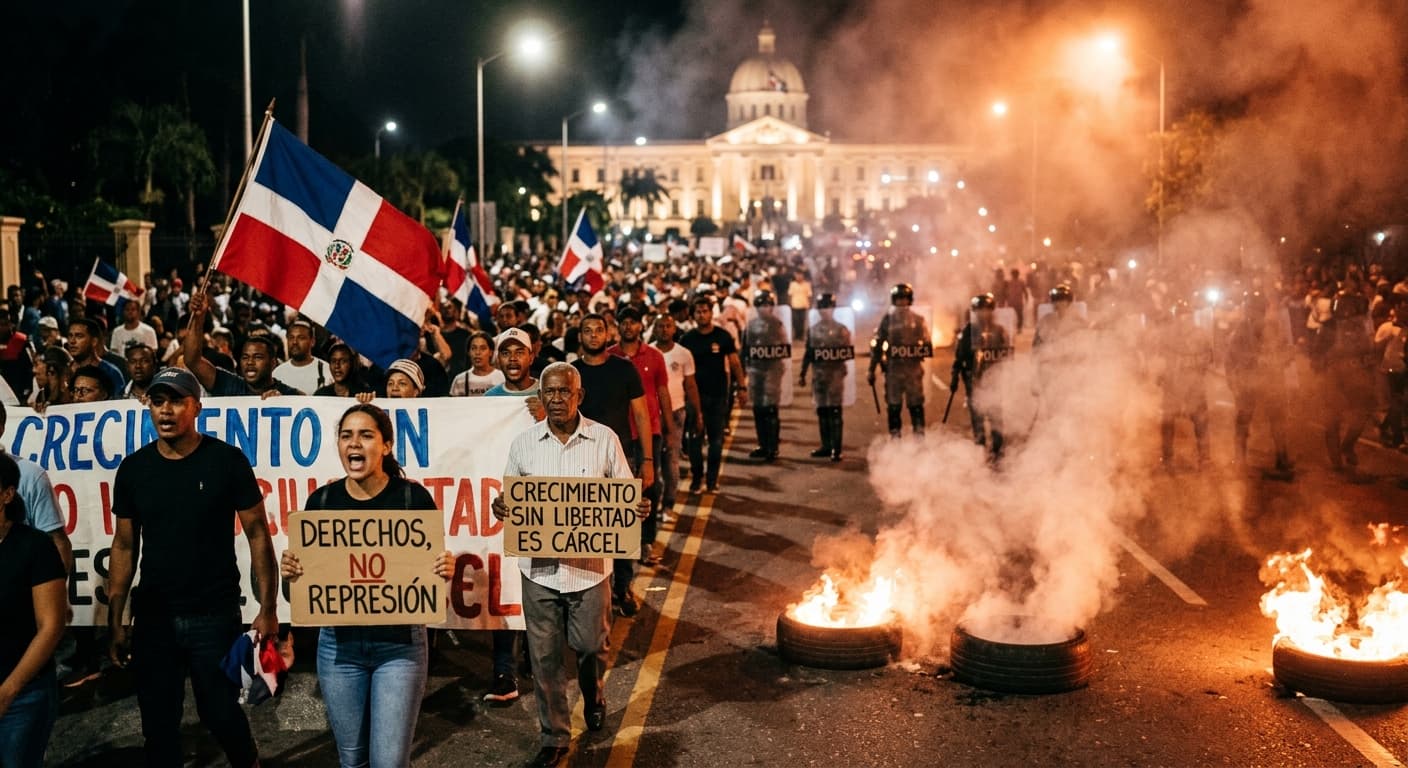
Dominican pot-bangers hit Abinader at his economic peak
Cacerolazos spread across Santo Domingo for a second night on July 7, 2026, targeting a media-restriction bill, tax hikes and a police killing — as the Dominican Republic posts Latin America's strongest growth.
The Dominican Republic's middle class is banging pots against a government the IMF just called the region's growth star — and that is precisely what makes the July 6–8, 2026 protests dangerous for President Luis Abinader. For a second consecutive night on July 7, residents of Ensanche Ozama, El Millón, Bella Vista, Naco, Arroyo Hondo, Renacimiento, Herrera and Evaristo Morales turned kitchens into instruments to oppose a media-regulation bill critics call the "Ley Mordaza," a new tax package, chronic blackouts and the police killing of a young man in Herrera, according to Diario Libre. The thesis is uncomfortable for the president: the revolt is not about the economy failing, but about a governing coalition using its second-term mandate to squeeze civil liberties while the numbers still look strong. That is a distinctly Latin American pattern of democratic backsliding — and this week's soundtrack, from the same Plaza de la Bandera that toppled the electoral calendar in 2020, is the alert.
What is actually being protested
The demands, catalogued by Voz Libre, form a tight bundle: the draft Ley de Libertad de Expresión y Medios Audiovisuales, a fiscal reform announcing new tax measures, prolonged blackouts in Santo Domingo Norte, high fuel prices, and the death of Darlyn Emmanuel Mercado during a police incident in Herrera. Layered above them is the new Penal Code that Abinader signed on August 3, 2025, which enters into force in 2026 with a total abortion ban and no protection against discrimination based on sexual orientation or gender identity — a text
Amnesty International called a consolidation of "institutional violence and gender injustice." Participación Ciudadana, the country's principal transparency NGO, has publicly rejected extending the code's grace period — a sign that even historically restrained civic groups no longer trust the process.
The convener of the pots is not a party. Rapper Martha Heredia — "Melymel" — and the citizen movement Somos Pueblo used social networks to summon the cacerolazos and have scheduled a mass rally for Thursday, July 9, at Plaza de la Bandera. That is the same plaza that became the epicentre of the February 2020 youth protests, which forced the postponement of municipal elections; as BBC Mundo noted at the time, they were among the largest youth mobilisations in the country's democratic history. Sociologist Rosario Espinal and analyst Rosario Dotel argued in that coverage that the 2020 movement signalled the consolidation of a "new generation" demanding higher-quality democracy. Six years later, those young people are the middle-class householders now on the balconies. The generation is the same. The government has changed. The plaza has not.
Why the numbers make the noise louder, not softer
Ordinarily, a president running a strong economy shrugs off street protests. Abinader's problem is that Dominicans do not feel the strong economy in the electricity bill, the fuel pump or the supermarket. The IMF's 2025 Article IV report projects GDP growth accelerating from 3.0% in 2025 to 4.5% in 2026, with inflation near the 4% ± 1 target and public debt on a downward path from 59.2% to 58.2% of GDP. The
World Bank frames the country as pursuing high-income status by 2036 with an active portfolio of about $1.8 billion. Yet the same IMF staff report says the deficit reduction is being achieved "in part due to the expected reduction of electricity sector losses and improved targeting of energy subsidies" — technocratic language for removing the generalised electricity and fuel subsidies that had been largely frozen since 2023.
That is the fiscal reform now landing in kitchens. The IMF has repeatedly urged the Dominican government, most notably in a June 2024 note by staff economists Emilio Fernandez-Corugedo, Pamela Madrid and Frank Fuentes, to raise tax revenues by at least 2 percentage points of GDP and to trim exemptions worth roughly 5% of GDP, arguing in the IMF Country Focus that comprehensive reform could raise GDP by 2% after 30 years. Abinader tried exactly that in October 2024 and withdrew it within days after middle-class backlash. The 2026 package is the retry — smaller, more targeted, but arriving alongside subsidy removal and an IMF-projected fall in tax revenue as a share of GDP from 16.0% in 2025 to 15.5% in 2026, which the fund's directors described in their
November 2025 press release as consolidation "focused on revenue mobilisation and improving spending efficiency, including by removing generalized subsidies." The macro looks orthodox. The distribution is regressive on impact.
The Ley Mordaza is the political tell
If the fiscal reform is what turns middle-class stoves into drums, the Ley Mordaza is what makes press associations, opposition politicians and business chambers join them. The label attaches to a draft Audiovisual Media and Freedom of Expression Law that would create new licensing and content-supervision mechanisms for radio, television and digital outlets. It slots into a documented pattern: Freedom House reports that in January 2024 Abinader signed an intelligence law empowering the National Intelligence Directorate to compel state agencies, private institutions and individuals to turn over information deemed relevant to "national security," with up to three years in prison for those who "hide information." The Inter American Press Association and local outlets warned then that the broad language threatened journalists' ability to protect sources and would encourage self-censorship.
The US State Department's most recent human rights report on the Dominican Republic separately noted that reporters "occasionally" faced attacks and that criminal defamation and insult laws — carrying harsher penalties for offences against public officials — were routinely used by politicians and the private sector to pressure critical coverage. Layered onto that,
Amnesty International confirmed in 2023 the country's first documented use of NSO Group's Pegasus spyware against a journalist — investigative reporter Nuria Piera, targeted three times between July 2020 and October 2021. The Ley Mordaza therefore is not read in isolation. It reads as the codification of an existing informal regime — and that is why the Dominican College of Journalists, Participación Ciudadana and press groups have moved fast against it.
The historical parallel that matters is Chile 2019 and Colombia 2021: two countries where cacerolazos escalated from single-issue protests (metro fares, tax reform) into open crises of legitimacy for governments the IMF had rated well. In both cases the trigger was a fiscal move onto middle-class household budgets. In both cases the president underestimated the coalition it would build.
Who wins, who loses
Abinader's Partido Revolucionario Moderno (PRM) sits on comfortable congressional majorities after May 2024's election, when — as Freedom House documented — analysts attributed the sweep to a strong economy and popular support for hardline restrictions on Haitian migration. That mandate is what emboldened the government to push through the Penal Code, the intelligence law, the migration crackdown that has expelled over 180,000 Haitians since October 2024 per
Amnesty International, and now the Ley Mordaza and fiscal reform. The winners of that agenda are the IMF-endorsed medium-term consolidation path, foreign direct investors already committing capital to the
Cabo Rojo $2 billion tourism megaproject in Pedernales, and the electricity distributors whose losses the state has agreed to phase out.
The losers are, first, the households — the IMF projects public-sector consolidated debt still at 58.2% of GDP in 2026, and inflation returning to the 4% target only because the "output gap should weigh on core inflation" — a technical euphemism for weak wage growth. Second, the press. Third, Dominicans of Haitian descent, whose statelessness following ruling TC 168-13 remains unresolved despite the 2014 Law 169-14, as Human Rights Watch documented in detail. And fourth, women and LGBTQ+ Dominicans under the new Penal Code, which retains the total abortion ban even though the country has among the region's highest maternal-mortality rates, with an estimated 10% of maternal deaths linked to unsafe abortion.
The regional read-across matters. The IMF's October 2025 Regional Economic Outlook singles out the Dominican Republic as one of the few LAC economies expected to accelerate in 2026 against a regional slowdown from 2.4% to 2.3%. In that context, Abinader is the pin-up for the "credible policy frameworks" the fund's Western Hemisphere Department recommends. If the pin-up simultaneously restricts press freedom and criminalises abortion in a Penal Code that even Amnesty says is a step backward, the region's technocratic model of democratic consolidation starts to look thinner than the growth chart suggests. That is the second-order effect: Santo Domingo becomes a case study of how "economic success + institutional backsliding" can coexist in Caribbean-Central American democracies, undermining the assumption that growth alone stabilises institutions.
What to watch next
The immediate pivot is the July 9 concentration at Plaza de la Bandera. Melymel's demand — daily cacerolazos until the fiscal reform is withdrawn and named officials are dismissed — is calibrated to force a governmental response by the weekend. Three signals will determine whether this becomes a 2020-scale crisis or fades:
- July 9 crowd size at Plaza de la Bandera. Below 5,000 and the government waits it out; comparable to February 2020's mass gatherings and Abinader must respond publicly.
- Business chamber and Catholic Church statements. In 2020 both intervened decisively. Silence this week signals institutional insulation for Abinader; a joint statement invoking "diálogo" is the classic pre-retreat trigger.
- Fate of the Ley Mordaza in Congress. PRM leaders can quietly park it in committee or push a vote. A vote before August recess would confirm the government reads the protests as containable — and set up a bigger confrontation when the Penal Code enters full force.
The single date that matters is not the rally. It is whether the government pulls the Ley Mordaza before Thursday night. If it does, the cacerolazos win a symbolic scalp and dissolve. If it doesn't, Santo Domingo will discover whether the coalition of 2020 — youth plus middle class plus press — still exists in 2026.
Diplomat View
The Dominican Republic in July 2026 is the clearest test case in the Caribbean of a regional pattern: strong macroeconomic performance masking narrowing civic space. Abinader's PRM is not authoritarian, and the country's institutions — the Central Election Board, the Constitutional Tribunal, the free press — still function. But the accumulation of the 2024 intelligence law, the 2025 Penal Code, the pending Audiovisual Media Law, and a fiscal reform that lands on middle-class households while shielding tourism-sector tax incentives worth roughly a third of tax revenues, according to the IMF, is a coherent programme. Its coherence is why the protests spread from one neighbourhood to seven in 48 hours.
The falsifiable call: if the Ley Mordaza is withdrawn or substantively rewritten before the Penal Code's full entry into force, the Dominican Republic remains within the region's democratic mainstream and Abinader's legacy is intact. If it is not, and the government responds to the July 9 rally with police force rather than concession, expect the Inter-American Commission on Human Rights to escalate its scrutiny, US congressional attention on Haitian deportations to increase, and the country's "investment-grade" trajectory to face reputational headwinds — the very outcome IMF technicians were trying to avoid with the fiscal reform in the first place. The revision trigger is simple: an official government retreat on the media bill by Friday, July 10, 2026. Absent that, watch the plaza.
Discover more
Global Politics
Xi Jinping Calls China-Russia Ties 'Precious'
Xi Jinping's description of China-Russia ties as 'precious' reflects a strategic imbalance, with Beijing dictating terms in the partnership.
US Politics
SNAP Food Assistance Faces Legal Challenges
In 2026, SNAP faces stricter eligibility rules and mounting legal challenges, threatening food assistance for the millions of Americans who rely on the program.
India
Women’s Reservation in India
India's 33% women's reservation law is enacted but won't take effect until after 2029 due to political setbacks and census delays.

Conflict & Security
Drone Warfare Killing Aid Workers at Unprec
Over 1,000 humanitarian workers killed in three years as cheap armed drones collapse legal protections. Gaza, Sudan, Ukraine, and DRC see deliberate targeting of aid convoys and hospitals with zero prosecutions.

