DOE Invests $75M in Coal Waste Projects
Funding aims to reduce reliance on Chinese rare earths
Model Diplomat8 min readNorth America
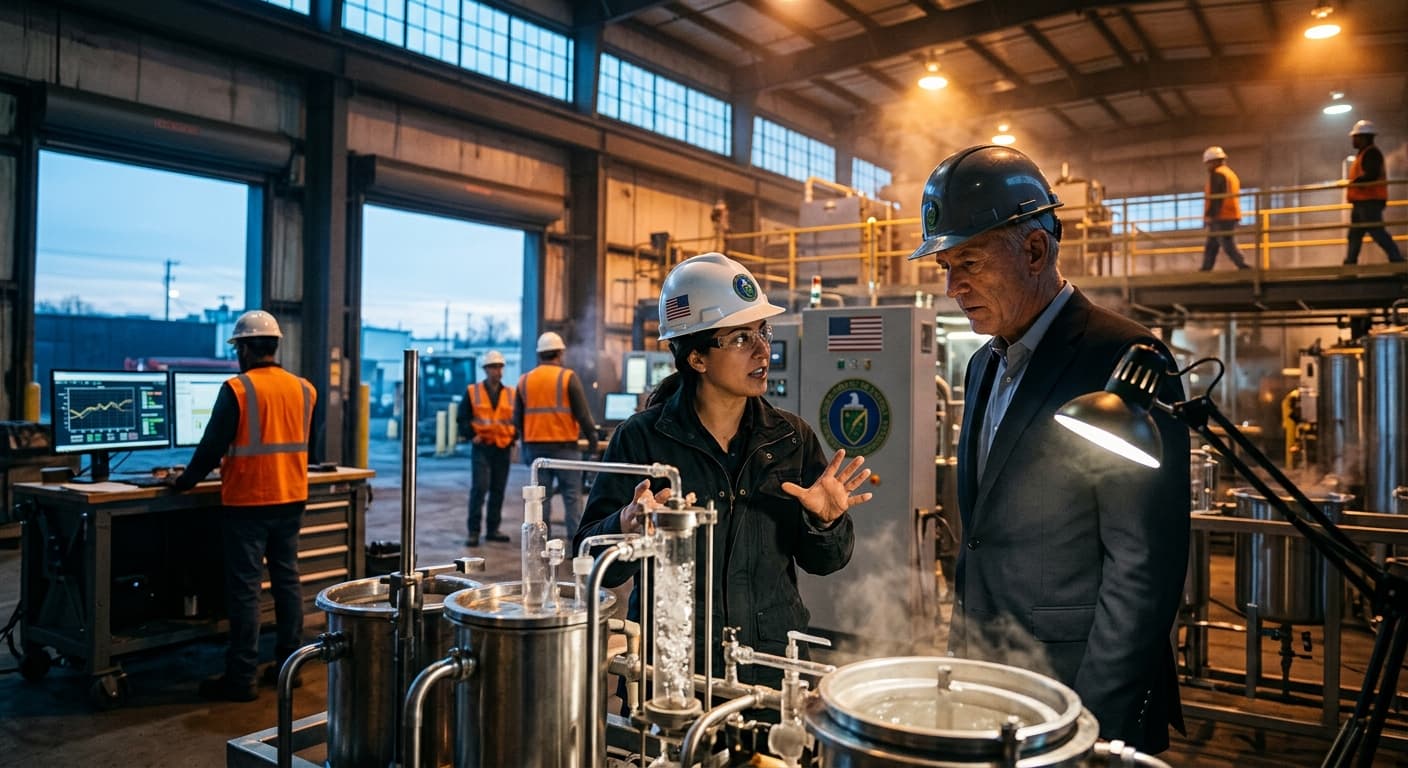
DOE Bets $75M on Coal Waste to Break China's Rare Earth Grip
The DOE's July 2 award of $75M to five coal-waste pilots is a geopolitical bet: mine Appalachian and Powder River ash to blunt Beijing's rare earth leverage.
The U.S. Department of Energy on July 2, 2026 selected five pilot projects to pull rare earths, gallium and germanium out of coal ash, tailings and mine waste — a $75 million tranche of a nearly $1 billion domestic-supply push that quietly repositions the abandoned coalfields of Appalachia and the Powder River Basin as the front line of America's answer to Beijing's mineral export controls. The bet is not that coal waste can replace Chinese refining next year. It is that Washington needs a domestic feedstock — any domestic feedstock — priced against a $110 per kilogram federal floor before a January 1, 2027 Pentagon deadline bars U.S. defense contractors from Chinese magnets.
The award, in detail
The five selections fall under Topic Area 1 of DOE's Mines & Metals Capacity Expansion – Piloting Byproduct Critical Minerals and Materials Recovery at Domestic Industrial Facilities funding opportunity, managed by the National Energy Technology Laboratory. According to Metal Tech News, the recipients are the University of North Dakota (piloting at the Falkirk lignite mine near Underwood, N.D.); Valor Metals (commercializing electrochemical liquid-liquid extraction); CONSOL Innovations (Pennsylvania coal tailings); American Resources (multi-site process technology); and Peabody Energy, which is standing up a "Wyoming Rare Earths Project" inside its Powder River Basin operations.
The dollar figure is smaller than the surrounding architecture. DOE's award is one leg of a broader $275 million initiative announced in November 2025, alongside the separate $134 million Rare Earth Elements Demonstration Facility Program, Innovation News Network reported. Assistant Secretary of Energy Audrey Robertson framed the award as risk-sharing: "By investing in these facilities, we can increase domestic critical materials production and help mitigate the financial risk of commercial deployment."
Selections are not final. As the DOE notice makes clear via Mining Engineering Online, the announcements begin award negotiations, not disbursement.
Why it matters: the leverage problem
The strategic context is not subtle. On April 4, 2025, Beijing imposed export licensing on seven rare earth elements and permanent magnets in retaliation for Trump-era tariffs. Global magnet exports fell roughly 70% year-over-year by May 2025, according to the International Monetary Fund's April 2026 World Economic Outlook. An October 2025 escalation extended a foreign direct product rule to any product containing trace Chinese-sourced rare earths — a de facto veto over allied supply chains. A one-year suspension negotiated between Presidents Trump and Xi in late October 2025 restored flows, but the
Center for Strategic and International Studies concluded in April 2026 that "even if China continues to suspend its export restrictions going into 2027, it is not a reliable export partner to the United States during times of heightened geopolitical tensions."
The dependency numbers are stark. Between 2020 and 2023, the United States relied on China for 70% of its rare earth compound and metal imports, the BBC reported, citing U.S. Geological Survey data. China still refines nearly all the world's heavy rare earths.
The Pentagon's response is a hard deadline: by January 1, 2027, U.S. defense contractors will be barred from sourcing rare earth magnets from China, Russia, Iran, or North Korea. CSIS analysts warn that "unless significantly more capacity comes online in the next eight months, adhering to this requirement may not be feasible." That is the clock the July 2 awards are racing against.
The geology beneath the geopolitics
Coal waste is not a random target. Peer-reviewed work published in 2023 by Robert Reedy, Bridget Scanlon and colleagues estimated that the United States produced 52 gigatons of coal between 1950 and 2021, generating 5.3 gigatons of ash — roughly 70% of it still accessible in landfills and impoundments. The study, published in npj Materials Sustainability and hosted on
SSRN, put the theoretical market value of extractable rare earth oxides at $8.4 billion.
Grade varies by basin, and the DOE's award map tracks the geology precisely. Appalachian Basin ash carries median total rare-earth concentrations of 431 mg/kg — comfortably above DOE's 300 ppm cutoff grade — versus 282 mg/kg in the Illinois Basin and 264 mg/kg in the Powder River Basin. A separate 2022 study in Renewable and Sustainable Energy Reviews on Powder River Basin byproducts concluded that all four coal stations examined had break-even unit costs above traditional mine-to-oxide operations — feasibility hinges entirely on price. That is precisely what the Trump administration's $110 per kilogram Nd-Pr price floor, negotiated with MP Materials in July 2025, is designed to fix, per the
IMF.
Technology risk remains real. The Government Accountability Office warned in 2024 that "most of the projects we identified seeking to recover minerals from these sources have been at the pilot scale," with chemical leaching techniques repurposed from conventional mining. Newer methods — supercritical CO2, ionic liquids, flash joule heating — remain laboratory or bench-scale. Recovery rates from Class F fly ash have run as low as 10% using citrate leaching, per a 2023
PubMed-indexed study. The chokepoint, as Rice University's James Tour told the
BBC, is separating the chemically similar rare earths from each other: "That's the really hard part."
Reading the political architecture
The July 2 award does not sit in isolation. It sits on top of a policy stack assembled in eighteen months:
"Coal supply chains and baseload power generation capacity, including coal mining, rail and barge logistics, export and domestic terminals, generating unit availability and life-extension work, on-site stockpiles, and associated reliability updates, are industrial resources, materials, or critical technology items essential to the national defense."
That is President Trump's Presidential Determination of April 20, 2026, invoking Section 303 of the Defense Production Act. Coal — the industry Washington spent a decade winding down — is now legally a national-defense industrial base.
The plumbing was laid earlier. Executive Order 14261, "Reinvigorating America's Beautiful Clean Coal Industry," drove DOE in May 2025 to add metallurgical coal to its Critical Material List. The One Big Beautiful Bill Act (P.L. 119-21), signed July 4, 2025, extended 45X advanced manufacturing tax credits to metallurgical coal at 2.5% of production costs and rewrote National Environmental Policy Act reviews for critical mineral projects,
Congressional Research Service analysts note. The White House then announced Project Vault, a $12 billion Strategic Critical Minerals Reserve, on February 2, 2026, according to a
CRS product on rare earth supply chains.
The underlying legal authority — 42 U.S.C. § 13344, enacted in the Energy Act of 2020 — authorized $27.8 million in FY2026 for coal-based rare earth R&D and up to $140 million for a demonstration facility. The July 2 selections operationalize a statute that has sat largely dormant for five years.
Winners, losers, and the second-order effects
The direct winners are two-fold. Coal producers — Peabody, CONSOL — get a second product line as thermal-coal demand structurally declines, and a political story that reframes them as national-security suppliers rather than climate liabilities. State governments in West Virginia, Pennsylvania, North Dakota and Wyoming get a federally subsidized answer to the coal-transition problem. GreenMet, a separate West Virginia venture, is building a $150 million coal-waste recycling plant on the same thesis.
The quieter beneficiary is the Department of Defense. Its January 2027 sourcing prohibition needs domestic feedstock the pilots will not deliver at scale in time — but DOE's award signals that the pipeline exists, which is what defense primes need to sign multi-year contracts under DPA offtake agreements at the $110/kg floor.
The losers are less obvious. MP Materials, holder of the Mountain Pass mine and the beneficiary of the July 2025 public-private partnership with DOD, now faces domestic competition subsidized on the same terms. Traditional hard-rock rare earth developers in Texas and Nevada must argue against a coal-ash feedstock that is already extracted, already stockpiled, and already politically favored. Allied producers in Australia and Malaysia — whom the Trump administration has courted through bilateral frameworks per CSIS — will discover that "friend-shoring" competes with "onshoring" for the same offtake dollars.
The historical parallel worth flagging: the last time Washington leaned this hard on coal-byproduct minerals was the 2018–2020 Rare Earth Element Advanced Coal Technologies push, which authorized $20 million annually. It produced pilot science but no commercial supply chain. The distinguishing feature of the 2026 iteration is not the funding — it is the price floor, the offtake guarantee, and the DPA authority sitting behind it.
What to watch next
- Q3 2026 award negotiations. Selections are not funding. Watch which of the five pilots close and on what cost-share terms. A Peabody or CONSOL walkaway would signal that even subsidized economics fail below current neodymium spot prices.
- January 1, 2027 DOD sourcing deadline. If the Pentagon extends or waives the prohibition, it validates CSIS's warning that domestic capacity is not ready. If it holds firm, expect emergency DPA Title III purchases against pilot output at premium prices.
- China's export-license renewal. The one-year Trump-Xi truce expires in late October 2026. A re-imposition — or a new licensing tightening akin to Beijing's January 2026 restrictions on heavy rare earths to Japan — would compress the U.S. capacity buildout timeline further.
Diplomat View
The DOE's coal-waste award is not, at $75 million, a supply-chain solution. It is a political and industrial-policy signal: Washington will fund any domestic feedstock — including the one it spent a decade regulating out of existence — before it will accept another Chinese export shock. The falsifiable call is this. If, by mid-2028, at least two of the five pilots reach continuous commercial output above 100 tons per year of separated rare earth oxides at prices supported by the federal floor, the coal-ash bet works and Washington will have manufactured a genuine second source. If none do — and the GAO's institutional warning about pilot-to-commercial gaps proves right — the initiative becomes a subsidy for coal producers dressed as a mineral strategy, and the 2027 defense deadline slips. The revision trigger is Peabody's Wyoming project: if it does not break ground within twelve months, the thesis that DPA authority plus price floors can force new supply is empty. Watch that shovel.
The Bottom Line
The DOE's $75 million bet on coal-waste rare earths is not about coal, and it is not really about $75 million — it is about buying time before a January 2027 Pentagon deadline the current U.S. supply chain cannot meet. If the pilots produce, Washington will have turned an environmental liability into a strategic asset and blunted Beijing's most powerful non-tariff weapon. If they do not, the United States will enter its next confrontation with China holding the same hand it held on April 4, 2025 — and Beijing knows it.
Discover more

US Politics
House Ethics Committee Pushes Sexual Miscond.
The House Ethics Committee has shifted responsibility for sexual harassment settlement records to the Office of Congressional Workplace Rights, complicating disclosure efforts.
Global Politics
Trump's Conflicting Messages on Iran War
Trump's mixed messages on Iran reflect a strategy of audience management, benefiting Tehran amid a complex geopolitical landscape.

Global Politics
US Seizes Iranian Ship, Tensions Surge
The US seizure of the Iranian ship Touska highlights a shift in control over the Strait of Hormuz, favoring Iran's strategic position.

Economics
Fed's Amex AML order puts correspondent banking on notice
Federal Reserve's Amex AML order requires board-level controls and a 90-day plan; OCC fined the bank $350 million over enterprise-wide deficiencies.