DiCarlo's Civil Society Pivot Explained
UN peacebuilding chief addresses funding crisis
Model Diplomat8 min readGlobal
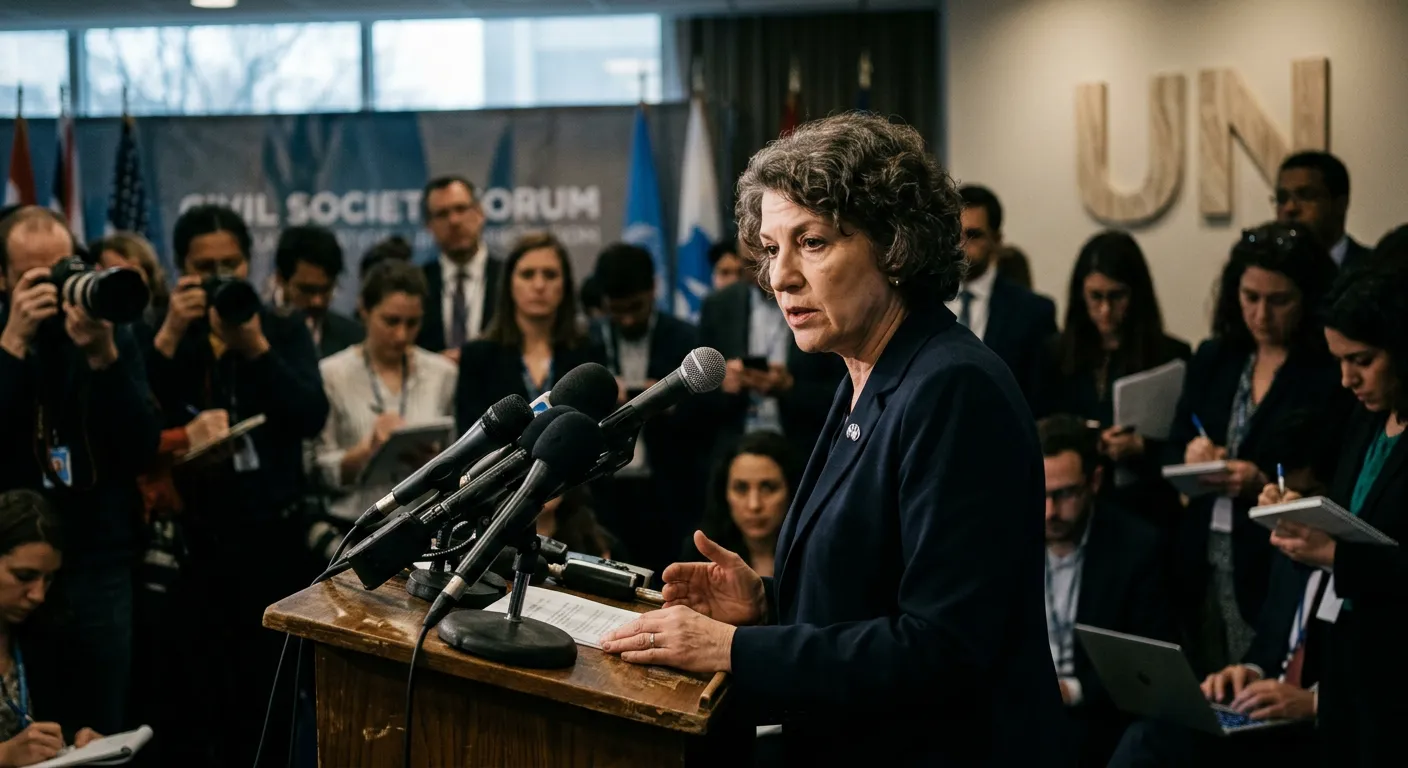
DiCarlo's Civil Society Pivot Masks a Peacebuilding Cash Crunch
UN peacebuilding chief Rosemary DiCarlo elevated civil society at the 2025 CSO-UN Dialogue as donor funding fell and the Peacebuilding Fund faces a $500M gap.
When Under-Secretary-General Rosemary DiCarlo told the "From Geneva to New York" stocktaking event on June 25, 2026 that "partnership between civil society and United Nations is critical" because "demands increase and resources diminish," she was not making a rhetorical flourish. She was describing a business model shift: the UN's peacebuilding architecture is quietly outsourcing more of its legitimacy and delivery to civil society organizations at precisely the moment that voluntary donor contributions to the Peacebuilding Fund have collapsed and civic space is closing in the very countries where those CSOs operate. The 2025 CSO-UN Dialogue's four priorities read, on paper, as an inclusion agenda. In practice, they are a coping strategy for a system running out of money and political consensus.
What Geneva actually produced
The third annual CSO-UN Dialogue on Peacebuilding convened 187 civil society participants alongside representatives from more than 40 UN entities and Member States at the Palais des Nations on December 10–11, 2025, according to the DPPA outcome report. Under the theme "Operationalizing a Whole-of-System Approach to Peacebuilding and Sustaining Peace," participants converged on four priorities: strengthening civil society as strategic partners and protecting civic space; enhancing system-wide coherence; advancing inclusive and locally led approaches under the Women, Peace and Security (WPS) and Youth, Peace and Security (YPS) agendas; and improving financing for peacebuilding.
Co-chaired by DPPA and the CMI-Martti Ahtisaari Peace Foundation, the Dialogue has more than doubled its civil society footprint since its 2023 launch, when only 72 CSOs from 45 countries attended, according to the initiative's concept note. The
2024 iteration in New York drew 125 participants from 78 countries; 57% were women, 27% youth.
The Dialogue is now formally hard-wired into the UN's intergovernmental machinery. General Assembly Resolution 80/11 and Security Council Resolution 2805, both adopted without a vote on November 26, 2025, concluded the 2025 Peacebuilding Architecture Review. The Assembly resolution "encourages the Peacebuilding Commission to further consult with relevant civil society organizations, especially local peacebuilders, grassroot organizations, women-led and youth-led organizations," according to the draft text released by the Office of the President of the General Assembly, and establishes an annual UN Peacebuilding Week in June — the very platform DiCarlo used in her June 25 remarks. Egypt's representative, who co-facilitated the resolution, called the consensus "a testament to the strength of multilateralism," according to the
UN press release covering the vote.
The number DiCarlo did not put in her speech
The elevation of civil society coincides with a financing picture that the UN's own accountants describe as untenable. The Secretary-General's report on the Peacebuilding Fund records that 29 donor partners contributed $132.3 million in 2025, an 8% decline from 2024 and a drop from $180 million in 2020. The
Q4 2025 fund status shows voluntary contributions falling further to a projected $80.4 million in 2026 — a 39% year-on-year collapse — with the fund balance sinking to negative $514 million even after a scheduled $94 million assessed contribution is factored in.
A $50 million annual assessed contribution, approved under General Assembly Resolution 78/257 and starting January 1, 2025, provides a baseline but does not close the gap, as the revised PBF terms of reference make explicit: voluntary contributions "remain the main source." The Fund crossed $1 billion in cumulative approvals in November 2025 — a milestone Peacebuilding Support chief Elizabeth Spehar and Advisory Group chair Macharia Kamau announced at UN Headquarters — but
UN News reported the same day that the Fund is $500 million short of its $1.5 billion target for the 2020–2026 period. The Advisory Group's second 2025 meeting warned candidly of the strain from "unresolved conflicts in places like Ukraine, Gaza, and Sudan, and looming financial uncertainty—including a possible 20% cut to the UN's overall budget," according to the
chair's summary.
The Fund's own strategy extension document had targeted $250 million in approvals for 2025 and $350 million for 2026. In practice, the SG's report shows the PBF approved only $124 million across 48 initiatives in 28 countries in 2025 — roughly half the target. Of that, $43.9 million went to UN mission transitions, $23.5 million to cross-border and regional approaches, and $23.3 million to women's and youth empowerment, per the same report. When a pooled fund shrinks by half against its own plan while global demand for prevention rises, the UN's operational reach depends increasingly on partnering with organizations that raise money elsewhere and deliver on the ground. Civil society is no longer a "constituency"; it is critical infrastructure.
The paradox: local partners under pressure
The Dialogue's first stated priority — protecting civic space — reflects a second-order problem. The very local peacebuilders the UN wants to institutionalize are operating in environments where governments are shutting them down. Freedom House's Freedom in the World 2026 report found that 54 countries experienced deterioration in political rights and civil liberties in 2025, while only 35 improved — the 20th consecutive year of decline. Just 21% of the world's population now lives in countries rated Free, down from 46% two decades ago.
The picture holds in ostensibly democratic settings, too. On December 9, 2025, the CIVICUS Monitor downgraded France from "narrowed" to "obstructed," citing "escalating police violence, surveillance practices, and arrests of protesters" and the 2021 "separatism law" that lets ministers dissolve NGOs by decree, according to Human Rights Watch. The Geneva outcome report explicitly noted that "participants from Eastern Europe, Western Balkans, Latin America and the Caribbean, WEOG, and the Middle East and North Africa underscored shrinking civic space and democratic erosion as urgent cross-cutting concerns." Carnegie's July 2025 analysis of
digital repression added a further layer: platform throttling, internet shutdowns, and algorithmic manipulation in countries from Kenya to Mozambique have foreclosed the digital spaces civil society relied on to organize.
This is the crux of DiCarlo's political problem. The 2025 PBAR resolutions passed without a vote, but only after Member States stripped out language the EU wanted retained. Denmark, speaking for the European Union, told the Assembly it "would have liked to see stronger language on civil-society engagement, gender equality and organizations led by women and youth," and regretted the absence of references to the Sustainable Development Goals and climate change, per the UN press release. That compromise was the price of consensus among 193 states with sharply diverging views on what "civil society" should mean inside UN bodies. On a companion resolution proclaiming an International Day of the World's Indigenous Women and Girls, Argentina, Israel and the United States voted against — a signal of where the ceiling now sits for identity-based inclusion at the General Assembly.
Who benefits, who loses
The immediate winner is DPPA, which has built the CSO-UN Dialogue into a semi-institutional forum with a 17-member organizing Core Group and a permanent link to the Peacebuilding Commission. In her June 25 remarks, DiCarlo said the Dialogue is "entering its fourth year" and framed its outputs as inputs to the Peacebuilding Fund's next strategy — giving the CSO network direct influence over allocation decisions from 2026 onward. She was equally explicit that "the 2025 Peacebuilding Architecture Review calls for stronger interaction with civil society, including local, women-led and youth-led organizations" and that "the Commission's monitoring framework offers a useful avenue for the Dialogue to inform intergovernmental deliberations."
The secondary beneficiaries are large international peacebuilding NGOs positioned as intermediaries: Interpeace, which co-chaired the 2024 Dialogue; ACCORD, the Africa Centre for the Constructive Resolution of Disputes, which is co-chairing the 2026 cycle; and CMI-Martti Ahtisaari Peace Foundation, the 2025 co-chair. Switzerland, Denmark and Finland co-sponsored the June 2026 stocktaking, according to UN Web TV — a reminder that the same small donor coalition that props up the PBF also underwrites the CSO forum. These organizations gain formal standing as brokers between grassroots peacebuilders and the UN system.
The losers are less visible. The Geneva outcome report is blunt that current UN engagement mechanisms are "insufficient for grassroots or informal organizations" and that "UN-CSO communication channels remain fragmented and insufficiently coordinated." The 2024 outcome report warned that CSOs "continue to face systemic barriers, including limited access to decision-making spaces" and are "often relegated to advisory or tokenistic roles, without real influence over policy outcomes." Institutionalization at the top may deepen a two-tier system in which credentialed international NGOs speak for local peacebuilders they cannot fully represent. The Global Partnership for the Prevention of Armed Conflict
warned in its PBAR vision paper that "in global forums, such as the PBC, local peacebuilders' participation must be independent and present a complementary perspective to that of national governments" — a bar the current architecture is not yet meeting.
The historical parallel
The 2005 creation of the Peacebuilding Commission followed a similar pattern: the UN institutionalized a new function precisely when its ability to deliver post-conflict recovery on its own had been exposed as inadequate in Bosnia, Rwanda, and Sierra Leone. Kofi Annan, as DiCarlo herself reminded the PBC in June 2025, called the new architecture a fix for "a gaping hole in the United Nations institutional machinery." Twenty years on, the machinery is being retooled around a similar admission: the UN cannot build peace at scale without partners it does not control and cannot fully fund. The
May 2025 PBC–Security Council retreat at Greentree Estate — the first to include all Council members — reached the same conclusion: the Commission's ability to convene "must be matched with enhanced follow-up mechanisms and stronger linkages with the UN system on the ground."
What to watch
- PBF replenishment event, second half of 2026. The Advisory Group has called for a high-level pledging moment tied to the UN80 commemoration. Whether traditional donors — Sweden, Germany, Norway, the Netherlands — restore contributions or continue scaling back will determine whether the CSO agenda has resources behind it.
- Peacebuilding Fund strategy 2027–2030, drafted in 2026. The Fund's independent evaluation and next strategy will translate the PBAR resolutions and CSO-UN Dialogue outcomes into allocation rules. Watch for dedicated windows for women-led and youth-led organizations, and for cost-sharing rules in middle-income countries.
- Fourth CSO-UN Dialogue, late 2026. ACCORD's Vasu Gounden takes the co-chair. The Dialogue's regional decentralization — a demand of Global South participants for three years running — is the test of whether Geneva was a genuine handover of authority or a well-managed consultation.
The Bottom Line
The 2025 CSO-UN Dialogue institutionalized civil society inside the UN peacebuilding architecture at the exact moment the architecture cannot afford to operate without it. With voluntary contributions to the Peacebuilding Fund set to fall to $80 million in 2026 against a $500 million annual ambition, DiCarlo's civil society pivot is less an act of generosity than a load-bearing repair to a system whose donors are walking away and whose local partners are being squeezed by their own governments.
Discover more

US Politics
SNAP Food Assistance Faces Legal Challenges
In 2026, SNAP faces stricter eligibility rules and mounting legal challenges, threatening food assistance for the millions of Americans who rely on the program.
US Politics
Virginia's Redistricting Referendum
Virginia's redistricting referendum is drawing a flood of dark money, shaping future elections and the fight for congressional control amid party stakes.
India
Rajnath Singh's Durga Squad for 2026 Polls
Rajnath Singh's Durga Squad promised women's safety in Bengal but has since disappeared from the agenda, revealing BJP's true priorities.

Economics
Fed's Amex AML order puts correspondent banking on notice
Federal Reserve's Amex AML order requires board-level controls and a 90-day plan; OCC fined the bank $350 million over enterprise-wide deficiencies.