Delimitation Controversy in India
Understanding the implications of the Lok Sabha vote
Model Diplomat9 min readIndia
India's Delimitation Controversy: Why the South Won a Reprieve, Not the Argument
The Modi government's April 17, 2026 delimitation bill lost 298–230 in the Lok Sabha — the first defeat of a constitutional amendment in a decade. Here's what that means for India's federal balance.
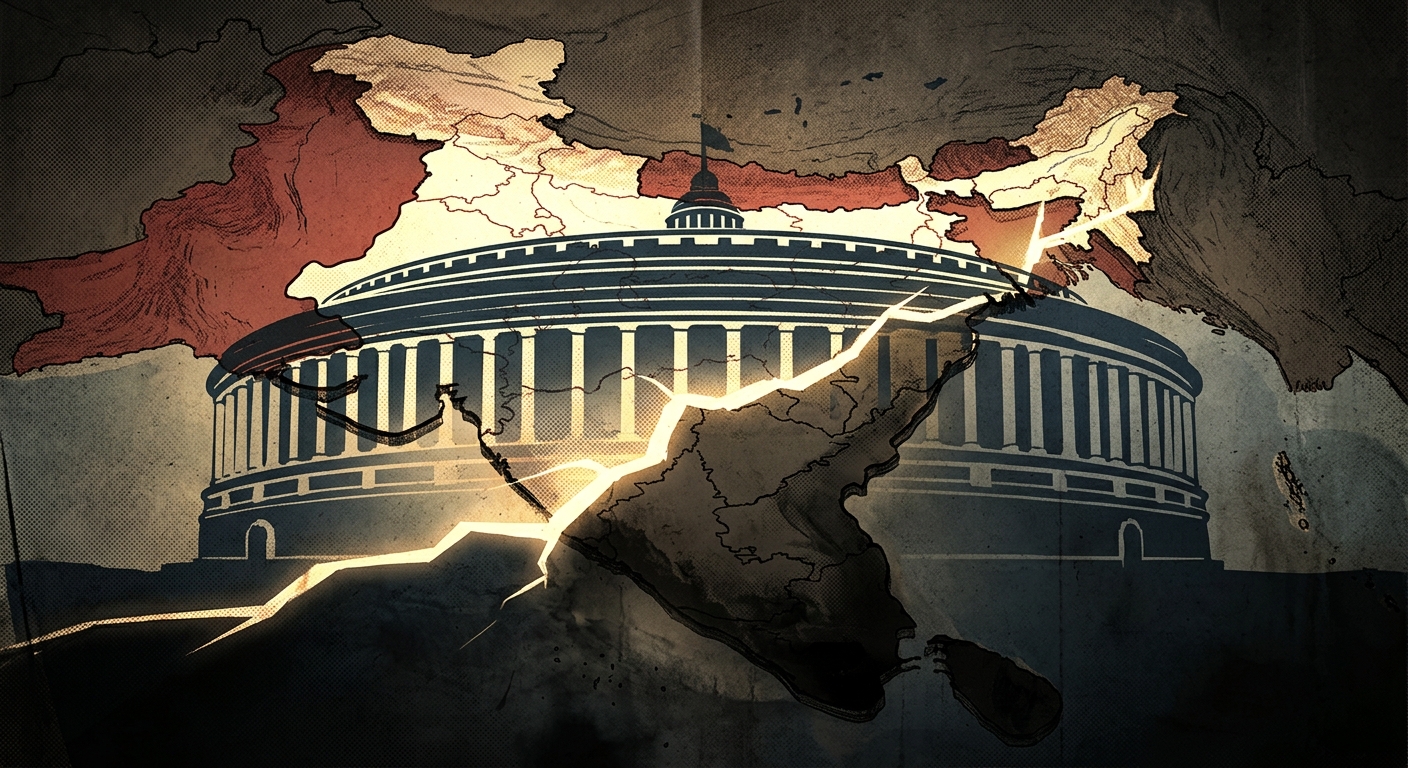
The Constitution (131st Amendment) Bill fell 63 votes short of its two-thirds threshold on April 17, 2026 — Narendra Modi's first defeat on a constitutional amendment since taking office in 2014. The government's own tally: 298 for, 230 against. The bill would have expanded the Lok Sabha from 543 to 850 seats, redrawn every parliamentary constituency on 2011 census figures, and finally activated the long-delayed one-third women's quota. The vote did not end the delimitation controversy; it postponed a fight over who governs India after 2029 — and made it more dangerous for New Delhi to lose.
The southern chief ministers who mobilised black-flag protests treated the outcome as a victory. It is not. The bills' architecture is already being redrafted at the Economic Advisory Council to the Prime Minister, and the ruling Bharatiya Janata Party (BJP) is topping up its Lok Sabha numbers through defections. What was defeated in April was a text. What returns will be a formula — and the choice of formula will decide whether India's next parliament looks like its economy or its demography.
What the bill actually did
Three bills were tabled on April 16, 2026: the Constitution (131st Amendment) Bill, the Delimitation Bill, and a companion Union Territories Laws (Amendment) Bill. The package's stated aim, per the government's own statement of objects and reasons, was to "constitute the Delimitation Commission to undertake the exercise of delimitation, inter alia, to provide reservation of seats for women." That text is on record in the Delimitation Bill, 2026 as introduced.
The substantive change was buried in the constitutional amendment. Articles 81 and 82 of the Constitution currently require that seat allocation across states be readjusted after each census. A 1976 Emergency-era amendment, extended in 2001, froze that reallocation to 1971 census numbers until "the first census after 2026." The 131st Amendment would have deleted that anchor and handed Parliament the power to decide, by simple majority, when delimitation happens and which census it uses. The companion Delimitation Bill answered that question in advance: the "latest published census" — meaning the 2011 count — according to a PRS Legislative Research analysis of the package.
That is why southern parties refused to trust the government's verbal assurances. Union Home Minister Amit Shah told the house that no state would lose seats and that the increase would be a uniform 50%. As former Tamil Nadu civil servant K. Ashok Vardhan Shetty told The Wire, "While such a promise was orally made, its absence in the text of the Constitution (131st Amendment) Bill debated in April 2026 rendered it unacceptable." Shah asked for "an hour" to draft an amendment writing the 50% promise into law. The opposition did not give it to him.
The number that terrifies Chennai
The reason a verbal promise was not enough sits in a single PRS Legislative Research table. If the 543-seat Lok Sabha were simply reallocated on 2011 figures without expansion, Tamil Nadu would fall from 39 seats to 32, Kerala from 20 to 15, and Andhra Pradesh from 25 to 22 — while Uttar Pradesh would rise from 80 to 89 and Bihar from 40 to 46. This is not a projection from the opposition; it comes from the parliament's own research service.
Carnegie's May 2026 analysis by Louise Tillin, Milan Vaishnav and Andy Robaina — puts the demographic driver plainly: since 1971, "Bihar's population has grown by roughly 215 percent, while Kerala's has only grown 70 percent," according to Carnegie Endowment for International Peace. India's south accounts for roughly 20% of the population but a much larger share of GDP and central tax transfers. The five southern states — Tamil Nadu, Andhra Pradesh, Karnataka, Kerala and Telangana — see themselves as subsidising the very states whose parliamentary weight is about to grow at their expense.
The BJP's promised 50% uniform expansion would technically preserve each state's share of an 850-seat house. Shetty's rebuttal, again to The Wire, is the sharpest available: if that is truly the intent, "there is no political advantage to be conceivably gained by such a 50% uniform increase for all States unless the intention is to significantly alter the boundaries of all the Lok Sabha constituencies … using this opportunity." Translated: a proportional expansion is only worth doing if you plan to redraw the map beneath it.
Gerrymandering, without the word
The concern is not academic. A government-appointed delimitation commission for Jammu and Kashmir produced constituencies where the average Muslim-majority Kashmir Valley seat contained 140,000 people, versus 120,000 in Hindu-majority Jammu — a gap Al Jazeera documented in May 2022 — a redraw opposition parties in the region called a deliberate demographic re-engineering, according to Al Jazeera. Assam's most recent delimitation, completed in 2023, similarly diluted several Muslim-majority constituencies before the BJP's return to power in the state in 2026.
That precedent is why the Economic Advisory Council to the Prime Minister's latest working paper is drawing more scrutiny than its bureaucratic origin would normally warrant. The EAC-PM has proposed a "targeted" splitting criterion that, per The Wire's reading, respects a broadly 50% state-level increase but subdivides constituencies with reference to future voter-turnout objectives — particularly women's turnout. On paper, a good-governance metric. In practice, a formula that gives the executive branch wide discretion over which constituencies to carve up and how — the essence of a gerrymander conducted through a delegated commission rather than a legislature.
The BBC's Delhi bureau quoted Arghya Sengupta of the Vidhi Centre for Legal Policy on the underlying design flaw: "While no state may lose seats, the absence of a clear proportional formula means outcomes could vary — and favour more populous states. This has significant federal implications," Sengupta told the BBC. The same report noted that state assemblies were not being expanded at all, creating a mismatch in which fast-growing states could gain MPs without gaining MLAs — a strange asymmetry unless the point is federal, not administrative.
Why the bill actually lost
The 298–230 count is worth reading carefully. Modi's National Democratic Alliance holds 293 Lok Sabha seats; two-thirds of the 541 members present and voting required 361. The government therefore secured only five opposition or independent votes — a rounding error — and lost even a few of its own back-bench and allied MPs, according to reporting by Al Jazeera. The BJP's own Telugu Desam Party ally voted for the bill but pressed for the 50% clause to be written in.
The proximate reason for defeat is that the 2024 election stripped Modi of his single-party majority; the deeper reason is that the government tied delimitation to the popular Nari Shakti Vandan Adhiniyam and dared the opposition to vote against women's reservation. The opposition called the bluff. Congress leader Rahul Gandhi framed the package publicly as "an attempt to seize power through delimitation and gerrymandering," per the same Al Jazeera report. Frontline described it as "a rare legislative setback for the Narendra Modi government," according to Frontline.
The 2027 census is the real deadline
Two calendar constraints now shape everything. The first is the Nari Shakti Vandan Adhiniyam itself: passed in September 2023, it conditions the women's quota on the "first census after the commencement" of the act. The Registrar General of India has set the reference date for that census at March 1, 2027 — meaning data will realistically be available only in late 2027 or 2028. The second is the general election due by mid-2029.
If the government waits for 2027 census data before delimiting, women's reservation cannot come into force until 2034 at the earliest, given the typical five-year delimitation cycle — the last commission took five years to produce a final report. If it moves before the data lands, it is doing delimitation on 2011 numbers that predate a decade of migration and fertility divergence. Neither option is politically clean.
That is why the government's fallback, according to The Wire, is a mixture of two moves: shore up NDA numbers through defections, then reintroduce a redrafted bill that writes the 50% guarantee into text while retaining flexibility over constituency-level redraw. Andhra Pradesh Chief Minister N. Chandrababu Naidu — a critical NDA ally — has publicly backed that path, telling reporters that the omission from the April text "was only a matter of omission … The opposition unnecessarily made it an issue."
One Nation, One Election — the parallel track
The delimitation fight cannot be read separately from two other structural reforms the Modi government is pursuing. The One Nation, One Election bill introduced in December 2024 would synchronise state and federal polls, a change former President Ram Nath Kovind's committee argued could add up to 1.5% to GDP but which critics say would centralise power around a national leader, according to the BBC. The Special Intensification Revision (SIR) of voter rolls, first rolled out in Bihar in June 2025 and expanded to nine states before the 2026 West Bengal election, has been challenged in the Supreme Court as a mechanism for removing opposition-leaning voters, per
Al Jazeera.
Read as a bundle, delimitation, One Nation One Election and SIR are three levers on the same machine: adjust who votes, adjust when they vote, adjust what their vote counts for. None is dispositive alone. All three together would meaningfully reshape the arithmetic of every election through 2034. The April 17 defeat means that machine is missing its most important lever.
What to watch
- Monsoon session, July–August 2026: The BJP has signalled it may reintroduce a slimmer amendment bill written with the 50% guarantee in text. Whether the DMK-led INDIA bloc holds its 230-plus block will determine if the government can extract concessions or must wait.
- 2027 census enumeration, reference date March 1, 2027: If the census is completed on schedule, the entire legal architecture of the April bill becomes moot — Parliament could delimit on fresh data. Any government attempt to accelerate or delay the count will be read as a delimitation move.
- Supreme Court hearings on SIR and One Nation, One Election: Rulings expected in late 2026 will determine whether the parallel structural reforms survive to shape a redelimited 2029 election.
Diplomat View
The dominant reading of April 17 — that the south "won" — is wrong in a way that matters. The southern chief ministers won a vote; they did not win the argument. India's constitutional freeze on Lok Sabha reallocation expires with "the first census after 2026," a deadline the framers of the 84th Amendment set in 2001 assuming the census would be timely. It was not. The question is now which government redraws the map, on what data, using which formula. The BJP has the executive machinery, an unresolved women's quota it can weaponise indefinitely, and — post-Bengal 2026 — momentum in states the opposition assumed were safe.
Our forecast: a redrafted delimitation bill passes before the 2027 winter session, using 2011 census data with a 50% uniform state-level increase written in law and constituency-level splits delegated to a commission dominated by executive nominees. The south's gain from April 17 will look, in retrospect, like a delay of roughly eighteen months. What would falsify this call: an unfavourable Supreme Court ruling on SIR that forces the BJP onto the defensive; a Congress-led breakthrough in a major state election in 2027 that reverses the momentum from Bengal; or the 2027 census completing on schedule with results published early enough that the opposition can credibly demand delimitation be based on fresh data. Any of the three flips the arithmetic. Absent them, the map is going to be redrawn — the fight in April was over the terms of the redraw, not whether it happens.
The bottom line
India's delimitation controversy is not a north-versus-south dispute. It is a fight over whether a Hindi-belt-anchored central government can rewrite the country's parliamentary geography before its southern rivals can price in the loss — and after April 17, that government knows exactly which sentence to insert next time.
Discover more

India
INDIA Bloc's Delimitation Strategy
The INDIA bloc is using delimitation and women's reservation to challenge the BJP's federalism narrative, setting up a high-stakes fight over representation.
India
India's Delimitation Debate
India's delimitation process raises critical questions about minority representation and the balance of political power as parties brace for future elections.
India
India's Women's Quota Bill Fails Amid Delim
India's Women's Quota Bill failed in Parliament, laying bare political tensions over delimitation and the future of women's representation under Modi.

India
India's Delimitation Plan
India's delimitation plan would expand the Lok Sabha but curb southern states' clout, fueling a BJP strategy that reshapes federalism and representation.