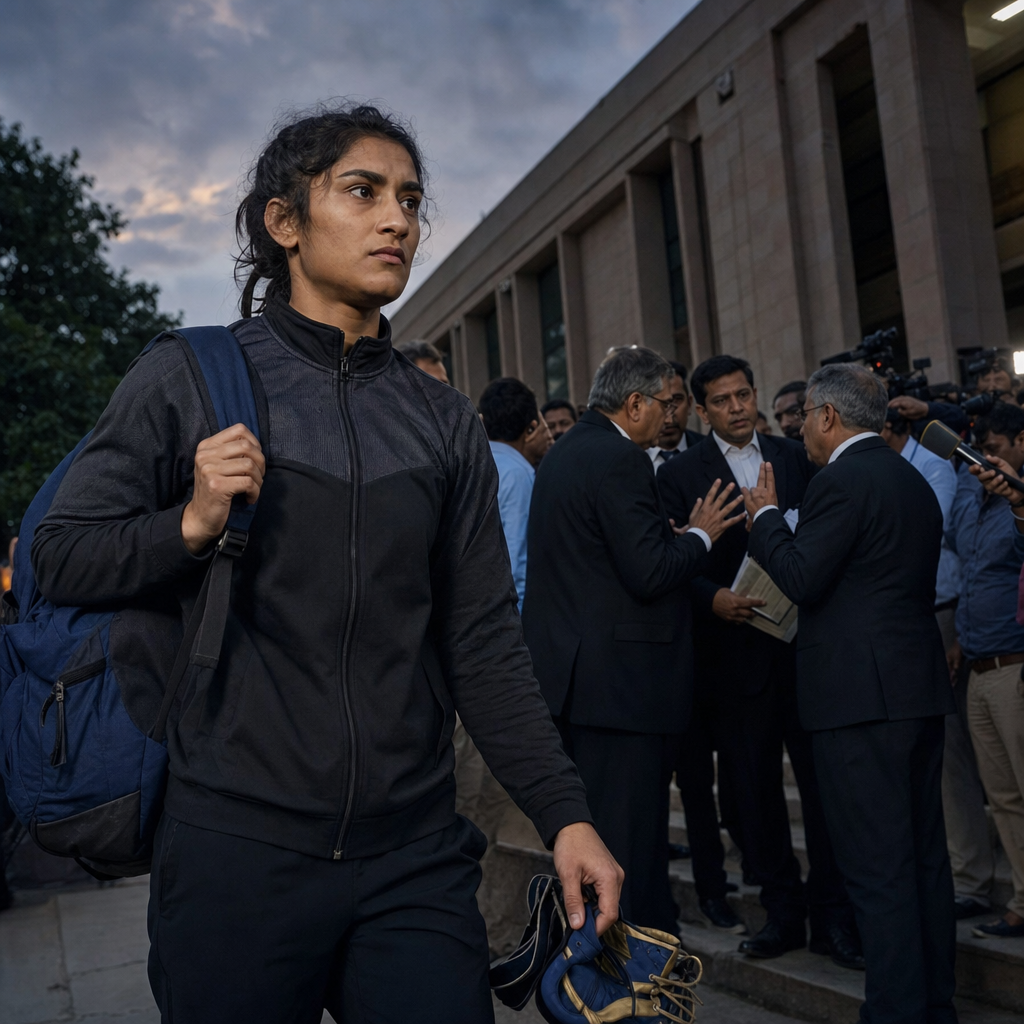
Delhi HC Rebukes WFI in Vinesh Phogat Fight
The court pushed back on WFI’s “national shame” framing, signaled skepticism of its eligibility rules, and pressed the Centre to keep Phogat in the trials process.
The Delhi High Court has turned Vinesh Phogat’s case into a test of how far the Wrestling Federation of India can use procedure to control a star athlete’s return. On Friday, the bench headed by Chief Justice D.K. Upadhyaya blasted the federation’s May 9 showcause notice and asked why it was describing Phogat’s Olympic disqualification as a “national shame,” telling WFI, “Don’t act in vengeance” ( The Indian Express). The court also told the Centre to “ensure her participation,” even as the federation argued she was ineligible for the May 30-31 Asian Games selection trials (The Indian Express;
  Sportstar).
WFI’s leverage is procedural, not political
The federation’s power comes from timing and paperwork. It issued Phogat a 15-page showcause notice on May 9, declared her ineligible until June 26, and said she had not completed the six-month notice period tied to athletes returning from retirement under anti-doping rules (Sportstar;  The Hindu). WFI also leaned on a new selection policy: a February 25, 2026 framework, followed by a May 6 circular limiting Asian Games trial access to 2025-26 medal winners, which Phogat says unfairly closes the door on her comeback (The Indian Express).
That is why the court’s reaction matters. The bench suggested the federation’s revised circular did not match the government’s September 24, 2025 guidance, which allowed relaxation for athletes of repute even without recent medals (The Indian Express). In other words, this is not just about one wrestler. It is about whether a national sports body can narrow eligibility by circular while claiming to act in the sport’s interest.
Vinesh has sympathy, but WFI still has the gate
Phogat is not a marginal petitioner. She is a two-time World Championships medallist, Asian Games gold medallist, a face of the 2023 wrestlers’ protest, and one of the most visible athletes in Indian sport (The Hindu; Sportstar). She says she had already informed the international authorities about her comeback and that the WFI has misread her sabbatical timeline; WFI says her reply was incomplete and that the disciplinary process must run first (The Hindu). The court did not hand her immediate access to the trials, but its tone makes clear the federation is now on the defensive.
For WFI, the risk is bigger than one missed trial. If the court accepts that the federation’s circulars were tightened to exclude Phogat, the case will expose weak governance and invite closer judicial scrutiny of future selection decisions. For the Centre, the issue is whether it is willing to overrule a federation that is already under pressure over wrestling governance. For Phogat, the practical question is simpler: can she still get back into the competition pipeline before the July 6 hearing and the next selection window? That is the date that now matters.