De la Espriella's Cúcuta Gambit Explained
Colombia's border policy aligns with US interests post-Maduro.
Model Diplomat9 min readLatin America
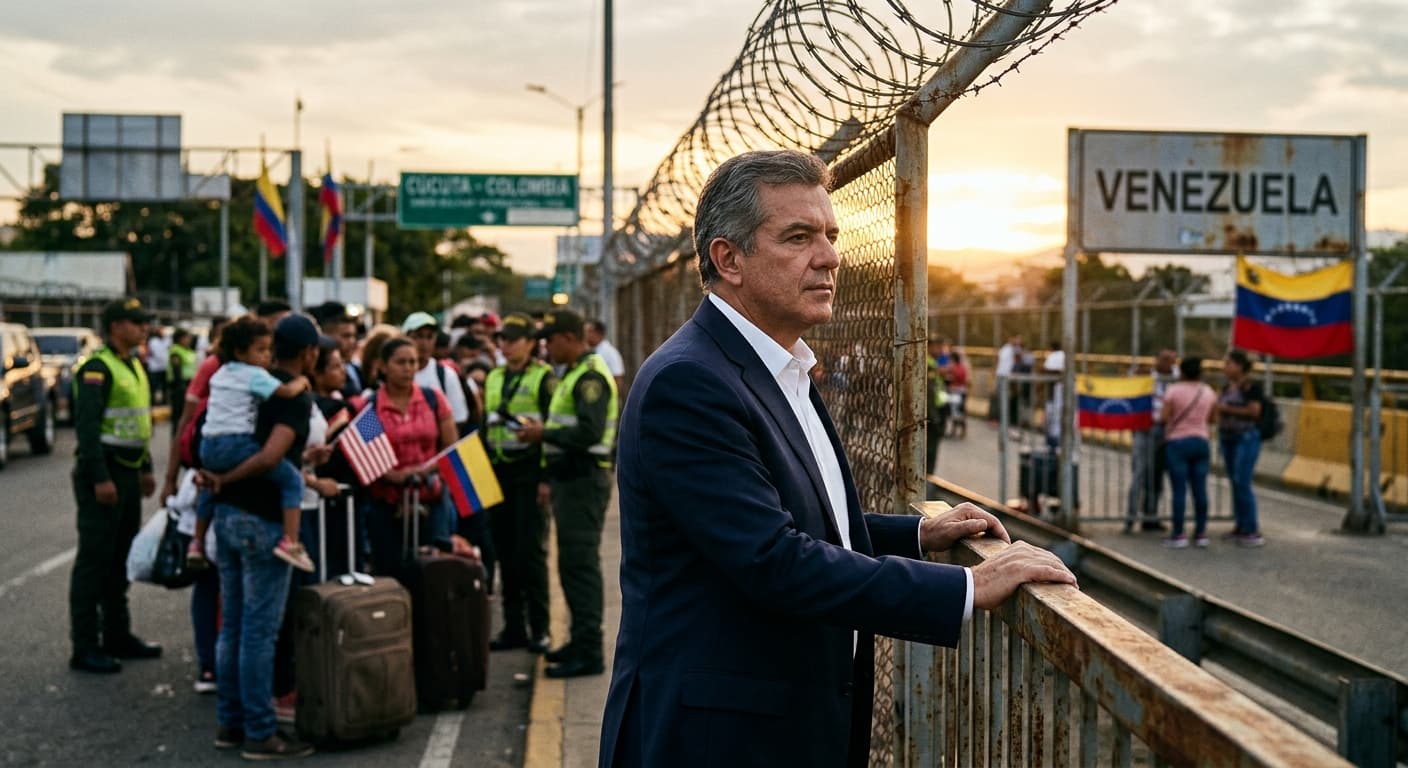
De la Espriella's Cúcuta Gambit: Colombia's Border Turns Into a US Play
How Abelardo de la Espriella's July 8 debut in Norte de Santander aligns Colombia's Venezuela border policy with Washington's post-Maduro project — and what it means for regional security.
Colombia's president-elect Abelardo de la Espriella chose July 8, 2026 — a month before he takes office on August 7 — to open his "territorial handovers" in Cúcuta, and the choice is the policy: Norte de Santander is where his security doctrine, his break with Gustavo Petro's paz total, and his alignment with the Trump administration's tutelage over Delcy Rodríguez's Venezuela all converge into a single operational theatre. His one-month surrender ultimatum to the ELN's Frente de Guerra Nororiental and the FARC-dissident Frente 33 is not a threat aimed at the Catatumbo alone. It is a signal to Caracas, to Washington, and to a Colombian military establishment Petro purged and De la Espriella now inherits — one that has been waiting four years for this call. The story here is not the mano dura — it is that Colombia's most porous 2,200-kilometre border is being rewired as an extension of US Venezuela policy, and the ELN's binational sanctuary is the first thing that has to break.
The choreography of a militarised debut
De la Espriella suspended the formal transition process with Petro's outgoing government the same week he launched his own regional format, according to EL PAÍS. In Cúcuta he framed the visit around recovering "authority" and "returning the State to the regions," and closed the day with an explicit ultimatum: the ELN commander alias 'Alfred' and the dissident boss alias 'Andrey' have one month to surrender before "the full weight of the law" comes down, per
Canal Tropical. The line was crafted for two audiences at once: Catatumbo campesinos who have watched the ELN and Frente 33 impose curfews for eighteen months, and a Colombian military establishment that has spent Petro's term under a defense minister who prosecuted them.
The messengers matter as much as the message. Retired general Jorge Mora — coordinator of De la Espriella's Norte de Santander campaign — was named defense minister at the start of the week. Rodrigo Lara takes the interior ministry, and the security empalme team is run by uniformed brass. EL PAÍS notes De la Espriella plans to be sworn in inside a military installation — a choreographic first that inverts Petro's 2022 civilian rupture with the armed forces, when the outgoing president replaced most of the top command and installed a human-rights jurist, Iván Velásquez, at defense, per BBC Mundo. The symbolic reversal will be complete on August 7. Petro's own late pivot — replacing Velásquez with General Pedro Sánchez in March 2025, the first military minister of defense in 34 years — is what raised operations against illegal groups by 34.5% in 2025, per the
Fundación Ideas para la Paz. De la Espriella inherits that momentum and intends to weaponise it.
The friction has already started. Petro publicly challenged the president-elect after De la Espriella urged the military not to obey "unconstitutional orders," retorting: "Who said I gave orders against the Constitution?" per El Diario de Todos. For a month, Colombia effectively has two commanders-in-chief in the eyes of the barracks: the constitutional one, and the one whose defense minister-designate is running the transition. The intra-security bureaucracy is being pulled between them. The risk is not a coup but a soft insubordination in which mid-level officers pre-position themselves for the incoming doctrine.
Catatumbo: the numbers that force the policy
De la Espriella's ultimatum lands on a region that has been, for eighteen months, the worst humanitarian emergency Colombia has registered in decades. Citing the Puesto de Mando Unificado of the Norte de Santander governor's office, the FIP counts at least 166 dead by January 13, 2026 — including six peace signatories, 10 minors, and 19 members of the security forces — and roughly 92,000 displaced since the ELN offensive against Frente 33 began on January 16, 2025, per FIP. The UN Office for the Coordination of Humanitarian Affairs put the affected population at close to 100,000 — half the region's inhabitants — by January 2026, with drone-dropped explosives now recurring, per
UN News.
The Unidad para las Víctimas registered 105,203 victims of the Catatumbo conflict between January 16 and December 7, 2025, of whom 101,587 were forcibly displaced, according to the Defensoría del Pueblo cited by FIP. Human Rights Watch, in a March 2025 field report, documented ELN killings, disappearances and assaults on civilians accused of collaborating with Frente 33 — as well as forced child recruitment by the dissidents — calling the crisis "one of the largest mass displacements in Colombia in decades," per Human Rights Watch. Petro decreed a state of conmoción interior on January 24, 2025, but the FIP concluded a year later that the emergency framework never gave authorities effective tools; the Zona de Ubicación Temporal offered to Frente 33 in April 2025 was never operationalised.
The economic substrate is coca. Colombia's cultivated area reached 253,000 hectares in 2023 and potential cocaine production rose 53% to 2,664 tonnes, per the UN Office on Drugs and Crime. Tibú, on the Venezuelan border, is the single largest coca-growing municipality in Colombia at 22,000 hectares, per
BBC Mundo's reporting on the UNODC data. That is the rent the ELN and Frente 33 are fighting over — and the reason Washington cares which army controls the border. It is also the reason De la Espriella's platform revived a US-financed "Plan Colombia 2.0" including forced eradication of 330,000 hectares with glyphosate — a policy Petro suspended — as documented in his manifesto by
CIDOB.
The second-order arithmetic is what should worry Bogotá. FIP estimates the ELN's Nororiental Front now fields more than 2,000 combatants against Frente 33's roughly 500, and analysts have warned that the Clan del Golfo and the Autodefensas Conquistadoras de la Sierra Nevada are probing entry into the region. A one-month ultimatum against a 2,000-strong guerrilla with a Venezuelan rearguard is not credible on its face — unless the rearguard is closing.
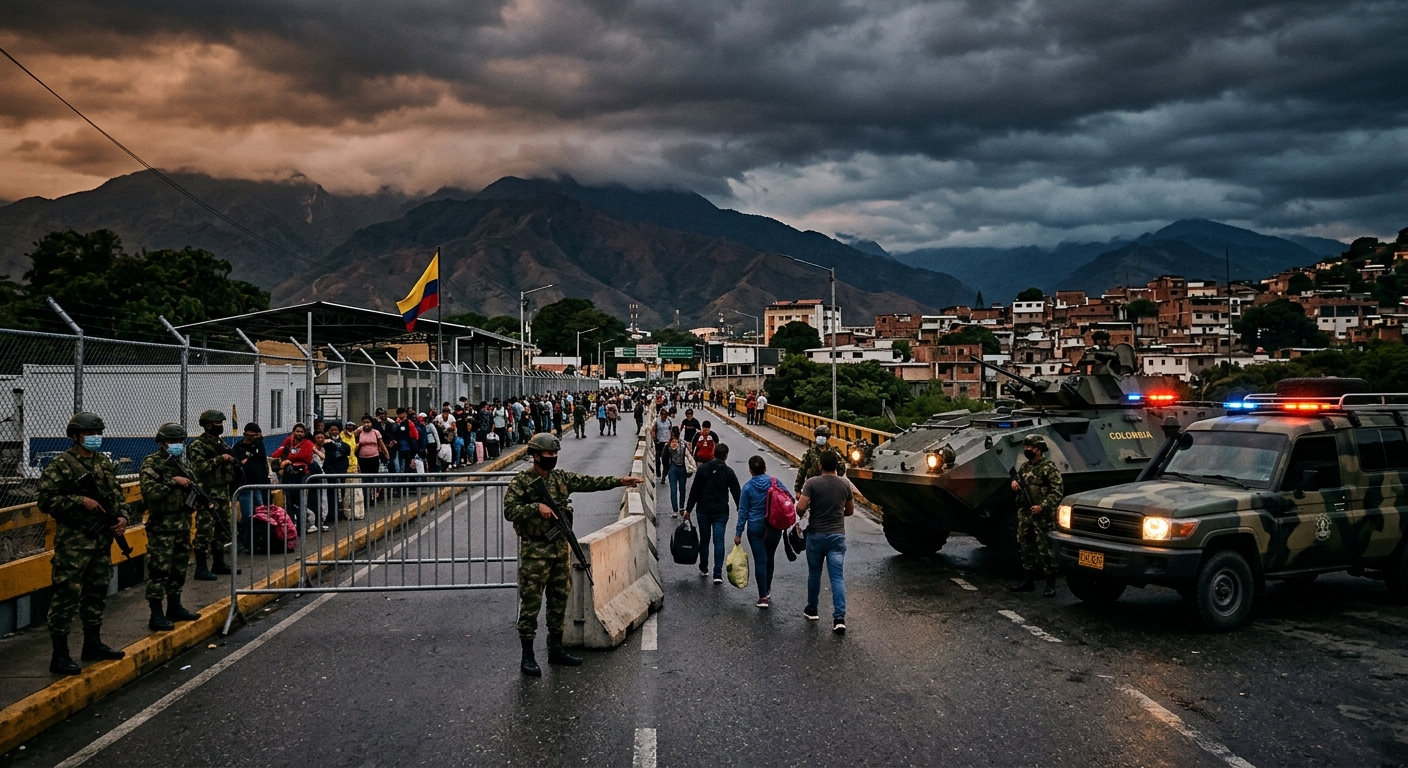
The Venezuela pivot: from Petro's détente to Washington's protectorate
This is where the Cúcuta debut becomes something bigger than a security roadshow. Colombia's border with Venezuela is no longer a bilateral matter. Since January 3, 2026, when US forces detained Nicolás Maduro and Cilia Flores in a pre-dawn raid on Caracas, it has been part of Washington's Venezuela project. President Donald Trump announced the US would "govern" Venezuela until a "safe, appropriate and judicious transition," per BBC Mundo. Delcy Rodríguez, Maduro's former vice-president, is now interim president in what NPR's Bogotá correspondent called "a very difficult balancing act" between Trump's demands and Chavista hardliners, per
NPR.
The International Crisis Group has warned that by decapitating Maduro's government and marginalising the opposition led by María Corina Machado, Washington risks freezing Venezuela's political conflict rather than resolving it — the operation "postponed the prospects of a political transition to an undefined future date," per International Crisis Group. Into this vacuum steps De la Espriella. Both he and vice-president-elect José Manuel Restrepo have told EL PAÍS that Bogotá's relationship with Caracas will be channelled through the US State Department — not negotiated bilaterally with Caracas.
That is a structural reversal. Under Petro, Colombia reopened the border unilaterally in 2022 and treated Caracas as a peer, driving bilateral trade above US$1 billion in Colombian exports in 2024, per BBC Mundo. Petro even received Rodríguez in Bogotá as a legitimate counterpart after Maduro's capture. De la Espriella's team is reversing the polarity — bilateral policy runs through Washington, not through Caracas. That is what analyst Sandra Borda meant when she told BBC Mundo that Washington was demanding "an unrestricted commitment against narcotrafficking and criminal organisations" from both governments, with the border as "the fundamental theatre of that fight."
The immediate context tightens the frame. Venezuela is reconstructing after the June 24, 2026 earthquakes that EL PAÍS notes in passing, and Rodríguez has already signed a hydrocarbons reform granting US oil companies broader rights, per NPR. Former US ambassador James Story told NPR that Rodríguez's strategy is to "do just enough to make it look as if they're complying" while betting Washington's focus fades after the US midterms — a wager De la Espriella's arrival directly threatens by lengthening the Colombian pressure horizon.
Who benefits, who loses
The primary winner is Washington. The Trump administration wanted Colombia inside its Venezuela architecture; De la Espriella — a US citizen, Republican Party donor, and personal beneficiary of Trump's endorsement in the runoff — delivers that in a form Petro never would. The mid-2025 Petro pivot toward more military operations, up 34.5% year-on-year, was itself a concession to that pressure after his February 3 meeting with Trump, per FIP. De la Espriella institutionalises what Petro conceded reluctantly.
The primary loser is the ELN. Analysts quoted by BBC Mundo have long described the guerrilla as a "binational actor" and "a clear instrument of Venezuela to influence Colombia." That leverage rested on Venezuelan security-force complicity documented by Human Rights Watch and on Caracas's willingness to ignore cross-border camps. Under Rodríguez, who is negotiating oil access with the State Department, that shield is worth less by the week. Frente 33 is the secondary loser: outnumbered four-to-one, its designated ZUT never materialised, and its combatants — many of them ex-FARC — face a president-elect who has pledged to dismantle the Jurisdicción Especial para la Paz that guaranteed their transitional-justice framework.
The subtler casualty is the 2016 peace architecture itself. De la Espriella has called the JEP the product of a "betrayal of the fatherland" and promised to abolish it, per CIDOB. Six peace signatories have already been killed in Catatumbo since January 2025, per FIP, and the political case for reintegration is bleeding out with them. A quieter loser is Colombia's own Congress: De la Espriella's Defensores de la Patria has no direct bench beyond four seats of the allied Movimiento Salvación Nacional, per BBC Mundo's candidate profile. Any structural reform he attempts — glyphosate, mega-prisons, Plan Colombia 2.0 — needs a coalition he does not yet have.
What to watch
Three catalysts will determine whether the Cúcuta doctrine holds:
- August 7, 2026 — De la Espriella's inauguration in a military installation and the delivery of the surrender ultimatum's deadline. If 'Alfred' and 'Andrey' do not surrender, a Catatumbo offensive follows immediately, with the risk of civilian and minor casualties in a region where 15 minors have already died in Petro-era bombings, per
BBC Mundo.
- March 2026 congressional elections — including the CITREP peace seat for Catatumbo, and De la Espriella's need to build a governing coalition in a fragmented Congress.
- Venezuela's political calendar — whether Rodríguez calls elections, whether the Manifiesto de Panamá framework signed by María Corina Machado gains traction with the US, per
Diplomat View
The Cúcuta debut is best read as the first operational chapter of a new hemispheric security arrangement, not a domestic security event. De la Espriella is signalling that Colombia's border policy will run through the US State Department, that the ELN's binational sanctuary is closing, and that "paz total" will be dismantled inside his first hundred days. The bet is that a US-tutored Venezuela plus a militarised Colombian border collapses the ELN's rents faster than the guerrilla can regenerate them — and that the resulting security dividend delivers what Petro could not: control of Catatumbo and the political room for a US-financed Plan Colombia 2.0.
The forecast is falsifiable. If the ELN survives the August ultimatum intact and Frente 33 fragments further toward the Clan del Golfo — a scenario FIP has flagged — the doctrine fails on its own terms within six months, and Cúcuta becomes a demonstration of state weakness rather than authority. If Delcy Rodríguez slow-walks border cooperation, as James Story predicts to NPR she will, De la Espriella loses his central lever before he has used it. Revise the call downward the moment either happens; revise it upward only if the August 7 offensive produces a captured or killed commander within the first month. Colombia's next test is not whether the tiger bites. It is whether Washington still holds the leash by January 2027.
Discover more
US Politics
House Ethics Committee Pushes Sexual Miscond.
The House Ethics Committee has shifted responsibility for sexual harassment settlement records to the Office of Congressional Workplace Rights, complicating disclosure efforts.

US Politics
US Launches $166B Tariff Refund Portal
The US is launching a $166 billion tariff refund portal to aid importers hit by Trump-era tariffs, with major implications for trade and supply costs.

International Relations
Pakistan's Key Role in US-Israel-Iran Meddle
Pakistan is seeking to mediate the US-Israel-Iran conflict, balancing high-stakes diplomacy against severe economic pressures and steep regional challenges.

Conflict & Security
Drone Warfare Killing Aid Workers at Unprec
Over 1,000 humanitarian workers killed in three years as cheap armed drones collapse legal protections. Gaza, Sudan, Ukraine, and DRC see deliberate targeting of aid convoys and hospitals with zero prosecutions.