De La Espriella's Cúcuta Ultimatum
Colombia's president-elect issues a guerrilla surrender ultimatum.
Model Diplomat9 min readSouth America
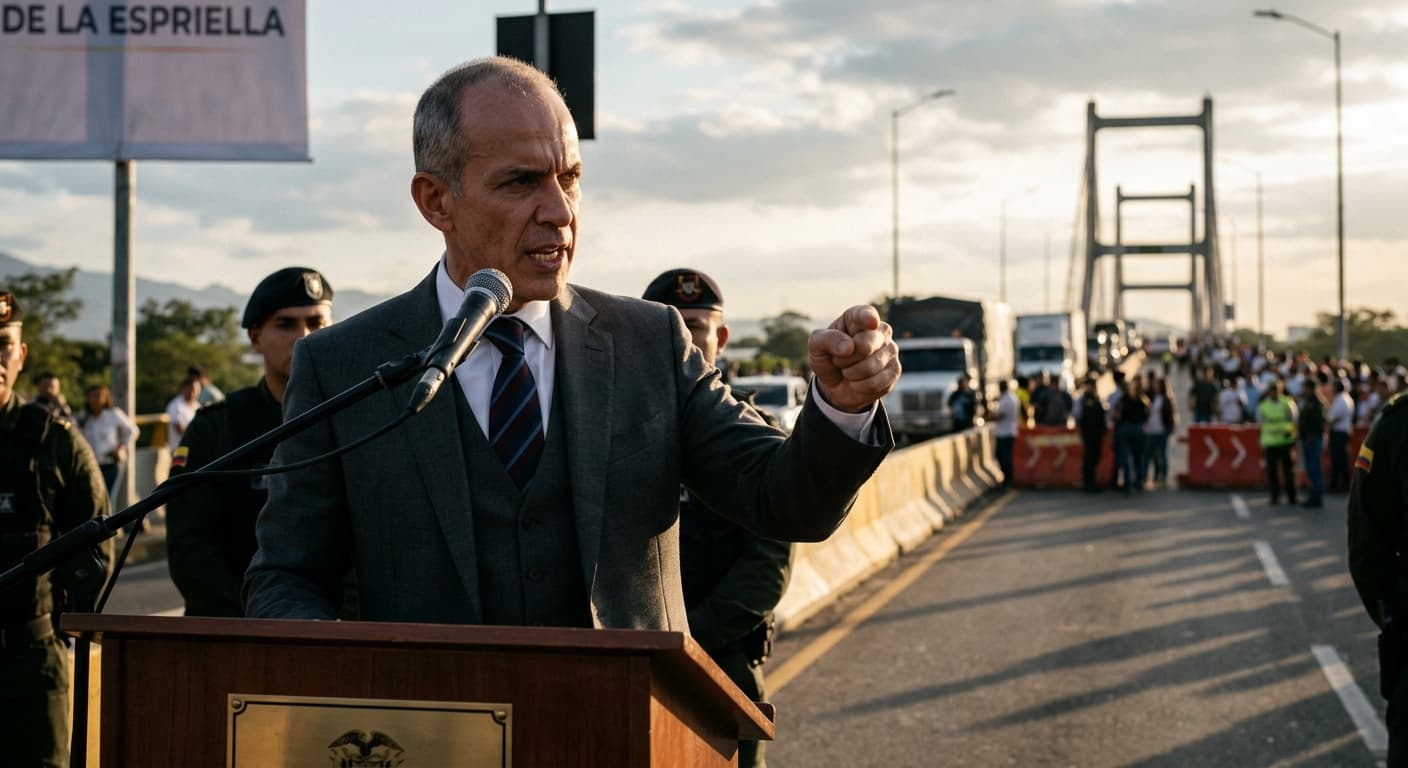
De La Espriella opens transition in Cúcuta with Catatumbo ultimatum
Colombia's president-elect gave two guerrilla commanders 30 days to surrender before his August 7 inauguration — a security signal aimed at burying Petro's "paz total."
Colombia's president-elect Abelardo De La Espriella chose Cúcuta on July 8–9, 2026 to open the "empalmes territoriales" of his incoming government — and used the stage to give guerrilla commanders "alias Alfred" of the ELN and "alias Andrey" of the FARC dissidents' Frente 33 exactly 30 days to turn themselves in. The move is less an operational order than a pre-inaugural repudiation of Gustavo Petro's "paz total": De La Espriella has no legal command of the security forces until August 7, and the clock he started expires almost exactly as he takes office in a region where the state controls less than it claims and the ELN's rear base sits across the Venezuelan border.
The choice of Cúcuta was not incidental. Norte de Santander delivered De La Espriella his single largest departmental margin — 76.56% — in the June 21 runoff, according to BBC Mundo's post-election maps. It is also the urban front of Colombia's worst internal displacement event on record. Launching the transition there fuses political stronghold with humanitarian emergency in a single frame — and lets the new government present itself as arriving where the outgoing one visibly failed.
What was actually announced
De La Espriella met the governor of Norte de Santander, William Villamizar, roughly 40 municipal mayors, and members of his designated cabinet, Meridiano 70 reported. His designated defense minister, retired General Jorge Eduardo Mora López, told the room the incoming government would reactivate capture orders against top commanders from August 7 and prioritise Norte de Santander. The ultimatum against "Alfred" of the ELN's Frente de Guerra Nororiental and "Andrey" of the Frente 33 was delivered in a written communiqué dated July 9, quoted verbatim by
Infobae:
"Alias Alfred, del ELN, y alias Andrey, del frente 33 de las disidencias de las Farc, tendrán un mes para someterse a la justicia. De no hacerlo, el nuevo Gobierno actuará con toda la capacidad legítima del Estado, bajo la Constitución, la ley y el Estado de Derecho."
Simultaneously, De La Espriella declared the national empalme with the Petro government terminated, accusing the outgoing administration of never fully recognising his 0.96-point win over senator Iván Cepeda. He was blunt about the rupture, per Infobae: "Yo no podía permitir que el empalme siguiera adelante con un gobierno que no reconoce el triunfo claro de este proyecto político y ciudadano en las urnas." Next stops on the territorial tour: Casanare, Santander and Antioquia — a corridor that traces both his electoral base and the areas where the Ejército Gaitanista de Colombia (Clan del Golfo) is expanding.
Why Catatumbo is the test case, not a talking point
The Catatumbo is the single region where Petro's "paz total" collapsed most visibly. On January 16, 2025, an ELN offensive against the Frente 33 of the FARC dissidents triggered what the UN Office for the Coordination of Humanitarian Affairs, in a March 2025 report, called the largest mass-displacement event ever recorded in Colombia: 91,879 people affected, more than 50,000 forced into Cúcuta, Tibú and Ocaña. UN Emergency Relief Coordinator Tom Fletcher released US$3.8 million from the CERF Rapid Response window on January 30, 2025, according to the
CERF allocation record, for a caseload that ultimately reached 58,145 people across food, shelter, WASH, education, nutrition and protection sectors. Six firmantes de paz — signatories of the 2016 accord — were among the dead.
Petro decreed a state of internal commotion on January 24, 2025, suspended ELN talks and launched Operación Catatumbo with more than 10,000 troops deployed to secure the Cúcuta–Tibú and Cúcuta–Ocaña axes. Twelve months later, the Fundación Ideas para la Paz documented that the government claims to have recovered 70% of the region, "pero en la práctica la región continúa sin experimentar mejoras reales en seguridad." The Zona de Ubicación Temporal announced for the Frente 33 in April 2025 never materialised; 'Andrey' was evacuated to a stalled negotiation table rather than captured.
That failure is the political asset De La Espriella is monetising. The UN Security Council, in document S/PV.9903, described the Catatumbo crisis as "el episodio de violencia más devastador desde la firma del Acuerdo Final" of 2016. When De La Espriella names 'Alfred' and 'Andrey' by alias from Cúcuta, he is not identifying targets his intelligence services just discovered — he is inheriting names Petro's negotiators failed to convert into either captures or a durable ceasefire.
The power play beneath the ultimatum
Three things are happening simultaneously in Cúcuta, and only one of them is about guerrillas.
First, De La Espriella is centralising the security narrative before he legally controls it. Retired General Jorge Eduardo Mora López publicly committed to "reactivating" capture orders from August 7, a phrasing that implicitly frames today's orders under Petro's minister Pedro Sánchez as insufficient. This is the reverse of a normal transition: rather than absorbing state information, De La Espriella is rejecting it. The president-elect confirmed to reporters that he had shut the national handover down and, as Infobae documented, would gather transition data "con los medios que tenemos" outside official channels — an unusual posture for a president 29 days from inauguration.
Second, he is bypassing Congress. The Pacto Histórico of Petro and Cepeda remains the largest single bloc in a fragmented legislature, BBC Mundo noted, and De La Espriella has no assured majority. Direct channels between Casa de Nariño and 40 mayors of Norte de Santander — bypassing ministers, governors' offices and parliamentary intermediaries — mirror the governance architecture Nayib Bukele and Javier Milei have used to route around institutional friction. In Colombia, where mayors control land-use decisions, licensing and much of the co-financing for regional infrastructure, that channel is not symbolic. It is the operational backbone through which a president with a divided Congress can still project state presence.
Third, he is telegraphing to Washington. BBC Mundo reported that Secretary of State Marco Rubio publicly signalled the Trump administration wants to "work closely" with the incoming government on regional security and migration. Since September 2025, U.S. strikes on suspected drug vessels have killed more than 200 people in South American waters,
BBC Mundo reported. De La Espriella has floated a "Plan Colombia 2.0" and speaks openly of bombing "narcoterrorist" camps and shooting down drug flights. Naming ELN and FARC-dissident commanders from a border city, weeks before inauguration, is a signal to Miami and Washington that Bogotá will accept — perhaps invite — a harder joint posture on the Venezuelan frontier.
Who benefits, who loses
The immediate beneficiary is not the state — it is, paradoxically, the ELN. FIP's March 2025 field analysis documented that the ELN, backed by its Frente de Guerra Oriental out of Arauca, had already seized roughly 90% of the territory previously held by the Frente 33 by end of February 2025. A frontal military offensive that targets both groups equally is likely to disrupt the Frente 33's survivors more than an ELN that operates as, in the words of criminologist Jorge Mantilla to
BBC Mundo, "un ejército binacional" with rear guards inside Venezuela and, per the same interview, a "relación de interdependencia" with the Maduro government. The ultimatum accelerates a consolidation the ELN is already winning.
The clearest losers are the 42,023 Venezuelan nationals living in Catatumbo counted by Migración Colombia and cited by UN News, and the roughly 4,600 migrants already displaced in the January 2025 escalation. Border militarisation without a Venezuela policy — and De La Espriella has none coherent yet — risks pushing this population into the interstitial space between two hostile governments. UNHCR has already had to suspend distribution of basic relief items in the region for lack of funding,
UN News reported in April 2025, noting that Colombia hosts more than seven million internally displaced people. A military-first doctrine will not close that gap; it may widen it.
The other quiet loser is Colombia's Jurisdicción Especial para la Paz, the transitional justice body created by the 2016 accord that De La Espriella has publicly promised to dismantle, per BBC Mundo. Roughly 170 municipios with Programas de Desarrollo con Enfoque Territorial designated under the 2016 accord still require, per the UN Secretary-General's report cited in
S/PV.9903, "una presencia más sólida del Estado." Dismantling the JEP without replacing its territorial architecture is the fastest path to reproducing the vacuum the FARC left in 2016 — the same vacuum, cited by the Al Jazeera field investigation from
February 2025, that produced the current Catatumbo war.
The tacit winner in Washington is Marco Rubio, who now has a Bogotá interlocutor aligned with the counter-narcotics posture State has struggled to sell to Petro since 2022. The tacit loser is China, whose infrastructure footprint expanded sharply under Petro and which De La Espriella's team has hinted, without committing, at rebalancing.
The historical parallel that reframes the announcement
The Cúcuta empalme is not an Uribe-era replay, though De La Espriella claims to BBC Mundo to be "el Uribe del 2002... pero costeño y más bacán." Álvaro Uribe took office in August 2002 with a fragmented but disciplined Congress, a functioning intelligence apparatus geared for FARC combat, and a $1.3 billion Plan Colombia already three years old. De La Espriella takes office with a record 12.9 million votes but under 50%, a Congress dominated by his opposition, an intelligence architecture that failed spectacularly to anticipate the January 2025 Catatumbo escalation, and a U.S. relationship that has been transactional under Trump — not the strategic partnership the first Plan Colombia embodied.
The closer parallel is Iván Duque's 2018 opening: a hard-security promise announced from a border zone that, absent state-building follow-through, produced short-lived symbolic captures and a durable expansion of the armed groups themselves. Between 2018 and 2024, the number of armed-group members in Colombia roughly doubled, according to BBC Mundo citing government advisors on victims and reconciliation. Bombing camps did not reverse that. Isabelita Mercado Pineda, Bogotá's peace advisor, told the same outlet that forced displacement rose 300% between 2024 and 2025 — a curve that pre-dates De La Espriella but that his doctrine, absent complementary state-building, is unlikely to bend.
The Pacto por el Catatumbo, launched by Petro and reviewed under the state of internal commotion by the Constitutional Court, remains the only current architectural response to the region's structural deficits. The FIP's twelve-month review noted the Pacto has not produced visible improvement — but crucially, no faster alternative exists. Nine years after the 2016 accord, the Ideas para la Paz analysts, FARC signatory Diego Tovar and the UN Secretary-General's own report all point to the same gap: rural state presence, not just firepower.
What to watch next
- August 7, 2026 — Inauguration. Whether Mora López's "reactivated" capture orders translate into named operational targets in the first 48 hours will indicate if the ultimatum was doctrine or theatre.
- August 9, 2026 — Deadline expiry. The 30-day surrender window closes roughly 48 hours into the new administration. Neither 'Alfred' nor 'Andrey' is likely to comply.
- Constitutional Court review. If De La Espriella invokes a new estado de conmoción interior for Catatumbo, the Court's response will define his executive latitude for the term.
- March 2026 congressional map. The FIP flagged that Catatumbo's curul especial de paz will be contested amid an active war — a legislative test of the doctrine's political durability.
Diplomat View
De La Espriella's Cúcuta ultimatum is best read not as a security plan but as an announcement of governing method: bypass the outgoing administration, bypass Congress, address mayors directly, align with Washington and let the border do the talking. The falsifiable call is this: within six months of inauguration, neither 'Alfred' nor 'Andrey' will be in Colombian custody, the ELN's territorial position in Catatumbo will be stronger not weaker, and Venezuelan-border displacement will exceed the January 2025 peak. What would revise that forecast is a concrete Venezuela policy — a channel, however hostile, that closes the ELN's rear base — or a credible replacement architecture for the JEP and the Pacto por el Catatumbo. Neither has been sketched. Until either appears, the Cúcuta empalme is a stronger political signal than security policy: a president-elect governing the narrative before he governs the state.
The Bottom Line
De La Espriella's Catatumbo ultimatum is a message about power, not policing. By naming two guerrilla commanders from Cúcuta before he holds any legal authority, he is claiming the security agenda Petro visibly lost — and signalling to Washington, to 40 border-region mayors, and to a Pacto Histórico opposition that his government will be built around the executive and the map, not the Congress. If the ELN's rear base in Venezuela remains untouched, this doctrine will produce photographs, not captures.
Discover more
India
700 Activists Accuse PM Modi of MCC Breach
Over 700 activists allege PM Modi breached election code with a televised address attacking opposition parties just before state elections.

US Politics
House Ethics Committee Pushes Sexual Miscond.
The House Ethics Committee has shifted responsibility for sexual harassment settlement records to the Office of Congressional Workplace Rights, complicating disclosure efforts.

International Relations
Pakistan's Key Role in US-Israel-Iran Meddle
Pakistan is seeking to mediate the US-Israel-Iran conflict, balancing high-stakes diplomacy against severe economic pressures and steep regional challenges.

Conflict & Security
Drone Warfare Killing Aid Workers at Unprec
Over 1,000 humanitarian workers killed in three years as cheap armed drones collapse legal protections. Gaza, Sudan, Ukraine, and DRC see deliberate targeting of aid convoys and hospitals with zero prosecutions.