Council of Europe Demands Rights Guardrails
Council of Europe sets four rights conditions for EU return hubs
Model Diplomat6 min readEurope
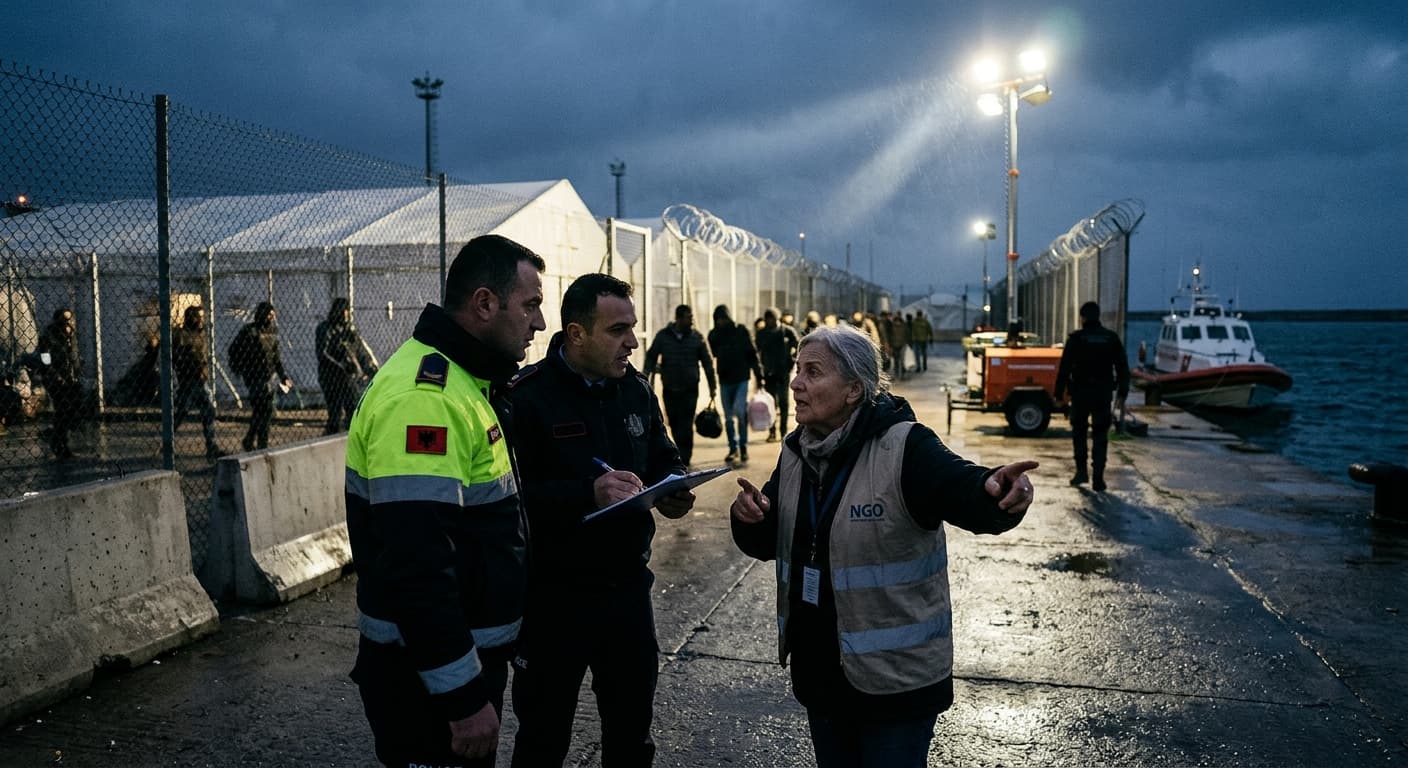
Council of Europe Demands Four Rights Guardrails Before EU Return Hubs Open
A July 8, 2026 letter from Commissioner Michael O'Flaherty to five EU governments sets human-rights conditions that the return-hub coalition has not yet met — and the legal precedent it must clear is already faltering in court.
On July 8, 2026, the Council of Europe's Commissioner for Human Rights, Michael O'Flaherty, wrote to the migration ministers of Austria, Denmark, Germany, Greece, and the Netherlands with a pointed message: any plan to establish "return hubs" outside the EU must comply with international human rights law. The letter, published July 16, sets out four guardrails — a comprehensive risk assessment, independent monitoring, legally binding agreements with enforceable clauses, and public judicial scrutiny — and arrives as the five governments race to finalize host-country agreements by year-end for implementation in 2027. The intervention matters because the legal architecture the five states are building on is already cracking: the EU's own Advocate General has conditionally blessed third-country detention only if full EU rights and in-person access to authorities are guaranteed, a bar the Italy-Albania precedent has repeatedly failed to clear.
The five-state coalition and its timetable
The coalition crystallized in early 2026. Austria, Denmark, Germany, Greece, and the Netherlands announced joint intentions to establish return hubs outside the EU, with the Dutch government stating it expected to announce agreements by the end of 2026, according to a European Parliamentary Research Service briefing. The hubs would host third-country nationals already issued return decisions — distinct from the Italy-Albania model, which processes asylum claims extraterritorially. Potential host countries cited in policy discussions include Rwanda, Uganda, and Uzbekistan, though Uganda's new government, which took office in February 2026, dropped a September 2025 letter of intent on returns while remaining interested in the concept.
The legal scaffolding arrived on June 17, 2026, when the European Parliament approved the Returns Regulation by 418 votes to 218, with 30 abstentions, according to the Parliament's press release. The regulation allows transfers to return hubs based on bilateral agreements with third countries that uphold human rights, international law, and the principle of non-refoulement. Crucially, the return-hub provisions apply immediately upon entry into force, while other provisions requiring preparatory steps apply 12 months later. The regulation also permits detention for up to 24 months, with a possible six-month extension.
O'Flaherty's four guardrails
The Commissioner's letter draws from his September 2025 report, "Externalised asylum and migration policies and international human rights law," which warned that sending people to return hubs would present "considerable human rights risks," according to the Council of Europe. The four guardrails are precise. First, a comprehensive human-rights risk assessment based on "rigorous factual and legal analysis" must precede any initiative, with a plan to prevent, mitigate, or remedy risks. Second, return hubs must be subject to "adequate, independent and continuous human rights monitoring, with robust review and suspension mechanisms." Third, cooperation must rest on legally binding agreements featuring enforceable human-rights clauses. Fourth, parliamentary, public, and judicial scrutiny must be enabled by making risk assessments, mitigation plans, monitoring outcomes, and agreements public.
As of July 16, Austria, Germany, Greece, and the Netherlands had replied, thanking the Commissioner and reaffirming their commitment to international and EU law, Eunews reported. Denmark had not publicly replied. The affirmations are diplomatic; whether they translate into binding operational commitments remains the open question.
The Italy-Albania precedent — and its judicial trouble
The five states' plans are modeled on the Italy-Albania protocol, signed November 6, 2023, which enables Italian authorities to operate detention facilities on Albanian territory for border and return procedures. The protocol's estimated cost was €670 million over five years, the EPRS briefing notes, though actual costs are now estimated higher. The facilities have been paralyzed by legal challenges — Italian judges blocked more than 20 transfers, and the deal was revised in March 2025 to target rejected asylum seekers rather than new arrivals.
The Court of Justice of the European Union's Advocate General delivered an opinion in Case C-414/25 that sets a conditional and demanding bar. The Advocate General found that Directive 2008/115 "does not, in principle, preclude national legislation permitting the transfer of third-country nationals subject to return procedures to detention facilities located in the territory of a third State," according to the official EUR-Lex text. But the compatibility is conditional: the legislation must ensure respect for rights under Article 13(3) and Article 16(2) of the Directive, permit immediate release when detention conditions are no longer met, and guarantee specific protections for minors and vulnerable persons. On asylum applications lodged from within third-country facilities, the Advocate General required that applicants be able to "appear in person, where required or permitted, before the competent administrative or judicial authorities." The Eunews report notes the Advocate General further observed that the Italy-Albania Protocol and implementing legislation "do not appear to contain clear and precise provisions capable of guaranteeing the full range of rights."
"Engagement on return hubs should be done with precaution, and only following clear evidence that they can be implemented in full compliance with states' obligations, including following mandatory and comprehensive human rights risk assessments, the development of risk mitigation [plans]."
— Michael O'Flaherty, Council of Europe Commissioner for Human Rights,
Observations on the new EU returns framework, March 2, 2026
The political split
The project divides Europe's leadership. Italian Prime Minister Giorgia Meloni and Danish Prime Minister Mette Frederiksen champion externalized return hubs as a tool to manage migration and assert state sovereignty. French President Emmanuel Macron and Spanish Prime Minister Pedro Sánchez have publicly criticized the centres, with Macron stating "Europe is not this," Eunews reported on June 19. The European Parliament's rapporteur, Malik Azmani (Renew, Netherlands), framed the regulation as a deliverable: "Today Europe delivered. People rightly expect that those with no right to stay return to their countries of origin,"
the Parliament's press release recorded. The vote breakdown — 418 in favor, 218 against — reflects a broad centre-right and far-right coalition,
the CIDOB analysis observed.
The strategic calculation is clear: the five states are racing to sign agreements before the legal and political headwinds intensify. O'Flaherty's guardrails, if enforced, would slow that timetable considerably. A comprehensive risk assessment, independent monitoring with suspension mechanisms, and enforceable human-rights clauses in binding agreements are not checkbox exercises — they require host-country compliance verified on the ground, which is precisely where the Italy-Albania model has stalled.
What the costs and precedents show
The Italy-Albania facilities have cost an estimated €800 million in total investment, with €297 per day per asylum seeker hosted — roughly ten times the cost of reception in Italy, CIDOB calculated. The UK's abandoned Rwanda scheme cost £370 million for construction, with £20,000 per person deported, before courts blocked it. The European Parliamentary Research Service briefing warns that the introduction of return hubs "is likely to lead to significant practical complications as well as court cases," citing a report by the Netherlands Institute of International Relations Clingendael. NGOs including Amnesty International and over 100 human-rights organizations have called the plans "inconsistent" with fundamental rights,
the EPRS briefing records.
The return rate the regulation aims to improve is the EU's persistent 20% — only one in five people ordered to leave are actually deported, a rate EU Migration Commissioner Magnus Brunner has called "unacceptable," ISPI reported. Whether return hubs move that needle depends on third-country cooperation that remains unsecured. The EU has already imposed visa restrictions on Somalia in June 2026 for insufficient readmission cooperation,
Al Jazeera reported — a sign of how leverage operates even before hubs exist.
The Bottom Line
The Council of Europe's intervention is not a veto but a litigation roadmap. O'Flaherty's four guardrails mirror the conditions the CJEU Advocate General has already attached to the Italy-Albania model — and those conditions have kept the Albanian facilities largely empty. The five-state coalition has the political will and the regulation, but it does not yet have a host-country agreement that clears the rights bar the Commissioner and the EU's own courts have set. The next test is whether any bilateral agreement announced by year-end can survive the judicial scrutiny that derailed every comparable precedent.
What to Watch
- End of 2026: Dutch government's stated deadline for announcing host-country agreements; any deal will face immediate legal challenge on O'Flaherty's four criteria.
- CJEU ruling on Case C-414/25: The Advocate General's opinion is non-binding; the full Court's judgment will determine whether the Italy-Albania model — and by extension the return-hub template — survives in operable form.
- Denmark's response: The only one of the five states that had not publicly replied to O'Flaherty as of July 16; its stance will signal whether the coalition holds or frays under rights pressure.
Discover more
Global Politics
Xi Jinping Calls China-Russia Ties 'Precious'
Xi Jinping's description of China-Russia ties as 'precious' reflects a strategic imbalance, with Beijing dictating terms in the partnership.
India
Congress Accuses Modi of Stalling Women's Law
Congress accuses Modi of stalling women's reservation law by linking it to delimitation, revealing a deeper electoral strategy.

India
BJP's Misunderstanding of Women's Quota Needs
The BJP's linking of the Women Reservation Bill to delimitation risks delaying women's empowerment in India, misreading the aspirations of female voters.

Conflict & Security
Drone Warfare Killing Aid Workers at Unprec
Over 1,000 humanitarian workers killed in three years as cheap armed drones collapse legal protections. Gaza, Sudan, Ukraine, and DRC see deliberate targeting of aid convoys and hospitals with zero prosecutions.