Congress Demands 33% Women’s Reservation Now
Demand for immediate women's quota in Lok Sabha seats
Model Diplomat8 min readIndia
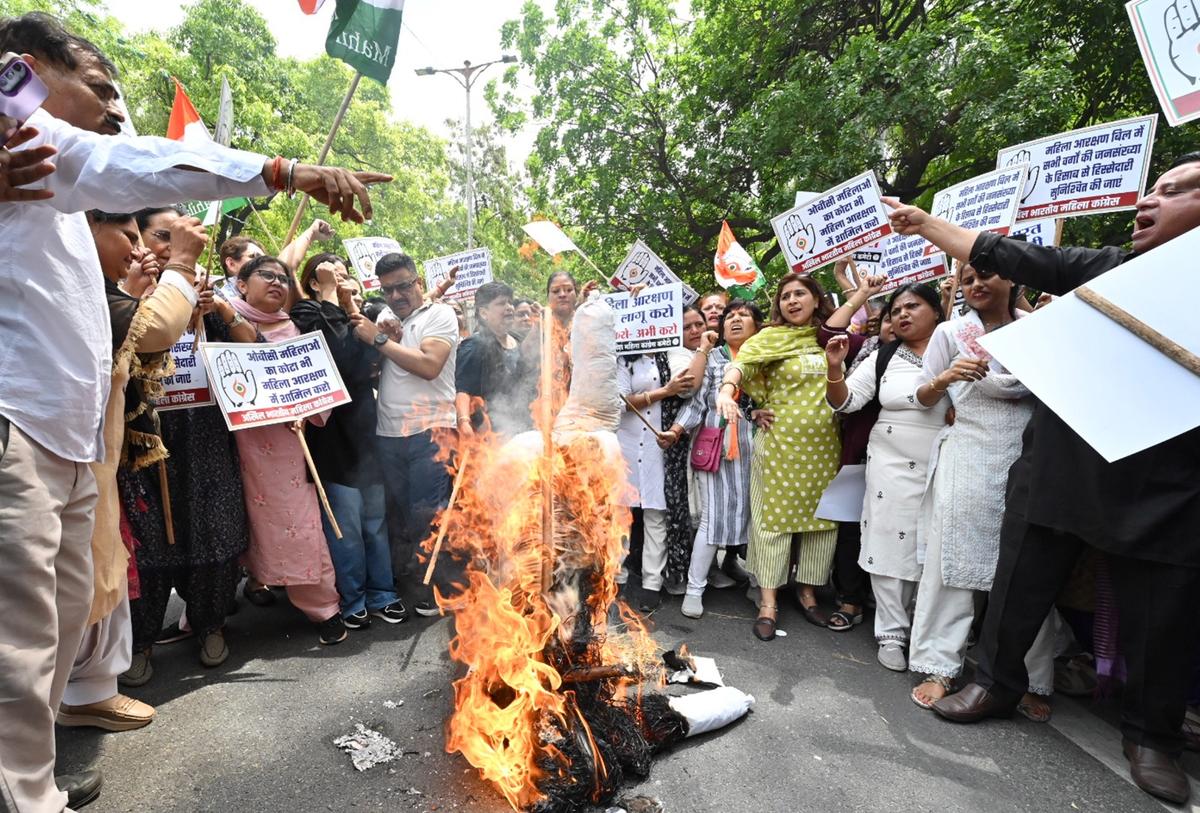
Congress Demands 33% Women's Reservation Now: The Bill Modi Lost
Congress is demanding immediate 33% women's reservation in the current 543-seat Lok Sabha after Modi's constitutional bill collapsed 298–230 on April 17, 2026.
For the first time in twelve years, the Modi government lost a constitutional amendment vote: the Constitution (131st Amendment) Bill — meant to tie the long-promised 33% women's quota to a sweeping redraw of India's political map — fell 62 votes short of a two-thirds majority on April 17, 2026. Congress is now weaponising that defeat: the party argues the quota can be triggered inside the existing 543 Lok Sabha seats without waiting for a census or delimitation, and is running a nationwide postcard drive to force the government to prove otherwise. That reframing — quota now vs. quota later — has flipped a technical debate about census timing into the central political fight going into the 2026 Monsoon Session.
The stakes are not the principle. Every major party voted for the 2023 Nari Shakti Vandan Adhiniyam. The stakes are what the government bundled with it: a 2011-census-based delimitation expanding the Lok Sabha to 850 seats, which the south believes will shift power decisively to the Hindi belt. Congress figured out that if it separates the two, it wins on gender and forces the BJP to defend delimitation on its own merits. That is why April 17 matters.
What actually happened in Lok Sabha
Three bills were tabled on April 16, 2026, in a three-day special session: the Constitution (131st Amendment) Bill, the Delimitation Bill, and the Union Territories Laws (Amendment) Bill — a package the government presented as a single unlock mechanism for the 2023 women's reservation law.
Per an analysis by PRS Legislative Research, the 131st Amendment Bill did three things at once: raised the Lok Sabha ceiling from 550 to 850 seats (815 general, 35 UTs); authorised Parliament to decide by simple law which census to use for delimitation; and — critically — deleted the clause in the 106th Amendment that made the women's quota effective only after the first post-commencement census.
The vote failed. According to BBC Hindi, 298 MPs backed the bill and 230 opposed — well below the 360 needed. Home Minister Amit Shah blamed the Congress, DMK, TMC, and Samajwadi Party on X for "sinking" the bill. Rahul Gandhi countered that the amendment had "no connection to women's reservation" and was "merely an attempt to seize power through delimitation and gerrymandering," per
Al Jazeera.
The next evening, Modi addressed the nation, apologised to India's women for the bill's failure, and warned the opposition it would "pay a long-term price" — without specifying what a standalone quota bill would cost him politically. Within hours, Congress president Mallikarjun Kharge issued the counter that has become the party line: bring a bill "tomorrow" to reserve 33% within the existing 543 seats. The Tribune reported Kharge's demand verbatim; it is now the Congress test the government is being asked to pass.
The trap Congress set — and why it worked
The 2023 Nari Shakti Vandan Adhiniyam, formally the 106th Constitutional Amendment Act, reserves one-third of Lok Sabha and state assembly seats for women "as nearly as may be." But the
PRS bill summary is unambiguous: "The reservation will be effective once the census conducted after the commencement of this Bill has been published. Based on the census, delimitation will be undertaken to reserve seats for women."
That commencement trigger is the point of leverage. The ongoing census has a reference date of March 1, 2027; by PRS's own assessment, "it is unlikely that delimitation exercise based on the 2027 census will be completed before the 2029 elections. This would imply that reservation for women will not apply to the 2029 Lok Sabha election." That is the sentence the Congress campaign is built around. If the trigger holds, women's reservation slips to at least 2034. If it goes, it can be delivered in 2029 — or, as Congress now argues, immediately, on the current 543 seats.
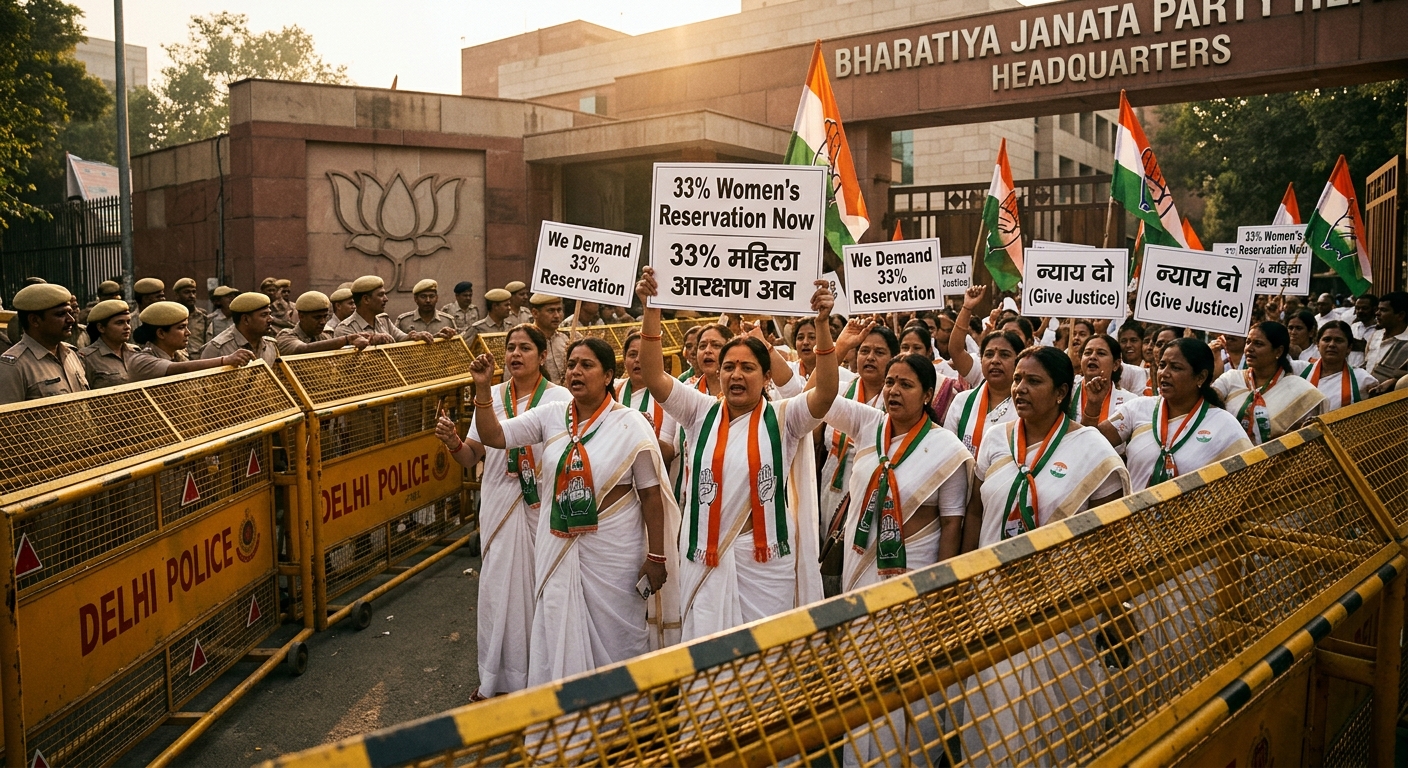
The government's April 2026 bill tried to solve the timing problem — but it solved it by also unbundling the seat cap and giving Parliament, not the Constitution, control over which census is used. Congress spotted the swap. Party spokespersons argued through April, per ThePrint's PTI feed, that if the census link can be legislatively removed for delimitation, it can be removed for the quota alone — no new districts needed. On April 19, the Delhi Pradesh Congress marched on the BJP headquarters at 6A Deen Dayal Upadhyaya Marg; on April 21, the party recalled letters Sonia Gandhi and Rahul Gandhi wrote to Modi in 2018 and 2023 asking for exactly this, as
The Hindu reported. On April 22, the All India Mahila Congress launched a postcard campaign targeting one million women's signatures to the Prime Minister, per
The New Indian Express.
Why the south will not sign the bundle
The bundle failed because the delimitation math is politically radioactive. India has frozen Lok Sabha seat shares between states since the 1971 census — first by the 42nd Amendment in 1976, extended by the 84th Amendment in 2001 until "the first census after 2026," per PRS. That freeze was, in effect, a bargain: states that stabilised their populations would not lose parliamentary power to those that did not.
Unfreeze that on the 2011 census and the south loses seats. Vidhi Centre for Legal Policy analyst Arghya Sengupta told the BBC that the government's proposed 850-seat ceiling has no clear proportional basis. PRS's own modelling shows Tamil Nadu falling from 39 seats to 32 and Kerala similarly diminished if the current 543-seat total were redistributed on 2011 numbers. Tamil Nadu Chief Minister M.K. Stalin burned a copy of the bill and called delimitation a "massive historic injustice," per Al Jazeera. Tamil Nadu, Kerala, Karnataka and Telangana had jointly sought a further 25-year freeze.
This is why the Congress "33% now, in 543 seats" formulation is not just a gender demand — it is a southern-alliance-preserving one. It gives the DMK, the TMC and the Left cover to back a quota bill without ratifying a delimitation that reshapes the federation. That is the political product Congress is selling.
The number that makes the fight worth having
Women hold roughly 14% of Lok Sabha seats — 74 of 543 — after the 2024 general election. That is up from 4.4% in the first Lok Sabha but still, per Carnegie Endowment analysis, places India 141st of 185 countries on the Inter-Parliamentary Union's rankings — below Nepal (34%), Bangladesh (21%) and Pakistan (20%). The global average is 26.5%.
Implementing 33% inside the current 543 seats would take the number of women MPs to at least 181, per the Law Ministry's own 2023 figure cited to Al Jazeera. Waiting for a post-2027 census delimitation, on PRS's timeline, delays that to 2034. That eleven-year gap — from a bill signed in 2023 to a chamber it reaches in 2034 — is what Congress means by "sitting on women's rights."
There is a counter-consideration Congress does not advertise. A study by the Ministry of Panchayati Raj, cited in the PRS issues brief on the 2023 bill, found that at the panchayat level, roughly 85% of women winners were first-timers because seat rotation after each delimitation cycle de-reserved their constituencies before they could seek re-election. Even a "33% now" bill on 543 seats would inherit that rotation problem — unless Parliament writes the enabling law differently. Neither party is talking about that. The design flaw is downstream of the current fight.
Who benefits, who loses
The BJP was the intended winner of the April 16 gambit. Senior journalist Sharad Gupta told BBC Marathi the whole exercise was pitched at West Bengal's 2026 assembly election: Modi wanted to campaign on a women's-empowerment win in a state where TMC's Mamata Banerjee has dominated the women's vote. The bill's defeat inverted that: the BJP now has no legislative trophy, and the opposition has a live grievance to run on.
The real winner may be Congress's Mahila Congress wing. The party's 2024 problem, per Al Jazeera post-poll analysis drawing on CSDS Lokniti data, was that only 22% of women voted Congress — a two-point gain but still a rout by the BJP among first-time women voters. A national campaign centred on a live quota demand, with a million-signature target, is designed to close that gap in the Bihar assembly cycle later this year and in Bengal in 2026.
The clearest loser is Tamil Nadu's political weight — but only if the government re-tables the bundle. If it does not, the south's freeze holds, and the BJP's Hindi-belt majoritarian arithmetic stalls.
Diplomat View
The Congress campaign will not deliver 33% women's reservation in 2026, but that is not the point. The point is to force the BJP to choose between the quota and delimitation — and to make refusing the choice look like a betrayal of women. On the arithmetic, the government's 293 Lok Sabha seats cannot pass a constitutional amendment without splitting the opposition, and there is no split visible. A standalone 33%-on-543-seats bill would pass — probably unanimously — and the government knows it, which is precisely why it will not table one: doing so concedes that delimitation was the real prize all along.
Expect the Monsoon Session, likely late July, to produce a rerun of the April bundle rather than the standalone. Watch for two revisions to this forecast: if the BJP loses the Bihar assembly election on women's turnout, it will unbundle; if the 2027 census reference date slips further, Congress will escalate from postcards to parliamentary walkouts. The forecast falls apart if the DMK or TMC breaks ranks — neither has an incentive to, but Bengal's 2026 polls could change TMC's calculation if Modi offers a targeted delimitation carve-out.
The deeper story is that India's most consequential gender reform in a generation has become a proxy for the country's oldest federal question: who owns the map. That is not an accident of drafting. It is the design.
What to watch next
- Monsoon Session 2026 (expected late July): Whether the government re-tables the 131st Amendment bundle, splits it into a standalone women's-quota bill, or lets it lapse.
- Bihar Assembly Election (Oct–Nov 2026): The first electoral test of the Congress postcard campaign's reach among women voters; a BJP setback would pressure the government to unbundle.
- Census reference date (March 1, 2027): Any slippage strengthens the Congress argument that waiting is a delay tactic and could force a legislative fix on the existing 543 seats.
The Bottom Line
Congress's demand for immediate 33% women's reservation in the existing 543 Lok Sabha seats is not really about gender arithmetic — it is a wedge designed to sever women's reservation from delimitation, denying the BJP the political prize of redrawing India's electoral map on 2011-census lines. The April 17 defeat of the 131st Amendment gave that wedge a live edge, and the postcard campaign is designed to keep it there until the Monsoon Session. If the government stays with the bundle, women wait until 2034; if it unbundles, the south keeps its share and Congress gets the credit. That is the choice the BJP has spent two months trying not to make.
---_
Discover more

India
INDIA Bloc's Delimitation Strategy
The INDIA bloc is using delimitation and women's reservation to challenge the BJP's federalism narrative, setting up a high-stakes fight over representation.
India
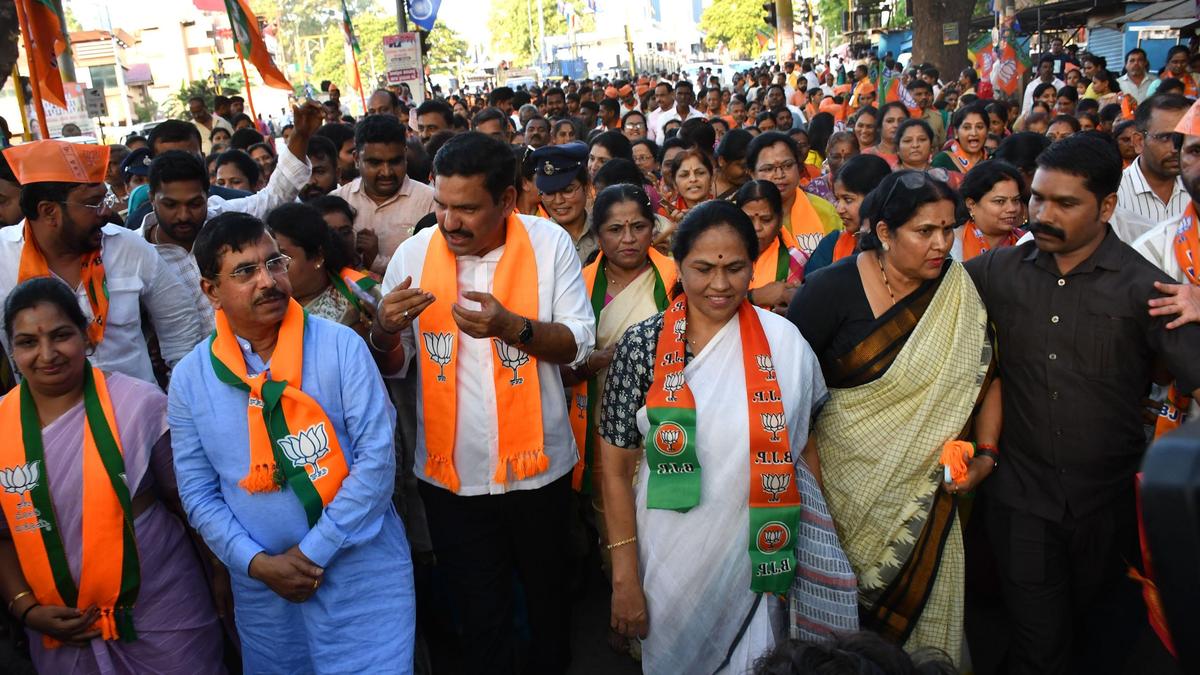
BJP Uses Hubballi Protests for Women's Quota
The BJP is using Hubballi protests to pin blame for delays on women's reservation onto Congress in Karnataka, sharpening its women's quota political offensive.
India
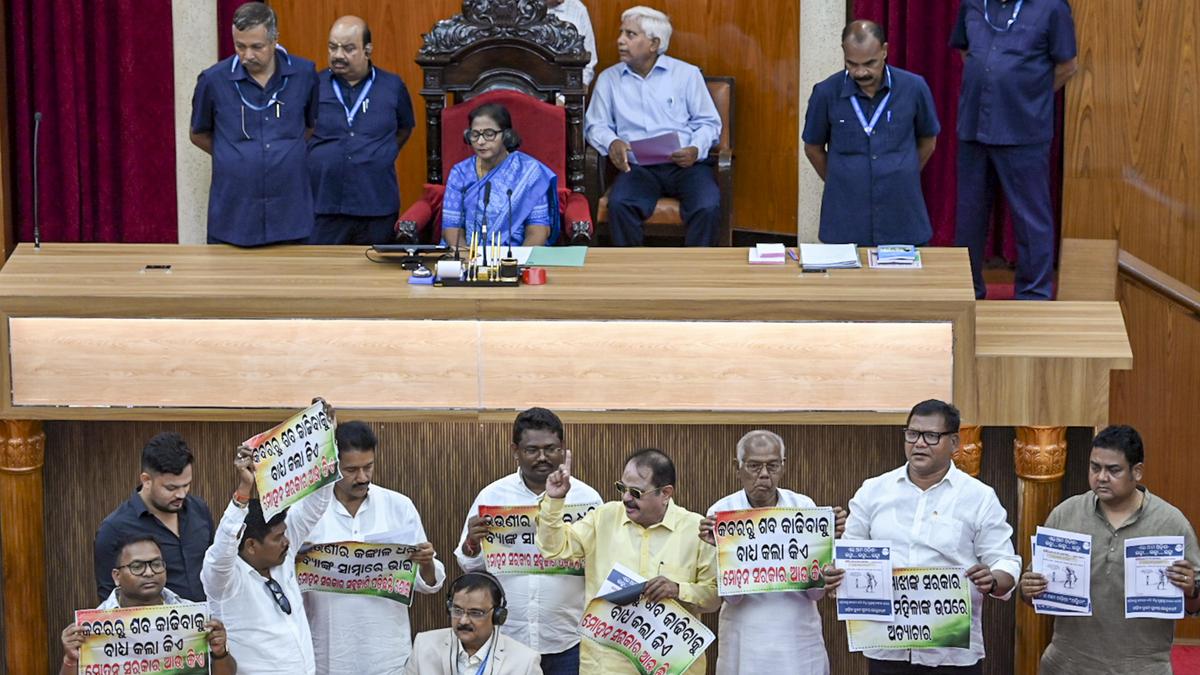
Odisha's Women's Reservation Debate
The fight over women's reservation in Odisha is shaping up as a calculated BJP and BJD strategy aimed squarely at gaining ground before the 2029 elections.
India
Uttarakhand's Push for Women's Reservation
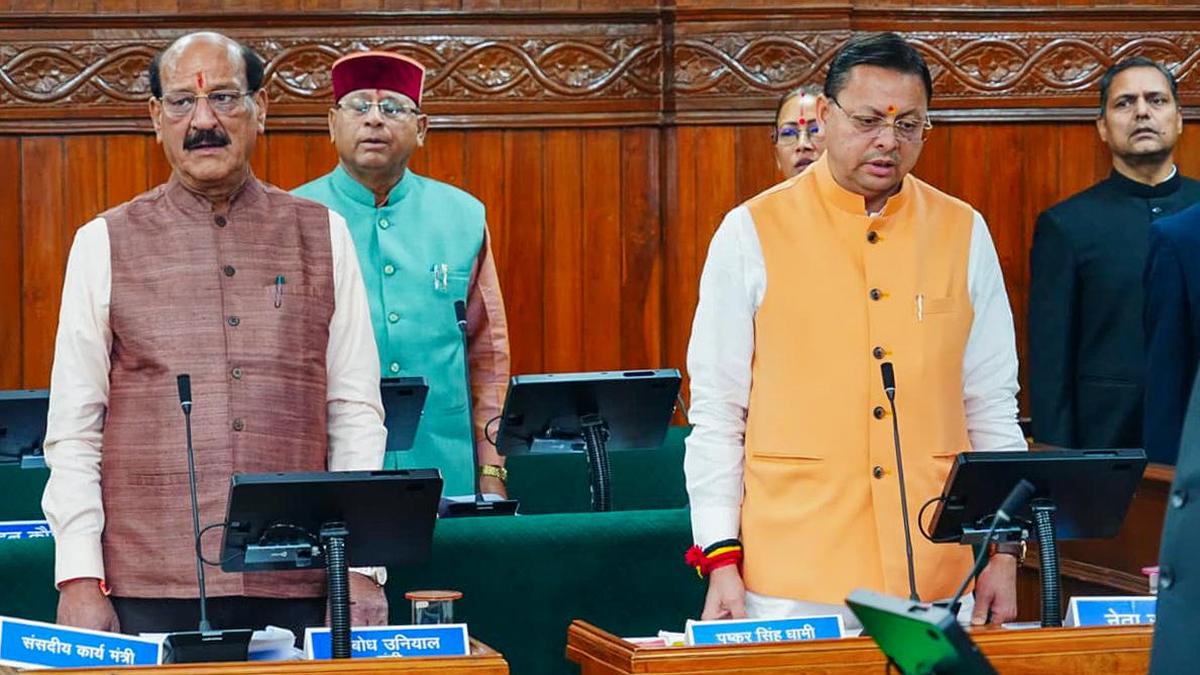
Uttarakhand CM Dhami's push for women's reservation is a strategic political move that follows national defeat and aims to reclaim momentum for the BJP.