Congress Protests for Women's Lok Sabha Quota
Congress demands immediate women's quota application
Model Diplomat9 min readIndia
Congress Protests Women's Quota to Bury Delimitation, Not Advance It
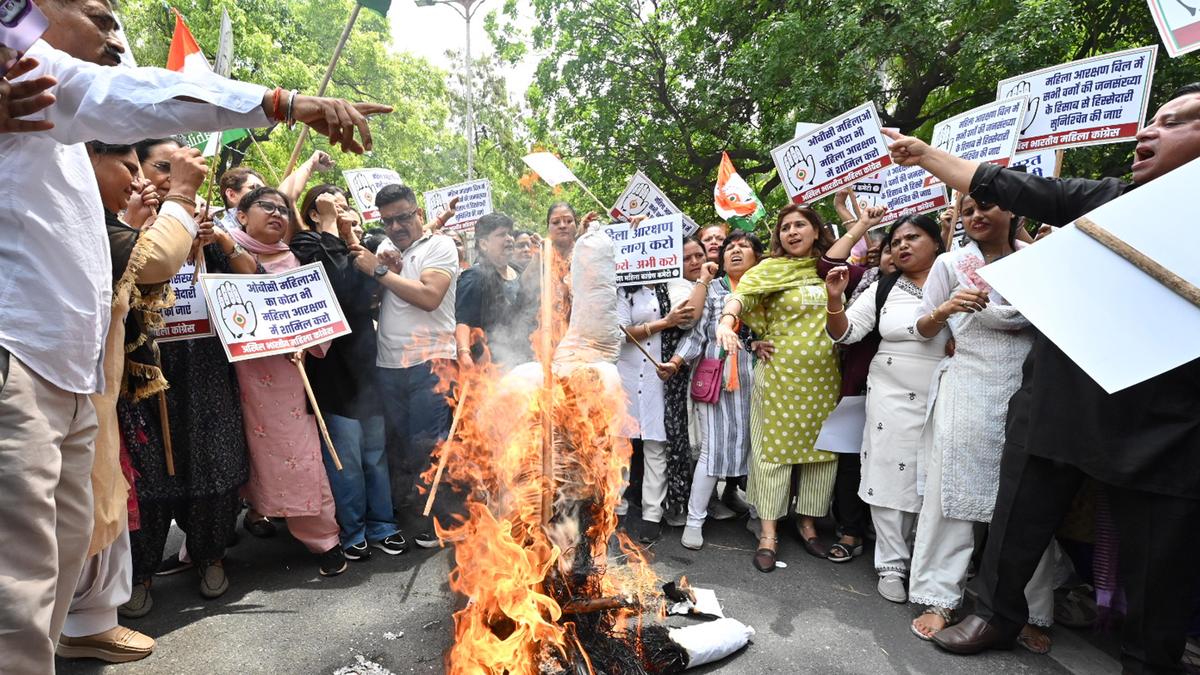
Congress marched on the BJP's Delhi HQ on April 19, 2026 demanding the women's quota apply to the existing 543 Lok Sabha seats — a tactic aimed at killing delimitation.
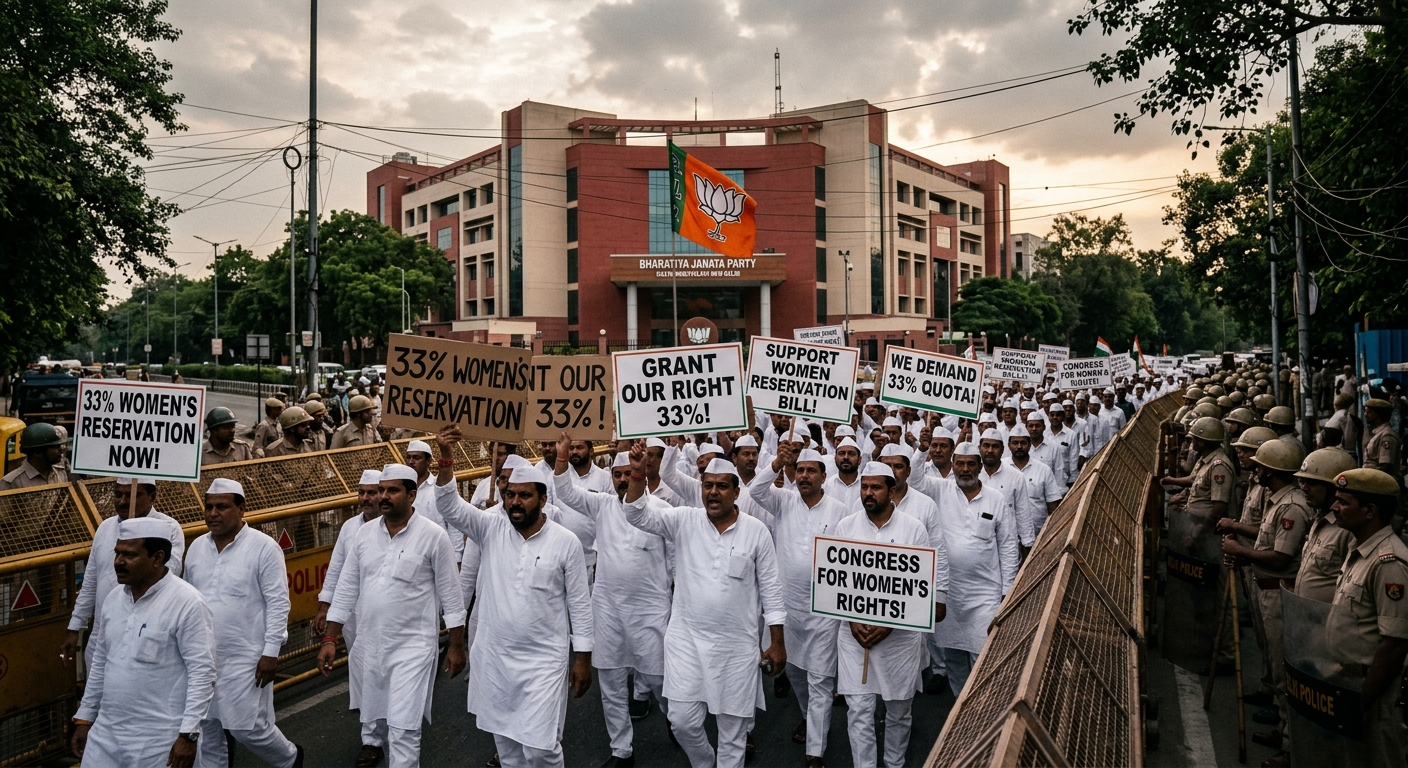
On April 19, 2026, Delhi Congress president Devender Yadav led party workers to the Bharatiya Janata Party headquarters on Deen Dayal Upadhyay Marg demanding that the 33% women's quota — enacted in 2023 but never enforced — be applied immediately to the current 543 Lok Sabha seats. The demand sounds like feminism. It is federalism. Congress's real objective is not to accelerate the Nari Shakti Vandan Adhiniyam; it is to prevent the Modi government from using that quota as a Trojan horse for a delimitation exercise that would shift roughly 100 parliamentary seats from India's south and east to the Hindi-speaking north. Two days earlier, on April 17, that Trojan horse had already collapsed on the floor of the Lok Sabha. The march was the victory lap — and the opening of a longer campaign to make sure the government cannot revive it.
What actually happened in Parliament
The Modi government convened an abrupt three-day special session on April 16–18, 2026, tabling three linked bills: the Constitution (131st Amendment) Bill, the Delimitation Bill, and the Union Territories Laws (Amendment) Bill. Per the Carnegie Endowment for International Peace, the package would have raised the Lok Sabha's constitutional ceiling from 550 to 850 seats, allocated 815 seats to states and 35 to Union Territories, and handed Parliament the power to choose which census to use for future delimitation — a direct departure from the constitutional requirement that reapportionment follow every census. Crucially, the Delimitation Bill defined "latest census figures" as those available on the date the delimitation commission was constituted, which analysts read as code for using the 15-year-old 2011 numbers.
The vote failed. On the evening of April 17, the 131st Amendment Bill received 298 ayes to 230 noes in the Lok Sabha, BBC Hindi reported, well short of the two-thirds majority a constitutional amendment requires.
Al Jazeera calculated the threshold at roughly 360 votes; Prime Minister Narendra Modi's National Democratic Alliance controls 293 seats. The Takshashila Institution's post-mortem noted that the amendments, "coming in the backdrop of several state elections, were seen as an affront to federalism and were defeated," according to the think tank's
April 28 assessment.
Home Minister Amit Shah framed the defeat as opposition betrayal. In his reply to the debate, Shah told the House that 130 members participated, including 56 women, and said the opposition alliance was "in effect, opposing" women's reservation itself, not merely the method. He also invoked Article 81 and Article 82 of the Constitution and reminded MPs that 127 constituencies now hold more than 2 million voters each, calling this a violation of the "one person, one vote, one value" principle. Congress had already prepared its counter-narrative. On April 19, Delhi Congress workers marched on the BJP office; on April 20, the party announced a pan-India campaign, with senior leaders instructed to hold Facebook Live events pressing for the quota on the existing 543 seats,
Deccan Herald reported.
The trap Congress is trying to spring
The Constitution (106th Amendment) Act, passed on September 21, 2023, contains a sequencing clause the government drafted itself: the 33% reservation "shall come into effect" only after a delimitation "undertaken for this purpose after the relevant figures for the first census taken after the commencement" of the Act are published. In plain language, no census, no delimitation, no women's quota. That single clause has been Modi's most durable political asset — and now his biggest liability.
That clause is the fulcrum of the current fight. Congress general secretary K.C. Venugopal argued in the Lok Sabha debate that the constitutional obstacle is the government's own creation — a rider Parliament could remove today with a two-line amendment to enforce the quota on the existing 543 seats. Rahul Gandhi, the Leader of the Opposition, put it more bluntly: the government's April 2026 package "has no connection to women's reservation," he told supporters on X, according to Al Jazeera. "It is merely an attempt to seize power through delimitation and gerrymandering." Congress parliamentarian Gaurav Gogoi alleged in the same coverage that the intention was not to implement women's reservation but to introduce delimitation "through the backdoor."
The numbers explain the anxiety. India has not redrawn parliamentary constituencies since the 1971 census. As the BBC has documented, the 42nd Amendment of 1976 and the 84th Amendment of 2002 froze reapportionment to protect southern states that had aggressively curbed fertility, meaning India has completed only three delimitations — in 1951, 1961 and 1971 — in its entire post-independence history. Tamil Nadu, Kerala, Karnataka and Telangana had asked for that freeze to be extended by another 25 years. The Vidhi Centre for Legal Policy's Arghya Sengupta told the BBC that the government's proposed 850-seat cap has no obvious mathematical basis and "does not appear to be proportionate to population growth recorded in the 1971 and 2011 census," while the absence of a matching expansion for state assemblies creates "a mismatch: fast-growing states could gain more MPs without a corresponding rise in MLAs."
Why "543 seats now" is the harder demand
The government's rhetorical trump card is that Congress voted for the 2023 amendment — including its census-and-delimitation trigger. Shah is using that consent aggressively. In his April 17 speech, the home minister said opposition parties would "face the anger of women" for blocking the enabling legislation, per the Press Information Bureau's official readout. BJP spokesperson Shehzad Poonawalla asked Sonia Gandhi why the Congress had waited since 2010 to demand urgency,
BBC Hindi noted — pointing out that a version of the bill passed the Rajya Sabha under UPA rule in 2010 but was never brought to a Lok Sabha vote.
Congress's answer is that circumstances have shifted. When the 106th Amendment was enacted in 2023, the census was assumed imminent; three years later, enumeration began only on April 1, 2026, and full data will not be published until 2027 at the earliest. Carnegie's Milan Vaishnav and Jamie Hintson wrote after the defeat that "women's reservation — despite being formally enacted — cannot take effect until after the 2027 census is completed and a new delimitation is carried out." That timeline pushes real implementation to the 2029 general election at the very earliest, and more plausibly to 2034 — because, as the
BBC noted in its explainer, the last delimitation panel took five full years to publish its final report.
Congress is therefore proposing what the Communist Party of India (Marxist)'s John Brittas told the BBC is the opposition's consensus position: reserve one-third of the current 543 seats immediately, and freeze the total Lok Sabha strength until "population trends stabilise." Under that model, roughly 181 seats would be reserved for women — the same figure the Modi government itself cited when introducing the bill in 2023,
Al Jazeera reported at the time. Congress MP Shashi Tharoor sharpened the argument on the House floor,
as BBC Marathi reported, comparing the tying of women's reservation to delimitation with the government's 2016 demonetisation — a policy sold as reform but engineered for a different purpose entirely.
The historical parallel that reframes the whole fight is closer at hand. India passed its 73rd and 74th Constitutional Amendments in 1992–93 to reserve 33% of panchayat and municipal seats for women — with no census condition, no delimitation trigger, and no fifteen-year wait. According to the Observer Research Foundation, women's representation in some panchayats has since climbed past 40% because women who win reserved seats often stand again once the seat rotates back into the general pool. The precedent demolishes the government's insistence that identifying reserved constituencies requires a census-driven redraw first.
Who benefits, who loses
Follow the seat math and the politics becomes legible. The Modi government's 850-seat proposal, per Carnegie's modelling of 2011 census figures, would sharply increase seat counts for the Hindi-belt states while giving southern states only nominal proportional gains — even under the "pro-rata" formula BJP MP K. Laxman promised to journalists, as the BBC noted. Sengupta's warning captures the design flaw: "While no state may lose seats, the absence of a clear proportional formula means outcomes could vary — and favour more populous states." The Bihar assembly election is scheduled for later in 2026; several southern states go to the polls in 2026–2027. A delimitation bill passed in that window would have reshaped the electoral map before the affected states voted.
That is why Tamil Nadu Chief Minister M.K. Stalin burned a copy of the delimitation bill on April 16, calling it a "massive historic injustice," Al Jazeera reported, urging supporters to fly black flags at their homes. Trinamool Congress MP Kakoli Ghosh Dastidar told the House her party opposed the package precisely because women's reservation had been "yoked to delimitation,"
BBC Hindi reported. Congress MP Karti Chidambaram called the defeat a rout of "the conspiracy to snatch away the rights of the southern states." Priyanka Gandhi Vadra labelled April 17 a "Black Day" for the Modi government — the first legislative defeat of the third-term Modi administration,
per BBC Hindi.
The BJP's response has been to reframe the vote as an opposition assault on women rather than a defence of federalism. Modi, in a national address, said "women never forget their humiliation" and warned that those who opposed the bill "will pay the price for a long time." Senior journalist Sharad Gupta, quoted by BBC Hindi, assessed the political fallout coldly: the government "will now repeatedly tell voters that the opposition did not let it work for women" — particularly in West Bengal, where the BJP hoped women-voter mobilisation would erode Mamata Banerjee's base.
The gender-parity number the fight is skipping over
Lost in all this constitutional choreography is the stark base rate. According to the U.S. Congressional Research Service, women held 27.4% of legislative seats worldwide as of April 1, 2026, nearly double the 14% share of women in India's current Lok Sabha,
per BBC data. India ranks 143rd of 187 countries on female legislative representation,
the Observer Research Foundation notes, trailing Nepal, Bangladesh and Pakistan. UN Women, cited in the same CRS report, calculates that at the current global rate, gender parity in national legislatures will not be reached until 2063.
That is the moral cost of the delimitation deadlock. Every year the sequencing clause holds, India stays parked near the bottom of the world table. Every year Congress successfully blocks a delimitation-linked rollout, the Hindi-belt majority Modi is trying to encode into the seat map is deferred — and 181 seats that could go to women stay in limbo. Both parties are calculating that the other side will blink first. Neither has an incentive to make the quota real on its own.
Diplomat View
The Congress protest at the BJP office is not the story it appears to be. It is a defensive federal manoeuvre dressed as a feminist campaign, and it is working precisely because the Modi government fused two politically incompatible reforms into a single bill and then lost the vote. Expect three moves in the next twelve months. First, the government will attempt to disaggregate the package — bringing back the delimitation bill without the women's reservation attached, or vice versa — to peel off opposition support. Second, Congress will keep the 543-seat demand alive as a rhetorical weapon into the 2026 Bihar election and the 2027 Tamil Nadu vote, where southern anti-delimitation sentiment is electoral gold. Third, if the census is completed on schedule by mid-2027, the underlying pressure for reapportionment will return regardless of parliamentary arithmetic, because the constitutional freeze technically lapses.
The forecast that would change this call: if the Modi government secures the backing of Naveen Patnaik's Biju Janata Dal or Nitish Kumar's Janata Dal (United) for a stripped-down 543-seat women's quota amendment, Congress loses control of the narrative overnight. That is the one scenario where the BJP reclaims the feminist framing it lost on April 17.
What to watch next
- Winter Session of Parliament (November–December 2026): Will the government re-table a stripped-down women's quota bill without the delimitation trigger, or double down on the 850-seat model?
- Bihar Legislative Assembly election (late 2026): The first electoral test of whether the BJP's "opposition betrayed women" narrative or the INDIA bloc's "federalism under attack" line wins female voters.
- Census data publication (expected 2027): The constitutional trigger for both reapportionment and the women's quota. The date the results are gazetted starts the clock on delimitation — and revives the entire fight.
The Bottom Line
Congress is not protesting for women's reservation — it is protesting to sever women's reservation from delimitation, because the two together would rewrite India's federal map in the BJP's favour for a generation. The April 17 defeat of the 131st Amendment gave the opposition a rare structural veto; the April 19 march at the BJP office was the visible edge of a campaign to make that veto permanent. If Congress succeeds, the 33% quota moves closer to the 2029 election; if it fails, the quota stays hostage to a census-and-delimitation timeline that could stretch to 2034 — and India stays parked at 143rd in the world on female legislative representation while both parties congratulate themselves on principle.
Discover more

India
INDIA Bloc's Delimitation Strategy
The INDIA bloc is using delimitation and women's reservation to challenge the BJP's federalism narrative, setting up a high-stakes fight over representation.
India
BJP Uses Hubballi Protests for Women's Quota
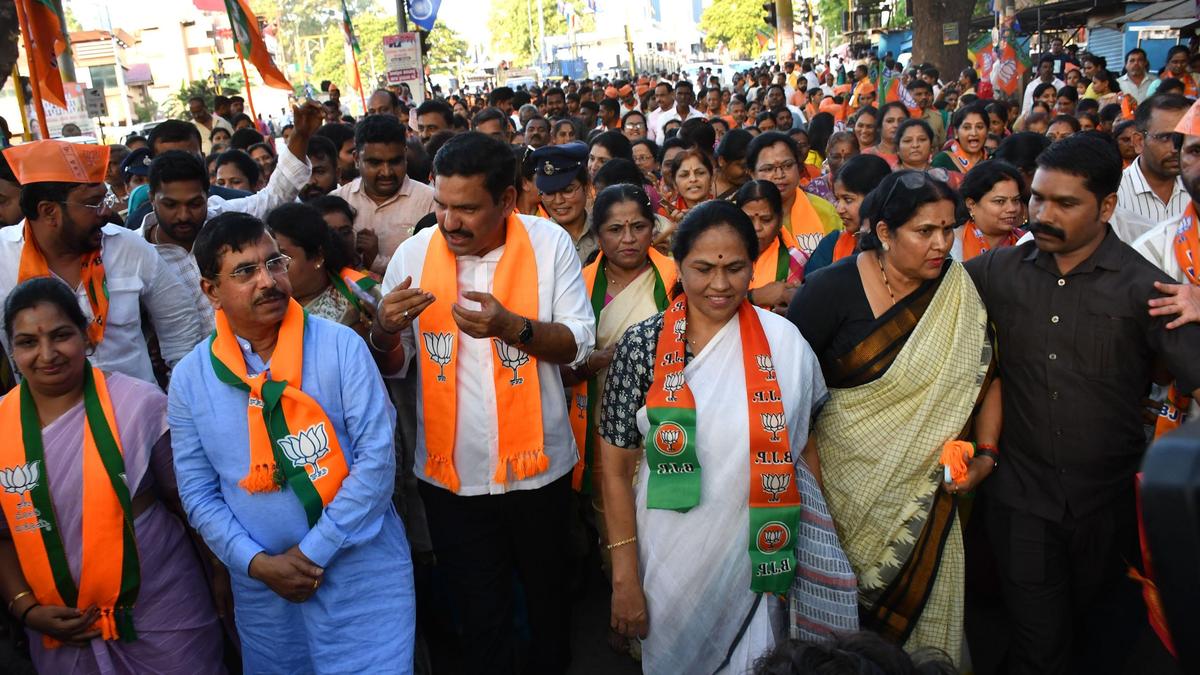
The BJP is using Hubballi protests to pin blame for delays on women's reservation onto Congress in Karnataka, sharpening its women's quota political offensive.
India
Odisha's Women's Reservation Debate
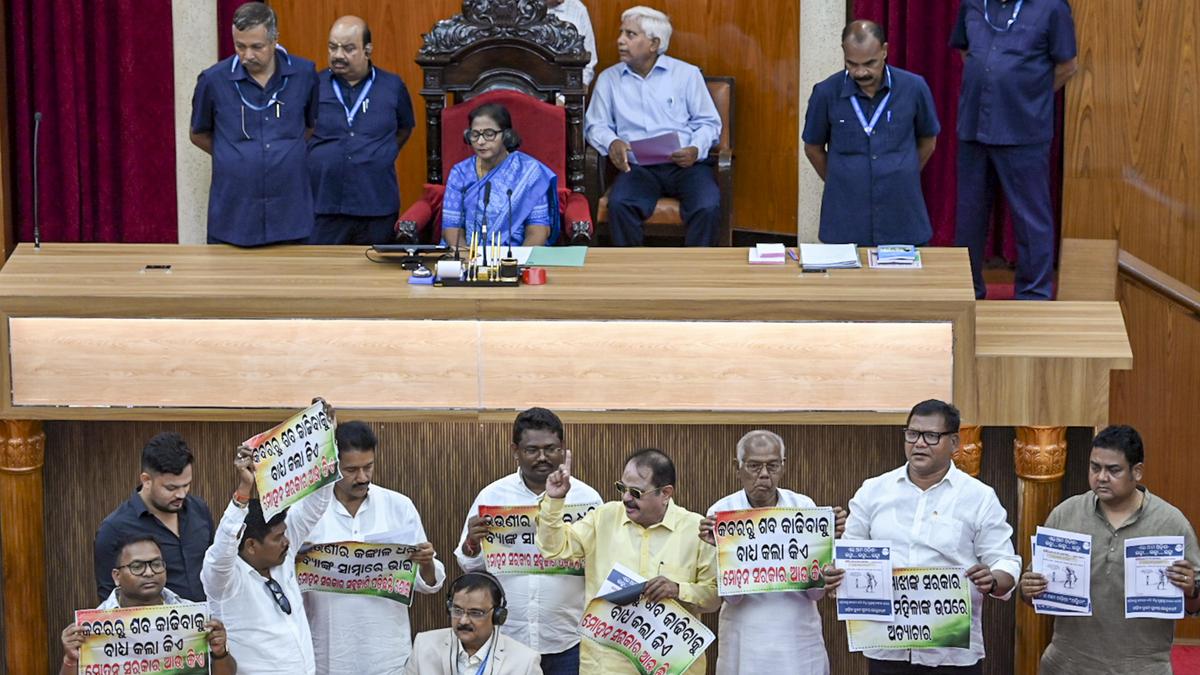
The fight over women's reservation in Odisha is shaping up as a calculated BJP and BJD strategy aimed squarely at gaining ground before the 2029 elections.
India
Uttarakhand's Push for Women's Reservation
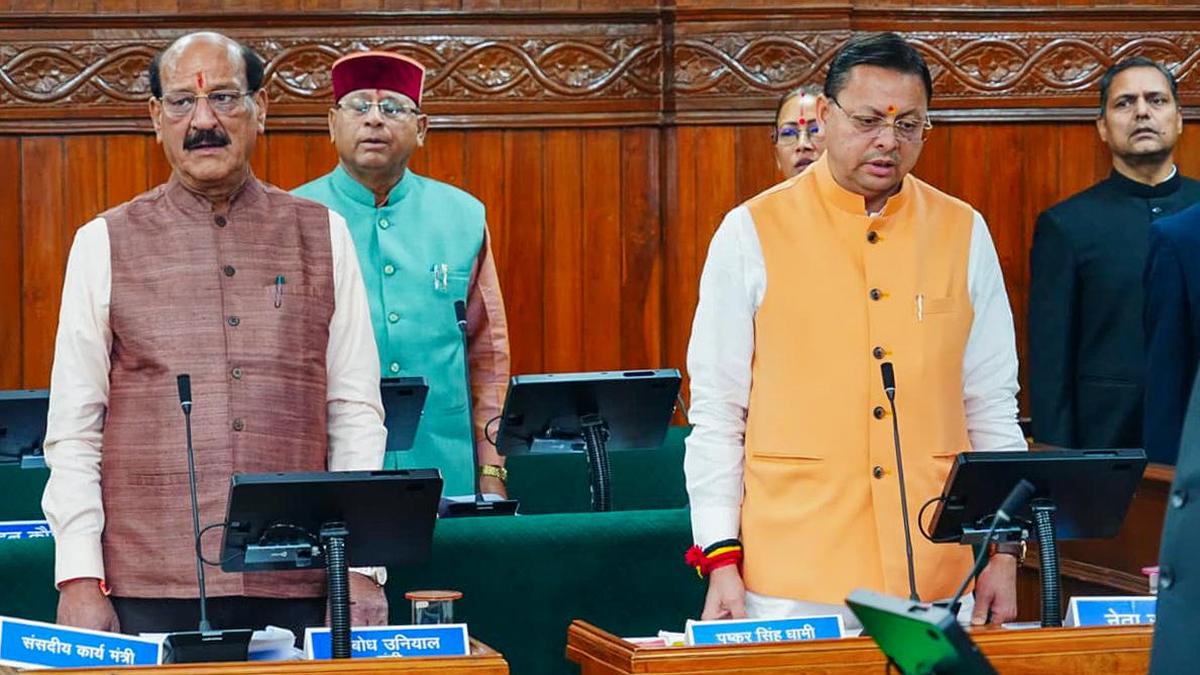
Uttarakhand CM Dhami's push for women's reservation is a strategic political move that follows national defeat and aims to reclaim momentum for the BJP.