Congress Approval Plummets to 10% Historic L
Gallup poll shows Congress at 10% approval amid crises.
Model Diplomat7 min readUnited States

Congress Approval Craters to 10% — A Historic Low With a Ballot-Box Twist
Gallup's April 2026 poll puts Congress at 10% approval and 86% disapproval — tying the record — as a 76-day DHS shutdown, ethics resignations and an Iran war-powers fight collide.
Americans' approval of the 119th Congress fell to 10% in Gallup's April 1–15 poll, one point above the all-time low of 9% recorded after the 2013 shutdown, while disapproval climbed to 86%, tying the record set in 2011, according to Gallup. The number itself is not the story. The story is that this collapse is being driven by Republican voters abandoning a Republican-run Congress they cheered fifteen months ago — and it is happening precisely as the Economist's forecast gives Democrats a 5-in-6 chance of flipping the House in November. The 10% figure is not a protest against gridlock in the abstract; it is a leading indicator that the majority owns this Congress, and is about to be punished for it.
The collapse is asymmetric — and that is the whole point
Congress-hates-Congress polls usually flatten partisan differences. This one does the opposite. Gallup's own trend line shows Republican approval of the 119th Congress surged to 63% in March 2025 after President Donald Trump's inauguration, then fell off a cliff. Democrats sit at 3% — statistically indistinguishable from their all-time low of 2% recorded last August. Independents hold steady at 11%. The 21-point plunge from the March 2025 peak of 31% overall is almost entirely a Republican defection story, per Gallup's write-up.
That matters because of a finding buried in the political-science literature. Analysis in the American Journal of Political Science by John Aldrich and colleagues shows that low congressional approval selectively erodes the vote share of majority-party incumbents, and that this effect has grown as polarization has increased, according to Aldrich et al.. Translation: the more the electorate sorts Congress's performance onto the party label, the more the 10% approval reading behaves like a targeted weapon aimed at House Republicans defending 220 seats.
The 2013 comparison is instructive but misleading. That 9% low followed a 16-day shutdown under divided government, when voters could plausibly diffuse blame, as The Hill noted in its write-up of the new Gallup numbers. The 2026 low is arriving under unified Republican control of the White House, Senate and House — a governance configuration in which blame-diffusion is much harder.
What actually caused the number
Gallup identifies four proximate drivers. Take them in order.
The DHS shutdown. Funding for the Department of Homeland Security lapsed on February 14, 2026, and did not reopen until President Trump signed a Senate-passed spending bill 76 days later on April 30, ending what the BBC called "the longest partial shutdown in US history." At its peak, more than 3,560 TSA officers called out on a single Friday — 12.35% of the workforce — with wait times in some airports topping 40% absentee rates, according to
NPR's reporting. This came only months after the fall 2025 full-government shutdown, itself the longest in modern history. Three of the five worst disapproval peaks Gallup has recorded since 1974 have coincided with shutdowns; this one delivers two in six months.
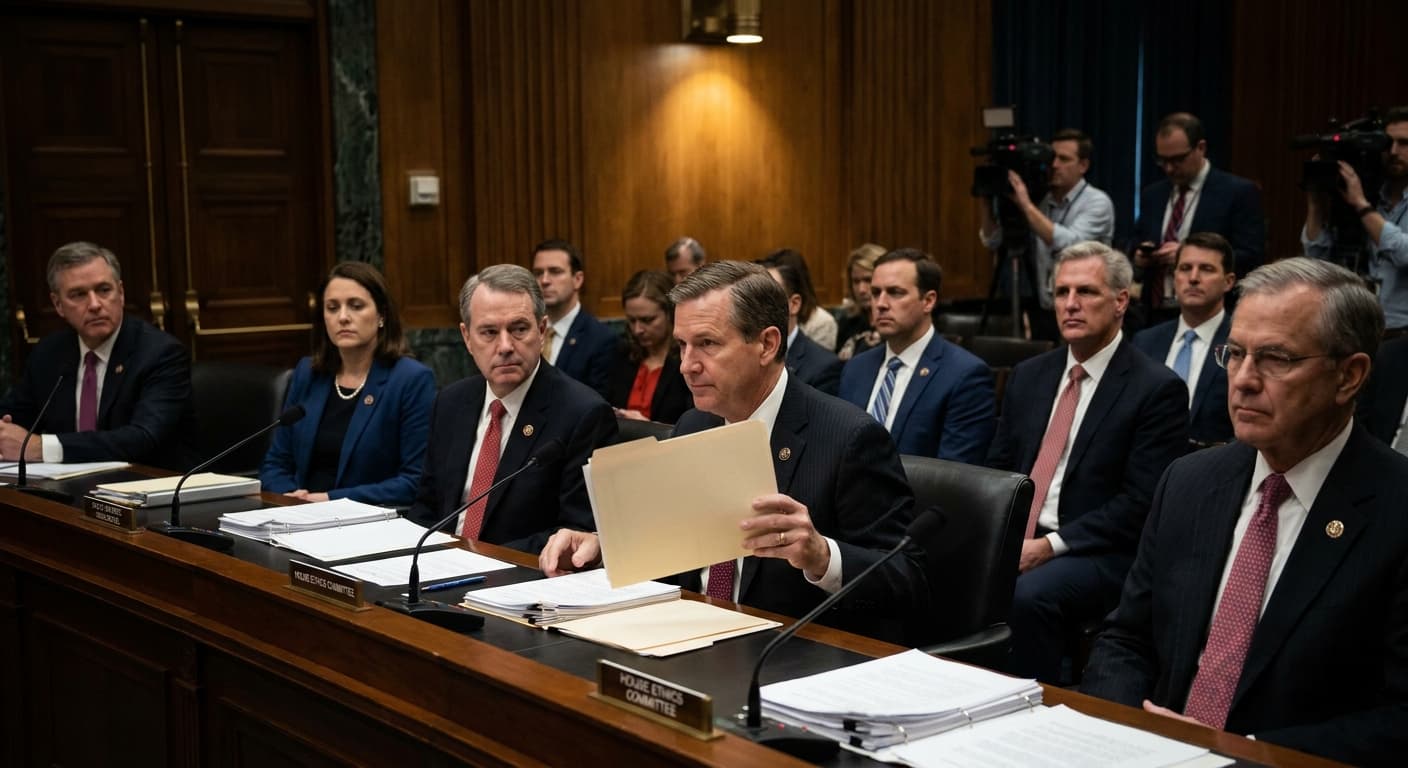
Ethics implosions. Between April 13 and April 22, 2026, three House members resigned rather than face expulsion: California Democrat Eric Swalwell over sexual misconduct allegations, Texas Republican Tony Gonzales over an admitted affair with an aide, and Florida Democrat Sheila Cherfilus-McCormick over a federal indictment for allegedly diverting disaster-relief funds. A fourth, Florida Republican Cory Mills, remains under Ethics Committee investigation. Had all four been expelled, that would have exceeded the total number of House expulsions in the past 165 years combined, NPR reported. The Gallup field period closed with resignation headlines still running.
Iran war-powers rupture. On June 3, 2026, the House passed a war-powers resolution demanding removal of U.S. forces from hostilities with Iran by 215–208, with four Republicans crossing the aisle, per NPR. On June 23, the Senate passed a companion measure 50–48, again with four GOP defections, according to
Al Jazeera. It is the first war-powers resolution to clear both chambers — a rebuke of a Republican president by a Republican-run Congress, and one that fell outside Gallup's field window but is priced into subsequent polling.
The SAVE Act frustration. Gallup explicitly cites Republican anger that the Safeguard American Voter Eligibility Act, which passed the House 220–208 on April 10, 2025, per the Office of the Clerk, has stalled in the Senate. The bill,
H.R. 22, would require documentary proof of citizenship for federal voter registration. Its Senate stall is the mechanical reason a chunk of the March 2025 GOP peak of 63% approval has bled away.
The productivity number that makes the poll defensible
Congressional productivity is not the primary driver of the poll — but the underlying data hardens the story. Between January 3 and March 31, 2026, the House was in session 47 days and the Senate 53 days, and the two chambers enacted just 13 public laws combined, according to the Congressional Record. GovTrack's cumulative counter for the entire 119th Congress records 102 enacted laws to date, tracking well below the 118th's own historically low pace, per
GovTrack. Congress is not gridlocked in the sense of being idle — it introduces bills at a normal clip — it is gridlocked at the finish line, where enactment happens. That is the shape of a legislature the public has stopped taking seriously.
The non-obvious beneficiary: House Democrats — but with a ceiling
Conventional wisdom holds that 10% approval simply means "throw them out." The empirical record is more specific. The Aldrich study finds that when Congress is deeply unpopular, majority-party incumbents suffer a measurable vote-share penalty, while minority-party incumbents gain, and that "these electoral effects hold largely irrespective of a member's individual party loyalty or seat safety," per the AJPS analysis. Institutional research reaches the same conclusion — 80% of voters who approve of Congress vote for the incumbent, versus 67% among disapprovers, according to
Political Research Quarterly.
Democrats already lead the generic ballot 52%–42%, an NPR/PBS News/Marist survey found, with 61% "very enthusiastic" versus 53% of Republicans, per NPR. The Economist's model as of July 2026 puts a Democratic House takeover at 84% probability with a median gain of 21 seats, per
The Economist.
The ceiling: redistricting. Republicans have secured mid-decade map changes in Louisiana, Tennessee, Virginia and potentially Florida after a Supreme Court ruling that further weakened the Voting Rights Act, with the Cook Political Report estimating a GOP net gain of five to fourteen seats from redistricting alone, per NPR. This is the structural counter-current against the 10% number: the electorate can hate Congress at record levels, and the map can still absorb most of the blow.
The historical parallel that reframes the polling
The instinct is to compare 2026 to 2013's 9% low. The better analog is 1994. That year, congressional disapproval hit 73% in October, Democrats controlled all three elected branches, a highly polarized electorate treated a midterm as a referendum on the majority, and Republicans gained 54 House seats — the sharpest partisan shift in half a century. Hibbing and Tiritilli's study of 1994 concludes that "public disapproval of Congress can be dangerous to majority party candidates," a point revisited in the SAGE analysis.
The paradox scholars call "Fenno's paradox" — people hate Congress but re-elect their own member — has softened as partisanship has hardened. A 2021 study in Personality and Social Psychology Bulletin found that voters process negative information about Congress categorically, not individually, but the incumbency shield is far weaker in a polarized environment. Carlos Algara's 2024 review of a century of congressional elections concludes that "the incumbency advantage largely disappeared as a salient component of election outcomes for both chambers as partisanship increasingly shapes these outcomes," per the
Journal of Political Marketing. In 1994 individual reputations still bought incumbents some protection. In 2026 they will buy less.
What to watch next
- September 30, 2026: Fiscal year 2026 funding for ICE and CBP expires; the second reconciliation bill Senate Majority Leader John Thune and House Speaker Mike Johnson promised in April will need to clear the Senate or trigger another shutdown standoff six weeks before Election Day.
- Late July 2026: An expected Trump veto of the Iran war-powers resolution, followed by veto-override votes; four Republican defections in each chamber leave overrides mathematically impossible but politically corrosive.
- August–October 2026: House Ethics Committee ruling on Rep. Cory Mills; any additional resignation before Election Day tightens the House GOP margin, currently the slimmest in modern memory.
- November 3, 2026: The midterm itself. Watch the House popular vote margin, not the seat count — Aldrich's model predicts majority-party bleeding shows up in vote share first, seat totals second.
Diplomat View
The 10% approval number is not a mood reading; it is a mechanical warning light. In a polarized, unified-government configuration, when the majority party's own voters defect from Congress at the scale Gallup measured in April, the seat-level consequences are asymmetric and forecastable. The base case: Democrats retake the House by 15 to 25 seats, absorb five to ten seats of redistricting damage, and finish with a working majority narrow enough to constrain but not reverse the Trump agenda. That forecast revises if two conditions change: a September funding deal that avoids a third shutdown of the 119th Congress, and a demonstrable Republican legislative win — the SAVE Act clearing the Senate, or a China or immigration package with visible enactment — that lets GOP voters re-attach to the party label before ballots print. Absent both, the 10% number is not the floor. It is the forecast.
The Bottom Line
Congress hitting 10% approval matters because the collapse is Republican-driven, and Republicans run Congress. Fifteen months of shutdowns, ethics resignations and a war-powers rebuke have detached the GOP base from the institution its party controls — and the political-science evidence says that specific pattern, in a polarized system, translates into majority-party seat losses that redistricting can dampen but not offset.
Discover more
US Politics
House Ethics Committee Pushes Sexual Miscond.
The House Ethics Committee has shifted responsibility for sexual harassment settlement records to the Office of Congressional Workplace Rights, complicating disclosure efforts.

Conflict & Security
Drone Warfare Killing Aid Workers at Unprec
Over 1,000 humanitarian workers killed in three years as cheap armed drones collapse legal protections. Gaza, Sudan, Ukraine, and DRC see deliberate targeting of aid convoys and hospitals with zero prosecutions.

Global
World Normalises Taliban as Afghan Women Eras
UN data shows Afghan women erased from public life as Russia recognises the Taliban, EU hosts officials in Brussels, and ICC warrants for gender persecution go unenforced.

Conflict & Security
West Africa Food Crisis: Three Shocks in 2026
Conflict, climate extremes, and the Strait of Hormuz closure drive a severe food crisis in West and Central Africa, with fertilizer prices surging 80% and millions displaced.