Congo Ships First Lithium, Beijing Wins Race
Zijin ships first-ever Congolese lithium as U.S. strategy stalls
Model Diplomat6 min readAfrica
Congo Ships First Lithium, and Beijing Wins the Race Washington Said It Would Contest
The DRC's first-ever lithium exports are now en route to China. Zijin Mining did not wait for the legal disputes to resolve, the ICC ruling to be enforced, or Washington's minerals-for-security framework to deliver a single tonne of concentrate. That tells you who holds the leverage — and why the West's entire critical-minerals strategy in Central Africa faces a structural problem no amount of diplomatic deal-making can fix.
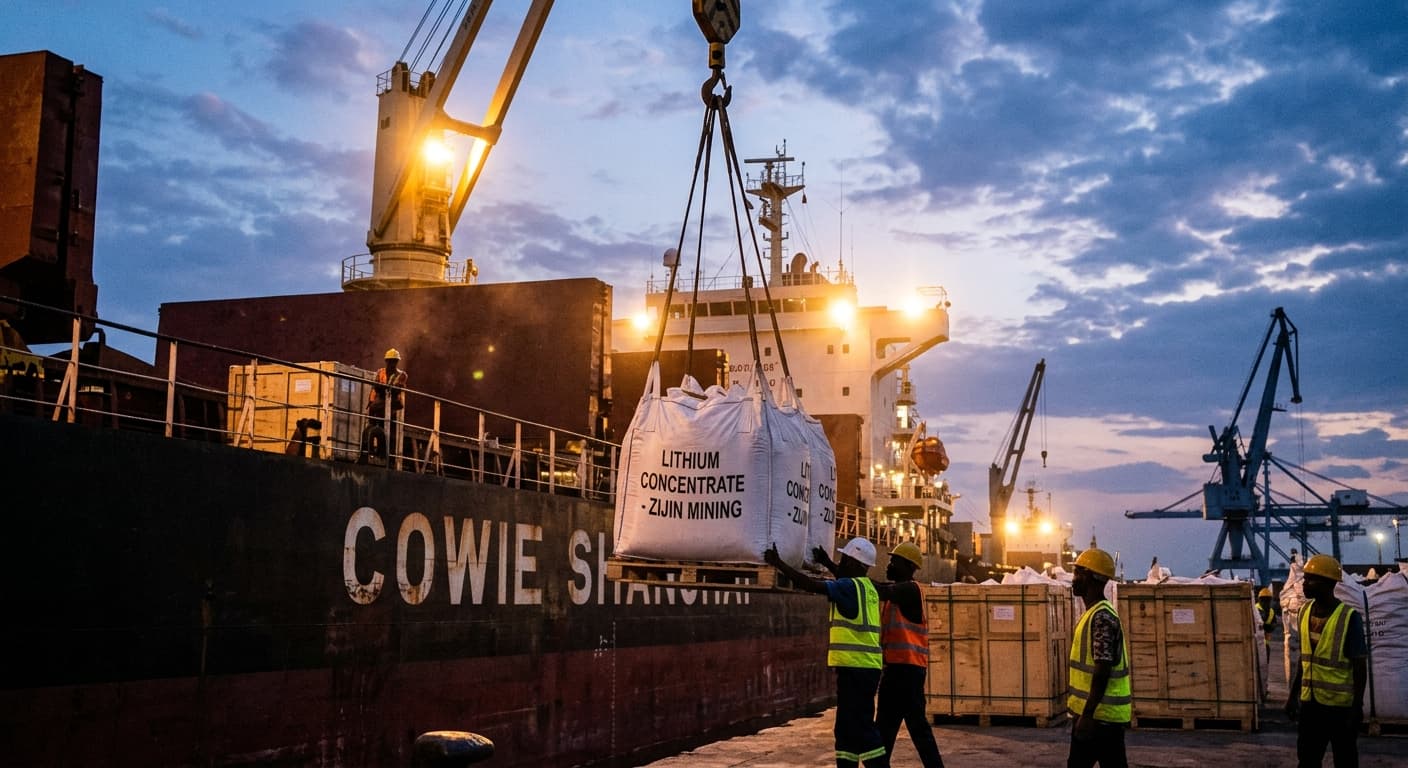
KINSHASA — On a June morning in 2026, trucks carrying spodumene concentrate departed Zijin Mining's Manono site in the Democratic Republic of Congo, bound for the Tanzanian port of Dar es Salaam and, ultimately, Chinese refineries. The shipment, the DRC's first lithium export in its history, marks the moment the world's most mineral-rich but chronically unstable nation joined the battery-metals supply chain. It also marks the moment China locked in a first-mover advantage over the United States in Congolese lithium — not through diplomacy, but through the brute fact of production.
Zijin Mining Group, the Chinese state-linked conglomerate that holds a 54.9% stake in the Manono joint venture, confirmed the trial shipments departed in June and will reach Chinese processing facilities by October 2026, according to Skillings Mining Intelligence. Production at the site commenced in May, with the company targeting 30,000 tonnes of lithium carbonate equivalent (LCE) for the year. The remaining equity is held by the state-owned Cominière (35.1%) and the Congolese government directly (10%), giving Kinshasa a combined 45.1% stake — a fiscal arrangement that aligns the DRC's interests tightly with Zijin's continued operation.
The shipment lands in a lithium market that has staged a dramatic recovery. After bottoming near $600 per tonne of 6% spodumene concentrate (SC6) in mid-2025, prices surged roughly 90% to around $1,600 by year-end, supported by China's suspension of domestic production and Zimbabwe's export ban, according to company filings from Savannah Resources, a European lithium developer. Spot prices in mid-2026 now sit in a range of $2,080 to $2,340 per tonne — a level that makes even high-cost African projects commercially viable. Zijin is shipping into the strongest spodumene market in two years.
A Logistics Corridor Built for One Customer
The supply chain from Manono to China is not merely long — it is a feat of industrial persistence that explains why no Western company attempted it first.
Concentrate is trucked 440 kilometers from the landlocked site to the lakeside port of Kalemie. From there, a dedicated fleet of cargo vessels crosses Lake Tanganyika to Kigoma, Tanzania. The material then travels overland to Dar es Salaam for ocean freight to Chinese ports. The entire transit takes roughly four months from mine gate to refinery.
Zijin has sunk approximately $1 billion into infrastructure to make this corridor functional, including roads, port facilities, and vessels, according to Skillings Mining Intelligence. That sunk cost is now the single most important fact about Manono: it makes unwinding the project through litigation or regulatory action extraordinarily expensive — and therefore unlikely. The logistics route runs entirely through territory the DRC and Tanzania control, meaning China is not reliant on the U.S.-backed Lobito Corridor, the flagship Western infrastructure play that has mobilized over $4 billion but whose rail link to Manono does not yet exist.
The contrast is instructive. The Lobito Corridor — a 1,300-kilometer rail project linking Angola's Atlantic port to the DRC's Copperbelt — has been the centerpiece of successive U.S. administrations' Africa strategy. The Trump administration expanded the project, with the U.S. International Development Finance Corporation signing a $753 million financing package in December 2025, described by its CEO as noteworthy for "its unprecedented scale and strategic significance," according to Al Jazeera. But the corridor's remit is copper and cobalt from the south. Lithium from Manono, in the northeast, moves through an entirely separate logistics chain that China controls from pit to port.
The Legal War That Did Not Stop Production
The lithium now sailing toward China comes from a deposit that remains at the center of one of Africa's most consequential mining disputes. The Manono license was originally held by Australian junior AVZ Minerals, which had secured rights to what it described as the continent's largest undeveloped hard-rock lithium resource. In 2023, the DRC government revoked those licenses and subsequently awarded development rights to Zijin.
AVZ fought back on multiple fronts. On March 14, 2025, the International Court of Arbitration of the International Chamber of Commerce ordered DRC's state-owned Cominière to pay a €39.1 million ($42.46 million) penalty for failing to comply with previous rulings related to the Manono license, according to the Council on Foreign Relations. It was a legal victory — but it did not halt Zijin's development.
The parallel ICSID arbitration — AVZ International Pty Ltd., Dathcom Mining SA, and Green Lithium Holdings Pte Ltd. v. Democratic Republic of the Congo (Case No. ARB/23/20) — has limped through procedural suspensions, arbitrator resignations, and a reconstituted tribunal as recently as March 20, 2026. The proceeding is currently suspended until July 3, 2026, under the parties' agreement, according to the ICSID case docket. The practical effect is unmistakable: Beijing's champion is shipping concentrate while the claimants are still fighting over jurisdiction. Every tonne that leaves Kalemie deepens the factual reality on the ground — production that a future tribunal cannot easily reverse.
Meanwhile, U.S.-backed KoBold Metals, which holds an adjoining license in the Manono district, has frozen development entirely until the ownership disputes are resolved. A spokesperson for the KoBold-backed venture stated explicitly that the company "will not proceed with development until all legal disputes around Manono are resolved," according to Skillings. The contrast in posture captures the asymmetry that defines the competition: Chinese state-backed capital absorbs legal risk as a cost of doing business; Western capital, answerable to shareholders and due-diligence committees, treats unresolved title as a showstopper.
Washington's Framework: Diplomatic Wins, No Tonnes
The DRC-Rwanda peace deal brokered by the Trump administration in December 2025 was supposed to change this calculus. The agreement included an economic component directly linking security guarantees to mineral access. Kinshasa signed a strategic partnership granting "U.S. aligned persons" — the agreement's own term — the right to bid first on certain critical minerals projects, as detailed by Foreign Affairs.
Congo delivered quickly on its end. The state miner Gécamines and Swiss commodity trader Mercuria announced a joint venture backed by the DFC to market cobalt, copper, and critical minerals to U.S. buyers. Gécamines exercised rights to purchase 100,000 tons of copper from the Tenke Fungurume mine for U.S. export. Virtus Minerals, a U.S. firm founded by former military and intelligence officials, moved to take over the copper and cobalt assets of Chemaf, a Dubai-based miner.
But none of this touched lithium. The Manono project sits outside the framework entirely — already committed to Zijin before the ink dried on Washington's deal. As Foreign Affairs noted in a July 2026 assessment, "even a huge expansion in U.S. presence is unlikely to displace Chinese supply chains in Africa. Over two-thirds of Congo's copper and cobalt exports go to China; over half the continent's bauxite, manganese, tantalum, and tungsten follow the same route."
The deeper structural problem is that China does not merely own the mines — it owns the processing capacity. By 2027, Chinese domestic plants will account for 81% of global spodumene refinery production, with only 15% of capacity not controlled by Chinese companies, according to Wood Mackenzie. This means even if Western firms were to extract lithium in the DRC, the concentrate would still likely flow to Chinese refineries for conversion into battery-grade chemicals.
As the CSIS noted in a May 2026 analysis, the U.S. has been "historically outmaneuvered by China in the DRC, primarily due to China's strategic deployment of financing and coordinated government-to-government engagement," citing the 2016 sale of Freeport-McMoRan's Tenke Fungurume mine to China Molybdenum — a deal in which Chinese state banks provided $2.48 billion of the $2.68 billion in credit, according to CSIS.
| The Numbers Behind Manono's First Exports | |
|---|---|
| Zijin Mining infrastructure investment at Manono | $1 billion — Roads, Kalemie port, Lake Tanganyika cargo vessels, and overland logistics to Dar es Salaam; sunk cost that makes legal unwinding economically prohibitive |
| Spodumene 6% price, mid-2026 | $2,080–$2,340/tonne — CIF China spot range; a ~90% recovery from mid-2025 lows of ~$600/tonne |
| Manono 2026 production target | 30,000 tonnes LCE — First-year target; DMS and flotation circuits ramping through Q3 2026 |
| ICC penalty against Cominière (March 2025) | €39.1 million — Awarded to AVZ Minerals for non-compliance with prior rulings; did not halt Zijin's development |
| China's share of global lithium chemical refining by 2027 | 81% — Per Wood Mackenzie; only 15% of capacity not controlled by Chinese entities |
Discover more
US Politics
House Ethics Committee Pushes Sexual Miscond.
The House Ethics Committee has shifted responsibility for sexual harassment settlement records to the Office of Congressional Workplace Rights, complicating disclosure efforts.
Global Politics
Trump's Conflicting Messages on Iran War
Trump's mixed messages on Iran reflect a strategy of audience management, benefiting Tehran amid a complex geopolitical landscape.

India
India-South Korea $50B Trade Expansion Plan
India and South Korea target $50 billion in bilateral trade by 2030, focusing on industrial cooperation and strategic alignment amid US pressures.

Conflict & Security
Drone Warfare Killing Aid Workers at Unprec
Over 1,000 humanitarian workers killed in three years as cheap armed drones collapse legal protections. Gaza, Sudan, Ukraine, and DRC see deliberate targeting of aid convoys and hospitals with zero prosecutions.