ConCourt Invalidates Refugees Act Clauses
Court ruling amid rising anti-migrant violence in South Africa
Model Diplomat8 min readAfrica
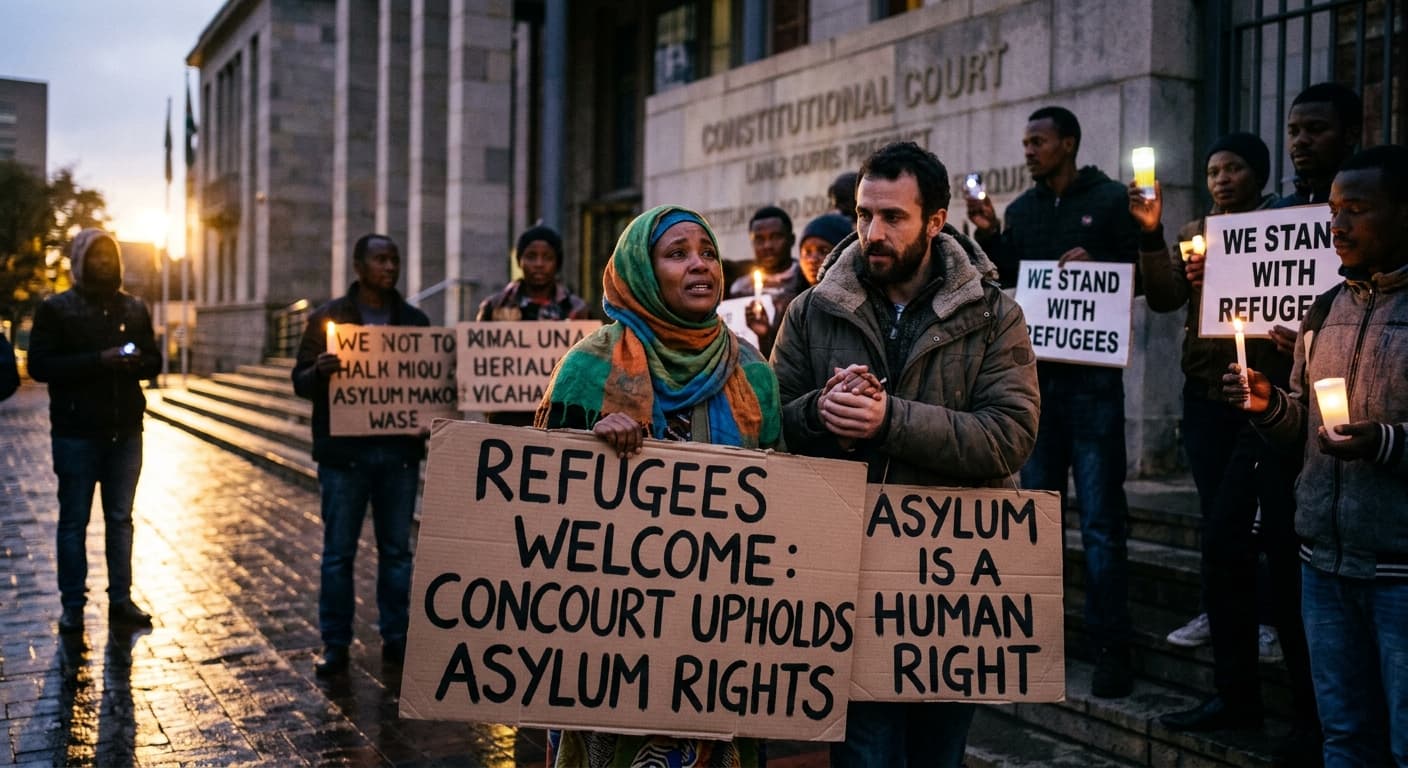
ConCourt strikes down key Refugees Act clauses as xenophobic crisis peaks
South Africa's Constitutional Court unanimously invalidated procedural bars in the Refugees Act on July 7, 2026, reaffirming non-refoulement as anti-migrant protests kill at least seven.
South Africa's Constitutional Court on July 7, 2026 unanimously struck down four sections of the Refugees Act and eight related regulations that had allowed officials to refuse asylum applications on procedural grounds alone — a ruling that, delivered a week after nationwide anti-migrant marches left at least seven foreigners dead and forced thousands to flee, forces the Ramaphosa government to defend refugee protection at the precise moment its coalition partners are campaigning against it. The judgment in Scalabrini Centre of Cape Town v Minister of Home Affairs (CCT 126/2025) reasserts a constitutional floor beneath asylum access that the executive has spent six years trying to lower — and it lands on the desk of a Home Affairs minister, Leon Schreiber of the Democratic Alliance, who has publicly framed the refugee system as one to be defended against "abuse."
What the Court actually decided
The apex court confirmed a 2025 Western Cape High Court order invalidating sections 4(1)(f), 4(1)(h), 4(1)(i) and 21(1B) of the Refugees Act, together with regulations 8(1)(c)(i), (2), (3) and (4) of the Refugee Regulations GNR1707. Under those provisions, asylum seekers who entered through unofficial ports of entry, or who failed to report to a Refugee Reception Office within five days, had to demonstrate "good cause" before their claim could even be examined. Those who could not — because they had no documents, missed the deadline, or simply could not reach one of the three functioning reception offices — faced deportation without any consideration of the merits of their claim, the applicants' lawyers explained in a statement carried by Inside Politics.
The Court held that procedural non-compliance "cannot be used as a threshold requirement for accessing the asylum system," reaffirming the principle of non-refoulement — the rule against returning a person to a country where they face persecution — as constitutionally binding on South African officials. According to the Helen Suzman Foundation's media statement, the judgment expressly agreed with the High Court that the impugned provisions "violate the fundamental rights at the heart of non-refoulement, including the rights of children."
The Court went further. In an unusually pointed passage, it criticised the Department of Home Affairs for making unsupported claims about Afghan and Bangladeshi asylum seekers in its papers, warning against "rhetoric that risks being perceived as xenophobic or racially charged." It also imposed a punitive costs order against the Minister and the Director-General — costs of two counsel — after finding the state had litigated "exceptionally poorly," according to the HSF's summary of the judgment.
The political timing is the story
The ruling arrives in the middle of the worst wave of anti-migrant mobilisation since 2019. Beginning in April, protest groups organising under banners like "March and March" set an unofficial June 30 deadline for undocumented migrants to leave the country. Mozambique's government has confirmed that five of its nationals were killed in Mossel Bay attacks in late May, with Al Jazeera reporting that around 800 Mozambicans were caught up in the violence and repatriated. A 29-year-old Malawian was killed near Pietermaritzburg on June 19, and more than 3,000 Malawians camped in an open field in Durban awaiting repatriation, according to further
Al Jazeera reporting. On June 30,
Al Jazeera documented more than 900 arrests as police deployed nationally against demonstrators.
President Cyril Ramaphosa responded with a televised address unveiling a five-point crackdown: jailing employers of undocumented workers, dedicated deportation courts, biometric registration "for every person in the country," discontinuation of the green ID book, and — most consequential for this ruling — the relocation of refugee reception centres to border posts. The BBC reported that Ramaphosa said the Border Management Authority had intercepted "over 450,000 people" attempting to enter illegally in the past year, and that 40,000 illegal immigrants had been arrested this year alone, per the ministerial task team on migration cited by the
BBC.
Against that backdrop, the ConCourt's reaffirmation of non-refoulement is not a technical administrative-law correction. It is a constitutional constraint on the executive's manoeuvring room three months before the November local elections — elections in which the ANC, the DA, and Jacob Zuma's MK party are all competing for votes in KwaZulu-Natal and Gauteng constituencies where anti-migrant sentiment is loudest.
The Helen Suzman Foundation's argument, and why it matters
The Helen Suzman Foundation, admitted as amicus curiae in both the High Court and the Constitutional Court, argued that the impugned provisions produced a "double harm" for children of asylum seekers — erasing their independent status as rights-holders and stripping them from procedural processes affecting them. The Court accepted the argument, agreeing that the provisions "unjustifiably limit the constitutional rights of children who are illegal foreigners while living in South Africa."
That framing is the crux of the HSF's broader point, made publicly on July 8: the ruling should cool rather than inflame the illegal-immigration debate, because it clarifies that the constitutional line runs between undocumented economic migrants (who may be deportable) and asylum seekers (who cannot be turned away at the door of the system). By forcing Home Affairs to actually process claims rather than warehouse them, the judgment removes one of the largest sources of "illegal foreigners" in the country — the roughly 200,000-plus asylum seekers whose applications the department has left in a decade-long limbo. Amnesty International's 2019 report documented rejection rates above 96%, appeal queues of up to 19 years, and RSDO backlogs of roughly 190,000 outstanding decisions — a system that, by the Amnesty findings, cannot distinguish a genuine refugee from an "illegal foreigner" fast enough for either category to matter.
The BBC recently reported that South Africa hosts more than 167,000 refugees and asylum seekers, primarily from Burundi, the DRC, Somalia, South Sudan, Rwanda and Zimbabwe, per UNHCR figures cited in its June 2026 coverage of a separate ConCourt refugee ruling. That population sits inside a country of roughly 2.4 million migrants overall — a scale that the state has, on its own admission, never fully counted.
The angle: judges vs. legislature — again
This is the second time in six months the Constitutional Court has intervened decisively in the refugee regime, and the pattern is worth stating plainly. In the earlier case, the same court sided with the government against Burundian applicants, ruling that rejected asylum seekers cannot lodge unlimited repeat applications — a decision Schreiber welcomed as a "major victory" against system abuse, per the BBC. In the July 7 judgment, the court moved sharply the other way, striking down the executive's preferred procedural gatekeeping.
The two rulings, read together, describe a court trying to hold the middle: closing off one avenue for indefinite non-removal while opening the front door of the asylum process wider. That balance mirrors an academic argument advanced by Fatima Khan and others in the Constitutional Court Review, which held that key Refugees Amendment Act 2017 provisions were vulnerable to constitutional challenge precisely because they collapsed the distinction between "asylum-seeker" under refugee law and "illegal foreigner" under the Immigration Act — see the SSRN version of the argument. The July 7 judgment vindicates that thesis. It rebuilds the wall the 2017 amendments had breached.
The pattern also creates a specific political headache. Schreiber, a DA minister in Ramaphosa's ANC-led Government of National Unity, has spent the past year branding himself as a reformer accelerating identity documents and visas — his October 2025 talk at Princeton was titled "Driving Rapid Reform." A costs order against his ministry for litigating "exceptionally poorly," combined with a judicial rebuke for "xenophobic or racially charged" submissions, is not the reform narrative his office has been selling. It is also awkward for the ANC, which has increasingly leaned into border-hardening rhetoric ahead of November.
Who wins, who loses
Winners are narrower than the celebratory headlines suggest. Individual asylum seekers — particularly those who entered irregularly from the DRC, Ethiopia, Somalia, Burundi and Zimbabwe — regain the right to have claims examined on the merits. Child asylum seekers, singled out by the Court's reasoning, gain a constitutional shield against derivative deportation. Civil-society litigants, especially Scalabrini and Lawyers for Human Rights, cement their role as the effective drafters of South African refugee policy through the courts.
Losers include the Department of Home Affairs, which now inherits the backlog the "good cause" bar was designed to prevent from growing; the border-reception-centre plan announced by Ramaphosa, which the Court's reasoning complicates because reception cannot be conditioned on procedural compliance; and anti-migrant protest movements, whose central claim — that undocumented status equals unlawful presence — the Court has just narrowed. The BBC noted that Freedom House, in a January 2020 statement, had warned when the 2017 amendments took effect that they would violate non-refoulement. The July 7 judgment retroactively vindicates that warning.
What to watch
- Home Affairs' remedial response. The Court noted that the state did not request a suspension of the declaration of invalidity or a "reading-in" remedy. That means the provisions are struck immediately, and Home Affairs must issue new directives to Refugee Reception Offices within weeks — the first test of whether Schreiber will comply cleanly or litigate around the edges.
- The border-reception-centre policy. Ramaphosa's plan to relocate reception centres to border posts, announced in his late-June address, must now be reconciled with a judgment that forbids procedural gatekeeping at the point of entry. Cabinet is expected to publish revised regulations before the November 4 local elections.
- The November 4 local government elections. Anti-migrant parties, including MK and smaller populist formations, are likely to campaign against the ruling directly. Watch for parliamentary bills seeking to re-legislate a modified "good cause" test — the Court left that door narrowly open, provided any new test comes with clear statutory guidelines.
- The reception-office backlog. UNHCR and Scalabrini will publish updated processing figures in the coming quarter; the true measure of the judgment is whether the roughly 200,000 pending claims start moving.
The Bottom Line
The Constitutional Court has told the South African state that it may not use paperwork to do what the Constitution forbids it to do openly — turn away asylum seekers without hearing them. Delivered in the same week that mobs killed foreign nationals in the streets of Mossel Bay and Pietermaritzburg, the July 7, 2026 judgment reasserts non-refoulement as a hard legal floor, not a policy preference. The illegal-immigration debate in South Africa is not settled by this ruling — but the line between "illegal foreigner" and "asylum seeker" has been redrawn by judges, and any government that wants to erase it again will now have to say so out loud.
Discover more

Global Politics
US Seizes Iranian Ship, Tensions Surge
The US seizure of the Iranian ship Touska highlights a shift in control over the Strait of Hormuz, favoring Iran's strategic position.

US Politics
SNAP Food Assistance Faces Legal Challenges
In 2026, SNAP faces stricter eligibility rules and mounting legal challenges, threatening food assistance for the millions of Americans who rely on the program.
US Politics
Congress Targets AI Chatbot Access for Terror
The House passed the Generative AI Terrorism Risk Assessment Act, focusing on AI's role in terrorism and potential surveillance implications.

Economics
Fed's Amex AML order puts correspondent banking on notice
Federal Reserve's Amex AML order requires board-level controls and a 90-day plan; OCC fined the bank $350 million over enterprise-wide deficiencies.