Colombia's Peace Accord: A Decade In
Ten years on, Colombia's peace deal shows mixed results.
Model Diplomat7 min readLatin America
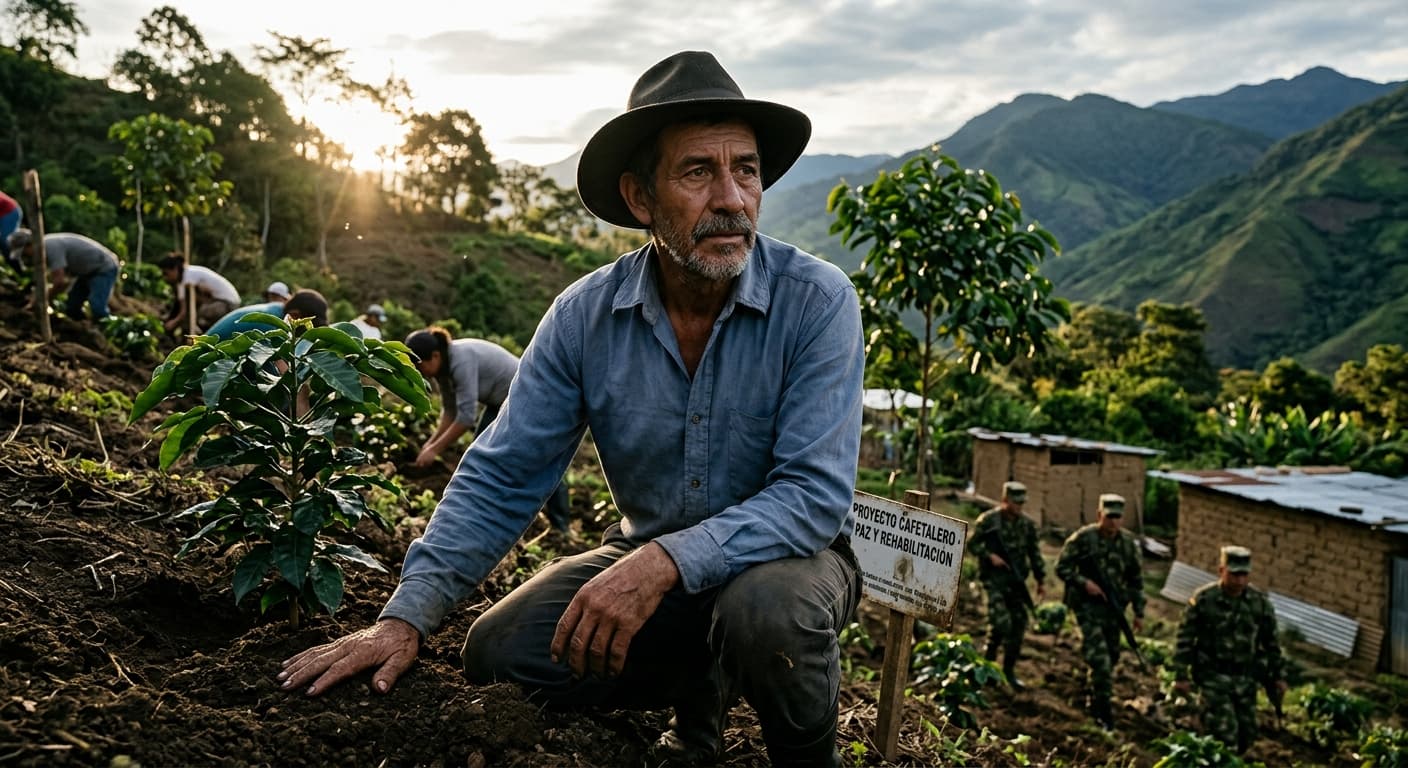
Colombia's peace accord at year 10: partial, but irreversible
Ten years in, Colombia's 2016 peace deal is only 34% implemented — yet its first war-crimes sentences and 3 million hectares of land make reversal costly.
Colombia's 2016 Final Agreement enters its tenth year only about a third implemented, but the pillars already built — the first war-crimes convictions of former FARC commanders, the reintegration of more than 11,000 ex-combatants, and the formalisation of roughly three million hectares of rural land — have made the accord too structurally embedded for any successor government to unwind cheaply. That is the operative fact heading into the 7 August handover to president-elect Abelardo de la Espriella, the Trump-endorsed far-right lawyer who won the 22 June runoff by 0.94 percentage points and campaigned to bury Gustavo Petro's "Total Peace." The accord's slow half-life is now Colombia's — and the region's — main firewall against a return to the pre-2016 conflict map.
What has actually been built
The load-bearing achievements are institutional, not territorial. In September 2025, the Special Jurisdiction for Peace (JEP) handed down the first restorative sentences under the accord: seven members of the former FARC Secretariat — including former commander Rodrigo Londoño — were sanctioned to eight years of reparations work for a systematic policy of hostage-taking involving more than 20,000 victims, according to UN News. Two days later, the JEP sentenced 12 army officers for their role in 135 "false positive" killings on the Caribbean coast,
Al Jazeera reported — the first individual sentences ever imposed on state agents for conflict-era crimes.
Reintegration is the second load-bearing pillar. In his 23 January 2026 briefing to the Security Council, UN Special Representative Miroslav Jenča told ambassadors that nearly 11,000 signatories remain active in the reintegration pathway a decade after signing, according to the UN meetings press release. Colombia's ambassador Leonor Zalabata added, at an earlier October 2025 briefing, that the state had formalised more than three million hectares of rural land and recognised Indigenous and Afro-descendant territories under the accord's ethnic chapter,
per UN News.
The Colombian delegate at the January Security Council meeting framed the argument in operative terms: "peace in Colombia can only be consolidated through the full implementation of the 2016 peace agreement," Vice-Minister Mauricio Jaramillo Jassir told the Council, again via the UN's meeting record.
The gap between paper and territory
The scoreboard, though, is unsentimental. The Kroc Institute at Notre Dame — mandated by both signatories to track the 578 discrete commitments — reports only 34% of the accord's provisions fully implemented as of its November 2024 baseline, according to CIDOB's synthesis of the Kroc data. Gender commitments sit at 13% completed with 17% never initiated; the ethnic chapter is worse, with 13% completed and 61% at minimum implementation.
The comprehensive rural reform — the accord's Chapter 1, and the single provision most tied to the roots of the conflict — is the slowest pillar. Colombia's Fundación Ideas para la Paz calculates that only 17.9% of the annual budget required for the Programas de Desarrollo con Enfoque Territorial (PDETs) has actually been executed on average since 2016; only 17.3% of registered victims have received indemnification, meaning at current pace the state would need 52.6 years to complete reparations, per FIP's eight-year assessment.
Security remains the accord's open wound. Jenča told the Council 487 former combatants have been killed since laying down arms, 45 of them in 2025 alone. The International Committee of the Red Cross reported in May 2026 that 2025 was the "worst humanitarian year" of the last decade of the conflict, with 235,619 people individually displaced — roughly double 2024 — and 42% concentrated in Norte de Santander, Al Jazeera reported from Bogotá. The number of active combatants across all armed groups more than doubled from about 13,000 in 2022 to roughly 27,000 by end-2025, according to FIP data cited by
Al Jazeera.
The Petro paradox
Petro campaigned on implementing the accord and instead diluted it. His "Total Peace" doctrine — codified in Law 2272 of 2022 — opened simultaneous negotiations with the ELN, two FARC dissident factions (Estado Mayor Central and Segunda Marquetalia), and urban criminal networks. The talks with the ELN collapsed in January 2025 after the group's Catatumbo offensive; talks with the other groups are effectively frozen, the European Parliament Research Service notes in its pre-election briefing.
The Council on Foreign Relations argues that Petro's parallel-tracks approach starved 2016-accord implementation of political oxygen and dedicated budget lines: "implementation again stalled, this time, not as a result of government opposition, but because of disorganization, a lack of dedicated resources, and his prioritization of his Total Peace agenda." Critics on the right, per CFR and the Atlantic Council, add a second-order effect: multiple ceasefires without enforcement gave armed groups room to reorganise and consolidate territory in Cauca, Catatumbo and the Pacific corridor.
Coca is the empirical scoreboard for that failure. Colombia's coca cultivation hit 253,000 hectares in 2023 — up 10% from 2022 — with potential cocaine production up 53%, Fundación Ideas para la Paz reported using UNODC monitoring data. Petro's crop-substitution program (PNIS), created under the 2016 accord, disbursed only 5% of its 2023 budget,
the Atlantic Council flagged in its 2024 evaluation.
The de la Espriella problem — and why the accord probably survives him
Petro leaves office on 7 August. His successor, Abelardo de la Espriella, won by a 250,000-vote margin, campaigning to end peace negotiations outright. "In our government, there will be no peace processes," he said at a Cali rally quoted by Al Jazeera. His platform includes cutting the state apparatus by 40%, resuming fracking, and governing by decree — a shock program the Atlantic Council's regional analysts warn will collide with the Constitutional Court and the State Council,
per their post-election reaction.
But the 2016 accord is not politically equivalent to Total Peace. It is a constitutional commitment — anchored in Legislative Act 01 of 2017, protected through 2031 by successive rulings of the Constitutional Court — with a 15-year implementation horizon that outlives any single administration. The JEP itself, on its own reading, operates through 15 January 2033, as documented in the December 2025 IRRC symposium. Cepeda's Historic Pact remains the single largest bloc in both chambers of Congress; de la Espriella lacks the two-thirds supermajorities that a formal repeal would require.
That is the analyst's read on why the accord's partial implementation is nonetheless "irreversible" in the sense Colombia's foreign minister used the word at the April 2026 Security Council session, captured in the meeting record: a rollback would require dismantling the JEP, defunding reintegration for 11,000 people, expropriating three million hectares of already-titled land, and forfeiting €650 million of accumulated EU peace financing, per the
EPRS pre-election brief. The political cost of that undoing is higher than the cost of neglect — which is the more likely outcome.
Regional stakes
The accord's implementation is no longer just a Colombian question. CFR's analysis argues the drift of Colombia's illegal economies since 2018 has destabilised Ecuador, spilled into the Brazilian Amazon, and enriched cartels as far away as Mexico. The Catatumbo offensive of January 2025 sent tens of thousands of civilians into Venezuela; the Pacific corridor now feeds cocaine flows through Central America to the United States and Europe.
The UN Verification Mission, meanwhile, is being shrunk. Under Security Council resolution 2798 (2025), adopted 31 October 2025 largely at Washington's insistence, the Mission was stripped of its mandates on transitional-justice verification and the ethnic chapter, cut by 200 personnel and 17% in resources, and refocused on three functions only: reintegration, security guarantees, and rural reform. US Ambassador Mike Waltz signalled in October 2025 that "the United States is closely examining this mission's mandate and whether it merits continued UN Security Council support,"
per UN News — a hint that further US pressure to end the Mission entirely is likely under a de la Espriella–Trump alignment.
Key catalysts to watch
- 7 August 2026 — Presidential inauguration. First test: whether de la Espriella retains or dismisses the Peace Accord Implementation Unit (UIAP) and the Alta Instancia para la Implementación coordination body.
- October 2026 — UN Verification Mission mandate renewal. A US-Colombia push to further narrow or terminate the mandate is the sharpest near-term risk to international monitoring.
- JEP macro-cases pipeline — Nine of eleven macro-cases still pending individual sentences. The Case 07 rulings on child recruitment and Case 03 adversarial trials for officers who denied responsibility will test whether restorative justice holds without UN verification.
- Congressional budget cycle, late 2026 — Whether the incoming government funds or defunds the Agencia Nacional de Tierras and Agencia de Desarrollo Rural, whose 2024 budget execution was already 7.2% and 19.9% respectively.
- 2031 constitutional deadline — The formal 15-year horizon of the accord; failure to complete comprehensive rural reform by then will trigger a constitutional accountability question no future government can dodge.
The Bottom Line
The bottom line: Colombia's 2016 peace accord is only a third implemented, but the third that exists — a functioning transitional-justice court, 11,000 reintegrated ex-combatants, three million hectares of formalised land, and a constitutional horizon running to 2031 — is now too expensive to dismantle and too incomplete to consolidate on its own. President-elect de la Espriella can starve the accord of political will, but he cannot repeal it; and that gap between what has been built and what can be undone is, for now, the entire firewall between Colombia's fragile peace and the return of a regionalised conflict.
Discover more
India
Rajnath Singh's Durga Squad for 2026 Polls
Rajnath Singh's Durga Squad promised women's safety in Bengal but has since disappeared from the agenda, revealing BJP's true priorities.
International Relations
Economist Impact Sustainability Week 2026
Economist Impact Sustainability Week 2026 spotlights the energy transition, AI in clean technology, and supply chain resilience as themes for global leaders.
India
BJP's Delimitation Strategy
Congress leader K.C. Venugopal claims the BJP uses women's reservation to advance delimitation, raising fears over electoral fairness ahead of the 2029 polls.

Economics
Fed's Amex AML order puts correspondent banking on notice
Federal Reserve's Amex AML order requires board-level controls and a 90-day plan; OCC fined the bank $350 million over enterprise-wide deficiencies.