Colby's Cusco Speech on Donroe Doctrine
Elbridge Colby redefines U.S. defense strategy in Latin America.
Model Diplomat9 min readAmericas
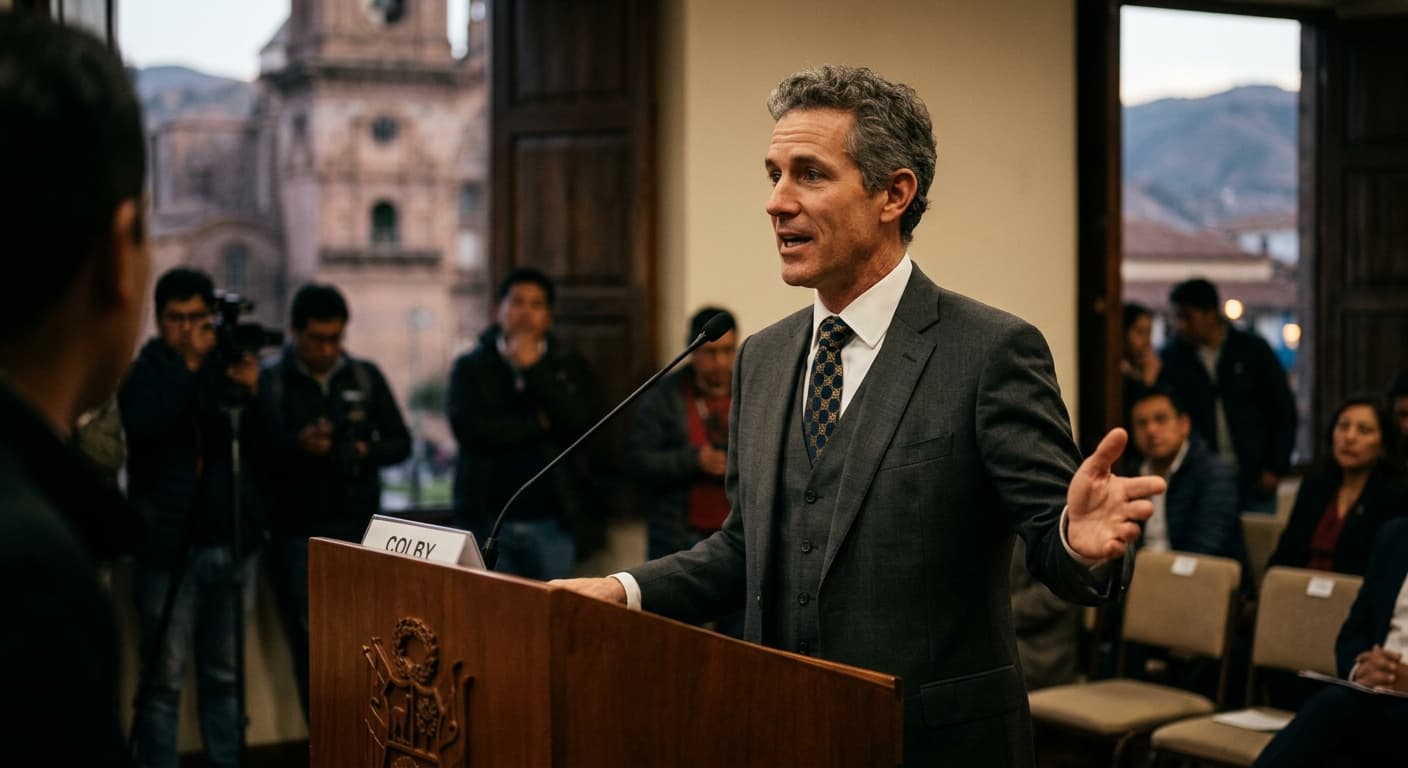
Colby's Cusco Speech Turns 'Donroe Doctrine' Into Burden-Sharing
Pentagon policy chief Elbridge Colby used the July 8 Cusco defense ministerial to convert Trump's Monroe revival into an operational burden-sharing pact for Latin America.
Speaking in Cusco on Wednesday to the Conference of Defense Ministers of the Americas, Pentagon policy chief Elbridge Colby did something the Trump administration had until now avoided: he handed regional governments a bill. The so-called "Donroe Doctrine" — the Trump Corollary to the 1823 Monroe Doctrine, codified in the November 2025 National Security Strategy and the January 23, 2026 National Defense Strategy — was pitched to defense ministers not as a warning but as a burden-sharing framework. Washington will strike drug boats and, as it did in Caracas on January 3, remove hostile governments; Latin American militaries are expected to raise defense spending, sever critical-infrastructure ties to China, and police their own territory to U.S. satisfaction — or invite the alternative. The Cusco speech is the most explicit signal yet that Donroe is no longer rhetoric. It is the operational manual for a hemisphere in which sovereignty has become conditional on alignment.
That has consequences well beyond Venezuela. It restructures the Inter-American system, redirects Pentagon resources away from Europe and Asia, and — counterintuitively — hands Beijing a propaganda gift while sparing it real losses in the region it cares about most.
What Colby actually said in Cusco
Colby addressed the CDMA — a body that includes Canada and every democratically-governed state in the Americas — with prepared remarks that treated the doctrine as settled policy, not proposal. "No longer do we separate America's defense strategy from the concerns of regular Americans — from the flood of lethal drugs into their communities and the accompanying horrendous violence, or from the impact of unchecked illegal migration into our nation," Colby said, according to NewsNation's reporting on the prepared text.
He anticipated the imperial charge and rejected it on economic grounds: "The fact is that America doesn't need your assets or your dependency," he told the ministers, arguing the U.S. is unlike Britain or Portugal because it does not require extraction. In the same breath he told them to "protect your critical assets" from external actors — Pentagon shorthand for Chinese port, telecom and space-station investments — and criticized Latin American governments that spend "less than 1% of GDP" on defense. "There is no reason why any country, particularly those facing significant narco-terrorist threats, should spend so little on defense," Colby said, per the same account.
This is the same speech Colby has given, in different rooms, to NATO and to Ottawa. In Brussels in February he told allies to build a "NATO 3.0" in which Europe assumes "primary responsibility" for its conventional defense. In May he paused U.S. participation in the Permanent Joint Board on Defense with Canada, citing what CSIS called a jab at Prime Minister Mark Carney's Davos
middle-powers speech. The Cusco text extends that template south — the same doctrine of conditional protection, rebranded for a region that until this year had been treated as strategic backwater.
The doctrine has a primary document — and it is harsher than the speech
The Cusco framing is diplomatic. The written strategy is not. The 2026 National Defense Strategy, released January 23, 2026, embeds the doctrine as its first line of effort. The document reads:
"We will engage in good faith with our neighbors, from Canada to our partners in Central and South America, but we will ensure that they respect and do their part to defend our shared interests. And where they do not, we will stand ready to take focused, decisive action that concretely advances U.S. interests. This is the Trump Corollary to the Monroe Doctrine, and America's military stands ready to enforce it with speed, power, and precision, as the world saw in Operation ABSOLUTE RESOLVE."
That is the sentence Latin American ministers in Cusco read before Colby arrived. It links non-intervention to compliance explicitly. The FY2026 defense budget attaches money: $5 billion for operational control of the southern border, roughly 10,000 DoD personnel in border missions, and a counter-drug portfolio targeting the Sinaloa Cartel, Jalisco New Generation Cartel, and cocaine flows from Colombia, Peru and Ecuador, according to
Pentagon comptroller documents. Congress has meanwhile written the doctrine into law: the FY2026 Intelligence Authorization Act requires DNI to deliver a 10-year National Intelligence Estimate on the Western Hemisphere by December 2026, per a
Congressional Research Service report.
The distinction between "engagement" and "focused, decisive action" is what Colombia's Gustavo Petro sees when he tells the BBC there is now a "real threat" of U.S. strikes on Colombian soil, citing his country's historical loss of Panama. It is what Mexico's Claudia Sheinbaum is calibrating when she publicly rejects intervention while quietly cooperating on fentanyl and migration.
The Caracas precedent Colby is monetizing
The lever Colby brought to Cusco was earned on January 3. On that night, 150 U.S. aircraft launched from 20 bases hit Caracas; Delta Force and CIA operatives seized Nicolás Maduro and his wife Cilia Flores from a fortified compound and flew them to the USS Iwo Jima, then to New York. The operation lasted two hours and twenty minutes, hit La Carlota airfield and Fuerte Tiuna, and — according to BBC reporting — was not disclosed to Congress in advance. Cuba said 32 of its nationals guarding Maduro were killed. Brazil's Lula condemned it as "yet another extremely dangerous precedent for the entire international community."
The precedent is what matters now. Operation Absolute Resolve did not just remove Maduro; it demonstrated that the U.S. can extract a sitting head of state from his own capital and lose no aircraft. Russian analysts, according to a CSIS analysis, acknowledged the humiliation — Buk-M2E and S-300 systems, the same Russian air defenses that failed in Iran, failed again in Venezuela. That failure travels. Every defense minister in Cusco understood that the question of who could plausibly resist an American extraction is now settled.
The legal question is not. More than 86 people had been killed in Caribbean and Pacific boat strikes before Maduro's capture, and the ACLU sued in December 2025 to force disclosure of the Office of Legal Counsel opinion authorizing them, Al Jazeera reported. Former ICC prosecutor Luis Moreno Ocampo told
the BBC the boat strikes fit the definition of crimes against humanity: "A crime against humanity is a systematic attack against a civilian population." Congress has done little to check the campaign. That absence of domestic constraint is itself part of the doctrine.
Who benefits, who pays
The doctrine's winners and losers are not the ones the rhetoric implies.
Winners. The immediate beneficiaries are Latin America's aligned right-wing governments — Argentina's Javier Milei, Ecuador's Daniel Noboa, El Salvador's Nayib Bukele, Peru's transitional leadership, and Chile's incoming president-elect José Antonio Kast. Milei received U.S. financial backing that paved the way for a strategic critical-minerals framework, according to the Peterson Institute for International Economics; Chinese firms are involved in 6 of Argentina's 16 major lithium projects, precisely the leverage Washington is buying out. El Salvador, Guatemala and Argentina were pushed to match U.S. tariffs on Chinese goods in newly signed free-trade frameworks, per a
Council on Foreign Relations analysis. Ecuador secured joint counter-drug operations. Twelve aligned leaders attended
Trump's Shield of the Americas summit at Doral on March 7, a gathering explicitly designed to freeze out China's Global Security Initiative and "safe cities" programs.
Losers. Petro's Colombia (visa revoked, sanctioned, threatened with strikes); Sheinbaum's Mexico (squeezed on USMCA leverage and tariffs); Cuba (energy-starved, migration-controlled, and, per CSIS, targeted for intelligence pressure); Brazil (rhetorically distanced under Lula); and the diminished Bolivarian state now nominally run by Delcy Rodríguez, whom the CIA judged more useful to work with than the exiled opposition, according to BBC reporting on the operation. The Organization of American States is a structural loser: it was bypassed for Absolute Resolve and again for the CDMA-adjacent "Shield of the Americas" architecture. Also losing: NPR reported polling from AtlasIntel showing 53% of Latin Americans would back a U.S. military intervention against Maduro versus only around 30% of Americans — an inversion that surprised even Washington think-tank hawks, per an
NPR account. That regional acquiescence emboldens the doctrine's authors, and dampens the political price for its excesses.
The counterintuitive winner is Beijing. This is Brookings' Sun Chenghao's argument, and it deserves attention. Because Latin America ranks low in China's strategic hierarchy relative to the first island chain, Beijing can absorb losses in the hemisphere at modest cost while collecting propaganda dividends. Sun notes that 25% of the U.S. Navy's deployed warships are now concentrated in the Caribbean — a resource shift that, if sustained, will force trade-offs against the Indo-Pacific mission Colby himself designed as Deputy Assistant Secretary of Defense in Trump's first term. The
FY2026 budget request still allocates $10 billion to the Pacific Deterrence Initiative and $2.4 billion to Taiwan, but every destroyer south of Havana is one not west of Guam. China now trades roughly half a trillion dollars a year with Latin America, up from near zero in 2000, per
CFR — a footprint the U.S. cannot dislodge with warships alone. Michael Rubin's warning at
AEI — that "Donroe would spark a free-for-all" by ceding Europe to Russia and the Gulf to Iran — is the neocon dissent inside the coalition.
The historical parallel that reframes everything
Colby's Cusco speech implicitly rehearsed 1904, not 1823. Monroe's original doctrine paired hemispheric vigilance with non-interference elsewhere. Theodore Roosevelt's Corollary, delivered in a 1904 annual message to Congress, arrogated to the U.S. the right to exercise "an international police power" in cases of "chronic wrongdoing" — the justification for a generation of Caribbean interventions. Trump's version, as historian Michael Cullinane told NPR, inverts Roosevelt's "speak softly, carry a big stick" logic: "Trump didn't conduct diplomacy before using the big stick. He just used the big stick." Colby's Cusco address is the softly-spoken half arriving six months late — after Caracas, not before.
The closer parallel is Woodrow Wilson: the president who ordered the most interventions in the Caribbean and Central America while presenting himself as a peacemaker. That is the tradition Cusco continues.
What to watch next
- USMCA review, July 2026: the joint review process runs through the summer; Colby has already signaled that continental defense cooperation is being priced into trade terms, per
CSIS. Sheinbaum's response will set the ceiling for Mexican resistance.
- Colombia's May 2026 election successor: Petro leaves office in 2026. A right-wing successor aligned with Washington would remove the last major left-wing holdout on the South American mainland; his replacement's stance on U.S. counter-narcotics operations is the single most consequential regional decision of the year.
- December 2026 National Intelligence Estimate on the Western Hemisphere: the 10-year NIE mandated by the
FY2026 Intelligence Authorization Act will formalize how U.S. intelligence classifies partner alignment — and, by extension, who is inside and outside the doctrine's protection.
- The Trump-Xi summit follow-through: the March summit produced no rollback of Chinese economic engagement in the hemisphere. The next test is whether the Development Finance Corporation and a reauthorized Ex-Im Bank can generate the "carrot" side that CFR's analysts say is missing.
Diplomat View
The Donroe Doctrine is coherent, sourced in a real primary document, and — for now — working on its own terms. Maduro is in custody. Milei, Noboa, Bukele and Kast form a functioning aligned bloc. Sheinbaum is cooperating. Petro is contained. Regional polling favors intervention. The question is not whether the doctrine succeeds in year one but whether it survives its own logic. It requires a permanent redirection of U.S. naval assets to the Caribbean, an open-ended legal theory that treats criminals as combatants, and the continued absence of a coherent economic offer to match Beijing's half-trillion-dollar trade footprint. Take away any one of those and Donroe becomes what PIIE called a Pyrrhic doctrine — visible primacy in the near abroad, quiet retreat in the theaters where great-power competition is actually decided. Our forecast changes if: (1) a boat-strike lawsuit reaches the Supreme Court and imposes real limits on Article II; (2) the Indo-Pacific tempo requires pulling warships back from the Caribbean; or (3) a Petro successor rebuilds a left-nationalist coalition around a Colombian pushback. Absent those, Cusco is the doctrine's institutional moment — the day Washington started charging the neighborhood rent.
Discover more

US Politics
US Military Funding Request for Iran Looms
The White House Budget Director signals a formal funding request for military operations against Iran, foreshadowing rising tensions and congressional clashes.

International Relations
U.S.–Iran Peace Deal
A narrow US-Iran deal on nuclear and regional issues could reshape Middle East diplomacy, offering a pragmatic path forward despite grand bargain obstacles.
US Politics
Virginia's Redistricting Referendum
Virginia's redistricting referendum is drawing a flood of dark money, shaping future elections and the fight for congressional control amid party stakes.

Conflict & Security
Drone Warfare Killing Aid Workers at Unprec
Over 1,000 humanitarian workers killed in three years as cheap armed drones collapse legal protections. Gaza, Sudan, Ukraine, and DRC see deliberate targeting of aid convoys and hospitals with zero prosecutions.