Coast Guard Clash Signals China's New Tactics
China's maritime strategy escalates tensions with Japan.
Model Diplomat9 min readEast Asia
Coast Guard Clash Off Senkakus Signals China's New Playbook
Japan and China both claimed to expel the other near the Senkaku/Diaoyu islands on July 7, 2026 — the incident marks a shift from posture to law-enforcement against Japanese civilians.
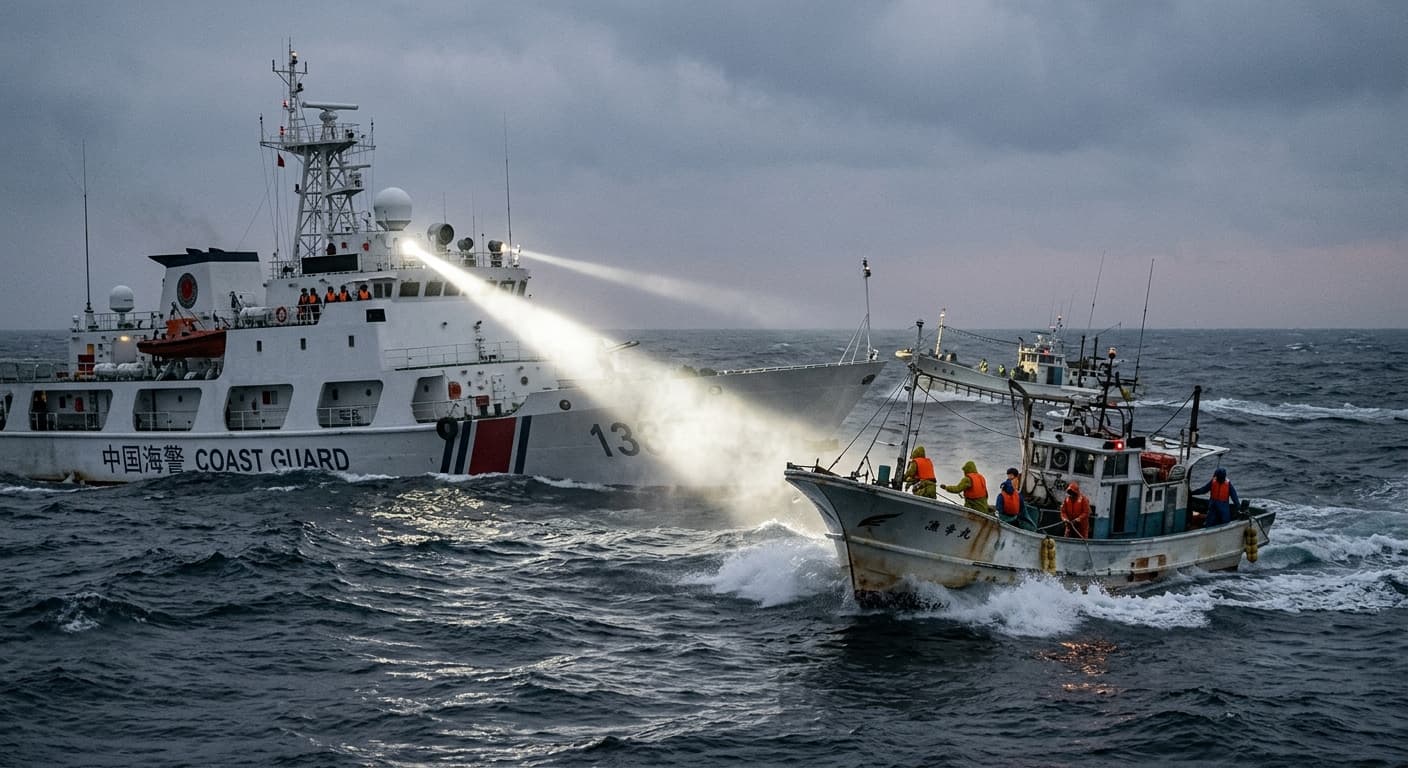
Two China Coast Guard cutters chased a Japanese fishing boat, the Zuiho Maru, into the territorial waters around the Senkaku/Diaoyu Islands on the morning of July 7, 2026, before four Japan Coast Guard vessels forced them out by 9:20 a.m. local time, according to parallel statements from both agencies reproduced by the Taipei Times. The face-off looks routine. It is not. It is the first territorial-sea intrusion since June 10, and — crucially — one of the rare recent moments Beijing has used its coast guard to physically pursue a Japanese civilian vessel, the exact tactic that would convert China's grey-zone presence into a claim of law-enforcement jurisdiction over Japan-administered territory. Read against Prime Minister Sanae Takaichi's November 2025 remarks on Taiwan and Beijing's simultaneous rare-earth and export-control retaliation, this is not a fishing dispute; it is the maritime front of a coordinated pressure campaign to make Tokyo pay for its Taiwan doctrine.
What actually happened on July 7
The Japan Coast Guard says four China Coast Guard (CCG) ships were operating around the islets when two crossed the 12-nautical-mile line and moved on the Zuiho Maru. Japanese patrol boats interposed themselves between the fishing vessel and the CCG cutters, "issued orders to leave," and forced the Chinese ships back into the contiguous zone by 9:20 a.m., according to Deutsche Welle. Tokyo called the entry "a violation of international law" and warned it would "continue to respond calmly and resolutely."
Beijing tells the mirror story. The CCG statement — reproduced by AFP via 24 News HD — declared that the Zuiho Maru had "intruded into" Chinese waters and that CCG vessels "took necessary measures to warn and expel it." That framing matters. Under Article 22 of China's 2021 Coast Guard Law, the CCG is empowered to use "all necessary means, including the use of weapons," against foreign vessels in what Beijing defines as its jurisdictional waters — a definition the
European Parliament's research service has flagged as inconsistent with the UN Convention on the Law of the Sea, particularly UNCLOS Articles 17–19 on innocent passage.
The Senkakus have been under Japanese administrative control since their 1895 incorporation as terra nullius. Japan's Ministry of Foreign Affairs maintains, on its official Senkaku page, that no territorial dispute exists and that CCG intrusions are answered with formal protests through both capitals. Washington reaffirmed in a March 2021 State Department release, cited by the
Ocean Policy Research Institute, that the islands fall within the scope of Article V of the U.S.-Japan Treaty of Mutual Cooperation and Security — meaning any armed attack triggers a U.S. defense obligation.
The Zuiho Maru tactic — why fishing boats are the tell
Presence is the low bar. The higher bar — the one that flips the dispute — is law enforcement against Japanese civilians. In an analysis for the Sasakawa Peace Foundation, maritime-law scholar Ippeita Furuya calls the pursuit of Japanese fishing boats "extremely serious," because it is the second step in a two-stage strategy: first normalize presence in the contiguous zone, then assert Chinese law over vessels flying the Japanese flag inside the 12-mile line.
That is precisely what the CCG statement claims to have done on July 7. Since August 2020, according to the Ocean Policy Research Institute, the CCG has operated under a standing rule to pursue any Japanese fishing boat spotted in the territorial sea "as a matter of principle." Only six such approach incidents were logged in 2020; the tactic has since become the pivotal escalation instrument. The Japan Coast Guard's counter-doctrine — sail a hull between the CCG and the fishing boat — is designed to preserve the visual record that Tokyo, not Beijing, is exercising sovereign authority over civilians in the water.
The Royal United Services Institute framed the shift back in 2020, dating it to a 39-hour-and-23-minute Chinese patrol on 5 July 2020 — the longest continuous stay inside the 12-mile line at the time. The RUSI analysis argued the question is not whether Beijing intends to replace Tokyo as administrator of the islands, but when. Each Zuiho Maru-style pursuit is a data point on that curve. Sasakawa's Furuya, in a
separate 2026 piece, cites Toshi Yoshihara of the Center for Strategic and Budgetary Assessments arguing that Beijing's aim is to create a de facto framework for future "joint management" — a diplomatic euphemism for erosion.
The Takaichi variable — why now
The maritime picture cannot be separated from Tokyo's politics. On November 7, 2025, Prime Minister Sanae Takaichi told the Diet that a Chinese blockade or use of force against Taiwan "could constitute a survival-threatening situation" — the legal trigger under Japan's 2015 peace-and-security legislation for exercising collective self-defense. The BBC has documented Beijing's response: summoning Japan's ambassador, warning citizens against travel to Japan, and framing the remarks as "gross interference in China's internal affairs."
Fudan University's Wu Xinbo, writing at Brookings, argues Beijing chose to escalate deliberately: "Beijing must not leave any impression of 'flexibility' on this particular issue. It wants to be crystal clear that it can pay any price to fight back when challenged." The Japan Institute of International Affairs, in a January 2026
research note, reads the same signal — China is running an "update" to its coercion mix around the Senkakus, comparable to the September 2012 shift that made contiguous-zone patrols routine after Tokyo nationalized three of the islets.
The retaliation menu has been broad. Beijing throttled rare-earth exports, banned some Japanese seafood, cancelled tour packages, reclaimed pandas, and on June 29, 2026, imposed export controls on dozens of Japanese entities, according to Al Jazeera. Japan's ministry of foreign affairs has meanwhile been protesting an accumulating series of grey-zone acts, including — per an
official July 10, 2025 MOFA statement — "unusual close approaches" by Chinese military aircraft toward Air Self-Defense Force surveillance planes. A coast-guard pursuit of a Japanese trawler slots neatly into that campaign: it imposes political costs cheaply, escalates reversibly, and keeps Tokyo's calendar full of near-misses that ricochet through the Diet.
There is a domestic feedback loop. The Observer Research Foundation notes that Takaichi's February 2026 election win was built partly on hawkish Taiwan and Senkaku messaging; her voters read every incursion as vindication. As Kiyoteru Tsutsui of Stanford's Shorenstein Center told the BBC, Beijing "sees that Takaichi is a pretty strong leader and the pressure campaign could only make her stronger domestically." That is the paradox of coercion: it works until it starts producing the opposite of what Beijing wants.
The gray-zone math Tokyo can't outbuild
The structural gap is stark. The China Coast Guard operated inside the Senkakus' contiguous zone on 357 of 365 days in 2025 — with roughly 1,380 vessel-days of activity — after a 335-day continuous run that broke only in October, according to the Observer Research Foundation. Sweden's
FOI defence-research institute documents that CCG fleets from the Ningbo and Shanghai bureaus now rotate monthly patrols, a pattern of institutional routinization — and that CCG territorial-sea intrusions have averaged 25–30 incidents per month over the last decade. The CCG had 159 large vessels in 2023; the Japan Coast Guard's plan tops out at 91 patrol vessels by fiscal 2029, per the
Sasakawa Peace Foundation.
Tokyo is spending. Prime Minister Takaichi's cabinet approved a record ¥8.9 trillion (roughly $58 billion) defense budget for the fiscal year starting April 2026 — the twelfth consecutive annual increase and the closing move in the five-year push to hit 2% of GDP two years ahead of the original 2027 target, reported by Al Jazeera. Roughly ¥100 billion is earmarked for the "SHIELD" unmanned coastal-defense system, operational by March 2028, and MQ-9B Sea Guardian drones will fly persistent surveillance over the Senkakus. Defense Minister Shinjiro Koizumi has committed to deploying surface-to-air missiles on Yonaguni Island — 110 km from Taiwan — by March 2031, per
Al Jazeera. The Observer Research Foundation calls the 2026 package a shift "
from restraint to readiness."
Yet the Japan Coast Guard, by law, remains a civilian police force. Atsuko Kanehara's analysis for JIIA notes that in any armed contingency CCG ships operating under Article 83 of China's Coast Guard Law could pivot instantly from law-enforcement to defense missions — effectively becoming warships — while their Japanese counterparts, bound by domestic law to police status, would not. The 2022 Control Guidelines under Article 80 of the Self-Defense Forces Law allow JCG-JMSDF collaboration on evacuation, port protection, and rescue, but stop short of a wartime military role. The asymmetry is the point of Beijing's design.
Who benefits, who loses
Beijing is the near-term winner. Every Zuiho Maru-style incident forces Tokyo to burn hulls, fuel and political capital on defensive optics rather than offensive investments. The Center for Strategic and International Studies notes that Senkaku patrols already crowd out the Japan Coast Guard's capacity-building missions in the Pacific Islands — precisely where Tokyo and Washington want to counter Chinese influence in Palau, the Marshall Islands and the Federated States of Micronesia. The second-order effect is a maritime-diplomacy deficit far from the Senkakus themselves.
Takaichi wins domestically. Her February 2026 electoral majority was built on a hawk-on-China platform, and each incursion validates her reading of the threat. That in turn makes the National Security Strategy revision due by December 2026 — the first update since December 2022 — more, not less, forward-leaning. The Observer Research Foundation notes that a strategic-document rewrite less than four years after the last one is itself a signal of urgency. Taipei benefits from the same dynamic: every Senkaku confrontation reinforces the Japanese domestic case that a Taiwan contingency and a Senkaku contingency are one problem, not two.
Washington also gains, but conditionally. Article V coverage of the Senkakus commits U.S. forces to a fight Tokyo increasingly frames as its own, and Takaichi is due in Washington in March 2026 for talks with President Donald Trump before his own Beijing trip. The risk is a Trump–Xi transactional bargain that leaves Tokyo exposed; the July 7 incident is the kind of visible provocation Takaichi can wave at U.S. counterparts to lock in reassurance ahead of it.
The clear loser is the "four-point consensus" architecture negotiated between the Abe government and Beijing in November 2014, which the JIIA note identifies as the last functioning off-ramp. Foreign Minister Iwaya and Wang Yi did meet on July 10, 2025 in Malaysia — a Japan-China ministerial recorded on the
MOFA readout — but the substance was Iwaya listing complaints: the Senkaku helicopter airspace intrusion, the ASDF close-approach incidents, the Liaoning carrier group's June 2025 penetration of Japan's EEZ near Minamitori. There is no diplomatic mechanism today capable of producing an equivalent to 2014's off-ramp, and both sides have domestic incentives to keep it that way.
Diplomat View
The July 7 incident is not an accident. It is a calibrated data point in a Beijing pressure campaign that started the day Takaichi named Taiwan in the Diet, and it is designed to test whether Japanese fishermen — not Japanese warships — become the friction surface where administrative control changes hands. Our forecast: the CCG will attempt at least two more Zuiho Maru-style pursuits inside Japanese territorial waters before the end of 2026, timed to the December National Security Strategy revision and to Takaichi's next major U.S. or Taiwan-adjacent statement. Two conditions would revise this call. First, if Beijing pulls the CCG rotation pattern back to pre-2020 frequencies — under 200 contiguous-zone days for a rolling year — read that as a real de-escalation offer. Second, if Tokyo publicly authorizes JCG use-of-force rules against CCG vessels approaching Japanese civilians, the escalation ladder shortens dramatically and the risk of a shooting incident inside the 12-mile line goes non-trivial. Absent either, expect more of the same, higher.
What to watch next
- March 19, 2026 — Takaichi–Trump summit in Washington, followed by Trump's Beijing visit; the transactional risk window for U.S.-Japan alignment on the East China Sea.
- May–August 2026 — Peak fishing season around the Senkakus, historically the highest-tempo period for CCG intrusions and fishing-boat pursuits; a repeat of the Zuiho Maru tactic would confirm routinization.
- December 2026 — Publication of Japan's revised National Security Strategy and companion defense documents. Expect explicit language linking Senkaku and Taiwan contingencies for the first time.
The Bottom Line
The July 7 face-off is Beijing's maritime answer to Takaichi's Taiwan doctrine — a low-cost, deniable, legally engineered move to erode Japanese administrative control over the Senkakus one fishing boat at a time. Tokyo's ¥8.9 trillion defense budget cannot fix that, because the contest is being fought below the threshold at which warships and missiles matter. The next real test is not whether Japan can build more hulls, but whether it can raise the political and legal cost of grey-zone coercion faster than Beijing can normalize it.
Discover more
US Politics
House Ethics Committee Pushes Sexual Miscond.
The House Ethics Committee has shifted responsibility for sexual harassment settlement records to the Office of Congressional Workplace Rights, complicating disclosure efforts.
US Politics
SNAP Food Assistance Faces Legal Challenges
In 2026, SNAP faces stricter eligibility rules and mounting legal challenges, threatening food assistance for the millions of Americans who rely on the program.

India
Congress Accuses Modi of Stalling Women's Law
Congress accuses Modi of stalling women's reservation law by linking it to delimitation, revealing a deeper electoral strategy.

Economics
Fed's Amex AML order puts correspondent banking on notice
Federal Reserve's Amex AML order requires board-level controls and a 90-day plan; OCC fined the bank $350 million over enterprise-wide deficiencies.