China's Pacific SLBM Test: A Strategic Miscal
Analysis of China's missile test and its regional implications
Model Diplomat8 min readAsia-Pacific
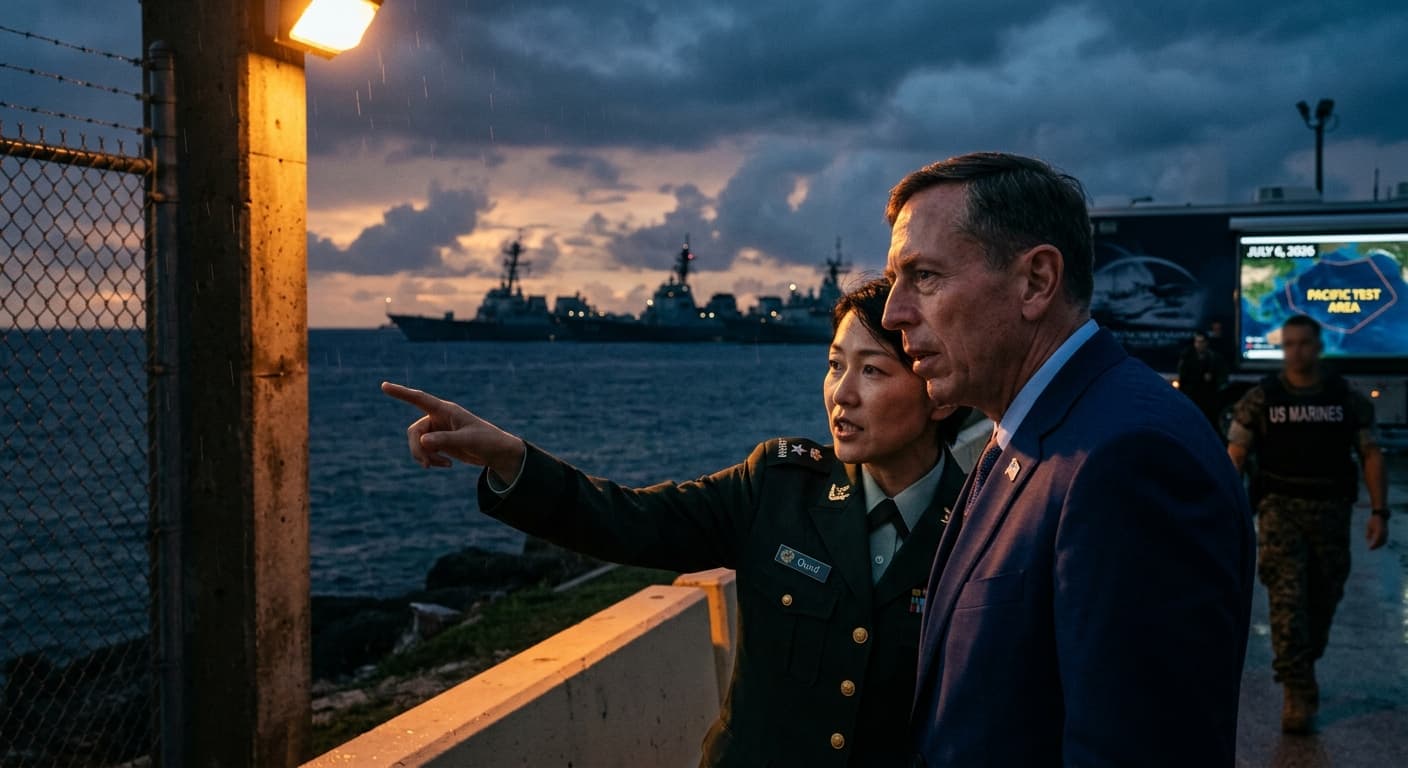
China's Pacific SLBM Shot: Manila's Restraint, Beijing's Own Goal
Analysis of China's July 6, 2026 submarine-launched ballistic missile test into the South Pacific — and how it accelerated an Indo-Pacific security realignment that Beijing spent a decade trying to prevent.
At 04:01 UTC on July 6, 2026, a People's Liberation Army Navy submarine fired a JL-series ballistic missile from the South China Sea across roughly 7,300 kilometres of Pacific airspace — likely overflying the Philippines — and splashed a dummy warhead into the South Pacific Nuclear Free Zone. Beijing wanted to demonstrate a survivable second-strike capability; instead it handed Anthony Albanese, Ferdinand Marcos Jr. and Washington the sharpest recruitment poster the Indo-Pacific coalition has had in years. The Philippine Department of Foreign Affairs on July 8 called for "restraint" and "transparency," according to the Manila Bulletin — diplomatic code for a country that just watched a nuclear-capable missile trace a real-world attack profile over its islands.
What Beijing actually launched
This was not a routine annual drill. According to the Center for Strategic and International Studies, the launch was "the first time that China has ever launched a submarine-launched ballistic missile (SLBM) into international open waters," and only Beijing's second ballistic missile shot into international waters since 1980. The previous open-ocean shot, in September 2024, was a land-based DF-31 fired from the Hainan area.
The missile was likely a JL-3, unveiled at China's September 2025 Victory Day parade, capable of ranging the continental United States from the relatively protected bastion of the South China Sea. The International Institute for Strategic Studies reported in February 2026 that China has now launched a seventh and eighth Type-094 (Jin-class) SSBN, and that the ongoing replacement of the older JL-2 with the JL-3 lets those boats target the western United States without leaving Chinese-controlled waters. That is the strategic point of this test: to prove, publicly, that the sea-leg of China's nuclear triad works — while never surfacing outside the first island chain.
The Pentagon's 2024 Military and Security Developments Involving the People's Republic of China estimated that Beijing had "surpassed 600 operational nuclear warheads" by mid-2024 and would exceed 1,000 by 2030. The July 6 shot is the first field validation, over an intercontinental trajectory, of the platform that has to carry a chunk of that expansion at sea.
The timing was the message
Hours before the missile broke the surface, Australian Prime Minister Anthony Albanese and Fijian Prime Minister Sitiveni Rabuka signed the Ocean of Peace Alliance in Suva — the same week that the Vuvale Union treaty and the Nakamal Agreement with Vanuatu were locked in. The BBC reported on July 6 that the Fiji pact was Canberra's most consequential Pacific security agreement of the decade. Michael Green, chief executive of the United States Studies Centre, told
The Australian the launch was a "clear attempt by Beijing to intimidate Pacific island nations and Australia, and to demonstrate there will be punishment" for such deals.
That reading is corroborated by the flight path. CSIS notes navigation warnings suggested Beijing had considered a second track — a Bohai Sea launch overflying Japan — but chose only the southern option, which crossed Philippine airspace and terminated inside the Rarotonga Treaty zone. Both symbolism and geography were selected.
The response was uniform. Japan's foreign ministry protested the "hours" of prior notice. New Zealand called the test "an unwelcome and concerning development." Australia demanded an explanation. Solomon Islands Prime Minister Matthew Wale — whose government signed the 2022 security pact with Beijing that shocked Canberra — declared, per the Lowy Institute, that the test was "not something a friend does."
The Manila angle: restraint as leverage
Philippine messaging has been deliberately bifurcated. Defense Secretary Gilberto Teodoro Jr. — whom Beijing sanctioned on June 11, 2026, per Al Jazeera — called the launch "flexing military muscle to provoke or intimidate smaller nations" in remarks reported by
Philstar. Department of National Defense spokesperson Arsenio Andolong labelled it a "reckless display of military power," according to the
Cebu Daily News.
The DFA, in contrast, played the role of adult in the room — a template it has refined across a series of primary statements, including its March 10, 2025 rebuke of Wang Yi, which insisted that Philippine actions "are driven entirely by national interest." That good-cop/bad-cop division is not confusion; it is architecture. Manila wants the record to show that even its diplomats — who talk to Beijing every week over South China Sea flashpoints like Ayungin and Scarborough — treated a nuclear-capable overflight of Philippine territory as a legitimacy issue, not merely a defence provocation.
Washington read the signal accordingly. The US State Department reaffirmed the 1951 Mutual Defense Treaty within hours, echoing language from the Fourth 2+2 Ministerial Dialogue that the treaty covers "armed attacks against either country's armed forces, aircraft, and public vessels — including those of their coast guards — anywhere in the South China Sea." A missile overflight is not an armed attack, but the reflex to invoke Article IV language after one is a policy statement in itself.
The Rarotonga problem
Here is the piece most wire coverage missed: China is a party to Protocols 2 and 3 of the Treaty of Rarotonga, and it just landed a missile designed to carry a nuclear warhead inside the zone those protocols exist to protect. Per the UN Office for Disarmament Affairs, Beijing ratified Protocol 2 (negative security assurances against Treaty parties) on February 10, 1987, and Protocol 3 (no nuclear testing in the zone). The
SIPRI Yearbook confirms the ratifications and the geographic scope.
Beijing's defenders will note — correctly — that a training warhead is not a nuclear test, and that a splashdown does not equal "stationing." But the political meaning of dropping a JL-series reentry vehicle into the same waters that PNG, Fiji, Solomon Islands and the Cook Islands consecrated as nuclear-free is not resolved by treaty pedantry. It hollows out a negative security assurance that Beijing spent the 1980s marketing to the developing world as evidence of its restraint. The Chinese diplomats who cited their 2024 advance notice at the 2026 Nuclear Non-Proliferation Treaty Review Conference, per CSIS, are now on the wrong end of that record.
That is why Oliver Nobetau, writing for Lowy, called the launch an "own goal": it validates the exact security-sovereignty story Canberra has been selling to Pacific capitals since the 2022 Solomon Islands shock, and it makes the "consultation clauses" — the fine print in the Vuvale Union, the Ocean of Peace Alliance, the Pukpuk Treaty with PNG, and the
Nauru and Tuvalu deals — easier for Pacific governments to defend domestically.
What Beijing bought, what it sold
The launch delivered three concrete assets to the PLA: flight-trajectory data for a near-full-range JL-3 profile; a public signal that the Type-094 fleet is operationally credible even if noisy relative to Russian or American boats, per the Royal United Services Institute; and a warning shot linked in time and space to Albanese's Pacific diplomacy.
It cost Beijing more. Manila now has a fresh, visual, non-South-China-Sea grievance to internationalise. Tokyo — where Prime Minister Sanae Takaichi has already, per Carnegie, signalled that the "Three Non-Nuclear Principles" may be up for review — gets political oxygen for its own deterrence debate. Canberra gets the case for the Quad Ports initiative in Fiji, announced in
May 2026, effectively made for it. And the Hague Code of Conduct against Ballistic Missile Proliferation, which China has never ratified, gains a fresh case study every state party can now cite.
The strategic arithmetic here is not subtle. Beijing gains a marginal deterrence signal. It loses ground on a decade-long narrative that its regional presence is benign, its notifications transparent, and its nuclear posture defensive. Pacific island governments that spent five years hedging just watched a missile fly overhead.
What to watch next
- August 2026 Pacific Islands Forum, Palau: Whether leaders formalise a regional condemnation and whether a Rarotonga Treaty compliance question is placed on the agenda. This is the first collective test of whether the July 6 shot changes Pacific politics.
- September–October 2026: Ratification vote in Papua New Guinea's parliament on the Pukpuk Treaty implementing legislation, and progress on the Vuvale Union text release. Both are proxies for how far Canberra can push consultation clauses.
- US Senate Foreign Relations Committee: Whether the long-dormant referral of the Rarotonga Protocols, sitting since May 2, 2011, moves. A US ratification now would be the cleanest possible answer to Beijing's launch — and per the
Australian Institute of International Affairs, the diplomatic case has never been stronger.
- Next PLA navigation warning cycle: Whether Beijing routinises open-ocean SLBM testing, as CSIS assesses it intends to, or pulls back after the diplomatic blowback.
Diplomat View
The July 6 launch is best read not as a nuclear signal but as a political miscalculation with lasting alignment consequences. Beijing's own scholars have argued for years that China's nuclear posture is a defensive minimum-deterrent; the value of that story is that regional states believe it. This week that story lost its most important audience — the Pacific island governments whose consent underwrites the Rarotonga zone and whose consultation clauses now underwrite Australia's regional architecture. The Philippines' bifurcated response — DFA restraint, DND condemnation — is the Marcos administration's calculated bid to convert overflight into leverage without triggering a rupture that would break its remaining diplomatic channels.
Forecast: within twelve months, at least two additional Pacific states — most plausibly Tonga and Palau — sign Australia-brokered security agreements containing third-party consultation clauses; the Philippines uses the incident to press for accelerated Enhanced Defense Cooperation Agreement site build-out; and Beijing conducts a second open-ocean SLBM test to normalise the practice, drawing another round of protests but no meaningful sanction. The forecast is falsified if: (a) an ASEAN consensus statement explicitly criticising the launch fails to emerge by year-end, indicating Southeast Asian appetite for confrontation has been overestimated; (b) Fiji delays or waters down implementing legislation on the Vuvale Union under Chinese economic pressure; or (c) Beijing publicly commits to Hague Code of Conduct notification standards, which would neutralise the transparency critique overnight.
The Bottom Line
China fired a submarine-launched ballistic missile 7,300 kilometres into a nuclear-free zone the same day Australia signed a defence pact with Fiji — and in doing so, converted a demonstration of deterrent reach into the strongest available argument for the security architecture Beijing has spent a decade trying to prevent. Manila's call for "restraint" is not passivity; it is a bid to keep the moral high ground while Washington, Canberra and Tokyo do the escalating. The next decision point is the Pacific Islands Forum in August, where Beijing will discover whether Pacific island states now see themselves as objects of Chinese power or the drafters of the rules that constrain it.
Discover more

US Politics
US Launches $166B Tariff Refund Portal
The US is launching a $166 billion tariff refund portal to aid importers hit by Trump-era tariffs, with major implications for trade and supply costs.

India
Delhi CM Rekha Gupta Blasts Opposition's Delm
Delhi CM Rekha Gupta's remarks on women's quota defeat reveal BJP's strategy for the 2029 Lok Sabha elections, focusing on delimitation.

US Politics
SNAP Food Assistance Faces Legal Challenges
In 2026, SNAP faces stricter eligibility rules and mounting legal challenges, threatening food assistance for the millions of Americans who rely on the program.

Conflict & Security
Drone Warfare Killing Aid Workers at Unprec
Over 1,000 humanitarian workers killed in three years as cheap armed drones collapse legal protections. Gaza, Sudan, Ukraine, and DRC see deliberate targeting of aid convoys and hospitals with zero prosecutions.