China's Legal Critique Targets Manila's Claim
Beijing's report counters Philippine claims ahead of arbitration anniversary.
Model Diplomat8 min readAsia
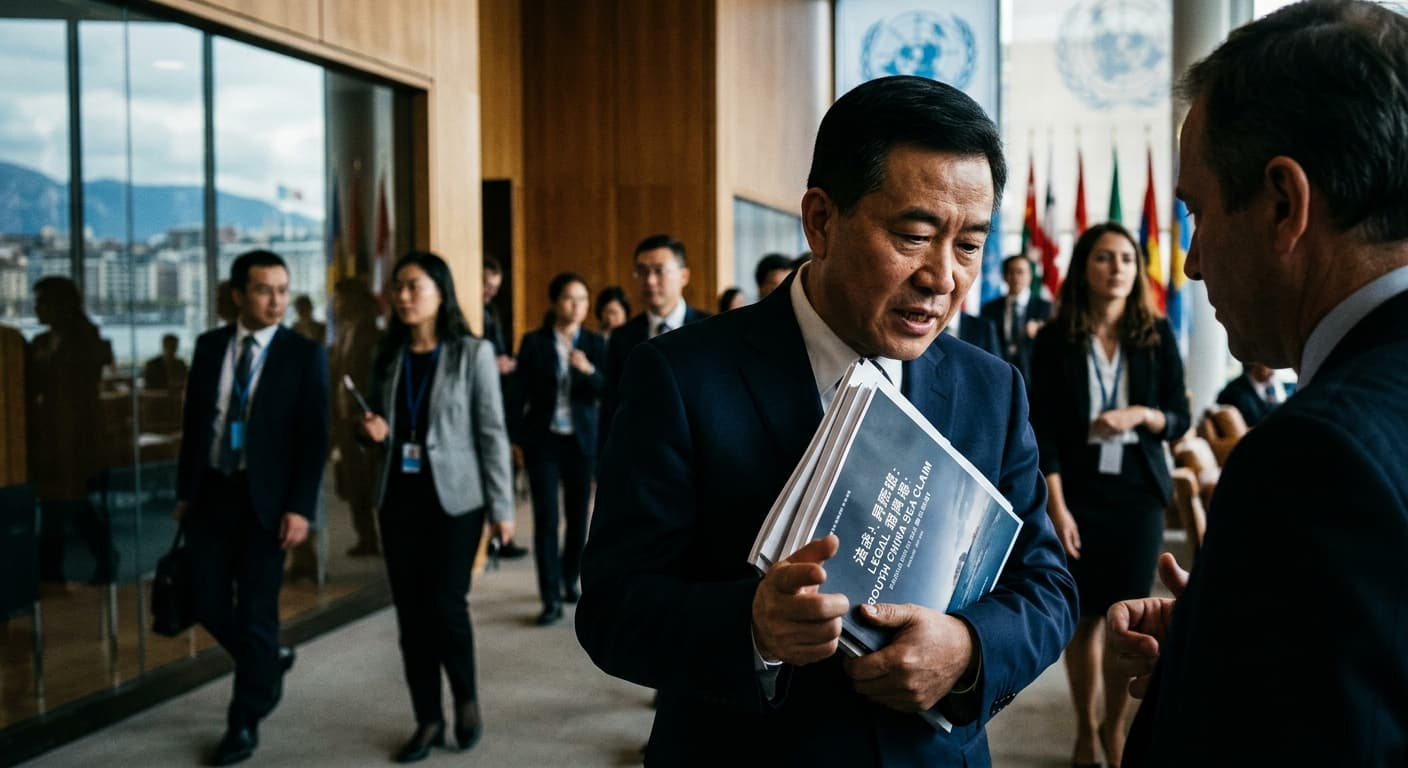
China's July 8 Legal Broadside: Manila's Anniversary Is the Target
Beijing's Ministry of Natural Resources released a 'Historical and Legal Critique' of Philippine South China Sea claims on July 8, 2026 — four days before the 10-year anniversary of the arbitration ruling it still calls waste paper.
Beijing did not pick July 8, 2026 by accident. Four days before the tenth anniversary of the 2016 arbitral award that gutted China's nine-dash line, the Ministry of Natural Resources' China Institute for Marine Affairs (CIMA) released a report titled Historical and Legal Critique of the Philippines' Territorial Claims in the South China Sea — Beijing's first book-length, legally-framed counter-brief since it lost at The Hague. The thesis of the report is that Manila's claims to Huangyan Dao (Scarborough Shoal) and features in the Nansha (Spratly) group are post-1970s inventions that the Philippines is estopped from asserting under international law, according to the Xinhua-run China Daily. The real audience is not Manila. It is the roughly 139 UN member states with no public position on the 2016 award — the swing bloc Beijing needs to keep off the record as the Philippines, now ASEAN chair, prepares to weaponise the anniversary in New York.
What the CIMA report actually says
The report, distributed by the Ministry of Natural Resources and picked up across Chinese state media including Bastille Post and syndicated by outlets like
Pakistan Economic Net, makes three interlocking arguments.
First, on history: the Philippine state's territorial limits were fixed by the 1898 Treaty of Paris, the 1900 Treaty of Washington, and the 1930 Convention between the United States and the United Kingdom. Nanhai Zhudao — China's collective term for the Paracels, Spratlys, Pratas and Scarborough — sat outside those lines, the report argues, and the newly independent Philippines confirmed the colonial boundaries in its 1935 and 1973 constitutions. Only after Marcos Sr.'s Presidential Decree 1596 in 1978, claiming the "Kalayaan Island Group," did Manila's map change.
Second, on law: because Philippine constitutions before the 1970s did not include the disputed features, Manila is now barred by the doctrine of estoppel — a state cannot contradict its own prior sovereign representations — from claiming them today. This is the same estoppel argument Foreign Minister Wang Yi deployed at the East Asia foreign ministers' meetings in Kuala Lumpur on July 11, 2025, when he called the arbitral award "a piece of waste paper" and said the Philippines had breached its bilateral commitments, according to the Chinese Foreign Ministry.
Third, on the map: the report reproduces a Philippine cartographic annex that shows Scarborough Shoal outside the country's territorial box — evidence, Beijing argues, that Manila's own official record concedes the shoal was never Philippine.
None of this is legally new. What is new is the packaging: a Ministry of Natural Resources–backed monograph, timed as counter-programming, with a stable citation. Beijing is building a document it can hand to third countries.
The audience is New York, not Manila
Read against the calendar, the release is diplomacy, not scholarship. On July 10, 2026, Philippine Foreign Secretary Ma. Theresa Lazaro will host a Manila conference with "like-minded countries" and their UNCLOS experts to mark the tenth anniversary of the award, she told CSIS in a June conversation in Washington. "The Arbitral Award is not a mere policy position; it is settled international law, now firmly woven into the global legal corpus. It is final, binding, and nonnegotiable," Lazaro said.
Manila's medium-term play is more ambitious. Philippine officials have spent the past 18 months quietly canvassing a second Annex VII arbitration and, more consequentially, a UN General Assembly resolution that could refer the South China Sea question to the International Court of Justice for an advisory opinion, as CSIS laid out in January 2025. That analysis put the current whip count at 27 public supporters of the 2016 award versus seven public supporters of China's position — with 139 states silent. Those 139 are the addressees of CIMA's report.
The precedent is Mauritius v. United Kingdom on the Chagos Archipelago. Port-Louis lost a bilateral fight, won an UNCLOS Annex VII arbitration in 2015, then rolled that award into a UNGA resolution and an ICJ advisory opinion in 2019, eventually forcing London to concede sovereignty in 2024. Manila has watched the playbook closely; Beijing has too. Its response — dropping a citable legal brief four days before the anniversary — is designed to seed doubt in capitals that have not yet chosen a side.
What Beijing is not saying
The CIMA report's argumentative structure is revealing for what it omits. It does not rehearse the "historic rights" claim within the nine-dash line, which the 2016 tribunal invalidated. It does not defend the "offshore archipelagos" theory that Chinese scholars have pushed since 2016 and which the US State Department dismantled in its Limits in the Seas series, as CSIS noted after Beijing published Scarborough baselines on November 10, 2024. Instead, the report picks a narrower, more defensible front: attack the Philippine title deed directly, on the terrain of general international law rather than UNCLOS.
That is a tactical evolution. Christian Schultheiss at ISEAS argued in 2023 that China's lawfare in the South China Sea had relied on strategic ambiguity — floating claims without pinning them to specific legal doctrine — precisely because ambiguity survived the 2016 award better than any positive legal position could. The CIMA report ends that ambiguity on one narrow question: sovereignty over Scarborough. It is a bet that estoppel-and-treaty history is more portable to third-country audiences than the discredited nine-dash line.
Manila's counter-record is on file at the UN. In Note Verbale No. 000191-2024 submitted to the UN Commission on the Limits of the Continental Shelf, the Philippines reiterated that the 2016 award "comprehensively addressed" China's maritime claims and that "none of the high-tide features in the Spratlys generates entitlement to an exclusive economic zone or continental shelf." China's own reply,
Note D.035/2025, asserted sovereignty over Nanhai Zhudao and dismissed the award as "erroneous." Both notes now sit in the UN registry — which is why the CIMA document, addressed to a broader public, matters.
The situation at sea has already tilted
The legal wrestling is running against a hardening operational picture. RAND analyst Derek Grossman warned in a June 2024 commentary that China had blocked Philippine access to roughly 30% of Manila's recognised exclusive economic zone through salami-slicing tactics. Since then the ratchet has continued.
On September 10, 2025, China's State Council declared a 3,500-hectare "Huangyan Island National Nature Reserve" over Scarborough Shoal, prompting Manila to lodge a formal protest and US Secretary of State Marco Rubio to condemn what he called "another coercive attempt," according to Al Jazeera. On June 11, 2026, Beijing barred Defense Secretary Gilberto Teodoro and his family from entering China, Hong Kong and Macau,
Al Jazeera reported — the first personal sanction against a serving Philippine cabinet minister. On June 30, the PLA Southern Theatre Command conducted combat-ready air, naval and coast guard patrols around Scarborough following a five-day US–Philippine maritime exercise.
Meanwhile, the diplomatic circuits have not shut. The eleventh China-Philippines Bilateral Consultation Mechanism on the South China Sea met in Quanzhou on March 28, 2026, per the Chinese MFA — with both sides pledging to "speed up consultations" on an ASEAN Code of Conduct. That the BCM still meets is Beijing's counter-narrative: legalism plus bilateralism, over Philippine multilateralisation.
Ten years on, the award is more useful, not less
The Manohar Parrikar Institute in New Delhi noted in a June 2026 assessment that the debate around the South China Sea has "become more about defending a rules-based order" than about resolving overlapping historical claims. That reframing is the ruling's second life. As the
BBC summarised at the time, the 2016 tribunal found no legal basis for China's historic rights inside the nine-dash line — but it explicitly declined to rule on sovereignty over Scarborough. That is the doctrinal gap CIMA is now trying to widen.
A decade on, three shifts have compounded Beijing's problem. The Philippines has moved from Duterte-era shelving to Marcos-era activism, with the November 2024 Maritime Zones Act codifying UNCLOS-consistent claims. ASEAN has agreed a third reading of the Code of Conduct text, per Beijing's own April 2025 white-paper style speech, but the COC will not adjudicate sovereignty. And a "Squad" of the US, Japan, Australia and the Philippines has begun EEZ-wide joint patrols — a minilateral solution to a multilateral deadlock, as CSIS has argued about
Manila's 2026 chairmanship.
Diplomat View
The CIMA report is Beijing's admission that the 2016 award is winning the diplomatic long game — otherwise the Ministry of Natural Resources would not spend political capital producing a citable rebuttal in 2026. Expect the document to be handed out at Chinese embassies in Global South capitals over the next 12 months, particularly ahead of any Philippine attempt to move a UNGA resolution or ICJ referral in the September 2026 General Assembly session. Our call: Manila will not file a second Annex VII arbitration this year — the Marcos administration prefers to run out the ASEAN chairmanship with COC diplomacy — but the odds of a UNGA advisory-opinion resolution in the 81st session are above 50%, given the Chagos precedent and Lazaro's public trailer. What would change that forecast: a serious US-brokered de-escalation at Scarborough that offers Manila a face-saving stand-down, or an ASEAN breakthrough on a COC clause that references UNCLOS by name. Neither is currently on the table. The more likely trajectory is that Beijing keeps hardening its physical grip at Scarborough while sharpening its legal counter-story — and the Philippines keeps building the international coalition to invoke, one anniversary at a time.
What to watch
- July 10, 2026 — Manila's like-minded-states conference marking the arbitration anniversary; watch which foreign ministers attend in person versus send envoys.
- Late July 2026 — ASEAN Foreign Ministers' Meeting under Philippine chair; the joint communiqué's language on UNCLOS and the 2016 award is the tell.
- September 2026 — Opening of the 81st UN General Assembly; the earliest window for a Philippine-led resolution seeking an ICJ advisory opinion.
Related: International.
The Bottom Line
The bottom line: Beijing did not release its "Historical and Legal Critique" to persuade the Philippines — it released it to inoculate the 139 UN member states still sitting on the fence, four days before Manila turns the tenth anniversary of the arbitration award into a coalition-building event. The tell is not the report itself but the fact that China finally felt compelled to write one; a decade after calling the award "waste paper," Beijing is now competing on the terrain the Philippines chose in 2013.
Discover more

India
Women's Reservation Bill 2026: A Political Sh
India's Lok Sabha rejected the Women's Reservation Bill, exposing a political maneuver to redraw electoral maps favoring the north over the south.

US Politics
White House Pressures Congress for Crypto Leg
The Trump administration's push for the CLARITY Act aims to reshape crypto regulation, impacting trillions in market value and the Trump family's wealth.
India
Modi's Women’s Convention in Varanasi
Modi's Varanasi rally frames women's reservation as a national mission, targeting the 2027 Uttar Pradesh elections with a strategic narrative.

Conflict & Security
Drone Warfare Killing Aid Workers at Unprec
Over 1,000 humanitarian workers killed in three years as cheap armed drones collapse legal protections. Gaza, Sudan, Ukraine, and DRC see deliberate targeting of aid convoys and hospitals with zero prosecutions.