China's Kinmen Intrusion: A New Strategy
Beijing's coast-guard tactics challenge Taiwan's waters
Model Diplomat10 min readAsia
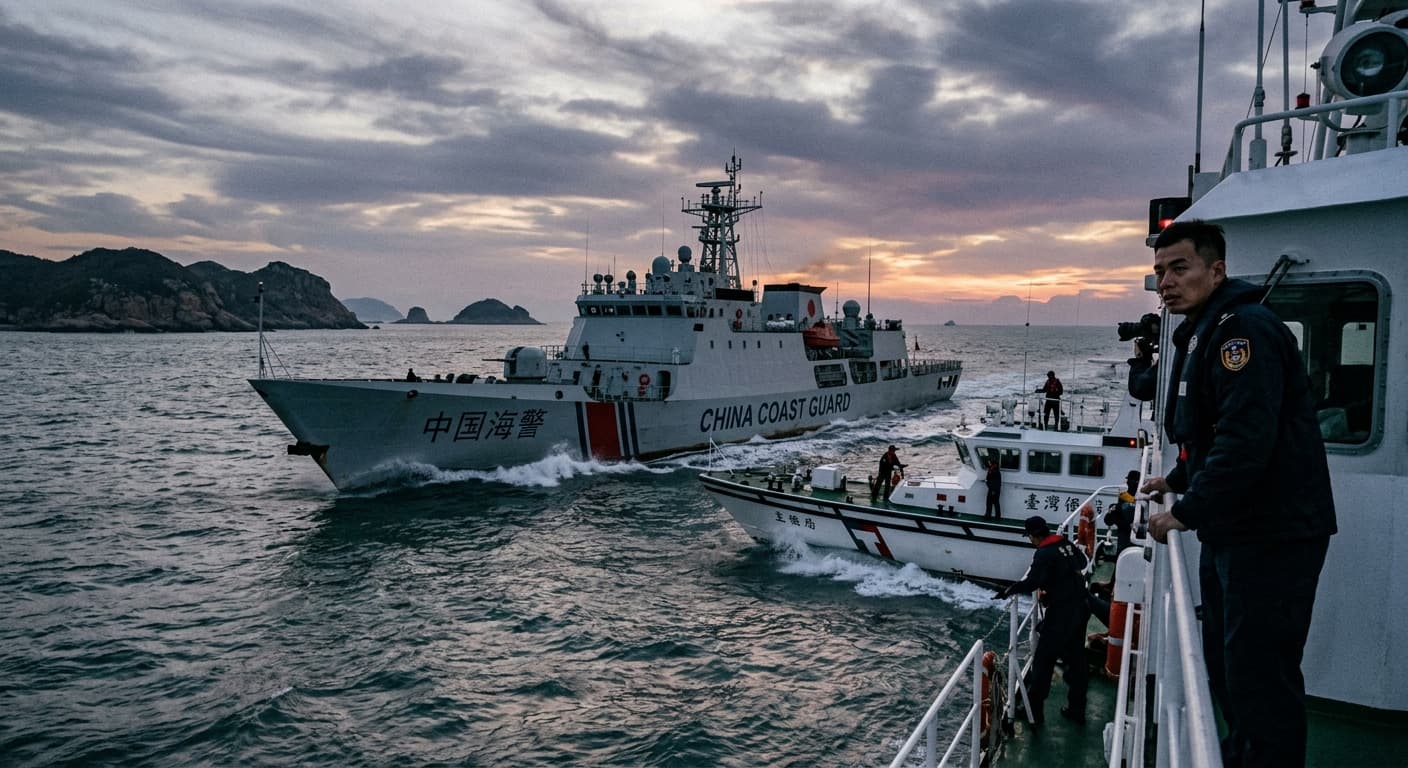
China's Kinmen playbook goes storm-proof: 4 coast-guard ships, one missile test
The Kinmen intrusion on July 8, 2026 is not a weather stunt — it is the operational payoff of a two-year Beijing campaign to normalize coast-guard jurisdiction inside Taiwan's restricted waters.
Four China Coast Guard cutters — hulls 14533, 14605, 14530 and 14602 — pushed into Taiwan's restricted waters south of Kinmen at 8:00 a.m. on July 8, 2026, hours before Typhoon Bavi was forecast to strike, and stayed for three hours before Taiwan's Coast Guard Administration (CGA) shadowed them out at 11:13 a.m. It was the latest publicly disclosed incursion in a campaign that has now averaged more than one Kinmen-area intrusion a week for two years, it came 48 hours after China lofted a submarine-launched ballistic missile from the South China Sea toward the Pacific, and it fits a pattern Beijing itself has branded the "Kinmen model" — using civilian-badged coast-guard hulls, not warships, to erase the legal line between Chinese and Taiwanese waters. That is the story: not a typhoon-day provocation, but the operational payoff of a two-year normalization campaign that is now the most credible short-of-war route to a Taiwan Strait crisis before 2030.
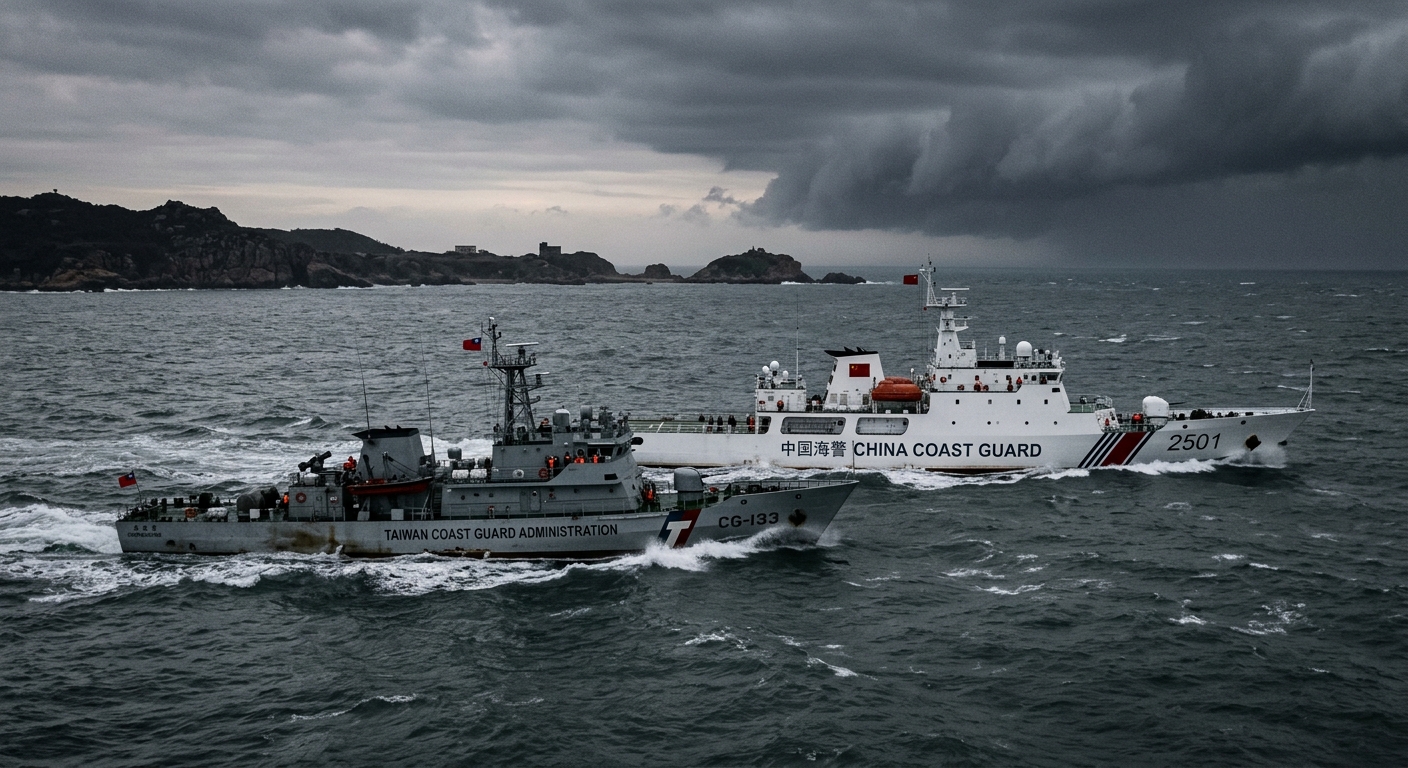
A three-hour standoff, timed to a storm and a missile
Taiwan's CGA said the four Chinese vessels split into two groups and probed Kinmen's southern restricted waters simultaneously, prompting a one-for-one shadowing response by the 12th Patrol Squadron and repeated Chinese- and English-language radio warnings to leave, according to the Central News Agency wire carried by PChome. The Kinma-Peng branch of the CGA called the operation "neither rational nor professional" and accused Beijing of exploiting a storm-preparation window "to keep imposing gray-zone harassment," per
ETtoday. The choice of moment was deliberate: on the same morning, three flag-of-convenience "Long An"-linked bulk carriers converged in Penghu waters, according to the
Liberty Times, forcing the CGA to dilute its Kinmen response with parallel deployments to the west.
The timing is the tell. Typhoon Bavi is forecast to make its closest approach on July 10–11, with the Central Weather Administration expecting sea and land warnings by Thursday and Guishan Island already ordering a four-day pre-emptive closure through July 12, ETtoday reported separately. Two days earlier, on July 6, the PLA Navy fired what the
Center for Strategic and International Studies assessed as a JL-2 or JL-3 submarine-launched ICBM roughly 7,300 kilometers across the Pacific into the South Pacific Nuclear Free Zone — Beijing's first-ever SLBM launch into international waters and, per CSIS, likely a signal timed to RIMPAC and to the Philippine Coast Guard's debut participation in that exercise. Australia, New Zealand and Japan condemned the launch, according to
Al Jazeera. CSIS notes Washington and Tokyo received "mere hours" of advance notice, roughly 23 hours went to Canberra — a pattern of technical compliance without meaningful pre-launch consultation that mirrors, at the strategic level, what the coast guard is doing at the tactical level around Kinmen.
Taiwan's Ministry of National Defense reported that in the 24 hours ending 6 a.m. July 7, it tracked 4 PLA sorties, 9 PLAN ships and 3 official (i.e. coast-guard or maritime-safety) vessels around the island, with 3 of the 4 sorties crossing the Taiwan Strait median line, per the MND Air Force Command bulletin. Ocean Affairs Council deputy chair Sung Cheng-en told the
Liberty Times on the morning of the intrusion that Beijing's pattern is not "long-arm jurisdiction" but "illegal expansion in the form of harassment" that "wears out" Taiwan's coast guard. His word choice matters: Taipei is deliberately refusing to legitimize China's "law-enforcement" frame, because to concede the label is to concede the jurisdictional claim.
The "Kinmen model": from an incident to a doctrine
What Beijing is doing off Kinmen is a doctrine, not an episode. The China Coast Guard (CCG) began routine patrols inside Kinmen's restricted and prohibited waters on February 14, 2024, after two mainland fishermen drowned fleeing a CGA chase — an event Chinese state media used to declare that Taiwan's restricted-water designations no longer exist "in practice." The American Enterprise Institute's PRC short-of-war study documented an average of five CCG incursions per month between February and mid-2024, with a July 19 patrol already labeled by Taiwan's CGA as the 32nd of the year. By late September 2024 the count had reached the 41st and 42nd incursions, according to the
AEI China-Taiwan Update, which also noted the CCG's shift from fixed linear patrol tracks to "extensive patrol zones" — a doctrinal move that lets individual ships wander into prohibited waters freely rather than as pre-plotted formations.
The rhetorical scaffolding matters as much as the ship count. CCTV's Yuyuan Tantian account — the outlet AEI identifies as the first to name the "Kinmen model" — argued in May 2024 that the template could be "applied to Matsu and Penghu, and even the entire Taiwan Strait," and a June 2024 post by a Chinese Academy of Social Sciences scholar reframed it as "an alternative plan for completely resolving the Taiwan issue" under a "one country, two systems" scheme. The International Institute for Strategic Studies tracked its progression through 2025: 256 average monthly ADIZ intrusions by PLA aircraft, 122 monthly median-line crossings, cross-strait arbitration centers opened in Fujian offering up to two-million-yuan subsidies to lure Taiwanese arbitration lawyers, and Chinese state-media claims that the model reflected Beijing's "sovereignty and law-enforcement rights." That is the lawfare stack: patrols on the water, courts on land, and narratives on state media, all reinforcing a single claim.
In 2025 the CCG extended the tactic to Pratas Island — first probing on July 9 and 11, 2025 with vessels turning off their AIS transponders to conduct "dark" patrols, per the AEI July 21, 2025 update — and by mid-2026 was operating almost continuously east of Taiwan. The Ministry of Natural Resources deployed the research vessel Xiang Yang Hong 22 for a "marine environmental survey" east of Taiwan from June 16 to 18, and the Ministry of Transport conducted a "special maritime law enforcement operation" east of Taiwan from June 6 to 10, per the
AEI June 26, 2026 update, which linked both to Japanese-Philippine EEZ delimitation talks. The Observer Research Foundation counts
39 Pratas incursions from February 2025 to May 2026 alone.
The escalation curve matters more than any single day. Premier Cho Jung-tai told coast-guard officers in February 2026 that Kinmen had been "harassed by Chinese coast-guard vessels 54 times" over the previous year, requiring 175 defensive sorties by Taiwanese cutters, per an Executive Yuan release. The same release disclosed that Taiwan's Ocean Affairs Council has budgeted NT$42.6 billion for a ten-year, 141-ship construction plan running from 2018 to 2027 — a fleet build-out that, on the CCG's current tempo, will barely reach parity for the outlying-island beat by the time it delivers.
The legal architecture behind the harassment
The Kinmen model is legally engineered. China's 2021 Coast Guard Law empowers the CCG to enforce law across "maritime areas under Chinese jurisdiction" without defining what those areas are, and authorizes forcible eviction of foreign vessels — including military ones — that "violate" Chinese domestic law, according to a CSIS analysis. A May 2024 update permits 60-day detention without trial of foreigners suspected of border violations; the IISS report cited above documented 15 Taiwanese detained and 51 interrogated by mainland border officials in a single year to July 2024. Japanese maritime lawyer Jun Tsuruta, writing for the
Asia Pacific Initiative, notes the law's draft explicitly listed "other waters under the jurisdiction of the People's Republic of China" alongside internal, territorial, EEZ and continental-shelf waters — a phrasing that extends Beijing's claim beyond anything UNCLOS recognizes and that has since been operationalized in the Kinmen and Pratas patrols.
Taiwan's counter-architecture is weaker by design. Kinmen sits roughly two miles from Xiamen; Taipei has never declared territorial waters around it, only "restricted" and "prohibited" waters defined under Article 29 of the Cross-Strait Act of 1992. Legislators are now trying to close that gap: a Legislative Yuan bill would add Article 80-2 to the Act to criminalize unauthorized entry by mainland vessels for one to seven years' imprisonment and NT$5–50 million in fines, targeting in particular the mainland sand-dredgers whose depredations, the bill's authors note, have retreated Kinmen's coastline by 256,631 square meters between 2007 and 2012 alone. A companion
reform bill would move authority to publish the restricted-water boundaries from the Ministry of National Defense to the Ocean Affairs Council — a technical change that reframes the dispute from a military standoff into a maritime-governance one, which is precisely the terrain on which Taipei believes it can win international support.
Legal scholar Song Chen-en (writing before he took the OAC deputy-chair role) argued in a Prospect Foundation analysis that Beijing's ultimate objective is to have the Taiwan Strait "internationally recognized as an inland sea within China's territory" — which is why every incremental CCG boarding matters legally, not just politically. The historical parallel is instructive: China's
nine-dash-line claim in the South China Sea was built the same way, one fisheries incident and one coast-guard patrol at a time, and the July 2016 arbitral award in favor of the Philippines has done nothing to reverse the facts on the water. Kinmen is being paved over by the same tarmac.
What Taipei is doing — and where it is still exposed
The Lai administration is treating the model as pre-quarantine drill. On June 25, 2026, the National Security Council ran an interagency tabletop exercise simulating a PRC "quarantine" in which the CCG would force ships bound for Taiwanese ports to file customs declarations through China's "International Trade Single Window," then progressively inspect, board and detain them, per the Presidential Office briefing document. Eleven ministries participated; the exercise explicitly rehearsed cross-departmental coordination on energy stockpiles, port throughput, drone-based commercial-vessel escort, and international messaging. President Lai Ching-te followed on June 23 with orders to expand drone reconnaissance, harden commercial-ship communications and update critical-supply stockpiles, per the
AEI July 2, 2026 update. Taiwan commissioned a new Littoral Combat Command on July 1 unifying Hsiung Feng and Harpoon anti-ship missiles under a single 24-nautical-mile coastal-defense authority.
The gap is at the low end. The CCG is the world's largest coast-guard force; the CSIS assessment cited above notes Taiwan's CGA is outnumbered and its "only recourse" against a CCG-led quarantine "would be to consider responding with naval forces — a step that could be seen by the international community as escalatory." That is the trap Beijing built. Every day the CCG stays inside Kinmen's restricted waters, Taipei must choose between accepting jurisdictional erosion or reaching for the Navy and looking like the escalator. The
BBC Chinese-language analysis of Beijing's June 2026 push east of Taiwan quotes National Taiwan Ocean University's Chung Chih-tung arguing that the fix is to elevate Taiwan-Japan and Taiwan-Philippines fisheries and enforcement agreements into full "security-guarantee" frameworks — from bilateral to minilateral — before Beijing normalizes coast-guard patrols beyond the first island chain.
Who wins from the July 8 intrusion is now clear. Beijing wins a cheap operational data point: the CCG can operate inside Kinmen's restricted waters during a Category-4 typhoon warning without deterrence. Fujian's Xiamen tourism and arbitration sectors win the domestic narrative — the "Kinmen model" is state-media shorthand for "reunification is already partly done." The losers are Taipei's outlying-island residents, whose fishing grounds and legal protections are steadily thinning; the CGA's officer corps, whose 175 defensive sorties in a year translate into deferred maintenance and burnout; and Washington, whose 2024 State Department condemnation of the Kinmen intrusions has now been in effect for more than two years without changing Beijing's tempo, as the Taiwan Ministry of Foreign Affairs has itself acknowledged by keeping that statement pinned to its front page into 2026.
Diplomat View
The July 8 intrusion is not about Kinmen. It is a live-fire test of whether coast-guard hulls, sequenced with a typhoon and a nuclear-signaling missile launch, can compress Taiwan's decision cycle to the point where the CGA runs out of ships and Taipei runs out of political oxygen — without ever letting a PLA warship cross the median line as the trigger event. The Kinmen model is winning on its own terms. Since February 2024 it has expanded from Kinmen to Pratas to the waters east of Taiwan, each expansion narrated by CCTV's Yuyuan Tantian as "nearshore governance" that frees PLAN assets for missions beyond the first island chain — the argument AEI analysts made explicitly on June 26, 2026. Our forecast: the next twelve months will see at least one CCG boarding of a Taiwanese-flagged commercial vessel inside Kinmen's restricted waters, and at least one CCG patrol into Matsu's or Penghu's restricted waters modeled on the Kinmen template. What would revise that call: a Japanese or U.S. coast-guard joint patrol with the CGA off an outlying island, a formal U.S. designation of the CCG as a paramilitary arm of the PLA (a step CSIS analysts explicitly recommend), or a Chinese domestic economic shock large enough to force Xi Jinping to redirect gray-zone bandwidth. Absent one of those three, the arithmetic of the model — five incursions a month, near-zero cost, cumulative legal gain — favors Beijing.
What to watch next
- July 8–9, 2026: Ocean Affairs Council's two-day Taiwan International Ocean Forum in Taipei, where Sung Cheng-en has previewed a push for coordinated allied responses to "law-enforcement" coercion.
- July 10–12, 2026: Typhoon Bavi's closest approach; watch whether the CCG maintains patrols during the storm window, which would signal Beijing is willing to accept navigational risk to hold the jurisdictional line.
- Late July 2026: Taiwan's Han Kuang exercise sequel drills, which per AEI now explicitly rehearse the peacetime-to-wartime transition triggered by CCG escalation rather than by a PLA amphibious move.
The Bottom Line
Beijing is not trying to seize Kinmen — it is trying to prove that Taiwan's restricted waters are a legal fiction the CCG can drive through on any Wednesday, storm or no storm. The July 8, 2026 intrusion, coming two days after China's first-ever open-ocean SLBM launch, is the clearest evidence yet that the "Kinmen model" has graduated from tactic to operating system, and that the decisive Taiwan Strait crisis of the late 2020s is more likely to arrive in white hulls than grey ones.
Discover more
India
700 Activists Accuse PM Modi of MCC Breach
Over 700 activists allege PM Modi breached election code with a televised address attacking opposition parties just before state elections.

US Politics
White House Pressures Congress for Crypto Leg
The Trump administration's push for the CLARITY Act aims to reshape crypto regulation, impacting trillions in market value and the Trump family's wealth.

US Politics
House Ethics Committee Pushes Sexual Miscond.
The House Ethics Committee has shifted responsibility for sexual harassment settlement records to the Office of Congressional Workplace Rights, complicating disclosure efforts.

Economics
Fed's Amex AML order puts correspondent banking on notice
Federal Reserve's Amex AML order requires board-level controls and a 90-day plan; OCC fined the bank $350 million over enterprise-wide deficiencies.