China's Kinmen Incursion Amid Typhoon Bavi
Beijing tests Taiwan's maritime response during a storm.
Model Diplomat9 min readEast Asia
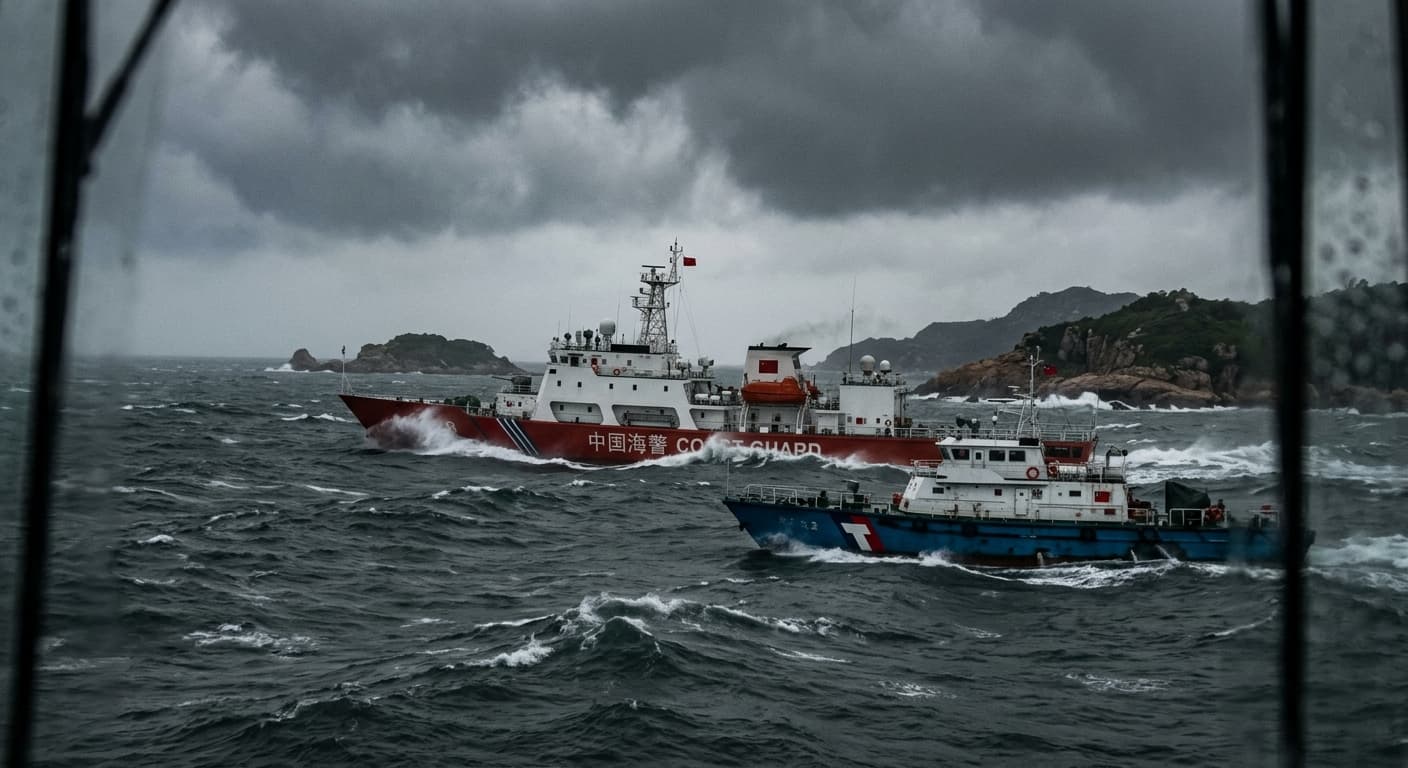
China's Kinmen Squeeze Meets Typhoon Bavi: A Gray-Zone Test
Four Chinese coast guard ships entered Kinmen's restricted waters hours before Typhoon Bavi's outer bands hit — a stress test of Taiwan's sovereignty script during a natural-disaster window.
Beijing is running its Taiwan Strait pressure campaign through a typhoon. On the morning of July 8, 2026 — with Taipei's Central Weather Administration on the verge of a sea-and-land warning for Typhoon Bavi — four China Coast Guard (CCG) hulls pushed into the restricted waters off Kinmen and were shadowed out by Taiwan's coast guard patrol boats, according to Liberty Times. The choreography is by now familiar; the timing is not. Beijing is testing whether Taipei will drop its maritime guard when a storm forces every other vessel off the water. That is the point: the "Kinmen model" only works if the CCG can be there when Taiwan's rules say no one else is allowed to be, and a typhoon is the cleanest opportunity Beijing gets all summer.
The incursion did not happen in isolation. It came 48 hours after China fired a JL-series submarine-launched ballistic missile roughly 7,300 kilometers into the South Pacific — its first-ever SLBM test into international waters, per CSIS — and against a backdrop of what Taiwan's own defense ministry described as more than 100 PLA and coast-guard ships arrayed along the first island chain. Read together, they are not three unrelated events. They are one campaign at three altitudes.
What actually happened off Kinmen
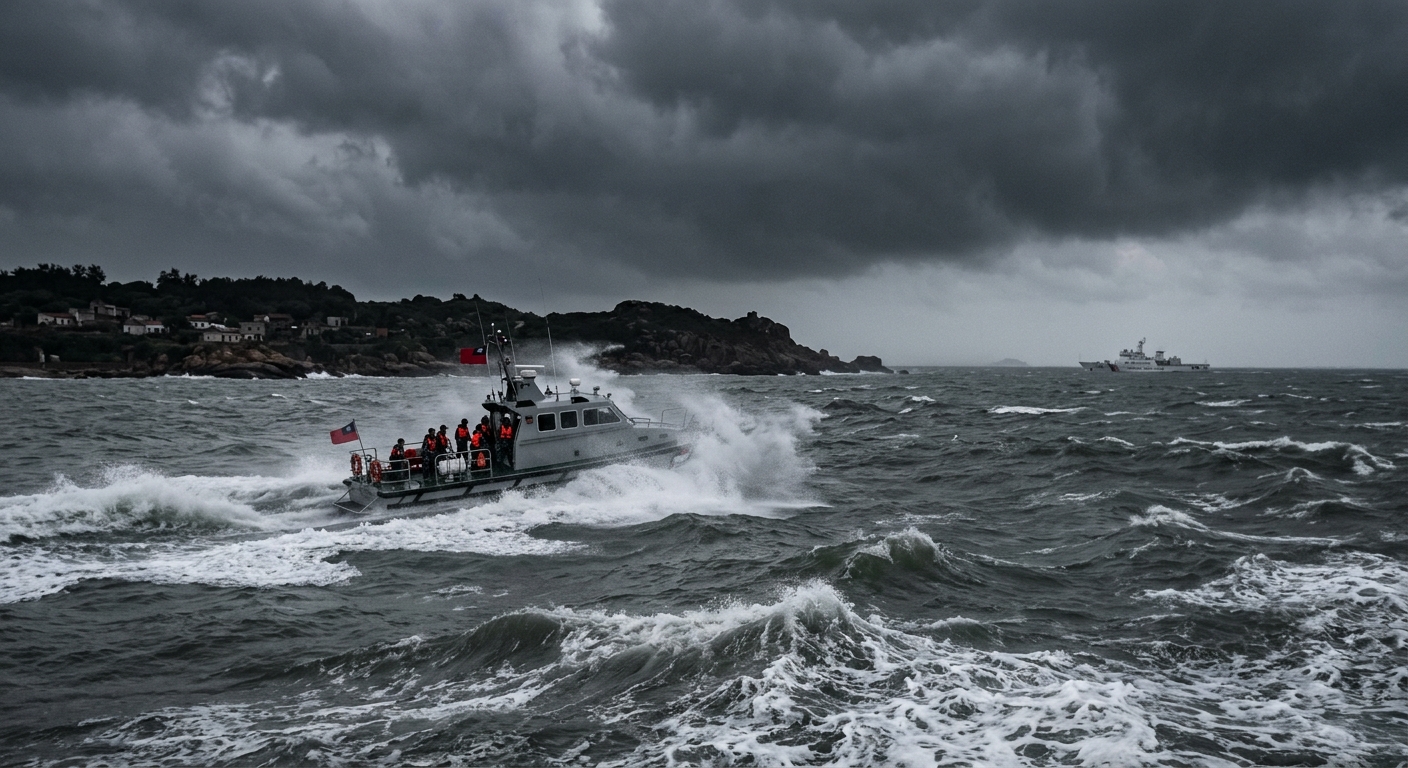
Taiwan's Coast Guard Administration (CGA) 12th Patrol District detected the four CCG hulls entering restricted waters off Liaoluo and Zhaishan on the Kinmen archipelago, deployed four patrol boats in one-to-one shadowing formation, and issued bilingual radio warnings before the Chinese vessels departed around 11:00 local time, Liberty Times reported. The CGA has run the same playbook against near-identical intrusions on June 29 — hull numbers 14606, 14531, 14607, 14530, per the
PChome/CGA release — and dozens of times before that.
Kinmen sits three kilometers from the Chinese coast at Xiamen, closer to the mainland than to any part of Taiwan proper. It is the softest legal target Beijing has. The archipelago's "restricted" and "prohibited" waters were unilaterally drawn by Taiwan's defense ministry in 1992 under cross-strait legislation, as BBC Chinese has documented, and depend entirely on a tacit understanding Beijing has now openly abandoned. In March 2024 the PRC's Taiwan Affairs Office declared the strait "internal waters" and denied the existence of any restricted zone around Kinmen. Every intrusion since then is a piece of physical evidence Beijing files against Taipei's claim.
The Ocean Affairs Council's deputy minister Sung Cheng-en told reporters on July 8 that the pattern amounts to "an illegal expansion in the form of harassment" — Beijing exercising what Chinese officials themselves call "long-arm jurisdiction" over Taiwan's waters, Liberty Times reported. That framing matters. Taipei is no longer treating each incursion as an isolated fishing dispute; it is now naming the doctrine.
The typhoon is the tell
The point of a Bavi-eve incursion is procedural, not tactical. Taiwan's Maritime and Port Bureau on July 7 activated its 12-nautical-mile clearance regime: ETtoday reported that all commercial and foreign vessels were ordered to clear the coastal warning zone ahead of the sea-typhoon alert, with foreign-flagged ships that stay behind subject to port bans under a revised Article 19 of the Commercial Port Law. Under that order, the only lawful hulls near Kinmen when Bavi arrives are Taiwan's own coast-guard and public-service vessels. Turtle Island announced a four-day preventive closure starting July 9, per
ETtoday.
Which is precisely why the CCG showed up. When Taipei clears the sea, the presence of any Chinese vessel becomes proportionally larger — visually, legally, politically. If Taiwan turns them away, Beijing can accuse Taipei of endangering "compatriots" during a storm. If Taiwan lets them stay, the CCG will have loitered inside restricted waters as the last non-Taiwanese hull on the water. Either outcome advances the narrative that Beijing's map is the operative one.
There is a second, uglier reason. Storms erode Taiwan's monitoring baseline. Fishing-vessel automatic-identification-system (AIS) traffic drops toward zero; radar clutter rises; patrol sorties are cut back on safety grounds. On July 8, Liberty Times reported that three flag-of-convenience "black list" vessels — including the Tanzanian-flagged Long An — had converged on the seas south of Penghu's Qimei ahead of Bavi, forcing CGA to dispatch cutters. That is the maritime militia's home terrain. Every typhoon offers a rehearsal for the day gray hulls need to be somewhere they legally are not, without witnesses.
The pressure ladder above the coast guard
The Kinmen incursion is the bottom rung of a much taller structure Beijing has been visibly building.
- Rung one (2024–present): the coast guard normalizes. The CCG has entered Kinmen's restricted or prohibited waters an average of five times per month since February 2024, with the July 19, 2024 incursion counted as the 32nd of that year, per
AEI's China–Taiwan Update. Between January 2020 and December 2025, the daily average of distinct CCG vessels in Taiwan's near waters rose more than 500 percent, per
CSIS's Futures Lab.
- Rung two (2025–2026): the model migrates. In February 2025 the CCG began identical "regular" patrols around Pratas (Dongsha), Taiwan's remote South China Sea outpost. In January 2026 a PLA WZ-7 "Soaring Dragon" drone entered Pratas's airspace — the first PLA aircraft incursion into Taiwanese airspace in years, per
Brookings. By June 2026, the CCG's Taishan-class flotilla was conducting "law enforcement patrols" 52 nautical miles southeast of Lanyu, in Pacific waters east of Taiwan, per
BBC Chinese.
- Rung three (July 2026): the nuclear leg surfaces. On July 6 the PLA Navy fired a JL-series SLBM roughly 7,300 km into the South Pacific Nuclear Free Zone, with less than 24 hours' notice to Washington and Tokyo, per
Al Jazeera.
The rungs are not connected by chance. Australia was signing its Ocean of Peace Alliance treaty with Fiji when the missile launched — the fourth Pacific security pact Canberra has closed in a year, per BBC Chinese's reporting. The Global Times, quoted by Carnegie's proliferation brief, crowed that "our national nuclear triad had another upgrade" and that "the Liberation Army's sea-based nuclear force is capable of carrying out stable, reliable strategic counterstrikes from anywhere in the vast open seas of the Pacific Ocean." Kinmen is the coast-guard chapter of the same book.
Who benefits — and who loses
Beijing's clear beneficiary is the CCG–PLA seam. The AEI China–Taiwan tracking team's July 2 update argues that expanding the CCG's jurisdiction east of Taiwan frees the PLA Navy for longer-range Pacific missions — the same logic that made the SLBM test possible without stripping the PLAN's Taiwan Strait blockade rehearsal. AEI's Blumenthal team writes in its July 2 update that Taiwan's June 25 tabletop exercise simulated exactly this: a CCG-led "maritime quarantine" in which Chinese customs would demand declarations from ships bound for Taiwanese ports, while the PLAN stood off. Kinmen is the pilot; the quarantine is the graduation.
Taipei's loss is definitional, not tactical. No Taiwanese fisherman was seized on July 8. But every CGA press release that describes CCG hulls being "expelled" implicitly concedes that Beijing's ships are the ones that came, and Taipei's ships are the ones responding. That is the asymmetry Brookings analysts Ryan Hass and Stephen Tan warn about: scrambling assets to shadow every intrusion wears down Taiwan's coast guard and navy while Beijing keeps escalating without cost. The Prospect Foundation's Cheng-fung Lu has documented that Taiwan's CGA drove away roughly 9,000 Chinese fishing boats over the past eight years and detained 400 — capacity that is now being redirected against uniformed state hulls.
The KMT-controlled legislature is the invisible variable. President Lai Ching-te's NT$1.25 trillion (roughly US$40 billion) special defense budget has been blocked eight times as of late 2025, per NPR; a US$14 billion U.S. arms sale was put on hold this spring while Washington preserved munitions for the U.S.-Israel war against Iran, per
Al Jazeera. Every Kinmen incursion the CGA absorbs without a policy escalation is a data point the opposition uses to argue the threat is manageable — and every CGA "expulsion" is a data point Lai uses to argue it is not. The same event feeds both narratives.
The historical parallel that reframes it
Kinmen has been Beijing's laboratory before. In 1954–55 and 1958, the PRC shelled the islands to test whether Washington would honor its defense commitment; in 1996 it fired missiles into waters near Taiwan to test whether it would deter a Taiwanese president. Each time, the ambiguity of the U.S. response taught Beijing where the red line actually was. The 2024–26 CCG campaign is the same experiment run without kinetic risk: how much sovereignty erosion can China buy in exchange for hulls that are legally civilian and physically unarmed above small-caliber weapons?
The answer so far is: a great deal. Yun Sun and Gregory Poling have both argued in analyses cited by NPR that the Kinmen patrols are calibrated to intimidate without provoking a U.S. response — a lesson learned from 1996. What is new in 2026 is that Beijing is running the same experiment simultaneously at Pratas, east of Taiwan, in the Bashi Channel, and now — under a typhoon — inside a natural window where Taiwan's own regulations legally clear the sea.
What to watch next
- The next 72 hours. Whether the CCG returns to Kinmen or Penghu during the peak of Typhoon Bavi (forecast landfall late Friday, July 10, per
ETtoday) will indicate whether July 8 was a probe or a precedent. If PLA Navy vessels join, this is no longer a coast-guard story.
- The KMT–DPP defense-budget vote. The opposition-dominated Legislative Yuan is expected to move on Lai's revised NT$210 billion drone package before recess; a CCG incursion during a storm is exactly the kind of imagery that could shift the arithmetic in either direction.
- U.S. State Department follow-through. Spokesperson Tommy Pigott called the SLBM test a "covert nuclear buildup" and demanded China formalize launch-notification procedures. Watch whether Washington attaches the CCG–Kinmen file to that demand or keeps them separate. Brookings has argued for Entity List sanctions on Chinese firms tied to CCG hulls; that would be the first real cost Beijing has ever paid for the "Kinmen model."
- Beijing's next legal move. The PRC's May 2025 Coast Guard Enforcement Procedures Regulation authorizes detention of foreign vessels for up to 60 days without judicial review, per
Diplomat View
The July 8 incursion is not a footnote — it is the coast-guard equivalent of what the JL-series SLBM was for Beijing's nuclear posture two days earlier: a routinization event, dressed as routine so that objecting to it looks hysterical. Our call: within twelve months, China Coast Guard hulls will loiter inside Kinmen's restricted waters during a named typhoon without withdrawing, and Taipei will not have a legal or political tool ready to force the issue without U.S. backing that Washington, distracted by Iran and Ukraine reconstruction, is unlikely to provide in time. The forecast changes if two conditions revise: (1) the KMT-DPP standoff over the special defense budget breaks in favor of funding unmanned surface vessels for the new Littoral Combat Command by year-end, giving Taipei cheaper shadowing capacity that does not exhaust the CGA fleet; or (2) the Trump administration attaches Entity List sanctions to specific CCG-linked shipyards, as Brookings has recommended, imposing a cost Beijing has never paid. Absent either, the "Kinmen model" migrates — first to Penghu, then to the Taiwan-facing side of the Bashi Channel — and the strait becomes what Beijing has been calling it since March 2024: inland waters, by facts on the water rather than by law.
The bottom line: China is using Typhoon Bavi the way it used the February 2024 fishermen deaths — as a permission slip to normalize a coast-guard presence in waters Taiwan's own regulations say should be empty. The story is not four ships driven off in three hours; it is that Beijing now knows Taipei's storm playbook well enough to schedule around it. If Taiwan cannot make the next intrusion cost more than the last one, the "Kinmen model" will be the Taiwan Strait model by 2027.
Discover more
Global Politics
Xi Jinping Calls China-Russia Ties 'Precious'
Xi Jinping's description of China-Russia ties as 'precious' reflects a strategic imbalance, with Beijing dictating terms in the partnership.

US Politics
US Launches $166B Tariff Refund Portal
The US is launching a $166 billion tariff refund portal to aid importers hit by Trump-era tariffs, with major implications for trade and supply costs.
US Politics
U.S. House Passes Alert Act for Aviation
The House passed the ALERT Act 396–10, replacing the ROTOR Act after Pentagon intervention, impacting aviation safety regulations.

Economics
Fed's Amex AML order puts correspondent banking on notice
Federal Reserve's Amex AML order requires board-level controls and a 90-day plan; OCC fined the bank $350 million over enterprise-wide deficiencies.