China's J-35 Blitz: Shenyang Doubles Stealth
Shenyang doubles stealth output as Pakistan nears first fifth-gen export deal
Model Diplomat8 min readAsia-Pacific
China's J-35 Blitz: Shenyang Doubles Stealth Output as Pakistan Nears First Fifth-Gen Export Deal
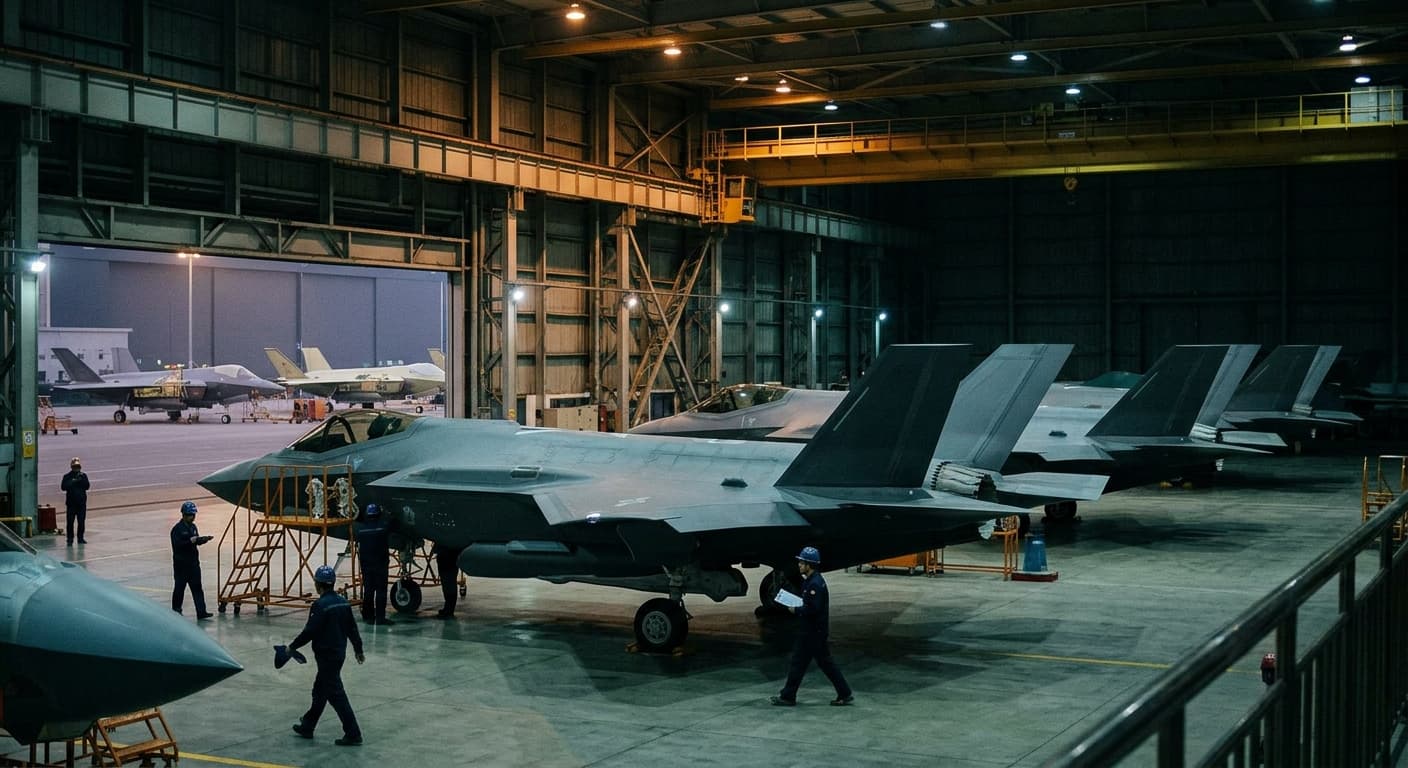
China's Shenyang Aircraft Corporation has doubled warplane production capacity to fulfil J-35 stealth fighter orders for its own forces and Pakistan, compressing the Indo-Pacific airpower gap far faster than Western planning timelines anticipated — and locking Islamabad into Beijing's defence ecosystem as New Delhi scrambles to build its own stealth jet from scratch.
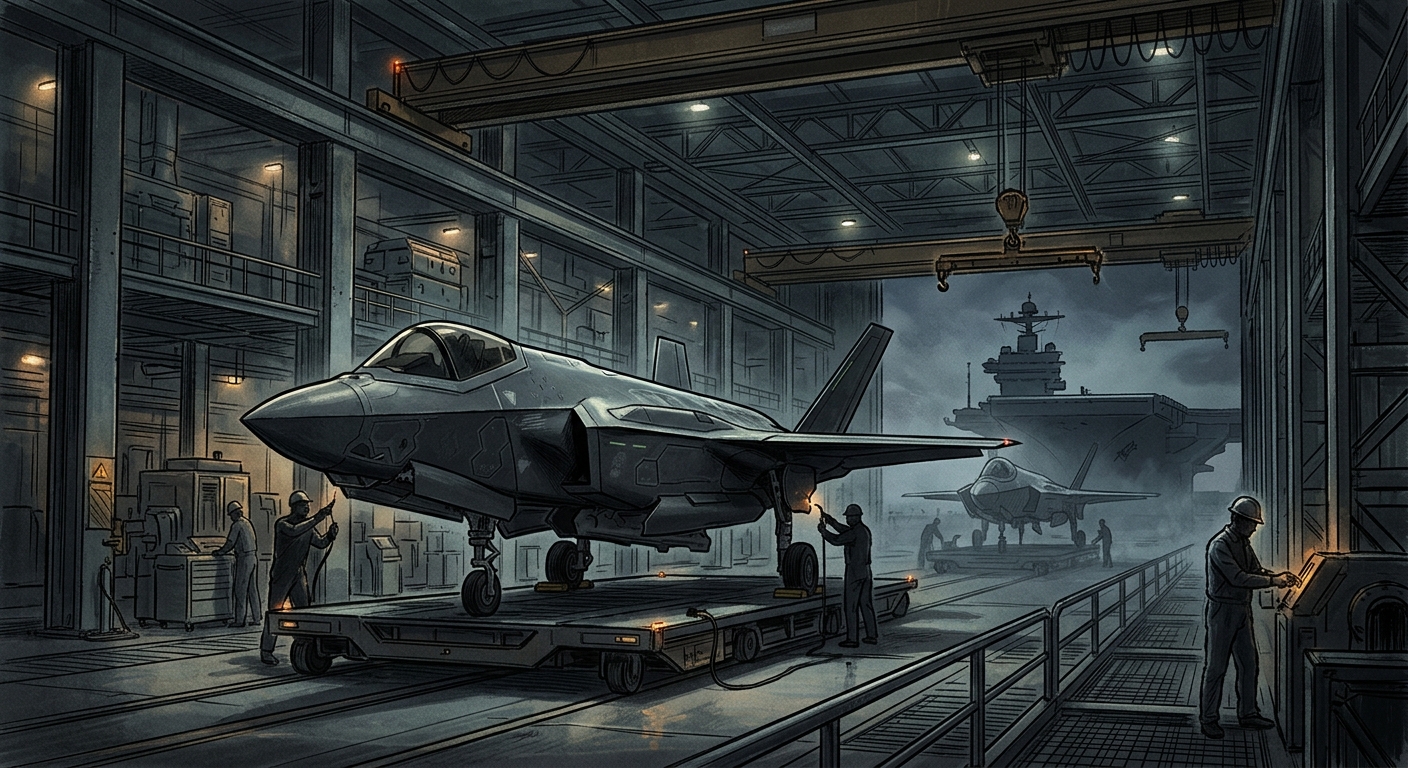
China's Shenyang Aircraft Corporation has entered what Defence Security Asia calls "a decisive industrial phase," expanding assembly capacity to simultaneously fulfil J-35 stealth fighter orders for domestic forces and Pakistan. The dual-track production surge, confirmed through open-source intelligence tracking of serial airframes, marks Beijing's arrival as a serial exporter of fifth-generation combat aircraft to a strategically vital South Asian partner — and it comes barely a year after Chinese-built fighters shot down at least one Indian Rafale in the May 2025 border war.
Shenyang's industrial surge
Shenyang has completed a major new assembly complex within the broader Shenyang Aerospace City initiative, structurally finished by mid-2025 with production ramping toward full-rate output through 2026. The facility spans approximately 4.2 square kilometres and includes more than 370,000 square metres of dedicated manufacturing space, alongside a purpose-built 3,660-metre runway for immediate flight testing, according to Defence Security Asia. The investment totals roughly 8.6 billion yuan, equivalent to about $1.2 billion.
Shenyang has publicly committed to doubling its overall warplane production capacity within three to five years through what state media describes as "intelligent manufacturing upgrades" — automation and digital production-line management across multiple aircraft variants. Open-source intelligence tracking identified a carrier-configured J-35 bearing serial number 350030 in June 2026, confirming that at least 30 serial-production airframes had entered fleet inventory by that point in the production cycle.
The same Shenyang production lines are configured to manufacture three distinct variants concurrently: the naval "Blue Shark," the land-based J-35A for the air force, and the export-oriented J-35AE. This "one-aircraft, multiple-variants" architecture lets Shenyang reallocate production capacity between domestic and export orders without retooling — a flexibility no Western fifth-generation production line currently matches.
The Fujian milestone and carrier aviation
The naval J-35 variant now operates from the Fujian, China's third aircraft carrier, commissioned on November 5, 2025, according to CSIS ChinaPower Project. The Fujian is China's first flat-deck carrier and its first equipped with an electromagnetic catapult launch system (EMALS), a technology previously found only on the U.S. Navy's Gerald R. Ford-class. The 80,000-tonne vessel can launch heavier aircraft with greater fuel and weapons loads than its ski-jump predecessors.
The J-35's electromagnetic catapult launches and arrested recoveries represent the first instance of a non-American fifth-generation stealth fighter operating from a carrier — a milestone that fundamentally alters carrier aviation dynamics across the Western Pacific. During sea trials, the PLAN launched the carrier J-35 alongside the KJ-600 early-warning aircraft and a J-15 variant, Al Jazeera reported.
The U.S. Department of Defense's 2025 Annual Report to Congress assesses that the PLAN aims to operate six aircraft carriers by 2035, for a total of nine, with the J-35 forming the core of future carrier airwings alongside J-15T fighters and KJ-600 surveillance aircraft, according to the DoD report.
Pakistan's deal: the first fifth-gen export
Islamabad's pursuit of up to 40 J-35A airframes under an initial collaborative framework would make Pakistan the first confirmed foreign operator of Chinese fifth-generation stealth technology. The package, structured within a broader deal potentially including KJ-500 airborne early warning aircraft and HQ-19 air defence systems, was confirmed by Pakistan's government on June 10, 2025, the same day it announced a 17 percent defense budget increase to roughly 2 trillion rupees ($9 billion), Bloomberg/FT reported.
The U.S.-China Economic and Security Review Commission's 2025 report noted that Beijing had offered to sell Pakistan up to 40 J-35A fifth-generation fighter jets, though no deliveries have yet taken place, according to Al Jazeera. Pakistan's Air Marshal Tariq Ghazi confirmed that "the initial foundation of cooperation regarding J-35 has been laid," with deliveries expected within roughly two months, though the cost remains undisclosed.
The deal cements a dependency trajectory that SIPRI data makes stark: China supplied 80 percent of Pakistan's arms imports in 2021–25, up from 73 percent in the previous five-year period, according to the SIPRI Trends in International Arms Transfers 2025. Pakistan's arms imports rose 66 percent between the two periods, and almost two-thirds of China's total arms exports went to Pakistan alone.
The May 2025 catalyst
The J-35 deal did not emerge from routine procurement planning. It was catalysed by the four-day India-Pakistan conflict in May 2025, the most serious conventional confrontation between the nuclear-armed neighbours in decades. Pakistan's Chinese-built J-10C jets, firing PL-15 long-range air-to-air missiles, shot down at least one Indian Rafale — confirmed by French and U.S. officials — delivering a symbolic victory for Chinese hardware against Western platforms, NPR reported.
But the conflict also exposed Pakistan's vulnerabilities. India's BrahMos cruise missiles struck multiple Pakistani airbases, including Nur Khan in Rawalpindi, near army headquarters. Pakistan's Chinese-supplied HQ-9B surface-to-air missile system failed to intercept them. Islamabad is now pursuing the longer-range HQ-19 ballistic missile defence system, with induction anticipated later in 2026.
The net result was a strategic paradox: Chinese air-to-air systems performed; Chinese air defence systems failed. Both outcomes accelerated Pakistan's deeper integration with Beijing's defence ecosystem. As Brookings analyst Tanvi Madan noted, Pakistan will "double down on its deep integration with the Chinese industrial base" while India faces the more complicated challenge of integrating a "motley force" of Israeli drones, Russian air defence, French fighters, and American surveillance aircraft into a single networked battlespace.
India's asymmetric response
India's fighter fleet shrank by 151 aircraft between 2014 and 2024, while China added 435 and Pakistan gained 31, according to ISS Military Balance data cited by political scientist Christopher Clary. The IAF operates 31 fighter squadrons against a sanctioned strength of 42.
In June 2025, weeks after the conflict, New Delhi greenlit the Advanced Medium Combat Aircraft (AMCA) programme — a 25-tonne, twin-engine stealth fighter with AI-enabled avionics, supercruise capability, and internally stored weapons, according to the Observer Research Foundation. Seven AMCA squadrons (126 fighters) are planned, but the first prototype is at least 30 months away, and the programme's Mark 1 variant will use the American GE F-414 engine — a dependency that itself has caused delays in the Tejas programme.
India's homegrown stealth jet remains at least a decade from operational service. The $20 billion Multi-Role Fighter Aircraft programme to buy 114 foreign jets built in India under technology transfer has been stalled since 2019. Prime Minister Narendra Modi's Washington visit saw President Donald Trump announce they were "paving the way" for India to acquire F-35s, but most experts believe co-production will not be offered, and integration with India's Russian-heavy fleet remains problematic, BBC News reported.
In December 2025, Washington notified Congress of a proposed $686 million package to upgrade Pakistan's F-16 fleet, extending its operational life to 2040, according to the U.S. Congressional Record. The sale — 92 Link-16 systems and avionics updates — was framed as supporting counterterrorism interoperability, but it underscores the awkward U.S. position: arming both sides of a nuclear-armed rivalry while its primary strategic rival, China, consolidates its position as Pakistan's dominant supplier.
The export market signal
The J-35AE export variant matters beyond Pakistan. If delivered, it would end the de facto monopoly that the U.S. F-35 and, to a lesser extent, the Russian Su-57 have held on the fifth-generation export market. China's J-20 has never been offered for export; the J-35 family, designed from the outset with an export configuration, changes that calculus.
The Takshashila Institution notes that Pakistan has already received roughly 95 JF-17 Thunder jets and 20 J-10CE fighters from China, making it Beijing's only export customer for modern combat aircraft. The J-35AE would add a stealth dimension — and, paired with the PL-17 air-to-air missile (range approximately 400 km), it would give Pakistan a first-look, first-shot capability against India's non-stealth fleet for the first time.
What to watch
- J-35AE delivery timeline: Pakistan's government says deliveries could begin within two months of finalisation, but no contract value or signature date has been confirmed. Watch for a formal announcement from Beijing or Islamabad — likely tied to a high-level visit.
- AMCA prototype deadline: India's DRDO faces a 30-month window to produce a flying AMCA prototype. The first quarter of 2028 is the implicit deadline. A slip beyond that widens the stealth gap further.
- Fujian operational deployment: The carrier entered service in November 2025 but has not yet conducted a full operational deployment with its J-35 airwing. The PLAN's first carrier strike group exercise with Fujian in the Western Pacific — likely in 2026 or 2027 — will be the indicator that the J-35's carrier variant has reached initial operational capability.
Key Takeaways
- Shenyang has doubled warplane production capacity at a new 8.6 billion yuan complex, manufacturing naval J-35, land-based J-35A, and export J-35AE variants concurrently on shared tooling.
- Pakistan's pursuit of up to 40 J-35A jets, paired with KJ-500 and HQ-19 systems, would make it the first foreign operator of Chinese fifth-generation stealth technology — a deal catalysed by the May 2025 India-Pakistan war.
- China supplied 80 percent of Pakistan's arms imports in 2021–25 (SIPRI), and almost two-thirds of China's total arms exports went to Pakistan alone.
- India's AMCA stealth fighter is at least a decade from service; its fleet shrank by 151 aircraft in a decade while China's grew by 435.
- The J-35AE export breaks the U.S./Russian hold on the fifth-generation fighter market and signals Beijing's intent to compete directly in the high-end combat aircraft space.
Diplomat View
The J-35 production surge is not primarily about the aircraft — it is about the industrial system behind it. Shenyang's ability to manufacture three variants on one line, at scale, for both domestic and export customers, is the capability that the U.S. achieved with the F-35 only after a decade and billions in overrun. China has compressed that timeline by building the production capacity before the export demand fully materialised, then letting the May 2025 war generate it.
The strategic consequence is a two-front problem for India that is now structural, not cyclical. Pakistan's J-35AE acquisition will give Rawalpindi a stealth advantage New Delhi cannot match until the AMCA arrives — at the earliest, the mid-2030s. India's interim options (F-35 without co-production, Su-57 with no Indian industrial participation) are both unsatisfactory, and the $686 million F-16 upgrade for Pakistan shows Washington will not choose between its relationships with Delhi and Islamabad. The forecast: India will accelerate the AMCA timeline under political pressure, but DRDO's delivery record makes a slip likely. If the J-35AE reaches Pakistani squadrons before India fields a single stealth fighter — and current trajectories suggest it will — the airpower balance on the subcontinent will have shifted decisively, and the next India-Pakistan crisis will be fought under terms Pakistan has not enjoyed since the 1980s.
Revision conditions: This forecast changes if (a) India signs an emergency F-35 or Su-57 purchase within 18 months, (b) the J-35AE deal stalls over financing (Pakistan's 3.7 trillion rupee debt deferral request is unresolved), or (c) Shenyang's production ramp falls short of the 30-airframe benchmark by year-end 2026.
Discover more

India
Delhi CM Rekha Gupta Blasts Opposition's Delm
Delhi CM Rekha Gupta's remarks on women's quota defeat reveal BJP's strategy for the 2029 Lok Sabha elections, focusing on delimitation.

US Politics
SNAP Food Assistance Faces Legal Challenges
In 2026, SNAP faces stricter eligibility rules and mounting legal challenges, threatening food assistance for the millions of Americans who rely on the program.
India
Congress Accuses Modi of Stalling Women's Law
Congress accuses Modi of stalling women's reservation law by linking it to delimitation, revealing a deeper electoral strategy.

Economics
Fed's Amex AML order puts correspondent banking on notice
Federal Reserve's Amex AML order requires board-level controls and a 90-day plan; OCC fined the bank $350 million over enterprise-wide deficiencies.