China's Gray-Zone Tactics in Taiwan Strait
Taiwan warns of changing maritime security norms.
Model Diplomat8 min readAsia
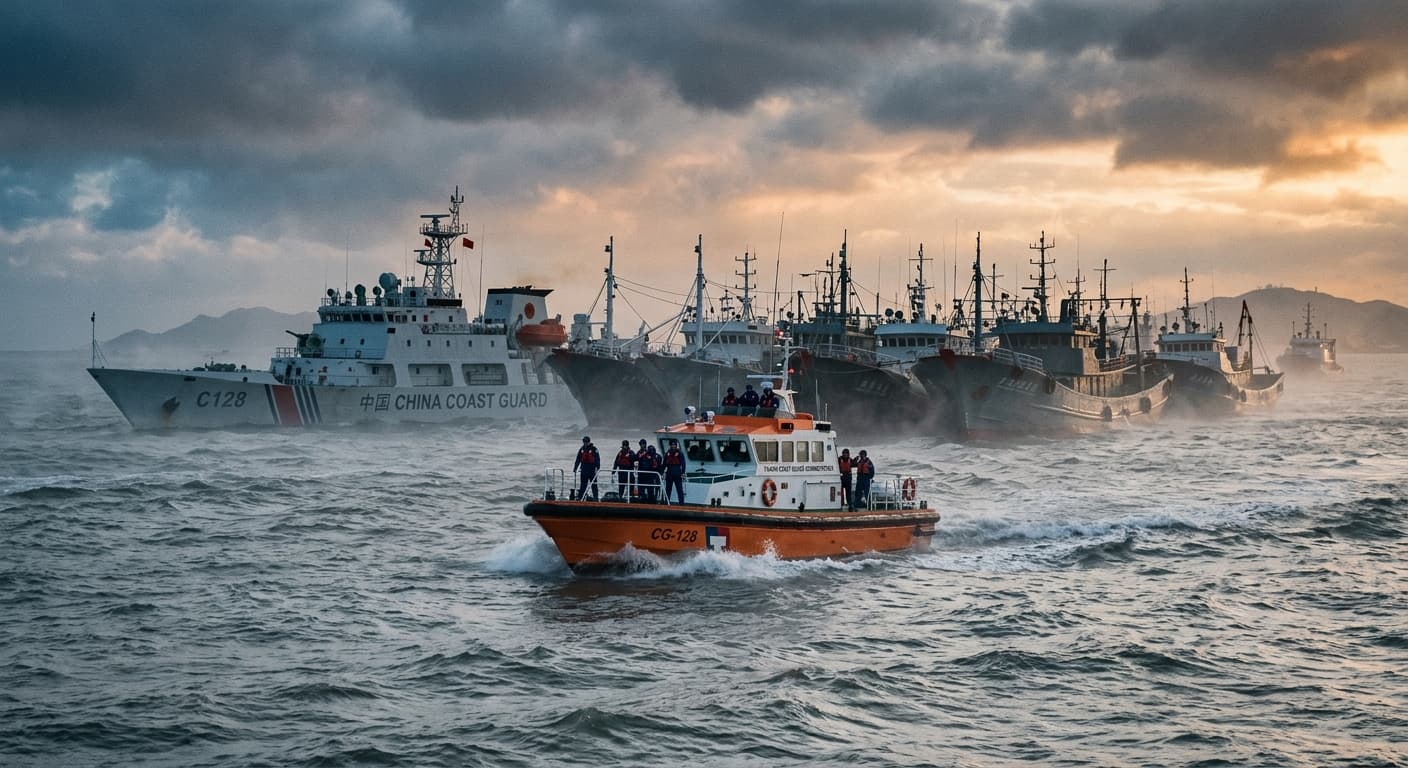
China's Taiwan Strait Gray-Zone Push Is Rewriting Indo-Pacific Norms
Taiwan warns China's coast-guard-led coercion is building a new Taiwan Strait status quo — reshaping Indo-Pacific maritime security, shipping and law without a shot.
Between January 2020 and December 2025, the daily average number of distinct China Coast Guard (CCG) vessels entering Taiwan's near waters rose by more than 500 percent, according to the CSIS Futures Lab. On July 8, 2026, Taiwan's Ocean Affairs Council (OAC) Minister Kuan Bi-ling used that curve as her warning to the world: Beijing is not preparing an invasion in the near term — it is executing one in slow motion, using civilian-branded coast guard cutters, survey ships and maritime militia to overwrite the rules of the Taiwan Strait, the East China Sea and the South China Sea before the international community reacts. Reported by the
Taipei Times, Kuan's argument is not that a crisis is coming. It is that the crisis is already here, disguised as routine.
That reframing is the story. It shifts the analytical burden from "will China invade?" to "what part of the maritime order has already changed?" — and the honest answer, by mid-2026, is: a lot.
The new status quo, defined
The old Taiwan Strait status quo, as former US officials described it into 2021, rested on three implicit rules: both sides respected the median line, PLA Navy and CCG vessels were not permanently ringed around the island, and there were no large PLA exercises inside Taiwan's contiguous zone. Brookings' Ryan Hass argued in a March 2026 transcript that "the status quo as we would define it, or as US officials would define it today, is very different than the status quo of 2022 or 2021" — every one of those three baselines, he noted, has been erased.
Kuan's forum sits on top of that erasure. Speaking at the 2026 Taiwan International Ocean Forum, attended by US Senator Tammy Duckworth and delegates from 15 countries, she framed the campaign as incremental normalization — the same pattern applied to Taiwan, Japan and the Philippines. Taiwan's National Security Council official Lii Wen called it "authoritarian expansionism": military, coast guard, maritime militia and survey vessels stacked on top of one another to gradually transform international waterways into internal Chinese waters, as
The Epoch Times reported from the forum.
President Lai Ching-te, receiving the forum delegation on July 7, was blunter than diplomatic convention usually allows. Per the Presidential Office readout, he cited the G7's June statement rejecting any unilateral attempt "by force or coercion" to change the status quo in the East China Sea, South China Sea or Taiwan Strait, and disclosed that his National Security Council had run a tabletop exercise the previous month specifically on "gray-zone intrusion" and "high-intensity maritime coercion."
What actually changed in June 2026
The concrete trigger for Kuan's warning is what analysts are calling the "Bashi Breakout." From June 1, 2026, China's CCG Zhoushan flotilla began high-profile "law-enforcement patrols" east of Taiwan — the Pacific side, historically outside the CCG's operating pattern. Between June 6 and 10, China's Ministry of Transport dispatched four large public-service vessels including the 10,000-tonne Haixun 09 to run a "maritime traffic special enforcement and sweep operation" covering more than 1,030 nautical miles east of Taiwan. Per state media cited by the BBC Chinese service, Chinese ships inspected 198 commercial vessels and issued "corrective notices" to three.
RUSI's analysis called this "a watershed moment": for the first time, Beijing intervened in the passage of international commercial shipping east of Taiwan under a domestic "law-enforcement" pretext. AEI's June 26
China-Taiwan update noted that CCG vessels have been patrolling east of Taiwan almost continuously since June 1, based on Starboard Maritime Intelligence tracking, and that CCTV-affiliated social media account Yuyuan Tantian is openly framing the area as PRC "near-shore waters" — the same rhetorical move that preceded the "Kinmen model" in 2024.
Beijing's stated pretext was Japan-Philippines negotiations over their overlapping exclusive economic zones between the Yaeyama and Batanes island chains, announced at the Tokyo summit between Prime Minister Sanae Takaichi and President Ferdinand Marcos Jr. in early June. But as one analyst told the BBC, the EEZ talks were "just an excuse" — the actual purpose was to normalize CCG "administrative jurisdiction" on Taiwan's Pacific-facing coast, shifting the campaign from the strait to the deep-water approaches that would matter most in a blockade or a PLAN submarine breakout.
The mechanics of "coercive bargaining"
Three quieter data points explain why this is not just posturing.
First, the coast guard is doing what a navy would do, without the political cost. CSIS's David Sacks argues in a Brookings policy brief that gray-zone coercion is not a distraction from a future war — it is a "pre-conflict campaign to prepare the conditions for China to defeat Taiwan and to prevent the United States from intervening." Taiwan's own
2025 National Ocean Policy White Paper, released by Kuan's OAC, documents 679 unauthorised CCG transits into restricted waters around Kinmen and Matsu in 2024 alone — each labeled by Beijing as "normalised law-enforcement operations."
Second, the tactics are converging around the first island chain. At Pratas Island in the northern South China Sea, ORF documented 39 CCG incursions by 12 different vessels between February 2025 and May 2026, culminating in a 34-hour standoff on June 5, 2026 when CCG vessel 3501 broadcast that "Taiwan's future lies in national reunification." Days earlier, Taiwan's Coast Guard Administration confirmed the first coordinated pressure operation involving both a CCG cutter and an oceanographic survey ship, per RUSI's
commentary on grey-zone coercion below the threshold of conflict. On the East China Sea, CSIS's Asia Maritime Transparency Initiative shows Beijing built three new
oil and gas platforms along the median line with Japan between August 2025 and April 2026. The same doctrine — assert presence, generate incidents, then treat those incidents as jurisdiction — is running in parallel in every theatre where China's claims overlap with a US ally.
Third, the economic transmission belt is already live. The Taiwan Strait carries roughly a fifth of global maritime cargo and more than half of the world's container fleet, according to Chatham House. Singapore's
RSIS estimates that a Strait blockade would force detours of up to 350 km and cost global shipping US$160–320 million per day; a full quarantine could shave 5 percent off global GDP. That is why insurance and shipping norms — not warships — are the terrain on which Kuan is asking allies to draw lines. Once war-risk premiums for Taiwan-bound cargo rise as a routine matter of underwriter policy, Beijing has won a war it never had to fight.

Where the international response actually sits
The forum in Taipei is a useful stress test of how far the coalition has actually moved.
On the primary-document side, the US Senate Armed Services Committee's FY2026 National Defense Authorization Act authorises deepened US Coast Guard training with Taiwan's Coast Guard Administration and directs the Department of War (renamed under the second Trump administration) to develop a joint program to co-produce uncrewed and counter-uncrewed maritime systems with Taipei. That is a policy shift: it treats the CCG problem as a US-Taiwan coast-guard-to-coast-guard problem rather than solely a Navy-to-Navy one. Senator Duckworth, whose July trip made her the first US senator to visit Taipei since the May Trump-Xi summit, told
CSIS she is pushing to bring Taiwan into a State Partnership Program modeled on the National Guard's 27-year link to Poland.
On the Taiwanese side, the Executive Yuan approved a Special Resilience Budget in September 2025 that includes US$894 million for the Ocean Affairs Council and US$206 million specifically for the Coast Guard's uncrewed maritime vehicles, per CSIS's readout of the 2025 White Paper. In October, coast guard vessels were folded into the Navy's command structure during the Haiqiang exercise to rehearse wartime transitions.
On the Japan and Philippines side, the June 2026 Takaichi-Marcos EEZ talks are the diplomatic mirror of the military build-up: Yonaguni missile deployments announced for 2031, per Al Jazeera, and new defence pacts allowing tax-free provision of fuel and ammunition during joint training. IPAC's Jan Paternotte, representing 45 countries and 300+ parliamentarians at the Taipei forum, tied the coalition explicitly to the tenth anniversary of the 2016 South China Sea arbitration ruling — a legal instrument neither Beijing nor Taipei recognises, but which Manila's partners are using to build a normative firewall.
What is missing, and Kuan is essentially asking for, is a coordinated response to CCG "law-enforcement" pretexts that neither escalates to military confrontation nor legitimises Beijing's framing. Taiwan's Institute for National Defense and Security Research proposes a "double-layer alert line" — coast guard forward, military in reserve — to avoid falling into the trap of turning a civilian encounter into a military incident. So far no allied coast guard force has committed to joint patrols inside Taiwan's contiguous zone.
Diplomat View
The evidence supports Kuan's core claim: the Taiwan Strait status quo of 2021 no longer exists, and by mid-2027 it will likely be irrecoverable without deliberate allied action. Our call: Beijing has passed the point at which its coast guard patrols east of Taiwan can be reversed by protest notes alone. The next 12 months will be decided by two variables — whether Washington, Tokyo and Taipei operationalise joint coast-guard responses at the working level (not just the NDAA authorising language), and whether Beijing overplays its hand with an incident that forces Lloyd's-market underwriters to reclassify Taiwan-strait war-risk cover. If either happens, the gray-zone campaign flips from asset to liability. We would revise this forecast downward if the CCG voluntarily pulls back from east-of-Taiwan patrols by year-end — an outcome we assess at under 15 percent probability — or if a KMT election win in 2028 produces cross-strait de-escalation that renders the coercion politically unnecessary for Beijing.
What to watch next
- July 16, 2026 — Senator Duckworth's
CSIS appearance, her first public read-out of the July Taipei trip and a preview of the Taiwan Partnership Act's next steps in the Senate.
- October 2026 — Taiwan's next Haiqiang exercise, which will test whether the coast guard's integration into the navy's command chain now includes rehearsed responses to a CCG-led "quarantine" scenario.
- APEC 2026 (South Korea, November) — the venue at which Brookings' Ryan Hass has flagged that Beijing is likely to attempt to exclude Taiwan; a coordinated allied pushback would signal whether the diplomatic firewall is real or rhetorical.
- Anniversary of the July 12, 2016 South China Sea ruling — IPAC and Manila will use the tenth anniversary as a legal focal point; watch whether any P5 government beyond the US endorses the ruling by name.
Kuan's line at the forum — "the international community might not realise it until it is too late" — is not rhetoric. It is a description of a bureaucratic problem: no single incident in 2026 crosses a threshold that would force a coordinated response, but the cumulative effect has already changed the map. The Global Politics question for the second half of the year is whether Taipei's partners can build a response calibrated to that pace — one that draws lines below the invasion threshold — before the next patrol makes the point moot.
Discover more

US Politics
White House Pressures Congress for Crypto Leg
The Trump administration's push for the CLARITY Act aims to reshape crypto regulation, impacting trillions in market value and the Trump family's wealth.

US Politics
House Ethics Committee Pushes Sexual Miscond.
The House Ethics Committee has shifted responsibility for sexual harassment settlement records to the Office of Congressional Workplace Rights, complicating disclosure efforts.
Global Politics
Trump's Conflicting Messages on Iran War
Trump's mixed messages on Iran reflect a strategy of audience management, benefiting Tehran amid a complex geopolitical landscape.

Economics
Fed's Amex AML order puts correspondent banking on notice
Federal Reserve's Amex AML order requires board-level controls and a 90-day plan; OCC fined the bank $350 million over enterprise-wide deficiencies.