China's Coast Guard Patrols East of Taiwan
New maritime enforcement reshapes Indo-Pacific security.
Model Diplomat8 min readAsia
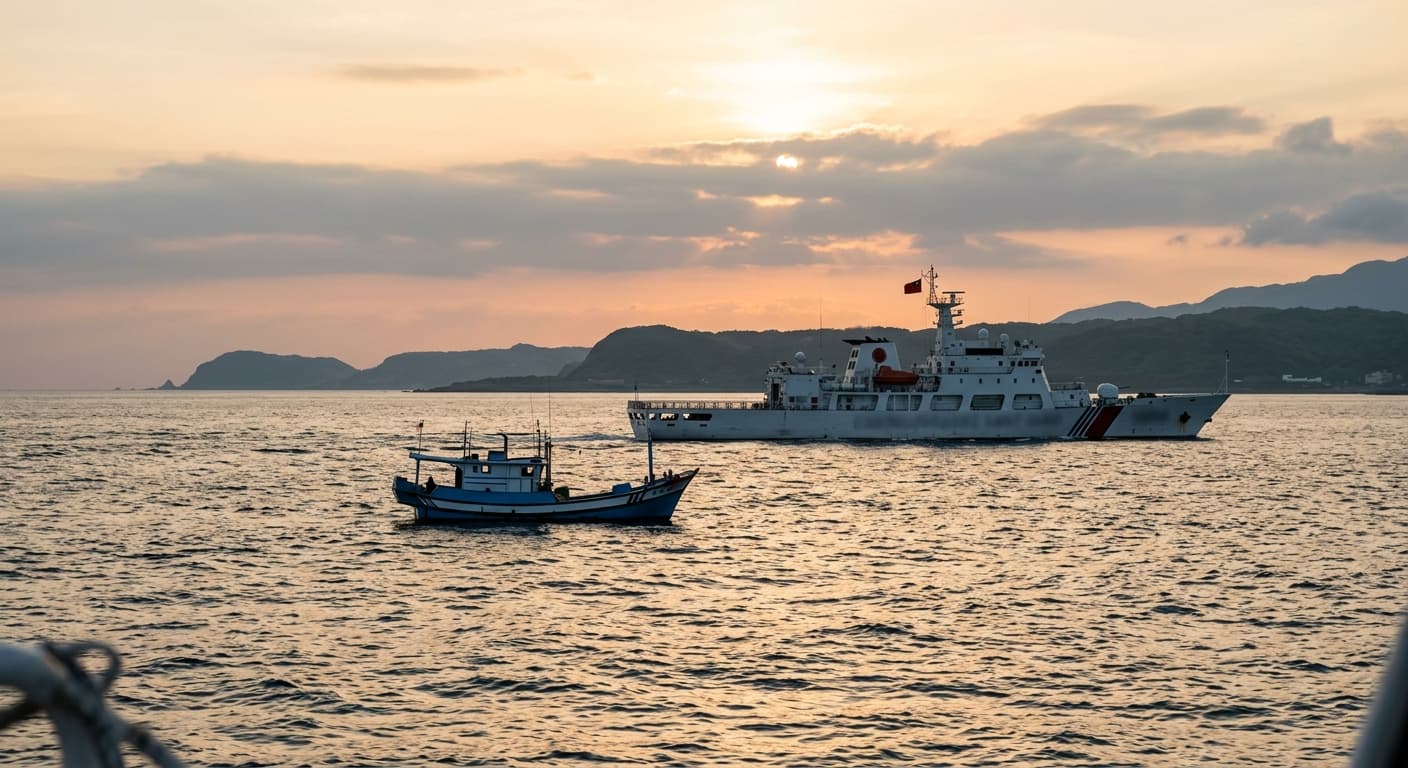
China's coast guard pushes east of Taiwan — a quiet turn of the strategic screw
China's June 2026 "law enforcement" patrols east of Taiwan turn the Pacific side of the island into a contested zone — and reshape Indo-Pacific security math.
On June 1, 2026, a China Coast Guard Yushan-class formation sailed 52 nautical miles southeast of Taiwan's Lanyu Island and, for the first time, declared "law enforcement" jurisdiction in open Pacific waters. Six weeks later, Beijing has made that patrol a fixture. The strategic point is not the ships — it is the map: by pushing enforcement to Taiwan's Pacific flank, China is quietly closing the resupply corridor from Guam, Yokosuka and Luzon that any US-led defense of Taiwan depends on, and doing it under a civilian flag that muddies allied responses. That is the story of this week, and it is the story of the next decade.
What actually happened
The Manila Times, AFP via Hong Kong Free Press and Taiwanese officials describe a two-track escalation compressed into ten days. The China Coast Guard's Yushan-class cutters — 12,000-tonne, near-navy platforms — began sustained patrols east of Taiwan on June 1. Between June 6 and 10, China's Ministry of Transport ran a parallel "maritime traffic special enforcement and survey operation," dispatching the 10,000-tonne Haixun 09 and 5,000-tonne Haixun 06 across more than 1,030 nautical miles of Taiwan's eastern approaches. Chinese vessels radio-verified 198 passing ships, demanded crew and destination data, and conducted seabed cable surveys — activities Taiwan's foreign ministry called "illegal enforcement" in a
June 9 protest note.
The trigger was not in the Taiwan Strait. On June 1, Japanese Prime Minister Sanae Takaichi and Philippine President Ferdinand Marcos Jr. announced in Tokyo that they would open UNCLOS-based EEZ and continental-shelf delimitation talks between Japan's Yaeyama Islands and the Philippines' Batanes group — the maritime chokepoint east of Taiwan, as BBC Chinese laid out. That zone overlaps Taiwan's claimed EEZ. Beijing declared the Japan–Philippines talks "completely illegal and invalid" and moved coast guard hulls into the overlap the same day.
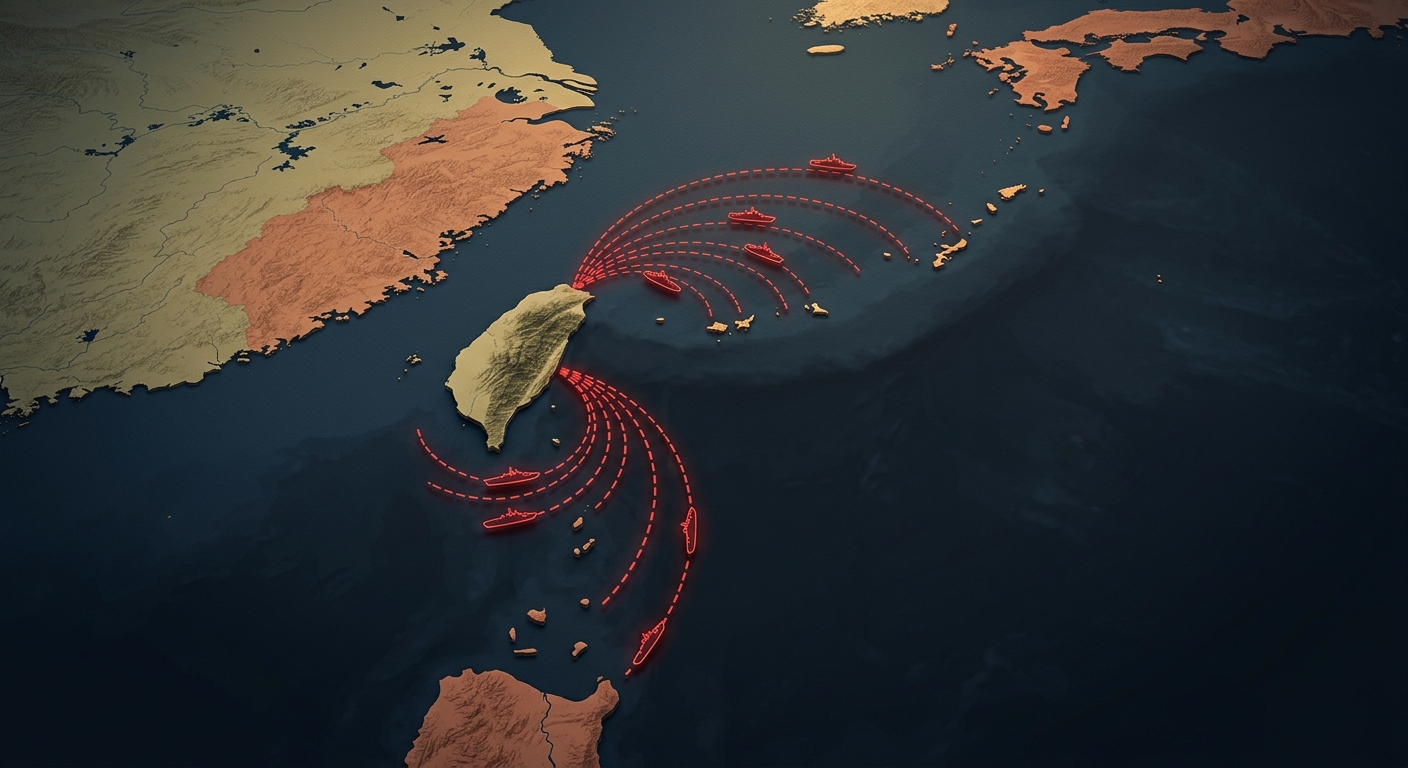
The angle other coverage misses: this is about supply lines, not signaling
Most analysis treats the eastern patrols as another gray-zone gesture. That reading is incomplete. Taiwan's east coast — Suao, Hualien, and the Pacific approaches off Yilan — is the island's operational back door. It is where Taiwan's air force disperses its F-16s into Chiashan's mountain hangars, where undersea cables land, and where any US or Japanese resupply of a besieged Taiwan would arrive. Zhong Zhidong of the Institute for National Defense and Security Research told BBC Chinese that "the PLA's actual strength has begun to approach the Pacific side of Taiwan, Japan and the Philippines — that is, the eastern edge of the First Island Chain."
Put plainly: a Taiwan quarantine that only sealed the Strait would leave the island's Pacific door open. A quarantine that also polices the east closes it. Foreign Affairs' April 2026 essay The Real Threat to Taiwan argued the most probable path to crisis runs through gray-zone quarantines — not amphibious assault — and noted that the December 2025 "Justice Mission 2025" exercise already simulated a blockade of Taiwan's port cities with 14 coast guard vessels and 18 warships. What began as choreography in December is deployed doctrine by July.
The legal machinery Beijing is using
Beijing is not improvising. It is executing a legal architecture built between 2021 and 2024. The 2021 China Coast Guard Law authorizes the CCG to use force against foreign vessels in waters China claims as its jurisdiction. The 2021 revised Maritime Traffic Safety Law extended vessel-reporting obligations into China's claimed maritime zones. And on June 15, 2024, Beijing brought into force Coast Guard Order No. 3 — "Provisions on Administrative Law Enforcement Procedures" — which permits boarding, inspection and detention of foreign vessels and personnel in waters China deems under its jurisdiction. Taiwan's MOFA warned at the time that the order was designed for "unilateral" enforcement outside UNCLOS.
The February 2026 CCG statement marking the fifth anniversary of the Coast Guard Law is the operative doctrine. It pledged, in words the Asia Maritime Transparency Initiative quoted verbatim, "the normalization of patrols, enhanced enforcement capabilities, and institutionalized control in sensitive maritime areas, asserting new operational patterns around the Taiwan Strait." The June patrols east of Taiwan are that policy executed on the water.
"China is pressuring not only Taiwan — Japan and the Philippines face the same salami slicing. By the time the world notices the status quo has changed, it will be too late." — Kuan Bi-ling, Minister of Taiwan's Ocean Affairs Council, Taiwan International Ocean Forum, July 8, 2026
Who gains, who loses
Beijing gains three things at once. First, it converts Taiwan's Pacific flank from strategic depth into contested space — the same tactic the Chinese Coast Guard used to make Scarborough Shoal a de facto Chinese lake. AMTI's July 2026 Scarborough tracking data shows CCG ship-days at the shoal ran to 933 in the first six months of 2026 — nearly matching the entirety of 2025. That is the template: not one dramatic seizure, but a monotone increase until the map is redrawn.
Second, Beijing gets a lever against the Japan–Philippines delimitation talks. Chinese Academy of Social Sciences researcher Yang Xiao told CCTV's Yuyuantantian that "since they [Japan and Philippines] are negotiating in a three-way overlap zone, we can further advance jurisdiction over Taiwan's eastern waters." Translation: any deal Tokyo and Manila cut becomes a pretext for Chinese enforcement inside it.
Third, it does all of this below the threshold that triggers Article 5 of the US–Japan treaty or the US–Philippines Mutual Defense Treaty. The CCG is nominally civilian; boarding a Panamanian-flagged bulker off Hualien does not shoot down a US aircraft.
The losers are equally clear. Taiwan's Coast Guard Administration is now stretched across three fronts — Kinmen and Matsu in the west, Pratas in the south, and the Pacific approaches to the east. The Ocean Affairs Council recorded 679 unauthorized CCG transits around Kinmen and Matsu in 2024 alone, per Taiwan's 2025 National Ocean Policy White Paper. Japan absorbs the second-order shock: any CCG cutter operating in the Yaeyama–Batanes overlap sits inside Okinawa's coast guard beat. And US Indo-Pacific Command must now plan resupply around a maritime zone Beijing polices as if it were domestic.
The historical parallel that reframes everything
The tempo matches Scarborough Shoal, 2012. That standoff also began as a "law enforcement" dispute — a Philippine navy attempt to arrest Chinese fishermen. It ended with China in permanent control of a feature 124 nautical miles from Luzon, never firing a shot. The template is fourteen years old and still working: assert jurisdiction, deploy coast guard hulls, wait, repeat. AMTI's expanding-patrols analysis documents how China now treats the entire 70-nautical-mile stretch between Scarborough and the nine-dash line as its enforcement zone — using the dashed line, not the shoal itself, as the operational boundary. The Taiwan-east patrols follow the same geometry: the enforcement area is defined by China's claim, not by any recognized maritime feature.
Brookings' Ryan Hass and Stephen Tan warned in March 2026 that Taiwan and Washington still lack "a coherent, unified response" to gray-zone coercion and that scrambling frigates and F-16s in reply is wearing down Taiwan's readiness — precisely the exhaustion effect Beijing courts.
The regional chain reaction
The eastern patrols connect three arenas that most analysts still treat separately. On July 8, Japanese and Chinese coast guard vessels faced off near the Senkaku/Diaoyu Islands, each accusing the other of intruding into territorial waters, the Taipei Times reported. Two days earlier, Japan and China had traded diplomatic protests over the eastern-Taiwan patrols. Meanwhile Manila reports
record CCG presence at Scarborough, with 112 dangerous CCG–Philippine Coast Guard interactions in the first half of 2026.
The First Island Chain is now a single, continuous friction surface — from the Senkakus down through Taiwan's east coast and into Batanes, Scarborough, and the Spratlys. That is what Chinese officials mean when state media describe a "circum-Taiwan maritime rights protection and governance system." It is the same doctrine Kuan Bi-ling described as an emerging fait accompli.
What to watch next
- August–September 2026: The next round of Japan–Philippines EEZ talks, expected before ASEAN foreign ministers meet. If Tokyo and Manila publish a joint delimitation framework, expect a matching CCG surge east of Taiwan within 72 hours.
- October 2026: Taiwan's Ministry of National Defense presents its FY2027 budget request. Watch whether the Coast Guard Administration's uncrewed-vessel line — funded from the $894 million Ocean Affairs allocation in the
2025 Special Resilience Budget — is doubled to cover a persistent eastern patrol.
- November 2026: Taiwan's nine-in-one local elections. A DPP setback would weaken President Lai Ching-te's hand and, per Brookings'
strategic-reality assessment, give Beijing incentive to escalate patrols in tandem with domestic political pressure.
- December 2026 / January 2027: Anniversary of "Justice Mission 2025." A repeat exercise that folds the new eastern patrol pattern into a formal quarantine drill would confirm the doctrine has moved from experiment to standing plan.
Diplomat View
The forecast: within twelve months the CCG will maintain a persistent, multi-hull presence east of Taiwan on the model of Scarborough Shoal — not a single deployment but a continuous rotation, verified by AIS trackers and Taiwan CGA press releases. Kuan Bi-ling's "new status quo" will be the operational reality by mid-2027. The single variable that would falsify this call is a Japan–Philippines suspension of the Yaeyama–Batanes delimitation talks under Chinese pressure — a plausible outcome if Beijing pairs coast guard patrols with the kind of rare-earth or tourism sanctions it used against Tokyo after Takaichi's late-2025 Taiwan remarks. Absent that retreat, the eastern patrols are here to stay, and the operational premise of any US defense of Taiwan — that resupply from the Pacific side is uncontested — is quietly obsolete. The right response is neither imitation nor escalation. It is the Coalition Joint-Maritime Anomaly Cell that CSIS proposed in October 2025 — near-real-time transparency that raises the political cost of each Chinese hull crossing an invisible line, and pre-authorized allied responses that Taipei can invoke without asking Washington first. Deterrence in the gray zone is a plumbing problem, not a firepower one. Beijing has understood that since 2012. The rest of the region is fourteen years late.
The Bottom Line
The bottom line: China's eastern-Taiwan patrols are not a signal — they are the quiet operationalization of a Taiwan quarantine doctrine that has been in draft since 2021. If Tokyo, Manila and Taipei do not treat the Yaeyama–Batanes gap as a single, jointly-patrolled corridor by year-end, Beijing will have redrawn the map of the First Island Chain without firing a shot, and the strategic depth Taiwan has assumed since 1949 will be gone.
Discover more

US Politics
White House Pressures Congress for Crypto Leg
The Trump administration's push for the CLARITY Act aims to reshape crypto regulation, impacting trillions in market value and the Trump family's wealth.

India
Congress Accuses Modi of Stalling Women's Law
Congress accuses Modi of stalling women's reservation law by linking it to delimitation, revealing a deeper electoral strategy.

India
Delhi CM Rekha Gupta Blasts Opposition's Delm
Delhi CM Rekha Gupta's remarks on women's quota defeat reveal BJP's strategy for the 2029 Lok Sabha elections, focusing on delimitation.

Economics
Fed's Amex AML order puts correspondent banking on notice
Federal Reserve's Amex AML order requires board-level controls and a 90-day plan; OCC fined the bank $350 million over enterprise-wide deficiencies.