China's Coast Guard Patrols East of Taiwan
Beijing's new maritime strategy shifts regional dynamics.
Model Diplomat8 min readIndo-Pacific
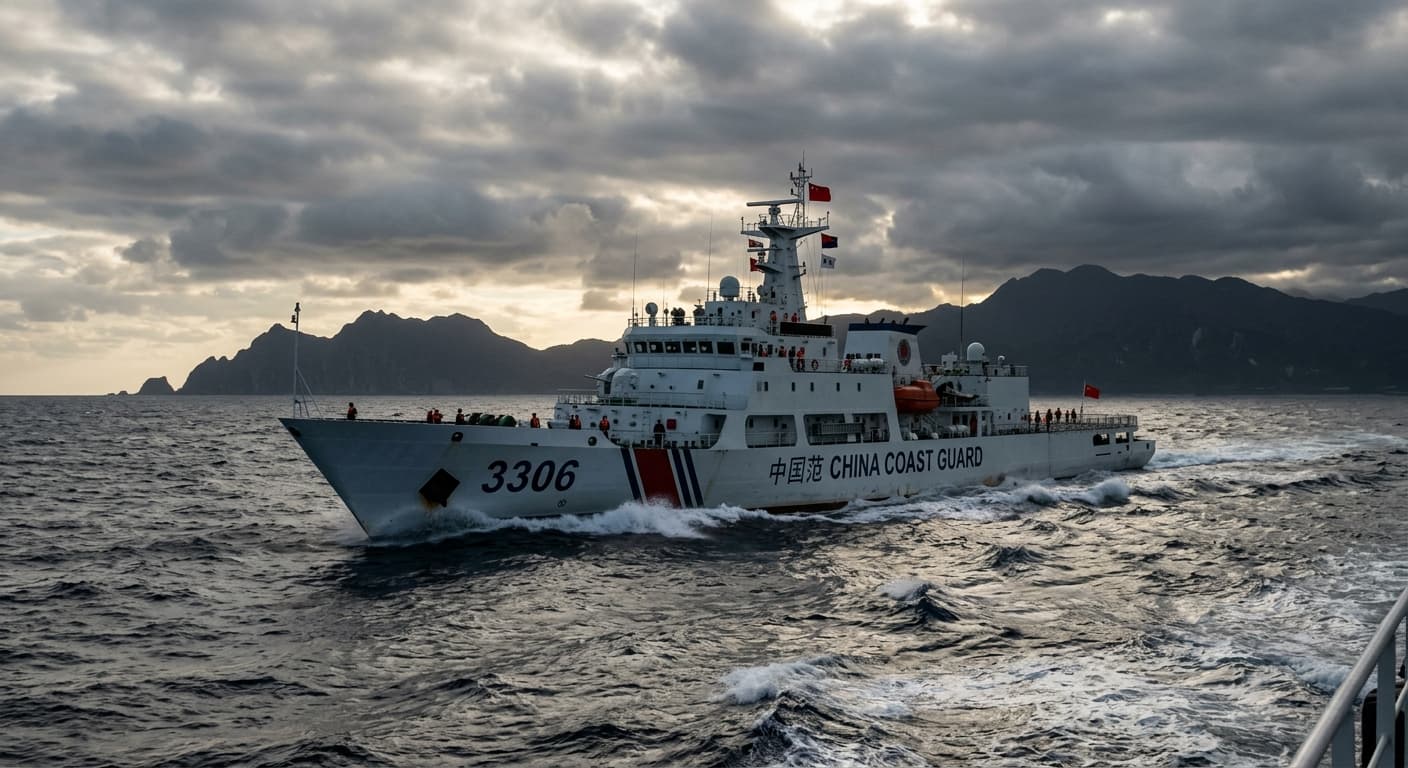
China's Coast Guard Moves East of Taiwan — Indo-Pacific's New Normal
Beijing's rotating coast guard patrol east of Taiwan since June 1, 2026 is the first standing PRC law-enforcement presence in the Western Pacific — a bid to pre-empt the Japan–Philippines EEZ deal and rehearse a quarantine.
The China Coast Guard has now held rotating "law enforcement" patrols in the Western Pacific east of Taiwan for 38 straight days — the first standing PRC civilian-enforcement presence ever recorded in those waters, and a direct answer to a Japan–Philippines maritime-boundary talk that overlaps Taipei's exclusive economic zone. The patrol is not about fisheries: it is Beijing's first attempt to project the same "gray-zone" regime it built at Scarborough Shoal and Kinmen onto the Pacific-facing side of the first island chain, and it changes the geometry of any future blockade of Taiwan.
The pattern was crystallized on July 4, when CCG spokesperson Jiang Lue said one formation had "handed over" to a second and that patrols "will continue," a formulation Ray Powell of Stanford's SeaLight told AFP amounted to Beijing "essentially announcing a new normal," according to reporting in Daily Tribune. Taiwan's National Security Bureau director-general Tsai Ming-yen confirmed to legislators on Monday that four Chinese formations — coast guard and warships — were operating in the Western Pacific during what he called China's peak exercise season.
What actually happened east of Taiwan
The trigger was diplomatic. On May 28, Japanese Prime Minister Sanae Takaichi and Philippine President Ferdinand Marcos Jr. announced in Tokyo that their governments would open UNCLOS-based negotiations to delimit their overlapping EEZs between the Yaeyama Islands and the Batan Islands — a strip of the Bashi Channel that also lies inside Taiwan's claimed zone, and which the Financial Times called the "sea east of Taiwan."
Beijing's Ministry of Foreign Affairs replied on June 2. Spokesperson Mao Ning said the target waters are "east of China's Taiwan island," that under UNCLOS "China has exclusive economic zone and continental shelf in this area," and that "any delimitation concerning waters to the east of Taiwan must have China as a party" — labeling the Tokyo–Manila talks "a severe violation of UNCLOS," per the Chinese consulate in Adelaide. Foreign Ministry spokesperson Lin Jian repeated the position on June 9, saying the CCG had released information on "law enforcement patrols" east of Taiwan "in accordance with the law," according to the
PRC embassy in Rwanda's transcript.
Rhetoric became sea state within 24 hours. On June 1, a formation led by the Kunlunshan-class cutter conducted the first declared CCG "law enforcement inspection" roughly 52 nautical miles (96 km) southeast of Taiwan's outlying Orchid Island (Lanyu), per BBC Chinese. From June 6 to 10, China's Ministry of Transport dispatched the 10,000-ton Haixun 09 and 5,000-ton Haixun 06, alongside Fujian and Guangdong maritime-safety cutters, on what Beijing called a "special maritime traffic enforcement and survey operation" covering more than 1,030 nautical miles, inspecting 198 vessels underway, sweeping undersea cables and — for the first time — radioing cargo ships east of Taiwan for crew lists and destinations. From June 16 to 18, the PRC research vessel Xiang Yang Hong 22 conducted a "marine environmental survey" under CCG escort, collecting hydrographic data with clear submarine-warfare applications, according to the
American Enterprise Institute's China–Taiwan Update.
The lever: this is Scarborough logic, moved 900 nautical miles north
Read the sequence and it is not improvisation; it is the Scarborough Shoal playbook rerun on the other side of Taiwan. Beijing manufactures a legal pretext — in 2012 it was Philippine navy action against Chinese fishermen; in 2024 it was the death of two Fujian fishermen off Kinmen; in 2026 it is the Japan–Philippines delimitation — then seeds the disputed water with civilian-flagged enforcement ships, rotates them so no single deployment can be called "escalation," and lets time do the work of jurisdiction.
The data are unambiguous on how well it works. According to CSIS Futures Lab's May 2026 report The Geometry of Coercion, the daily average of distinct CCG vessels entering Taiwan's near waters rose more than 500 percent between January 2020 and December 2025, while daily incursions into Taipei's second maritime security ring more than quadrupled. Around Kinmen and Matsu, CCG incursions were essentially unknown before February 2024; Taiwan's Ocean Affairs Council documented 679 unauthorized transits in 2024 alone, as summarized in a
CSIS analysis of the 2025 National Ocean Policy White Paper. Around Taiwan-administered Pratas Island, the
Asia Maritime Transparency Initiative counted zero CCG patrol days in 2021 and 60 in 2025.
The east-of-Taiwan patrol closes the ring. Until June, as International Crisis Group's William Yang told AFP, CCG presence in the Western Pacific had been "limited to blockade-style military exercises" tied to Joint Sword drills. Gregory Poling, who runs AMTI, is blunter: "Beijing appears to be claiming vast law enforcement rights across its claimed exclusive economic zone that go far beyond what is allowed by international law," he told the Daily Tribune. Su Tzu-yun of Taipei's Institute for National Defense and Security Research put the operational point sharply: "By conducting radio verification procedures for passing commercial vessels, China is effectively rehearsing the mechanisms required for a future blockade or quarantine."
Who loses — and the quiet beneficiary
The narrative loser is obvious: Taiwan. President William Lai Ching-te's government now faces a coast-guard-led pressure vector on all four sides of the island — Strait median line, Kinmen/Matsu, Pratas, and now the Pacific approaches through which US, Japanese and Philippine resupply would flow in a crisis. The Coast Guard Administration is outnumbered and outgunned; CSIS's June 2024 study on CCG coercion and quarantine noted that Taipei's 2018 program to build 141 new cutters by 2027 is still the ceiling of its response capacity, and September 2025's Special Resilience Budget added only US$206 million for unmanned maritime vehicles.
Tokyo and Manila lose diplomatic altitude too. The BBC's Chinese-service analysis noted that Taipei was initially "cautiously supportive" of the Japan–Philippines EEZ talks but hardened its line after realizing the negotiated line would run through waters Taiwan claims, forcing Foreign Minister Lin Chia-lung to demand that both partners "consult with Taiwan." Beijing has thus split its adversaries' diplomatic coalition before it could form — the classic wedge maneuver.
The quieter beneficiary is the PLA Navy. The waters east of Taiwan sit atop the Bashi Channel and the Miyako Strait, the two chokepoints through which any US carrier group would enter the Taiwan theater. As AEI's tracking noted, the hydrographic data collected by Xiang Yang Hong 22 — marine chemistry, bathymetry, hydrometeorology — has direct applications for submarine navigation and undersea detection. The coast guard's presence provides a lawful-looking umbrella for surveys that, done by a PLA Navy hull, would trigger an entirely different diplomatic reaction. This is the "military-police coordination" Beijing openly discussed after Joint Sword-2024A, now industrialized.
The legal question the West is losing on paper
The uncomfortable analytical truth is that Beijing's UNCLOS argument is not laughable. Under Article 74 of the UN Convention on the Law of the Sea, delimitation of EEZs "between States with opposite or adjacent coasts shall be effected by agreement on the basis of international law" to achieve an "equitable solution." Because most states — including the US — follow a "one China" formulation, Tokyo and Manila cannot formally invite Taipei to the table. If they exclude Beijing too, the PRC will argue no valid delimitation is possible in the overlap, which is precisely Mao Ning's line. That is why the CCG rotation matters more than the tonnage suggests: it establishes the fact pattern — continuous presence, published enforcement acts, radioed inspections — that Chinese lawyers will cite in every future proceeding as evidence of effective administration.
Congressional testimony collected by the House Homeland Security Committee in June 2024 already identified this "war without gun smoke" as the operational core of Chinese seaward expansion — and warned that CCG law-enforcement moves east of Taiwan would be a "potential harbinger" of PRC law-enforcement operations on the Pacific side of the strait. That harbinger has now arrived.

What Taipei, Tokyo and Manila do next
Three responses are already visible. Taiwan's coast guard has held to a "monitor and expel" posture with English- and Chinese-language broadcasts, avoiding hull-to-hull contact, and its Navy has, unusually, joined those broadcasts. AIT director Raymond Greene, the de facto US ambassador in Taipei, on July 2 urged Taiwan to become a "hornet's nest" of maritime and aerial drones, per Al Jazeera; Lai's government has proposed a NT$210 billion drone package through 2031, though the opposition KMT is countering with its own bill. Tokyo, having relaxed weapons-export rules earlier this year, is reportedly considering transferring Abukuma-class destroyers to Manila. And in January 2026,
Japan and the Philippines signed a further Acquisition and Cross-Servicing Agreement, building on the 2024 Reciprocal Access Agreement.
None of that will move a Chinese cutter out of the Pacific by autumn. What it will do is force Beijing to keep escalating to maintain the pressure differential — the pattern the AMTI Kinmen study documented, where the CCG had to add hulls and complexity every quarter to sustain "new normal" status.
Diplomat View
The base case: the CCG patrol east of Taiwan becomes a permanent rotation by year-end, and by the 2027 PLA centenary, Beijing will cite continuous administration as a legal fact — the same accretion strategy that turned Scarborough Shoal into a de facto Chinese lake between 2012 and 2016. The real inflection point is not a shooting incident; it is the first time a Chinese cutter formally cites this year's radio-inspection record to justify boarding a commercial ship east of Taiwan. That could happen inside 18 months.
The forecast changes if two things occur together: Taiwan's Coast Guard Administration accelerates its 141-vessel program and integrates command-and-control with the JCG and Philippine Coast Guard on the model of the CSIS-proposed Coalition Joint-Maritime Anomaly Cell in Signals in the Swarm; and Washington rules that CCG hulls acting east of Taiwan fall under an existing US–Japan or US–Philippines mutual-defense reading. Absent both, Beijing wins the paperwork war before any missile flies. The falsification test: if CCG rotations east of Taiwan halt before November's APEC summit, this thesis is wrong and the operation was tactical signaling; if a third rotation is announced, the "new normal" designation is confirmed.
What to watch
- August–September 2026: Beijing's peak exercise season. Whether the CCG east-of-Taiwan patrol overlaps a Joint Sword or "Strait Thunder" drill will indicate whether the coast guard is being fused into the PLA quarantine playbook.
- October 2026 (Taiwan National Day): Lai's speech and any Chinese exercise response — 2024's Joint Sword-2024B established the coast guard as an encirclement tool; a 2026 sequel would embed the Pacific patrol in that architecture.
- First Japan–Philippines delimitation round: the moment the two governments publish coordinates, expect a matching CCG deployment surge to contest them physically.
The Bottom Line
Beijing's rotating coast-guard patrol east of Taiwan is not a reaction to a Japan–Philippines diplomatic move; it is the moment the "gray-zone" model perfected around Scarborough and Kinmen was ported to the Pacific side of the first island chain, closing the last unpressured face of Taiwan. The next 18 months will decide whether that patrol becomes as unremovable as the CCG presence at Scarborough Shoal — and if it does, any future blockade of Taiwan will already have its legal scaffolding built in daylight, by ships painted white.
Discover more

US Politics
White House Pressures Congress for Crypto Leg
The Trump administration's push for the CLARITY Act aims to reshape crypto regulation, impacting trillions in market value and the Trump family's wealth.

India
Congress Accuses Modi of Stalling Women's Law
Congress accuses Modi of stalling women's reservation law by linking it to delimitation, revealing a deeper electoral strategy.
US Politics
House Ethics Committee Pushes Sexual Miscond.
The House Ethics Committee has shifted responsibility for sexual harassment settlement records to the Office of Congressional Workplace Rights, complicating disclosure efforts.

Economics
Fed's Amex AML order puts correspondent banking on notice
Federal Reserve's Amex AML order requires board-level controls and a 90-day plan; OCC fined the bank $350 million over enterprise-wide deficiencies.