China's Coast Guard Expands Patrols Near Taiw
Beijing's maritime jurisdiction extends to Taiwan's east.
Model Diplomat9 min readAsia
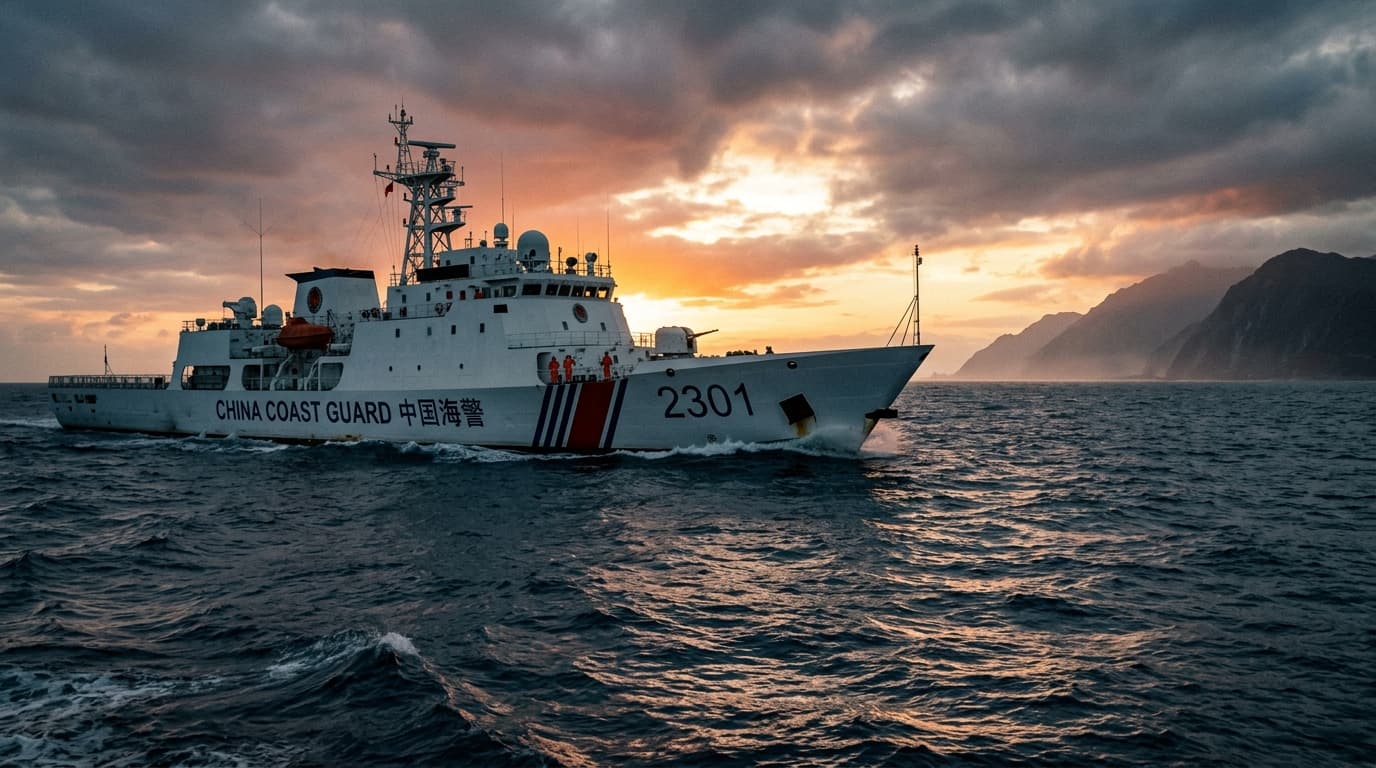
China's Coast Guard Crosses to Taiwan's Pacific Side — And Plans to Stay
China Coast Guard patrols east of Taiwan since June 1, 2026 are now permanent — extending Beijing's "Kinmen model" of jurisdictional creep to the Pacific side of the first island chain.
Beijing has quietly moved its coercion of Taiwan from the Taiwan Strait to the Pacific: China Coast Guard vessels have patrolled the waters east of the island almost continuously since June 1, 2026, and on July 8 a second CCG group rotated in to replace the first — the clearest signal yet that what began as a protest over a Japan–Philippines maritime deal is now a permanent extension of Beijing's claimed jurisdiction across the first island chain. The thesis is straightforward and load-bearing: the eastern patrols are not retaliation; they are the "Kinmen model" scaled out to the Pacific, and they hand Beijing the rehearsal architecture for a coast-guard-led quarantine of Taiwan without a declared war.
The immediate story, as the Daily Tribune reported, is a rotation: one CCG task group hands off to another, patrols continue, officials call it the "new normal." The bigger story is that Taiwan's eastern flank — the deep Pacific approach that has for decades been the island's strategic redoubt, the corridor U.S., Japanese and Philippine resupply would have to use in a crisis — is now being written into Chinese domestic maritime jurisdiction, one broadcast at a time.
What actually happened
The trigger is dated. On May 28, 2026, Japanese Prime Minister Sanae Takaichi and Philippine President Ferdinand Marcos Jr. announced formal talks to delimit their overlapping exclusive economic zones under the UN Convention on the Law of the Sea, focused on the seam between the Yaeyama Islands and the Batanes group. That seam sits directly east of Taiwan — and, as BBC Chinese reported, it "significantly overlaps" with the EEZ Taipei claims from its own baselines.
Beijing's foreign ministry declared the talks "completely illegal and invalid." Within 96 hours it moved ships. According to the American Enterprise Institute's China–Taiwan Update, the PRC Ministry of Transport ran a "special maritime law enforcement operation" from June 6 to 10, coordinating Fujian and Guangdong Maritime Safety Administration cutters with the East China Sea Navigation Support Center and the East China Sea Rescue Bureau. At least three MSA vessels and one search-and-rescue ship joined two China Coast Guard cutters — CCG ships that had already begun patrolling east of Taiwan on June 1 and, per Starboard Maritime Intelligence tracking, have not left.
The numbers matter. During the four-day sweep, the operation covered more than 1,030 nautical miles east of the main island, hailed 198 commercial ships by radio, and issued "corrective notices" to three. The Royal United Services Institute — which named the episode the "Bashi Breakout" — argues that inspecting international transit shipping (not just Taiwan-flagged vessels bound for Taiwan) is a "watershed moment." Every previous PRC interference with commercial traffic around Taiwan had been confined to the Strait; this one reached into the Pacific and into third-flag hulls.
The rotation reported on July 8 confirms the pattern is not a spike. A second CCG group is now on station, with officials telling state media patrols will continue.
The Kinmen model, exported
The playbook is not new — the geography is. In February 2024, after a Chinese motorboat capsized in prohibited waters off Kinmen, Beijing declared it would step up patrols; the CCG then normalized incursions into Taiwan's restricted waters around Kinmen and Matsu, waters the mainland had tacitly respected since 1993. Asia Maritime Transparency Initiative documented how those patrols hit an "all-time high" by late 2024, with a record 11 Chinese government vessels entering waters around Kinmen simultaneously in a single May 2024 incident.
The same escalation curve then ran at Pratas (Dongsha). AMTI's AIS analysis found zero Chinese law-enforcement patrols around Pratas in 2021, 25 days of activity in 2024, and 60 days in 2025 — with as many as 23 vessels inside the contiguous zone by year-end. The pattern each time: an "incident" as pretext, patrols formalized as "law enforcement," then codification by state media into a doctrine of "nearshore governance."
The doctrinal codification arrived on June 20, 2026. Yuyuan Tantian, the CCTV-affiliated social account that first named the "Kinmen model" in 2024, declared that recent activity meant Beijing now treats the waters east of Taiwan as PRC "near-shore waters." AEI's June 26 update flagged the language as deliberate — the same rhetorical device that preceded permanent patrols at Kinmen and Pratas.
The trend line
The eastern patrols do not sit in a vacuum. They cap a five-year escalation that has already reshaped the maritime map.
The Center for Strategic and International Studies' Futures Lab, in "The Geometry of Coercion" (May 2026), found that between January 2020 and December 2025 the daily average of distinct China Coast Guard vessels entering Taiwan's near waters rose by more than 500 percent, while daily incursions into Taiwan's second maritime security ring more than quadrupled. The
ChinaPower Project separately logged that the CCG more than doubled its presence around Scarborough Shoal in 2025 compared to 2024, and in October 2025 conducted law-enforcement patrols through the Northern Pacific — passing both north and south of Japan's main islands.
The eastern-Taiwan patrols are the missing tile. They fill the last quadrant of a 360-degree CCG presence around the island — an "encirclement" Chinese state media had claimed but AIS data had never quite confirmed during the Joint Sword-2024B exercises, when there was still, per ChinaPower's tracking, a gap in the southeast.
Who wins, who loses
The named winner is the People's Liberation Army Navy. If the CCG owns the Pacific-side jurisdictional theater, the PLAN can push farther. As the Atlantic Council noted in its April 2026 analysis, Taiwan's Coast Guard Administration disclosed that day that the Eastern Theater Command exercises operational control over the CCG during exercises — meaning the "law enforcement" white hulls are a PLA instrument in all but paint. Freeing the CCG to police east of the island lets the PLAN devote more assets to blue-water missions: the same year, according to ChinaPower, China's two carriers spent nearly twice as many days operating beyond the first island chain as in 2024, and for the first time deployed simultaneously in the Pacific.
The named loser is Taipei. Taiwan's Foreign Ministry, per BBC Chinese, demanded that Tokyo and Manila hand over the coordinates of their negotiation area and "must not exclude or damage Taiwan's sovereign rights and interests." The Ministry of National Defense called the CCG patrols "provocative," as Taipei Times coverage noted through the week. But Taiwan's diplomatic position is structurally weak: Japan and the Philippines are negotiating under UNCLOS, a treaty Taipei cannot join as a non-state party, and cannot invoke Taiwan by name without inviting Chinese retaliation. Taiwan is the third party the treaty has no seat for.
The second-order loser is Manila. The Marcos administration got a security upgrade from Tokyo — a comprehensive strategic partnership, an Acquisition and Cross-Servicing Agreement, potential Japanese warship transfers per Al Jazeera — and, in return, a Chinese coast guard now claiming jurisdiction over an EEZ segment that used to be a Philippine bargaining chip. The
MP-IDSA analysis argues Beijing is using the delimitation talks as a legal wedge to push its "east of China's Taiwan Island" theory from theory into practice.
The subtler loser is the freedom-of-navigation regime itself. RUSI's warning is worth quoting in the original:
"PRC statements that this operation included inspection of 198 international commercial vessels making passage through the region (rather than bound for Taiwan), with 'corrective notices' issued to three, marks a watershed moment… Beijing is increasingly willing to go much further in its efforts to reshape regional and international maritime norms."
The historical parallel
The obvious analogue is not Kinmen. It is Scarborough Shoal, 2012 — where a standoff between Philippine and Chinese vessels ended with Chinese coast guard cutters simply not leaving, and never leaving. Fourteen years on, the shoal is under de facto Chinese administrative control, though the 2016 arbitral tribunal ruled against Beijing's claim. The Observer Research Foundation argues Pratas is now Beijing's "laboratory" for the same technique — repeated incursions, documented "law enforcement" actions, and the accumulation of a paper record that can later be cited as evidence of effective jurisdiction.
The legal machinery for this is the 2021 China Coast Guard Law, which — as the CSIS analysis on a potential PRC quarantine explains — empowers the CCG to board and inspect vessels in "maritime areas under Chinese jurisdiction," a category Beijing defines unilaterally. The eastern-Taiwan patrols are the first sustained field application of that authority outside the strait and outside the South China Sea.
The quarantine rehearsal
The specific worry among Western analysts is that these are not just claim-planting patrols — they are dress rehearsals for a peacetime coast-guard-led quarantine of Taiwan. Every element visible in the June operation maps onto quarantine mechanics: MSA cutters hail commercial ships and check crew and voyage information; CCG cutters stand by armed; a research vessel scouts seabed cables; a "corrective notice" regime creates the paper trail for later interdictions. RUSI reads it plainly: the patrols "provide further evidence that the PRC is preparing for a future quarantine of Taiwan… using the CCG in the lead and justified under 'law enforcement' rather than the law of naval warfare."
Taiwan's response has so far been calibrated. The Coast Guard Administration deployed multiple vessels to shadow the CCG group, broadcasting warnings in Mandarin and English, per BBC Chinese; the Navy issued rare public broadcasts scolding the mainland ships. Taiwan's Institute for National Defense and Security Research has explicitly urged Taipei to hold a "double-layer alert line" — CGA in front, Navy in reserve — to deny Beijing a pretext for kinetic escalation.
What to watch next
Three near-term catalysts will determine whether the June "new normal" hardens or is walked back.
- The next Japan–Philippines delimitation round. If Tokyo and Manila proceed without explicit acknowledgement of Taiwan's overlapping claim — the position Taipei's foreign ministry has publicly demanded — Beijing gets its rhetorical opening to expand patrols. If they insert a "third-party rights" clause, the pretext narrows.
- PLAN carrier movements east of Taiwan through August–September. ChinaPower's tracking of dual-carrier operations beyond the first island chain in 2025 suggests Beijing will pair CCG "governance" with PLAN presence to lock in the corridor. Watch for the Shandong group.
- The U.S. Coast Guard's response posture. The FY2026 National Defense Authorization Act, per the INDSR brief, authorizes deepened U.S. Coast Guard training with Taiwan's CGA. Whether Washington moves from training to joint patrols inside Taiwan's contiguous zone — a step CSIS has explicitly recommended — will decide whether Beijing pays a real deterrent cost or a rhetorical one.
The Bottom Line
The east-of-Taiwan patrols are not a reaction to a Japan–Philippines negotiation — they are the operational payoff of a five-year Chinese strategy to write "law enforcement" jurisdiction across every quadrant of Taiwan's near seas. Beijing has now closed the last gap in that encirclement, and it has done so with white hulls that Western capitals still find hard to treat as military coercion. If the July 8 rotation holds through the autumn without a coordinated Taiwan–Japan–Philippines–U.S. response, the "new normal" east of Taiwan will be locked in — and the legal architecture for a peacetime quarantine will be operational, not theoretical.
Diplomat View
The forecast is specific and falsifiable. The eastern patrols will still be running on January 1, 2027, and by then Beijing will have applied "corrective notices" to at least one non-Taiwan-flagged vessel bound for a Taiwanese port — the threshold event that converts jurisdictional theater into commercial disruption. The condition that would revise this call: a joint U.S.–Japanese coast guard patrol inside Taiwan's contiguous zone before year-end, or an explicit third-party-rights clause in the Tokyo–Manila delimitation framework naming Taipei's interests. Neither is currently on the calendar. The strategic implication for Washington is uncomfortable but clear: the Indo-Pacific deterrence problem has moved below the military threshold, where U.S. carriers do not deter and U.S. law does not cleanly apply. The instrument that matches Beijing's instrument is the U.S. Coast Guard — and it is not sized, funded, or postured for the mission the CCG has just handed it.
Discover more

US Politics
White House Pressures Congress for Crypto Leg
The Trump administration's push for the CLARITY Act aims to reshape crypto regulation, impacting trillions in market value and the Trump family's wealth.

India
Congress Accuses Modi of Stalling Women's Law
Congress accuses Modi of stalling women's reservation law by linking it to delimitation, revealing a deeper electoral strategy.
US Politics
House Ethics Committee Pushes Sexual Miscond.
The House Ethics Committee has shifted responsibility for sexual harassment settlement records to the Office of Congressional Workplace Rights, complicating disclosure efforts.

Economics
Fed's Amex AML order puts correspondent banking on notice
Federal Reserve's Amex AML order requires board-level controls and a 90-day plan; OCC fined the bank $350 million over enterprise-wide deficiencies.