China Wins the Lithium Race at Manono
China's Zijin ships first lithium from DRC's Manono deposit
Model Diplomat9 min readAfrica
The Lithium Rush Is Over at Manono — China Won It
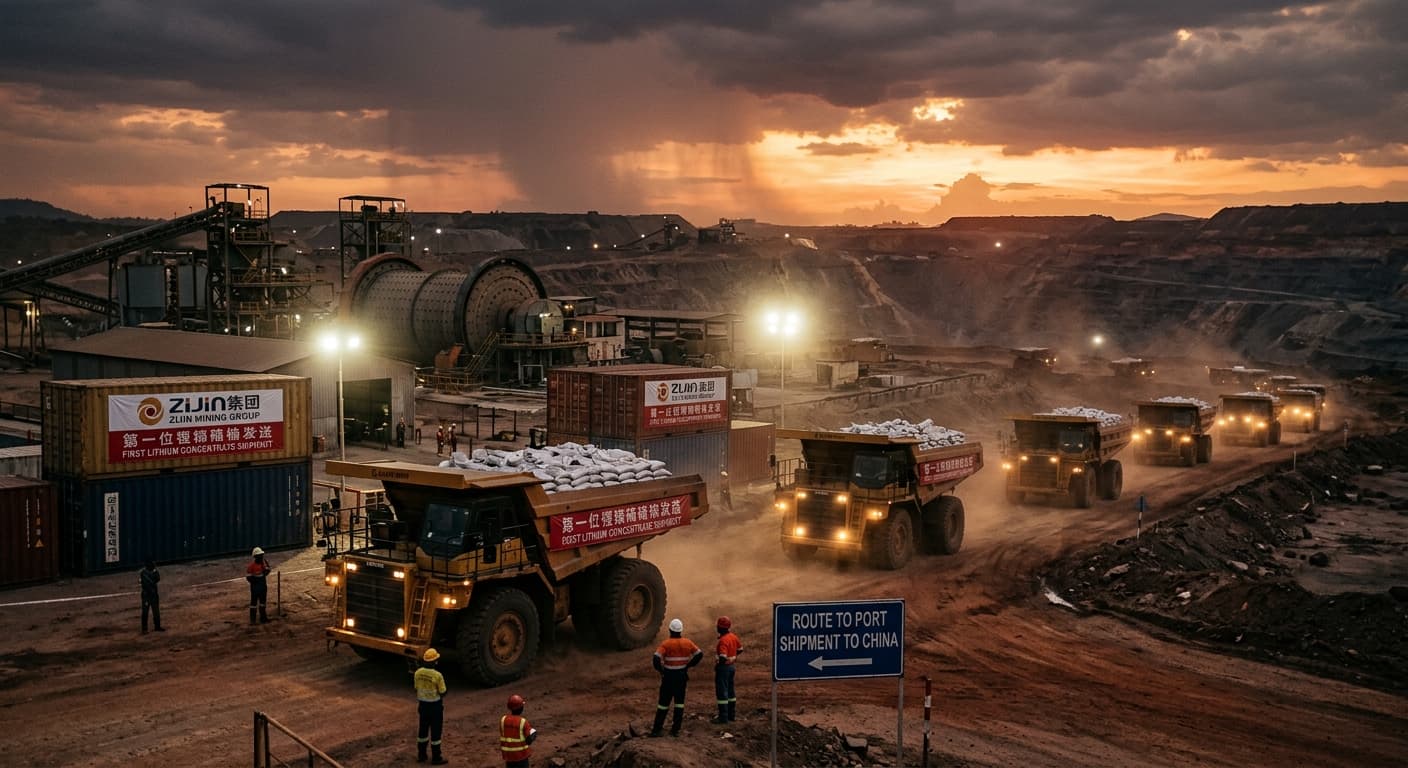
In June 2026, the first shipments of DRC lithium concentrate left for China. That single convoy — trucked 440 kilometers to a lakeside port, ferried across Lake Tanganyika, and loaded onto ocean freight at Dar es Salaam — settled a three-year legal war, a U.S. counter-offensive, and the question of who controls Africa's largest hard-rock lithium deposit. The answer: Beijing, by roughly a billion dollars.
The Democratic Republic of Congo joined the ranks of global lithium exporters in June 2026, but the real story is not the shipment itself. Zijin Mining Group won the race for Manono — Africa's largest undeveloped hard-rock lithium deposit — by betting approximately $1 billion on production infrastructure while Western rivals bet on international arbitration. The first spodumene concentrate is now in transit, with market analysts expecting arrival at Chinese refineries by October 2026 Skillings Mining Intelligence. Production commenced in May. Trial shipments departed in June. The ICSID arbitration that was supposed to halt all of this? Suspended until July 3, 2026, per the parties' agreement — and with concentrate already on the water, it is now largely a damages question, not a blockade.
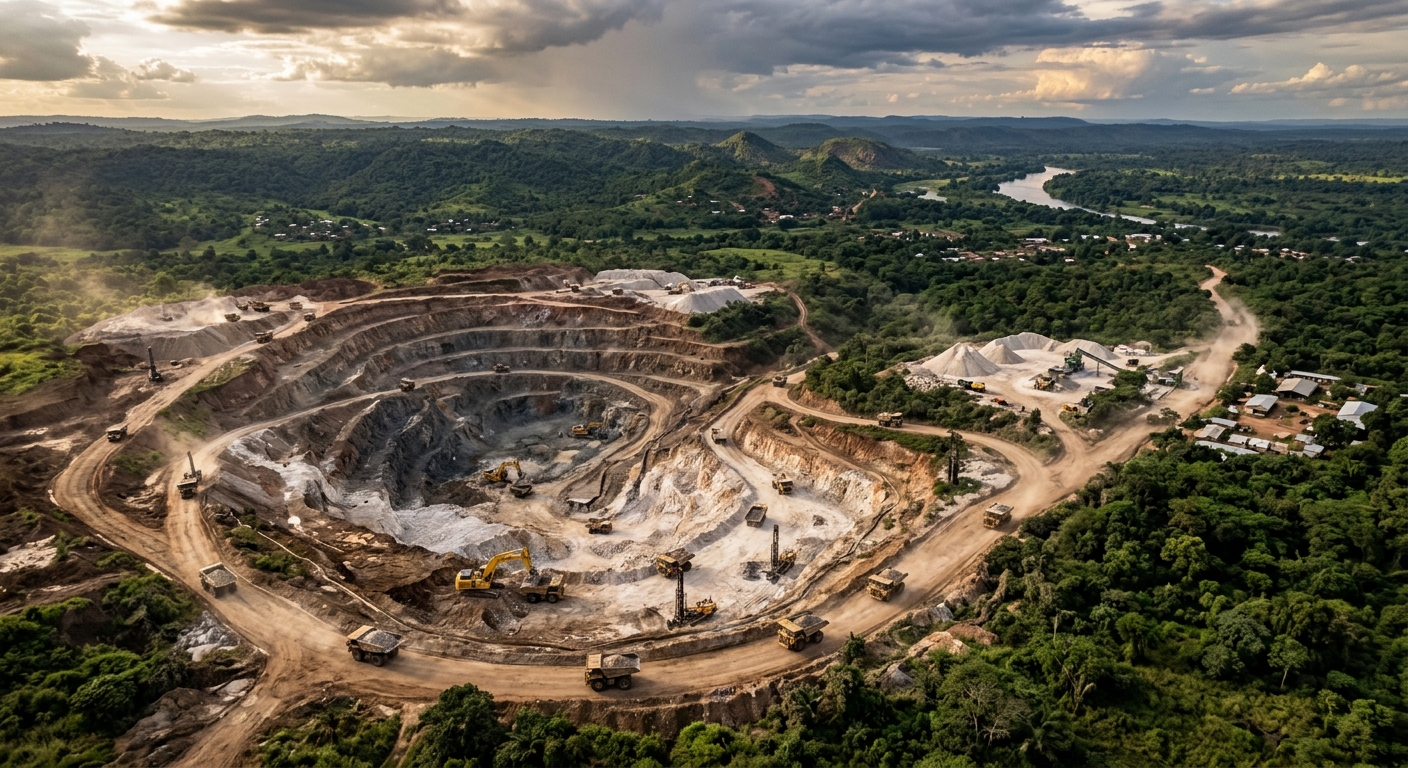
The ownership structure tells the story before any legal filings can. Zijin holds 54.9%. The DRC state-owned Cominière holds 35.1%. The Congolese government holds the remaining 10%. That architecture — a Chinese majority, a state-minority partner, and Kinshasa holding a direct stake — is the signature of a deal the government chose to honor, not one it was forced into. And production began on that basis, even as the Australian firm AVZ Minerals pursued its claims through the World Bank's own arbitration body.
The Legal Battlefield: ICSID vs. ICC
The Manono deposit did not arrive at Zijin's doorstep cleanly. AVZ Minerals, an Australian junior miner, had previously held the license through its subsidiary Dathcom Mining SA. In 2023, the DRC government revoked those licenses and re-awarded the northern section of the deposit to Zijin. What followed was a multi-front legal war that has now produced contradictory rulings and an arbitration process that has ground to a crawl precisely when speed mattered most.
At the International Centre for Settlement of Investment Disputes (ICSID), AVZ International Pty Ltd., Dathcom Mining SA, and Green Lithium Holdings Pte Ltd. brought claims against the DRC under the ICSID Convention. The case, registered as ARB/23/20, has been repeatedly suspended. The tribunal was reconstituted on March 20, 2026, with Jan Paulsson — one of the world's preeminent arbitrators — as President, Peter Turner appointed by the claimants, and Mohamed Shelbaya appointed by the respondent ICSID Case Database. On April 23, 2026, the tribunal issued Procedural Order No. 7 concerning provisional measures and the claimants' request for suspension. The proceeding was then suspended until July 3, 2026 — meaning the ICSID tribunal has not yet ruled on the merits.
Meanwhile, at the International Chamber of Commerce (ICC), AVZ secured a more tangible victory. On March 14, 2025, the ICC's International Court of Arbitration ordered DRC's state-owned Cominière to pay a €39.1 million ($42.46 million) penalty for failing to comply with previous rulings Council on Foreign Relations. That figure, while significant, is a fraction of the value of a producing lithium mine. And critically, U.S. officials reportedly signaled they would allow Zijin to retain control of the northern section of Manono to avoid a direct conflict with China — focusing instead on trying to return the southern section to AVZ, which would then sell the asset to a U.S. entity.
The arithmetic of litigation versus production now speaks for itself: Zijin is shipping concentrate; AVZ is filing procedural requests. A billion dollars in infrastructure — roads, processing plants, logistics corridors — is already sunk and operational. No tribunal ruling can put that back in the ground.
The American Counter-Offensive: KoBold, Lobito, and the Minerals-for-Security Deal
The U.S. response to China's lithium land-grab in Congo has been ambitious, multipronged, and — at least at Manono — unsuccessful to date.
KoBold Metals, the Silicon Valley-backed exploration company, holds an adjoining license at Manono. Its CEO, Josh Goldman, described Congo as "the most mineral-rich place on earth" and could not resist entering The Economist. Yet KoBold has frozen development pending resolution of the ownership disputes. A spokesperson stated that the venture "will not proceed with development until all legal disputes around Manono are resolved"
Skillings. That freeze, while legally prudent, ceded the first-mover advantage entirely to Zijin.
Washington's broader play has been the Lobito Corridor — a 1,300-kilometer rail and transport route linking the Atlantic port of Lobito in Angola to the mineral-rich regions of the DRC and Zambia. The U.S. has mobilized over $4 billion to develop the corridor, including refurbishing Angola's Benguela rail line. The International Development Finance Corporation (DFC) signed a $753 million financing package in December 2025 Al Jazeera. But Lobito serves the southern Copperbelt — Katanga's copper and cobalt mines — not the remote Manono site in Tanganyika province.
The Trump administration also brokered a minerals-for-security agreement with Kinshasa. The deal, signed on June 27, 2025, in Washington, required Congo to grant "U.S. aligned persons" the right to bid first on certain critical minerals projects in exchange for security support against M23 rebels in the east. The day after the agreement, Gécamines and the Swiss-based trader Mercuria announced a joint venture to market cobalt, copper, and other critical minerals to the U.S. Foreign Affairs. But by the time these handshakes were exchanged, Zijin had already been pouring concrete at Manono.
As Foreign Affairs noted in July 2026, the entire U.S. approach has been "a transactional one that prioritizes dealmaking" while struggling with the reality that "over two-thirds of Congo's copper and cobalt exports go to China." Lithium is now following the same gravitational pull. The U.S. can talk supply-chain diversification; China simply builds mines.
The Logistics That Make or Break Manono
Moving lithium concentrate from Manono to a Chinese refinery requires a supply chain that reads like a 19th-century explorer's journal. The concentrate is trucked 440 kilometers from the landlocked site in Tanganyika province to the lakeside port of Kalemie. From there, it crosses Lake Tanganyika via a dedicated fleet of cargo vessels to Kigoma, Tanzania. Then it moves overland to the port of Dar es Salaam for ocean freight to China Skillings.
This is not the streamlined Lobito Corridor. It is a slower, costlier, multi-modal route — but it is the one Zijin controls. And crucially, it runs east, toward the Indian Ocean and China, not west toward the Atlantic and American or European markets. The logistics corridor itself is a strategic commitment to Beijing.
Zijin has reportedly invested heavily in making this route functional — roads, vessels, port handling — as part of the broader billion-dollar infrastructure package. Chinese state-backed firms develop the complete infrastructure package for mining operations, including roads and energy systems, as CSIS analysts have documented in their study of the DRC mining ecosystem CSIS. The contrast with Western approaches — where infrastructure is financed separately by multilateral banks and development agencies — is stark and operationally decisive.
The Market: Tight Supply, Rising Prices, and a New African Producer
Manono's entry into the global lithium market comes at a moment of recovery after a punishing 2023-2025 downturn. Spodumene concentrate 6% Li₂O (SC6) prices hit a low of approximately $617 per dry metric ton in mid-2025, driven by oversupply and slower-than-expected EV demand growth. By early 2026, prices had recovered to well over $2,000 per ton Kodal Minerals, via FT. A Q1 2026 scoping study for a Canadian lithium project cited Benchmark Mineral Intelligence pricing at an average SC6 price of $2,261 per ton for near-term deliveries
Elevra Lithium, via FT.
SQM, the world's second-largest lithium producer, reported that global lithium demand could exceed 1.9 million metric tons of LCE in 2026, with "market dynamics continuing to suggest a tight supply-demand balance" SQM, via FT. SQM upgraded its sales volume guidance from 10% to 15% growth for the year.
Zijin's initial 30,000-tonne LCE target for 2026 is modest in global terms — just 1.6% of projected demand. But the ramp-up is underway, with a dense media separation (DMS) plant and flotation circuits being commissioned throughout Q3 2026. The real significance is not volume but precedent: the DRC, already the world's dominant cobalt supplier (over 70% of global production), has now demonstrated it can produce and export lithium at scale.
The logistics penalty is real. Shipping spodumene from Manono to China via Lake Tanganyika and Dar es Salaam costs far more than shipping from Australia's Greenbushes or Chile's Atacama. But at $2,200-plus SC6 pricing, those costs are absorbable. If prices soften — as Benchmark Mineral Intelligence forecasts suggest they might, toward $1,260 per ton by 2031 — Manono's competitiveness relative to lower-cost producers will be tested.
What Happens Next: Three Decision Points
The story is now in motion, not concluded. Three catalysts will determine whether the first shipment is a footnote or a turning point.
First, the ICSID ruling on the merits. The AVZ arbitration is suspended only until July 3, 2026. When the tribunal reconvenes, it faces a reality in which Zijin is producing and shipping concentrate from the very license AVZ claims. Procedural Order No. 7 on provisional measures suggests the claimants are seeking, among other things, to halt or constrain Zijin's operations. If the tribunal declines — and given the factual posture, that seems likely — the legal pathway for AVZ narrows to damages. That suits Beijing fine; China can pay damages later and mine now.
Second, KoBold Metals' investment decision. The U.S.-backed firm's freeze on development is rational but self-defeating if the goal is to establish a Western lithium foothold in Congo. KoBold's CEO has publicly stated his conviction that Congo is unmatched in its mineral potential. At some point, that conviction must either overcome legal caution or be abandoned. The date to watch is the resolution of the ICSID suspension — if the tribunal signals it will not enjoin Zijin's operations, KoBold faces a choice: negotiate a coexistence with a Chinese neighbor or walk away from one of the world's largest lithium deposits.
Third, the Lobito Corridor's northern extension. The existing Lobito railway serves the Copperbelt — Katanga, not Tanganyika. For the West to access Manono's lithium, a northern spur would need to be built, crossing hundreds of kilometers of territory with minimal existing infrastructure. No such plan has been funded. Until one is, Manono's lithium will continue flowing east to China, not west to Atlantic markets. The World Bank has approved a $250 million credit as the first phase of a $1 billion Inga 3 Development Program to boost energy access, and a separate $1.5 billion Transport and Connectivity Support Project is under preparation World Bank. But neither project directly addresses the Tanganyika-to-Atlantic missing link.
Diplomat View
The first lithium shipment from Manono is not a commodity story. It is the closing of a window — the moment when a three-year contest between Beijing's "build first, litigate later" approach and Washington's "litigate first, build never" approach produced a definitive outcome. Zijin now holds a producing lithium mine in a country that controls 70% of global cobalt and 44.6 million tons of proven lithium reserves World Bank.
The U.S. minerals-for-security deal, the Lobito Corridor, the ICC ruling, and the ICSID arbitration were all meant to create a different outcome. They did not — because none of them put a shovel in the ground fast enough. Zijin was willing to spend approximately $1 billion on infrastructure, absorb an ICC penalty of €39.1 million, and tolerate unresolved arbitration while producing. Western firms, by contrast, conditioned investment on legal certainty that never arrived.
The forecast: Manono will ramp to full production over 2027-2028, making the DRC a meaningful — though not dominant — lithium producer. The concentrate will flow overwhelmingly to Chinese refineries, deepening the structural interdependence between the DRC's mineral wealth and China's battery supply chain. The U.S. will continue to develop the Lobito Corridor, which serves copper and cobalt well but does not yet reach the lithium. KoBold will face growing pressure to either develop its adjoining license or sell it — likely to a Chinese buyer.
Conditions that would change this forecast: a definitive ICSID injunction halting Zijin's operations (low probability after concentrate is already shipping), a funded U.S. commitment to extend Lobito into Tanganyika (no signs of this), or a Congolese government decision to renegotiate the Manono ownership structure (politically costly given Kinshasa's 10% direct stake and Cominière's 35.1% share).
The Bottom Line
The bottom line: China's Zijin Mining won the race for Africa's largest lithium deposit by spending roughly $1 billion on production while Western rivals spent on lawyers. The first concentrate is on the water. The arbitration is stalled. And the U.S. minerals-for-security architecture in Congo has no asset at Manono to secure. This is the cobalt playbook — Chinese state-backed capital builds, produces, and ships while Western policy frameworks take shape — now applied to lithium. If Western buyers want Congolese lithium, they will be buying it from a Chinese-owned mine through Chinese-controlled logistics.
Discover more
US Politics
House Ethics Committee Pushes Sexual Miscond.
The House Ethics Committee has shifted responsibility for sexual harassment settlement records to the Office of Congressional Workplace Rights, complicating disclosure efforts.
India
Modi's Women’s Convention in Varanasi
Modi's Varanasi rally frames women's reservation as a national mission, targeting the 2027 Uttar Pradesh elections with a strategic narrative.
Global Politics
Trump's Conflicting Messages on Iran War
Trump's mixed messages on Iran reflect a strategy of audience management, benefiting Tehran amid a complex geopolitical landscape.

Conflict & Security
Drone Warfare Killing Aid Workers at Unprec
Over 1,000 humanitarian workers killed in three years as cheap armed drones collapse legal protections. Gaza, Sudan, Ukraine, and DRC see deliberate targeting of aid convoys and hospitals with zero prosecutions.

