China-Russia Naval Drill Reshapes Indo-Pac
Joint Sea 2026 signals new military dynamics in the Indo-Pacific.
Model Diplomat8 min readAsia-Pacific
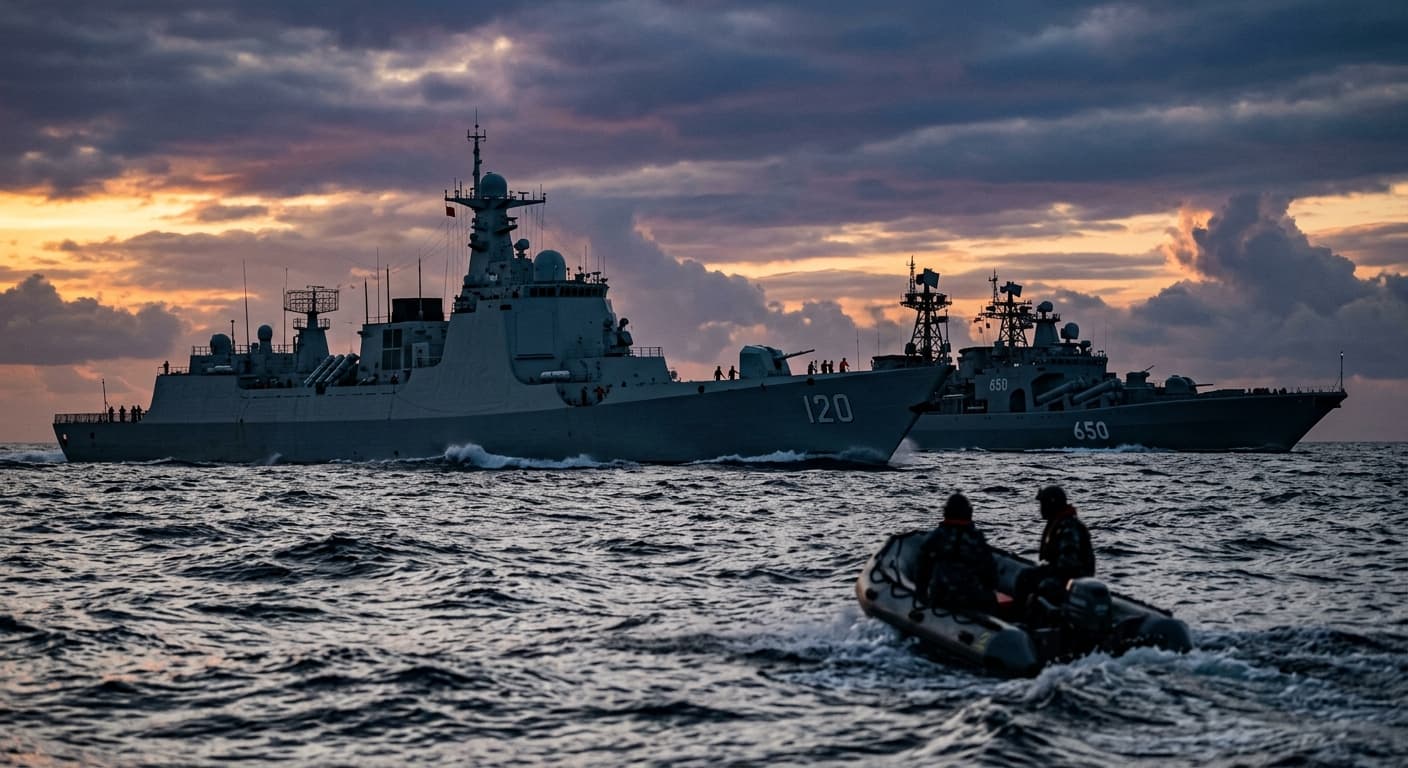
China-Russia 'Joint Sea 2026' Drill Reshapes Indo-Pacific Risk
Beijing and Moscow's July 6 naval exercise off Qingdao is choreography; the Pacific patrol that follows is the signal that binds the Taiwan Strait to a European crisis.
The eight-day "Joint Sea-2026" exercise that opened in the Yellow Sea on July 5, 2026 is not the story. The story is the joint Pacific patrol that will follow it — the seventh in an annual sequence that has quietly turned a bilateral training gimmick into an operational template for tying down Japan, encircling Taiwan and diluting US attention across two theatres at once. That linkage — not the live-fire drills off Qingdao — is what should worry planners in Taipei, Manila and Tokyo.
According to China's Ministry of National Defence, Chinese destroyers Kaifeng and Anshan, frigate Wuhu, a supply ship, a rescue ship and a submarine will drill in Shandong's waters and airspace alongside the Russian missile cruiser Varyag, frigate Surovy and submarine Ufa through July 13, before both fleets move into "relevant waters of the Pacific" for a joint patrol, Xinhua reported. Russian Rear Admiral Sergei Sinko and Chinese Rear Admiral Qiu Wencheng are jointly commanding a programme covering reconnaissance, air and missile defence, and anti-submarine warfare,
Anadolu Agency reported. Both sides billed it "defensive in nature," the language Russia's Pacific Fleet used before last year's iteration in the Sea of Japan,
Al Jazeera noted.
The exercise, in the numbers that matter
Joint Sea began in 2012 as a modest bilateral drill in the same waters off Qingdao. The Center for Strategic and International Studies has tracked the series through the Mediterranean (2015), Baltic (2017), South China Sea (2016 and 2024) and Sea of Japan (2025). What has changed is not the branding but the tempo. A January 2026 Congressional Research Service report, drawing on Pentagon and intelligence-community data, records that Russia and the People's Republic of China conducted 11 combined exercises or patrols in 2024 — up from seven annually in 2022 and 2023 — with the trend continuing into 2025,
according to Congress.gov.
The composition is also more capable. Varyag, a Slava-class guided-missile cruiser, is the Russian Pacific Fleet's flagship; Ufa is a Kilo-class diesel-electric submarine delivered to Pacific Fleet only in late 2022. Beijing's decision to field an SSK and two modern destroyers means both sides are now practising the task set the Pentagon considers most sensitive: coordinated anti-submarine warfare and integrated air defence, exactly the disciplines a Taiwan contingency would require. General Alexus Grynkewich, Supreme Allied Commander Europe, told Congress in March 2026 that "China's military cooperation with Russia deepened in 2025," specifically citing joint naval drills and air patrols over the East China Sea and Western Pacific, in testimony quoted in the CRS report.
The 2025 iteration produced a first that the annual briefings tend to soft-pedal: Russia and the PRC conducted their first combined submarine patrol in the Sea of Japan and East China Sea in August 2025, according to the same CRS assessment. Submarine cooperation is the discriminating variable — the domain in which navies share their most sensitive acoustic signatures and tactics. That the two fleets are pairing SSKs again in 2026, immediately after that first combined dive, is the operational tell.
Why the venue is a message
Choosing Qingdao — the PLA Navy's northern headquarters and the port from which aircraft carrier Liaoning had just returned on June 23 after an over-40-day deployment in the South China Sea and West Pacific, AEI noted — puts the drill directly on the operational spine that would service a Taiwan blockade from the north. It also faces the Korean peninsula and Japan's exposed western flank.
Japanese analysts have watched this pattern harden for five years. Yujen Kuo of Taiwan's National Sun Yat-sen University, writing for the Prospect Foundation, argues that intensifying Sino-Russian naval activity around Japan is designed to signal that Tokyo's Maritime Self-Defence Force must divide attention between the Kurils, the Tsushima Strait and the Ryukyus even as the PLA presses on Taiwan. The
Royal United Services Institute reached the same conclusion after the 2021 clockwise circumnavigation of Japan by 10 Russian and Chinese ships — 1,700 nautical miles travelled together — arguing Moscow and Beijing "seem intent on making Japan feel encircled."
The Japanese Ministry of Defence's 2025 annual report, cited by Al Jazeera, warned that "China's growing military cooperation with Russia poses serious security concerns." Since that publication, Beijing and Moscow have added the first joint submarine patrol; the
Japan Institute of International Affairs has documented the PLA Navy's first simultaneous two-carrier deployment near Okino-torishima and Minami-torishima in June 2025; and, per Taiwan's
Prospect Foundation, Russia notified Tokyo on the eve of 2026 that it would run more than two months of live-fire drills in the disputed Southern Kurils beginning January 1, coinciding with the wind-down of the PLA's "Justice Mission 2025" blockade rehearsal around Taiwan. Add North Korea's January 3 ballistic-missile launch into the Sea of Japan, and you have a three-front choreography Taipei analysts already read as rehearsal.
The Taiwan angle nobody is saying out loud
The Berlin-based Mercator Institute for China Studies argued in November 2025 that China's contracting of Russia to equip and train an air-assault battalion — first reported by the UK's Royal United Services Institute — "goes beyond the two partners' long history of military cooperation and sets sights on Taiwan," Claus Soong wrote. The naval exercises fit the same architecture. In a Taiwan scenario, MERICS argues, Moscow's role is to fix Japan through the Sea of Okhotsk, Sea of Japan and East China Sea — the precise waters where Joint Sea has concentrated since 2019.
India's Observer Research Foundation reaches a similar conclusion by another route: an ORF analysis concludes that Russia is helping the PLA "refine operational art" drawn from Ukraine, so Beijing can approximate a "winning without fighting" outcome over Taiwan. October 2025 reports of Russian training of Chinese amphibious units and airborne-vehicle transfers, cited by ORF, sit awkwardly next to Moscow's usual claim to strategic autonomy. The traffic is running the other way too: EU High Representative Kaja Kallas confirmed on June 15, 2026 that Brussels had verified reports of the PRC training Russian personnel to fight in Ukraine — including some 200 instructors trained in mine-clearing and drone operations across four Chinese cities in late 2025,
AEI reported.
Chatham House is more cautious about calling this an alliance. Its May 2026 analysis argues the partnership is "resilient because it is pragmatic, transactional, and rooted in shared interests — rather than treaty obligations or deep mutual trust." Estonia's International Centre for Defence and Security estimates that
almost a third of all joint military exercises between China and Russia since 2003 have occurred after 2022, but notes Russia still restricts full military-technology transfers to Beijing. Both readings can be true simultaneously: the alignment does not need to be an alliance to complicate American planning across Europe and the Indo-Pacific in the same fortnight.
The South China Sea overlap
Manila's tempo has not slowed while the drill runs. In June 2026, Al Jazeera reported that Beijing barred Philippine Defence Secretary Gilberto Teodoro and his family from entering China, Hong Kong or Macau over his South China Sea comments — an unusually personal sanction against a US treaty ally's cabinet minister. The Philippine Coast Guard reported the removal of a Chinese floating platform from Scarborough Shoal on June 17, followed by the immediate arrival of Chinese research vessel Tong Ji, according to
AEI's China-Taiwan update. Beijing announced a nature reserve at Scarborough Shoal in September 2025 — a legal fig leaf to justify a more permanent presence.
The 2016 Permanent Court of Arbitration ruling — which the US Congressional Research Service summarises as finding that China's "Nine-Dash Line" has "no legal basis" and that Scarborough Shoal falls within the Philippines' exclusive economic zone — remains the legal architecture Beijing rejects. Every Sino-Russian joint drill in these waters is, in effect, a live-fire commentary on that ruling. Moscow endorsed China's rejection of the 2016 award at the time of Joint Sea 2016, as documented by
SWP Berlin.
Who wins, who loses
The immediate winner is Vladimir Putin. With ground forces pinned in Ukraine, Russia's navy is what General Grynkewich's CRS-cited testimony describes as Moscow's "primary global power projection tool" — and Joint Sea-2026 lets it project without spending. For Xi Jinping, the payoff is doctrinal: PLA officers are, per ORF, being tutored in wartime adaptation by a peer that has fought a modern high-intensity war. The loser column is longer. Japan — whose 2025 defence white paper already treats Sino-Russian cooperation as a first-order threat — must now budget for simultaneous northern and southwestern pressure. The Philippines finds its bilateral confrontation with the China Coast Guard escalating just as Beijing's naval bandwidth for coercion grows. Taiwan's Ministry of National Defence, which is fielding its 2026 Han Kuang war games this month with "immediate combat readiness" pre-drills to simulate a snap escalation, as AEI noted, is now planning against a two-navy problem.
The second-order loser is Washington's theatre-separation doctrine. If Russia can fix Japan while China contests the first island chain — the explicit MERICS scenario — then the Pentagon's ability to surge from Europe to the Pacific in a Taiwan crisis becomes a mathematical problem, not a doctrinal choice. NATO Secretary-General Mark Rutte's oft-quoted line, that the alliance now has to "look at [Russia and China] as one," is the operational implication of the Qingdao pier.
Diplomat View
Joint Sea-2026 will not change the balance of power in July. It changes the planning horizon. The specific, falsifiable call: within 24 months, expect at least one Joint Sea iteration to be paired with a PLA Navy exercise in the Taiwan Strait or a Russian activity in the Southern Kurils on overlapping dates — the choreography that Taipei's Prospect Foundation and Berlin's MERICS have flagged. Look for a second joint submarine patrol before end-2026 and a first Russian surface transit through the Taiwan Strait as the escalation ceiling. What would falsify this thesis: a genuine slowdown in the annual patrol tempo (a return to fewer than seven combined activities in 2026), or a Sino-Russian rupture over Central Asia or the Arctic — both credible but not visible in current signalling. If the tempo holds, Washington's "two-theatre" contingency is no longer a Pentagon abstraction; it is a schedule.
What to watch next
- July 13, 2026 — Formal close of Joint Sea-2026 and start of the seventh annual Sino-Russian Pacific patrol; watch for a Miyako or Tsushima Strait transit.
- Q3 2026 — Taiwan's Han Kuang war games, coinciding with the peak PLA operational tempo around the strait.
- September 2026 — Anticipated Russian Zapad strategic exercise; PLA participation would signal further doctrinal integration.
- Japan MOD white paper (July 2026) — First codified assessment of the August 2025 joint submarine patrol; language on "one integrated threat" is the tell.
The Bottom Line
Joint Sea-2026 matters not for the missiles fired off Qingdao but for the schedule it sets. It converts Russia's Pacific Fleet into a permanent northern flank of any Taiwan contingency, hands the PLA the anti-submarine and amphibious tutelage Ukraine has taught Moscow, and forces Japan, the Philippines and the United States to plan against one integrated adversary across two oceans. The exercise is annual; the strategic problem it locks in is generational.
Read today's full |
Discover more

US Politics
White House Pressures Congress for Crypto Leg
The Trump administration's push for the CLARITY Act aims to reshape crypto regulation, impacting trillions in market value and the Trump family's wealth.

US Politics
Virginia's Redistricting Referendum
Virginia's redistricting referendum is drawing a flood of dark money, shaping future elections and the fight for congressional control amid party stakes.
Global Politics
Xi Jinping Calls China-Russia Ties 'Precious'
Xi Jinping's description of China-Russia ties as 'precious' reflects a strategic imbalance, with Beijing dictating terms in the partnership.

Economics
Fed's Amex AML order puts correspondent banking on notice
Federal Reserve's Amex AML order requires board-level controls and a 90-day plan; OCC fined the bank $350 million over enterprise-wide deficiencies.