China-Pakistan's 75-Year Bond
Exploring the dynamics of China-Pakistan ties amid India tensions
Model Diplomat3 min readAsia
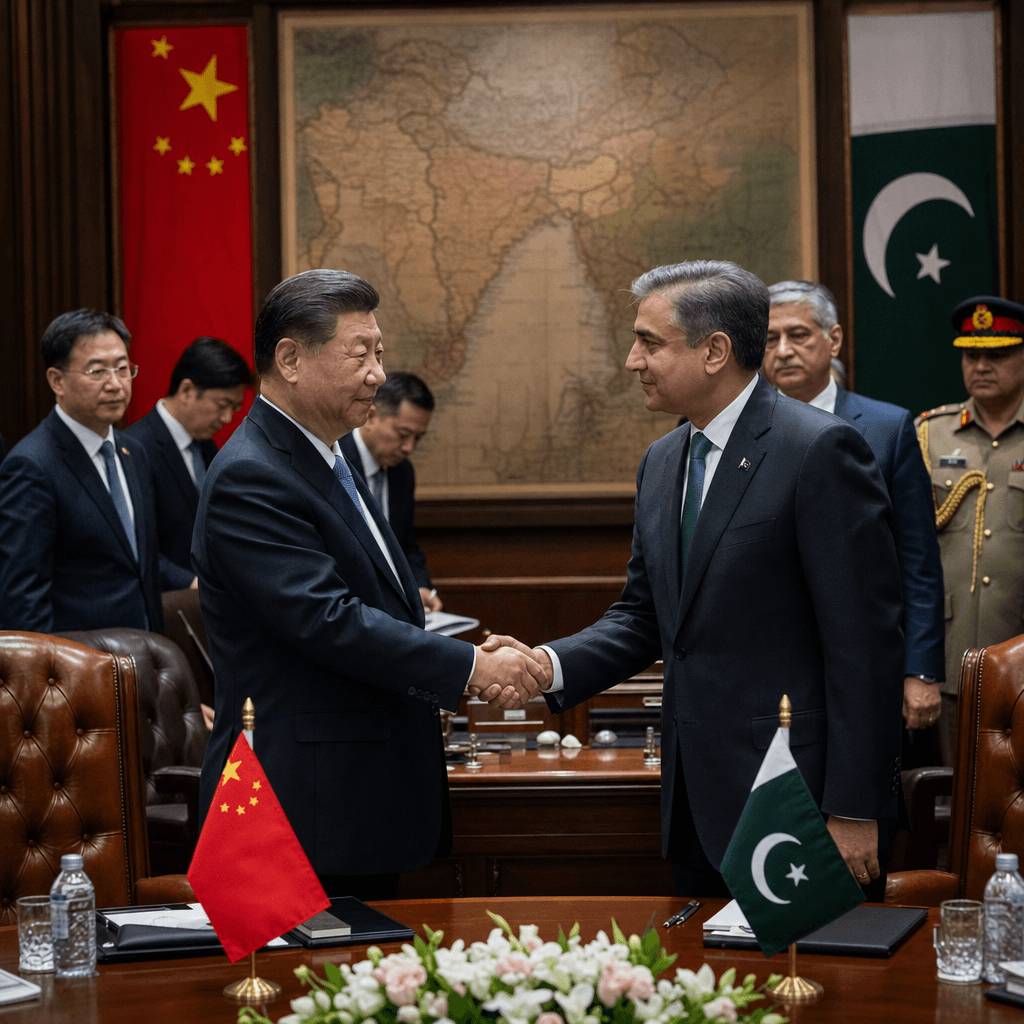
China-Pakistan’s 75-Year Bond Is Still About India
Pakistan is celebrating 75 years with Beijing, but the relationship now runs on hard leverage: security cover, financing, and China’s power to choose.
Pakistan and China marked 75 years of diplomatic ties this week with the usual language of “iron brothers,” but the real news is the balance of power underneath it. Al Jazeera reports that Islamabad’s Senate adopted a unanimous resolution reaffirming the partnership, while Pakistan also issued its first panda bond in China’s onshore market on May 14, a $250m yuan-denominated deal backed by the AIIB and ADB Al Jazeera. Reuters separately reported that Prime Minister Shehbaz Sharif will visit China from May 23 to 26, giving both sides a fresh stage to package the relationship as strategic permanence rather than dependence
Reuters.
A relationship built in the shadow of India
The bond has always been less about sentiment than geography and rivalry. Al Jazeera traces the partnership to Pakistan’s early recognition of Beijing in 1950, the 1963 Shaksgam Valley transfer, the Karakoram Highway, and the nuclear cooperation that followed Pakistan’s 1971 defeat by India Al Jazeera. That history matters because it explains why the alliance endured every ideological mismatch: communist China and Muslim-majority Pakistan were never natural partners, but they were mutually useful adversaries of India.
That logic still holds, but it is no longer symmetrical. Pakistan wants China as a strategic guarantor and economic backstop. China wants Pakistan as a dependable corridor to the Arabian Sea, a military partner on India’s flank, and a state that will not drift into Washington’s orbit. The result is a relationship that looks durable from the outside and transactional from Beijing’s side.
Finance now exposes the hierarchy
The panda bond is symbolically important, but it is also a reminder of constraint. Islamabad is not just celebrating friendship; it is entering China’s domestic capital market because it needs money and credibility. Al Jazeera notes that the bond’s launch was presented as proof that the relationship had moved into China’s financial architecture Al Jazeera. That is a gain for Pakistan in the short term. It broadens funding options and signals that Beijing is still willing to underwrite Pakistani stability.
But the costs are obvious. The same Al Jazeera feature says Chinese nationals continue to be targeted in Pakistan, and the China-Pakistan Economic Corridor has generated debt as well as infrastructure Al Jazeera. That limits how far Beijing will go. China is not writing Pakistan a blank cheque; it is buying influence while hedging risk.
For India, the alliance remains a live strategic problem, but Beijing’s recent warming with New Delhi narrows Islamabad’s room. Pakistan can still count on China to keep channels open and preserve its regional relevance, but it can no longer assume that Beijing will always choose Pakistan first. That is the key shift.
What to watch next
The next decision point is Sharif’s China visit from May 23 to 26 Reuters. Watch for three things: whether Beijing announces any new CPEC financing or debt relief; whether security cooperation is upgraded after repeated attacks on Chinese personnel; and whether China repeats its recent balancing act by praising Pakistan while preserving room with India.
If Beijing gives Pakistan symbolism but no fresh cash, the relationship stays strong — but more on China’s terms than Islamabad’s.
Discover more

International Relations
Pakistan's Key Role in US-Israel-Iran Meddle
Pakistan is seeking to mediate the US-Israel-Iran conflict, balancing high-stakes diplomacy against severe economic pressures and steep regional challenges.

India
India-South Korea $50B Trade Expansion Plan
India and South Korea target $50 billion in bilateral trade by 2030, focusing on industrial cooperation and strategic alignment amid US pressures.

Conflict & Security
Drone Warfare Killing Aid Workers at Unprec
Over 1,000 humanitarian workers killed in three years as cheap armed drones collapse legal protections. Gaza, Sudan, Ukraine, and DRC see deliberate targeting of aid convoys and hospitals with zero prosecutions.

Global
World Normalises Taliban as Afghan Women Eras
UN data shows Afghan women erased from public life as Russia recognises the Taliban, EU hosts officials in Brussels, and ICC warrants for gender persecution go unenforced.