Cameroon's $3.1B Mining Gap
Only bauxite has real money behind it
Model Diplomat4 min readAfrica
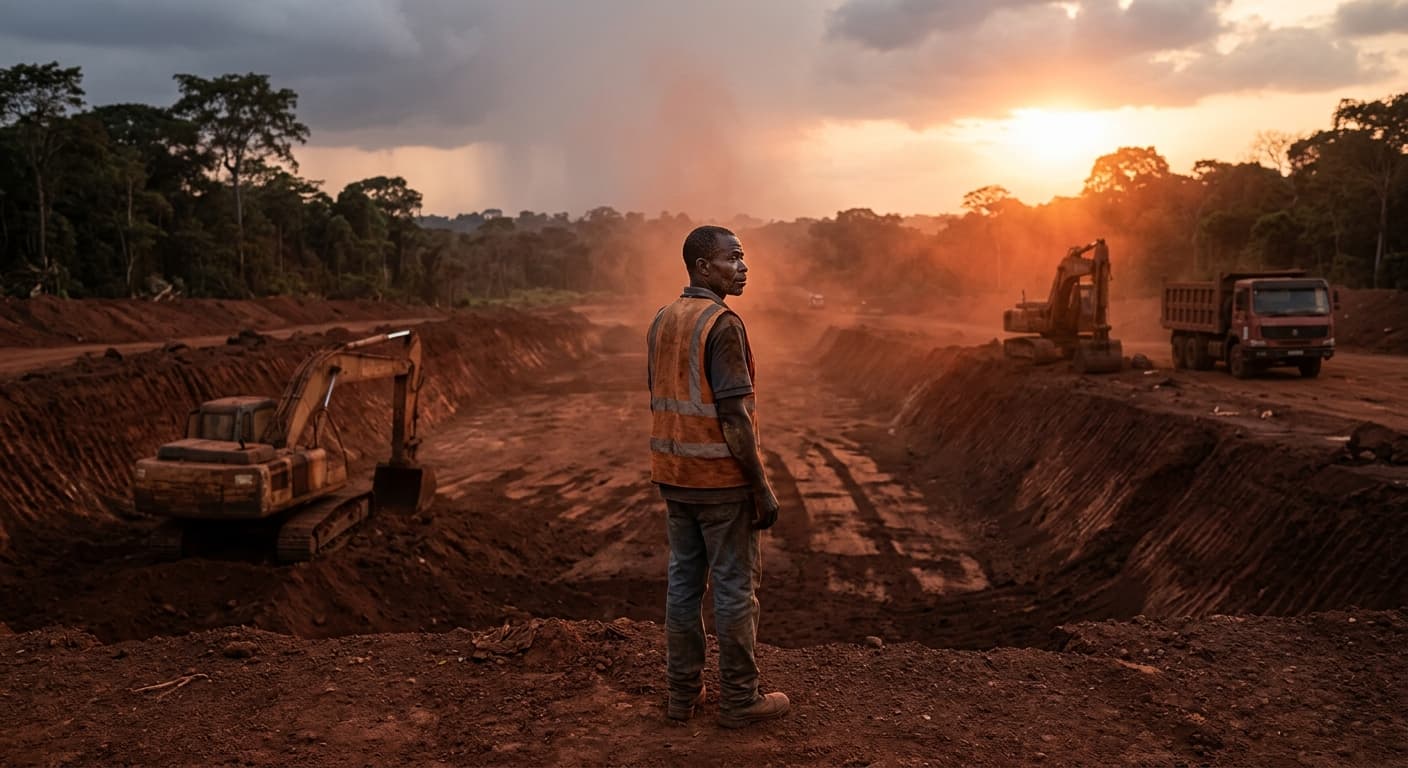
Cameroon's Mining Boom Has a $3.1 Billion Problem: Only One Project Is Actually Funded
Cameroon's oil output fell 8.2% in 2024 and the government is betting $3.1 billion on iron ore to replace it. But only bauxite has real money behind it — and the fiscal math already assumes all projects deliver.
Yaoundé — On paper, Cameroon's pivot from oil to mining is the most ambitious economic transformation in Central Africa in a generation. Mines Minister Fuh Calistus Gentry declared 2025 "a historic turning point," five industrial mining operations were commissioned, and 1,748 billion CFA francs ($3.1 billion) are earmarked for iron ore alone between 2026 and 2030, according to The Rio Times.
The problem is the gap between the projects that have financing and the ones that anchor the government's fiscal projections. Of the five major operations the minister cited, one, the Minim Martap bauxite project, has secured funding, broken ground, and is within weeks of its first export shipment. The three iron ore projects, which account for the bulk of the government's promised $3.1 billion investment and the revenue forecasts built into Cameroon's medium-term budget, have permits but no confirmed construction financing.
That gap is not a footnote. It is the difference between a managed transition and a fiscal crisis.
The Oil Math Is Unforgiving
Cameroon's oil production is in structural decline. The World Bank's 2025 Economic Update recorded an 8.2% contraction in oil output in 2024, accelerating from a 4.3% drop in 2023. The Fund's
2026 Article IV consultation projects oil GDP declining another 7.2% in 2025.
The causes are structural, not cyclical: no new field discoveries in recent years, insufficient investment to maintain aging wells, and maturing basins. The World Bank was blunt: the hydrocarbon sector "detracted from overall growth in 2024, with a negative contribution of 0.2 percentage points."
Oil-related revenue, which comprises corporate income tax from oil companies and royalties from the state-owned Société Nationale des Hydrocarbures (SNH), has collapsed from late-2000s peaks to approximately 2% of GDP in 2024, according to the IMF's Selected Issues Paper. Hydrocarbons now contribute less than 10% of budget revenue even as they still represent roughly half of exports.
This is the fundamental asymmetry: oil still dominates the export profile, but it no longer funds the state. Cameroon's 2023 crude oil exports totaled $1.87 billion, according to World Bank trade data, flowing mainly to European and Asian refineries. That export volume masks the fiscal reality: declining production plus fuel subsidies that cost an estimated 0.3% of GDP in 2025 mean the net contribution to public finances has withered.
The Project Gap
The Mines Minister's declaration of five commissioned operations looks ambitious. But the projects occupy radically different stages of readiness.
Minim Martap Bauxite (Canyon Resources, ASX: CAY): This is the one that is actually happening. Australian-listed Canyon Resources secured a US$140 million credit facility from AFG Bank Cameroon, has a surface miner on site at the Daniel Plateau, and mobilized trial mining in April 2026. The company holds 144 million tonnes of direct-shipping ore reserves at 51.2% alumina and 1.7% silica — among the highest-grade bauxite globally — with a total JORC resource of 1.1 billion tonnes, per Canyon's September 2025 DFS.
Canyon has also executed the logistics play. Through its subsidiary Camalco, it increased its stake in Camrail to 26.9% for XAF 9.85 billion (A$23.8 million) and acquired a 42.8% stake in Terminal Bois du Port de Douala, the port operator, for CFA 347 million, according to a May 2026 project update. Seven locomotives shipped from China in March 2026, with wagons due in July. First bauxite shipment is scheduled for late September 2026.
Stage 1 targets 1.2 million tonnes, scaling to 6 million tonnes by Year 4 and 10 million tonnes by Year 6, phased around the PQ2 rail upgrade. An alumina refinery feasibility study is due Q3 2026.
The project commands a price premium: its low-silica bauxite will fetch up to US$11 per tonne over Guinea Standard bauxite on the Chinese market. This is a genuinely world-class deposit, and it is genuinely in motion.
Mbe Gold (Oriole Resources, AIM: ORR): The project has delineated a JORC Inferred resource of 1.23 million ounces of contained gold across two deposits — 870,000 ounces at MB01-S and 360,000 ounces at MB01-N, according to an April 2026 Oriole announcement. BCM International has earned a 50% stake by meeting US$4 million in exploration spending commitments. A step-out drilling program is underway, with an updated resource estimate expected in Q3 2026.
But Mbe remains firmly in the exploration/definition phase, with no construction, mine plan, or production date. It is a discovery, not a mine.
Kribi-Lobé, Mbalam, and Bipindi-Grand Zambi Iron Ore: These three projects form the core of the government's 1,748 billion CFA ($3.1 billion) investment plan between 2026 and 2030. Permits have been issued. The government's own finance-law annex describes these deposits as constituting "most of the new mining cycle."
Mbalam is the largest, with reserves of roughly 775 million tonnes and a production target of 20 million tonnes per year. Bipindi-Grand Zambi holds 150 million tonnes. Kribi-Lobé, closest to the deep-water port, holds 100 million tonnes, according to Invest-Time analysis.
But none of the three has publicly confirmed construction financing. Mbalam has been stalled for over a decade — the original developer Sundance Resources saw its entire board killed in a 2010 plane crash en route to the site, and the project has cycled through multiple ownership structures without breaking ground. The 2026 start dates embedded in the government's plan are targets, not confirmed timelines.
Nkamouna Cobalt-Nickel: The Lomié-Nkamouna polymetallic deposit, once held by Geovic Cameroon, saw its permit withdrawn in 2025. State mining corporation SONAMINES is now seeking international partners through an Expression of Interest process, according to Business in Cameroon. No construction, no financing, no timeline. After two decades, Nkamouna rests on a withdrawn permit and a partner search — no closer to production than in 2005.
Discover more
India
700 Activists Accuse PM Modi of MCC Breach
Over 700 activists allege PM Modi breached election code with a televised address attacking opposition parties just before state elections.
International Relations
Economist Impact Sustainability Week 2026
Economist Impact Sustainability Week 2026 spotlights the energy transition, AI in clean technology, and supply chain resilience as themes for global leaders.
US Politics
House Ethics Committee Pushes Sexual Miscond.
The House Ethics Committee has shifted responsibility for sexual harassment settlement records to the Office of Congressional Workplace Rights, complicating disclosure efforts.

Economics
Fed's Amex AML order puts correspondent banking on notice
Federal Reserve's Amex AML order requires board-level controls and a 90-day plan; OCC fined the bank $350 million over enterprise-wide deficiencies.