CADENA's Role in Venezuela's Earthquake
A Jewish NGO steps in where the state fails
Model Diplomat7 min readLatin America
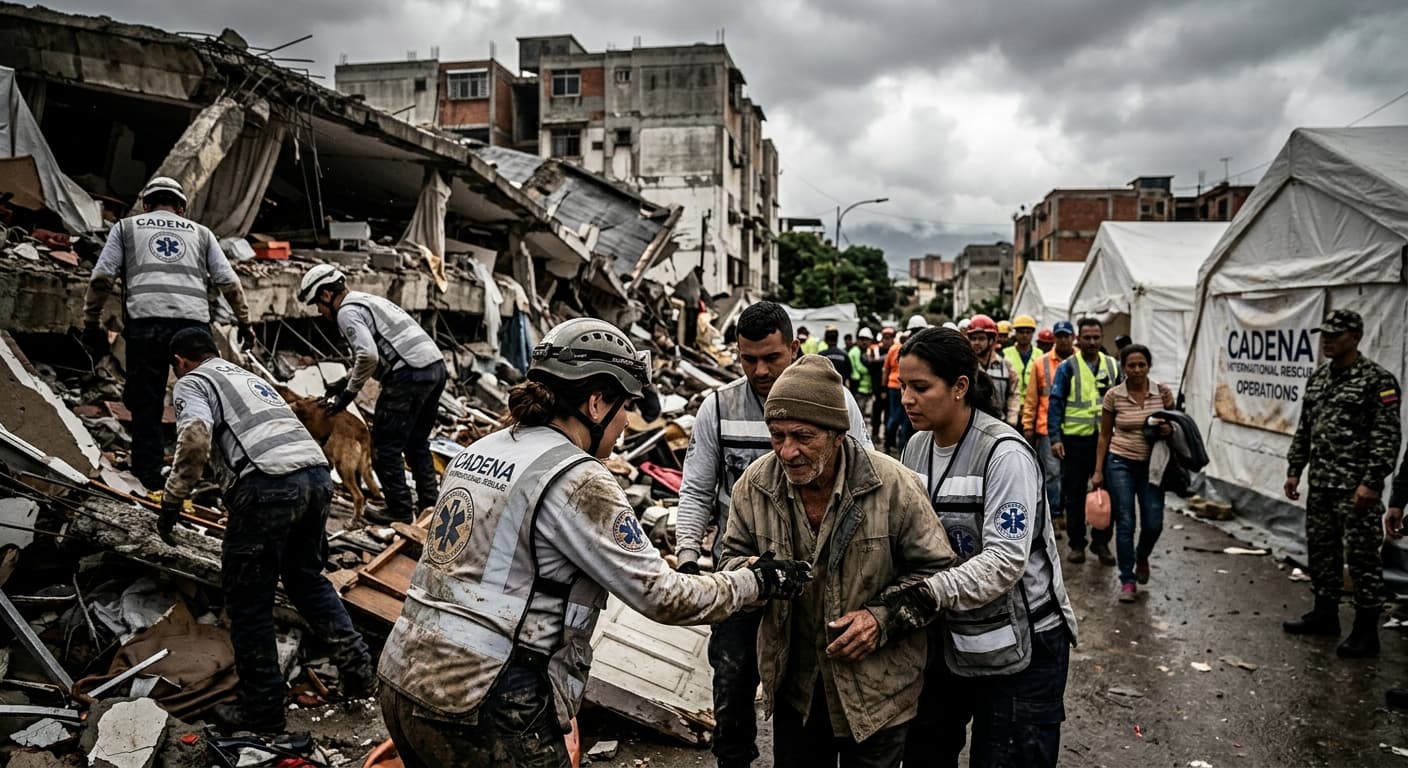
CADENA's Life Locators Fill a Gap Venezuela's State Left Open
How a Mexico City-based Jewish humanitarian NGO ended up on the front line of Venezuela's worst quake in a century — and what its role reveals about the collapse of state disaster response.
When the humanitarian arm of the world's Jewish communities announces it is deploying a search-and-rescue team to Caracas, the news story is not the deployment. The news story is that CADENA International's small, tech-equipped Go Team is doing work the Venezuelan state has proven unable or unwilling to do — and that the interim government of Delcy Rodríguez is now dependent on a patchwork of foreign NGOs, US military logisticians, and diaspora volunteers to reach its own citizens. That dependency, more than any single rescue, is the defining fact of the post-June 24 emergency.
CADENA said on June 25 that it was sending its Go Team with Life Locator seismic-detection equipment to Caracas, working alongside "the Jewish community of Guatemala and with our local CADENA team," according to the organisation's own press release. The Mexico-based NGO is one of roughly 50 international teams now operating in the country, per
Al Jazeera, and one of the very few reaching neighbourhoods that state emergency services have not.
The scale of the disaster — and of the state's absence
The twin quakes of magnitudes 7.2 and 7.5 struck within seconds of each other on the evening of June 24, 2026, near Caracas and the coastal state of La Guaira. The US Geological Survey's shakemap gave the second event a 42% probability of causing more than 10,000 deaths, per BBC News. Two weeks on, the confirmed toll stands at 3,535 dead, 16,740 injured and 17,854 without housing, National Assembly president Jorge Rodríguez said on July 6, according to
Al Jazeera. An estimated 60,000 buildings are damaged or destroyed. Material losses have been valued at more than $6.7 billion in a UN Development Programme satellite assessment.
That is the disaster. The scandal is the state's response to it. In Catia la Mar, a coastal town north of Caracas, residents told Al Jazeera that federal help arrived on Sunday June 28 — three days after the quakes — and in parts of La Guaira has still not arrived. "In the case of Venezuela, the state has been the last responder," Carolina Jiménez, president of the Washington Office on Latin America, told Al Jazeera. The Council on Foreign Relations attributes the vacuum in part to a Bolivarian Armed Forces "hollowed out through decades of corruption and politicization," per
CSIS.
Into that vacuum stepped everyone else: Venezuelan volunteers digging with their bare hands, an El Salvadoran contingent of 300 rescuers, a UK ISAR team of 68 firefighters and specialist dogs deployed with a £2 million package from London — announced in a June 26 statement from the Foreign, Commonwealth and Development Office — plus roughly 3,600 rescue workers and 118 search-and-rescue dogs from around the world.
What CADENA actually does — and why it matters here
CADENA — an acronym for Comité de Ayuda en Desastres y Emergencias Nacionales, "the humanitarian arm of the world's Jewish communities" in its own framing — is not a household name outside Latin America. It was founded in Mexico after the trauma of the 1985 Mexico City quake became a template for civilian-led disaster response, and it has since built a rapid-deployment model that punches above its weight: pre-positioned volunteer teams in multiple countries, a "Go Team" with structural-collapse rescue training, and Life Locator seismic sensors — the same class of equipment the more famous Israeli teams like ZAKA carry.
The organisation's model is not new to the UK's disaster-funding machinery. In November 2024, the Foreign, Commonwealth and Development Office confirmed that £150,000 in Start Fund money was routed to CADENA to run flood response in Honduras — an operational trust marker that explains why CADENA arrives in Venezuela already plugged into the wider donor architecture that includes the IFRC's DREF and the UN's CERF.
Two features of CADENA's Venezuela mission are worth calling out. First, the Guatemala pivot. CADENA is deploying "closely with the Jewish community of Guatemala," per its own press release — a routing that matters because Guatemala City is under two hours by air from Caracas and because Venezuela's own Jewish community has shrunk from roughly 25,000 in the Chávez era to a few thousand today, thinning the local partner base. Second, the technology. Life Locators and drone-based structural assessment are exactly the "specialist drones" the UK ISAR contingent is also flying, per the
FCDO — the gear most Venezuelan volunteers digging in La Guaira do not possess. As Al Jazeera reported, most local rescuers are working "without even helmets."
The strategy: work around, not through, the state
What is happening in Venezuela is a live experiment in what disaster scholars call the "polycentric" response model — many small, redundant actors coordinating laterally rather than through a central state. Research on Hurricane Sandy in the Journal of Institutional Economics found that tight-knit faith communities with pre-existing organisational infrastructure recovered faster than areas dependent on FEMA alone. CADENA is the export version of that model.
In Venezuela, the model is being applied in a hostile environment. Volunteers from the Central University of Venezuela reported that seven trucks of donated supplies were seized by state officials, per Al Jazeera. Local rescuers told the BBC that police and military set up checkpoints in La Guaira demanding salvoconductos — safe-conduct passes — before allowing aid vehicles into the disaster zone, according to
BBC News Mundo. Amnesty International, on June 26, called on Caracas to lift "illegal and disproportionate restrictions" on humanitarian access and to guarantee that aid workers can operate under principles of humanity, impartiality, neutrality and independence, per
Amnesty International.
For an NGO like CADENA — small, faith-based, publicly branded — that environment is manageable precisely because the organisation is small. It does not need OFAC clearance on the scale of USAID; it can move through the Guatemalan Jewish community's charter flights; and its explicit stance of assisting "regardless of origin, creed, or religion" gives it political cover the US military does not have.
The winners and the losers
Winner: Delcy Rodríguez, at least tactically. The interim president, installed after the US-led operation in January 2026 that removed Nicolás Maduro, is running an emergency response she does not have the state capacity to run. Every foreign team that arrives — CADENA, UK ISAR, Israel's contingent, the US Disaster Assistance Response Team — buys her legitimacy without requiring her to build institutions. The CFR notes the political dimension explicitly: post-January, the US has moved from sanctioning to bankrolling Venezuela, with $300 million pledged through NGOs and the UN, per the Council on Foreign Relations.
Loser: USAID, in a deeper sense. NPR reported this is "one of the strongest responses to a natural disaster since the dismantling of its premier aid agency," per NPR. The Trump administration had already slashed Venezuela aid from $94.5 million in 2024 to $2.2 million in 2025, per the
Council on Foreign Relations. What is filling the gap is a mixed force: SOUTHCOM logistics, the State Department's Bureau of Disaster and Humanitarian Response, and a constellation of NGOs — Oxfam, Cáritas, MSF, the IRC, CADENA — that are now doing work career USAID field officers used to do.
Loser: the Bolivarian first-responder myth. The government insisted on TV that "the Venezuelan state was activated as a whole" within hours, per BBC News Mundo. BBC correspondents on the ground documented the opposite: the first official rescue crew arrived in some parts of La Guaira on Friday June 26, roughly two days after the quakes. This is the Chávez-era social contract cracking in real time — and, as CSIS argues, will likely "drive further disaffection toward the remaining members of Maduro's inner circle."
Quiet winner: the diaspora NGO model. The nearly eight million Venezuelans who have left the country since 2013 are now organising supply chains from Bogotá, Madrid, Miami and Lima. CADENA — a diaspora-inflected, faith-based, transnational NGO — is the archetype of the actor best positioned to move in these conditions. Academic research on the Colombia response to Venezuelan migration in DOAJ has documented how such diaspora-led organisations, often dismissed as marginal, become load-bearing when state capacity collapses.
The historical parallel that reframes this
The comparison the analysts keep reaching for is not Turkey-Syria 2023 or Haiti 2010. It is Vargas, 1999 — the December mudslides that killed tens of thousands in what was then Vargas state and is now La Guaira. Pedro Romero, a Cáritas volunteer working the current response, helped in 1999 too. He told Al Jazeera that Venezuela's economic situation "has worsened since then," per Al Jazeera. The 1999 disaster is remembered inside Venezuela as the moment Hugo Chávez consolidated power through disaster response; the 2026 disaster may be remembered as the moment that model exhausted itself.
What to watch next
- Aid access after July 10. OFAC issued a general license carving humanitarian transactions out of remaining Venezuela sanctions on June 25, per the
Council on Foreign Relations. Whether Venezuelan banks actually release funds — historically the choke point — will determine whether CADENA-scale NGOs can operate for weeks or just days.
- The WFP $50 million pledge. The World Food Programme is targeting 500,000 people in shelters. If disbursement lags, expect a second-wave public-health crisis; trauma-unit head Eugenio Cova at Caracas's Hospital José Gregorio Hernández already warned Al Jazeera about infections in patients pulled late from rubble.
- The frozen $3.2 billion. These Venezuelan assets held abroad, meant to fund the 2022 Social Agreement, are the single largest non-military lever the US holds, per the
The Bottom Line
The bottom line: CADENA's Venezuela deployment is small in dollar terms and large in what it signals. When a Mexico-based Jewish NGO with Life Locators is the fastest team into a Latin American disaster zone, the story is not about CADENA — it is about the collapse of a state's first-responder function and the rise of a distributed, faith- and diaspora-led model that is quietly becoming the default post-USAID architecture of humanitarian response in the Western Hemisphere.
Discover more

US Politics
White House Pressures Congress for Crypto Leg
The Trump administration's push for the CLARITY Act aims to reshape crypto regulation, impacting trillions in market value and the Trump family's wealth.

India
Women’s Reservation in India
India's 33% women's reservation law is enacted but won't take effect until after 2029 due to political setbacks and census delays.
Global Politics
Xi Jinping Calls China-Russia Ties 'Precious'
Xi Jinping's description of China-Russia ties as 'precious' reflects a strategic imbalance, with Beijing dictating terms in the partnership.

Economics
Fed's Amex AML order puts correspondent banking on notice
Federal Reserve's Amex AML order requires board-level controls and a 90-day plan; OCC fined the bank $350 million over enterprise-wide deficiencies.