Côte d'Ivoire's $80 Billion PND Bet
Donors pledge $80 billion for Ivorian development amid regional instability.
Model Diplomat8 min readWest Africa
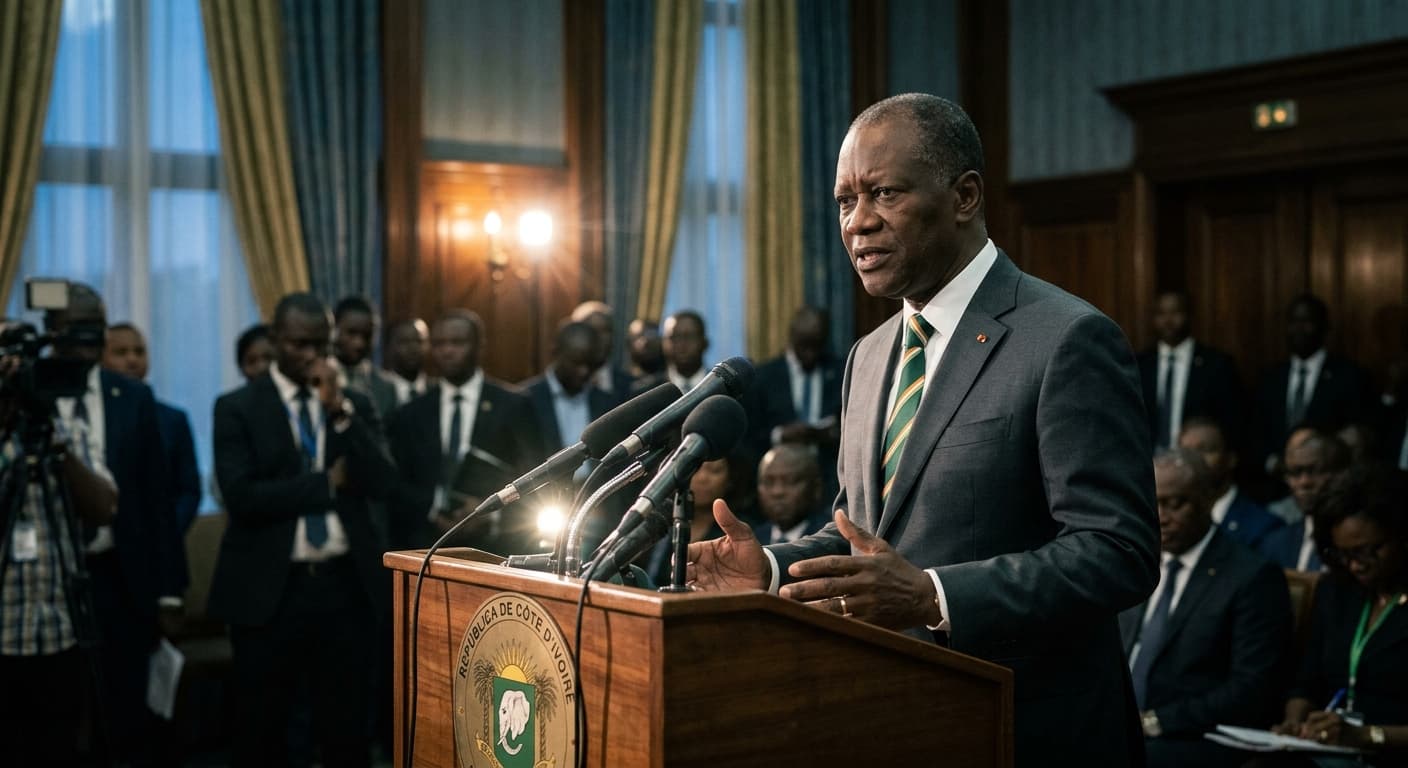
Côte d'Ivoire's $80 Billion PND Bet Anchors a Fracturing West Africa
Donors pledged 47,820 billion FCFA for Côte d'Ivoire's 2026–2030 National Development Plan — 4× the ask — as the Sahel breaks from ECOWAS and jihadist violence creeps south.
Côte d'Ivoire secured 47,820 billion FCFA — roughly $80 billion — in donor pledges on July 8, 2026 for its 2026–2030 National Development Plan (PND), more than four times the $20.3 billion Abidjan had asked for. The oversubscription, announced at the Consultative Group in Abidjan chaired by Vice-President Tiémoko Meyliet Koné, is not really a story about Ivorian macroeconomics. It is a story about geography. With Mali, Burkina Faso and Niger having walked out of ECOWAS to form the Alliance of Sahel States, and jihadist violence pressing on Côte d'Ivoire's northern border, Western and multilateral capital is being channelled into a single francophone anchor — betting that a stable Abidjan can hold the coast while the interior burns.
The pledge is real; the plan is more fragile than the headline suggests. Public authorities will finance only 29.8% of the PND's 114,838.5 billion FCFA envelope. The remaining 70.2% — some 80,616.6 billion FCFA, or roughly $139 billion — must come from private investors, according to figures presented by Plan Minister Souleymane Diarrassouba and detailed by HCN Times. That is the number the market will price. It is also the number that determines whether this money ever leaves the pledge sheet.
A donor conference the size of the country's GDP
The Groupe consultatif drew more than 3,000 participants from 49 countries. The World Bank, the African Development Bank, the European Union, the UN system and the Islamic Development Bank were all publicly on stage; Ousmane Diagana, the World Bank's vice-president for West and Central Africa, and UN Deputy Secretary-General Amina Mohammed both attended, per HCN Times. The PND envelope — about $209 billion at current exchange rates — is larger than Côte d'Ivoire's nominal GDP, which the World Bank places at around $86 billion in 2024. The Ministry of Plan and the
UN in Côte d'Ivoire put the growth target at 7.2% annually through 2030, with a stated aim of pushing poverty below 20% from 37.5% in 2021.
The macro backdrop is favourable enough to justify the enthusiasm. On July 9, 2026 — twenty-four hours into the donor conference — the IMF Executive Board completed its sixth and final review of the Extended Fund Facility and Extended Credit Facility arrangements approved in May 2023. The staff report notes that the fiscal deficit is back to the WAEMU convergence ceiling of 3% of GDP, and that "the debt-to-GDP ratio [is] declining for the first time in more than a decade and the risk of debt distress improving from moderate to low." In the April 30, 2026 staff-level agreement,
IMF mission chief Geneviève Verdier called performance "remarkable" and projected growth of 6% in 2026, following 6.5% in 2025, with regional foreign-exchange reserves at roughly eight months of imports.
That is the pitch: a $86 billion economy that grew above 6.5% through the pandemic, cut poverty by 18 points in a decade, and just cleared a Fund programme with a debt ratio going the right way. In a continent where the IMF is warning of a "growth reset", Abidjan is one of the very few capitals that can credibly ask donors to double the ticket.
The real angle: Côte d'Ivoire is being priced as the anti-Sahel
The reason $80 billion showed up for a $20 billion ask is not in the PND slide deck. It is in the map.
Since the January 2024 announcement that Mali, Burkina Faso and Niger were quitting ECOWAS to consolidate the Alliance of Sahel States, francophone West Africa has split cleanly in two. A 2026 study in the African Development Review by Sebego, Ouedraogo and Folawewo models the trade-diversion consequences and finds that the AES exit "could increase exports for ECOWAS's three lead economies (Côte d'Ivoire, Ghana, and Nigeria)." That is the quiet dividend. The port of San Pedro is already, per a
World Bank supply-chain study, the transit hub for Mali and Burkina Faso; Mali absorbs 60.5% of Ivorian refined-petroleum exports. When the juntas closed borders and Western donors froze aid to Bamako and Ouagadougou, Abidjan became the surviving conduit.
The security stakes cut the same way. The Stimson Center's June 2026 assessment warned that jihadist groups — chiefly JNIM — are no longer just raiding across borders but "embedding within communities, building supply networks" in the coastal states' northern peripheries. The International Crisis Group has been blunter still, noting in its
northern-Côte d'Ivoire briefing that the country's "relative wealth and pro-Western stance will continue to make it an attractive target" and calling for stepped-up investment in the north. The International Academy for the Fight Against Terrorism at Jacqueville — funded roughly half by France, with new money from Saudi Arabia — is the physical symbol of that bet.
Read that way, the PND is a security-development instrument dressed as a growth strategy. Pillar V — balanced regional development — funnels investment north; Pillar III — private-sector development — is what donors like the World Bank are structuring against. The Bank's Renewable Energy and Financial Stability Initiative (REFI), approved June 8, 2026, combines a $20 million IBRD loan and up to €622 million in partial guarantees to mobilise €938 million in commercial financing for two 120 MWp solar-plus-storage plants — explicitly aligned to PND pillars III and V. That is the template: multilateral guarantee, private capital, northern and rural exposure.
The private-sector problem
Seventy per cent of the plan sits on a bet that global private capital will follow the multilateral flag into a country whose president just won a contested fourth term and whose northern districts are within JNIM's operational envelope. That is not obviously wrong — but it is not the Fund's baseline either.
Ouattara was returned on October 25, 2025 with 89.77% of the vote on 50.1% turnout, after his two most credible rivals — former president Laurent Gbagbo and ex-Credit Suisse CEO Tidjane Thiam — were barred by the Constitutional Council, Al Jazeera reported. The opposition PPA-CI and PDCI called it a "civilian coup d'état"; the Institute for Security Studies described the outcome as one that
"entrenches democratic fragility". Ouattara, 83, was sworn in on December 8, 2025 for what the current constitution frames as his final term. The succession question — who inherits the PND — is unanswered.
For a plan whose disbursement window runs to 2030, that is not a footnote. The 2010–2011 post-electoral crisis, triggered by Gbagbo's refusal to concede, cost the country an estimated 3,000 lives and a lost year of GDP. Investors pricing 70% of a $209 billion envelope will discount for the possibility that Ivorian politics produces another rupture between now and the 2030 handover.
Then there is the north. A Clingendael/XCEPT field study published in October 2025 found that protectionist responses and militarised security deployments along the Burkina Faso–Côte d'Ivoire border are, in several places, disrupting the very cross-border livelihoods that keep communities out of JNIM's recruitment pipeline. The PND's northern-investment component is designed to reverse that, but the political economy is hard: agro-processing clusters, cashew plants and solar farms in Bounkani or Tchologo have to be built before the security environment gets worse, not after.
Who benefits, who is exposed
The immediate beneficiaries of the July 8 pledge are the multilaterals that get to move flagship deals off their pipeline: the World Bank, whose Country Partnership Framework has been rebuilt around the PND, the AfDB, the IsDB and the EU. Paris benefits diplomatically — Côte d'Ivoire is now the single largest francophone success story left after France's expulsion from Bamako, Ouagadougou and Niamey. Rabat also benefits: Morocco's CGEM employers' federation used the sidelines of the Consultative Group to push for expanded Moroccan investment, per Ivorian press.
The exposed parties are more interesting. AES governments lose leverage: the more Abidjan absorbs regional trade and logistics rents, the harder it is for Bamako and Ouagadougou to squeeze coastal states diplomatically. Ivorian opposition parties lose the argument that international partners will punish democratic backsliding — the $80 billion vote of confidence, cast three weeks after the IMF closed a five-star review, tells them the opposite. And the Ivorian treasury is exposed to a familiar problem: pledges are not disbursements. The 2016 Consultative Group in Paris raised commitments north of $15 billion for the previous PND, and the World Bank's own retrospective has been explicit that domestic resource mobilisation, not foreign promises, is what actually determined execution.

Diplomat View
The $80 billion pledge is best read as a geopolitical instrument, not an economic one. Western capitals, multilateral banks and Gulf financiers are consolidating Côte d'Ivoire as the francophone anchor of a coastal West Africa that has to hold while the Sahel is triaged. That is a defensible bet on the numbers: 6%+ growth, a completed IMF programme, a debt trajectory turning down, and a port network the AES states depend on. It is a fragile bet on the politics. An 89.77% election on 50.1% turnout, two barred frontrunners and a succession that has to be organised inside a single five-year plan is not the profile of the "stable, prosperous, united and ambitious" Côte d'Ivoire the plan promises. The forecast revises downward if two conditions hit together: a JNIM-linked attack inside Ivorian territory that closes northern trade corridors, and any credible signal that Ouattara intends to engineer a fifth term. Either alone is manageable; both would break the private-capital thesis on which 70% of the PND rests.
What to watch
- Second half of 2026: Actual disbursement rates versus pledged amounts — the 2016 PND's execution gap is the base rate to beat.
- 2027 legislative elections: First test of whether the PDCI and PPA-CI re-enter the political system or entrench a boycott posture that raises Ivory Coast's political-risk premium.
- The next IMF successor arrangement: With the EFF/ECF closed on July 9, 2026, the terms of any follow-on programme will signal how tightly the Fund wants fiscal policy anchored during a private-investment surge.
The Bottom Line
The bottom line: Côte d'Ivoire's $80 billion pledge is not a development story — it is the West's chosen instrument for containing the geopolitical collapse of the Sahel by turning Abidjan into an economic firewall. If the private sector shows up for 70% of the bill, the plan works and the coastal states hold. If it does not, Ouattara's fourth term will be remembered less for the PND than for the moment donors bet on political stability that markets refused to underwrite.
Discover more
US Politics
SNAP Food Assistance Faces Legal Challenges
In 2026, SNAP faces stricter eligibility rules and mounting legal challenges, threatening food assistance for the millions of Americans who rely on the program.
International Relations
Economist Impact Sustainability Week 2026
Economist Impact Sustainability Week 2026 spotlights the energy transition, AI in clean technology, and supply chain resilience as themes for global leaders.

International Relations
Pakistan's Key Role in US-Israel-Iran Meddle
Pakistan is seeking to mediate the US-Israel-Iran conflict, balancing high-stakes diplomacy against severe economic pressures and steep regional challenges.

Conflict & Security
Drone Warfare Killing Aid Workers at Unprec
Over 1,000 humanitarian workers killed in three years as cheap armed drones collapse legal protections. Gaza, Sudan, Ukraine, and DRC see deliberate targeting of aid convoys and hospitals with zero prosecutions.