Burkina Faso's Jihadist Crisis Deepens
Coordinated attacks leave 22 dead, highlighting security failures.
Model Diplomat7 min readAfrica
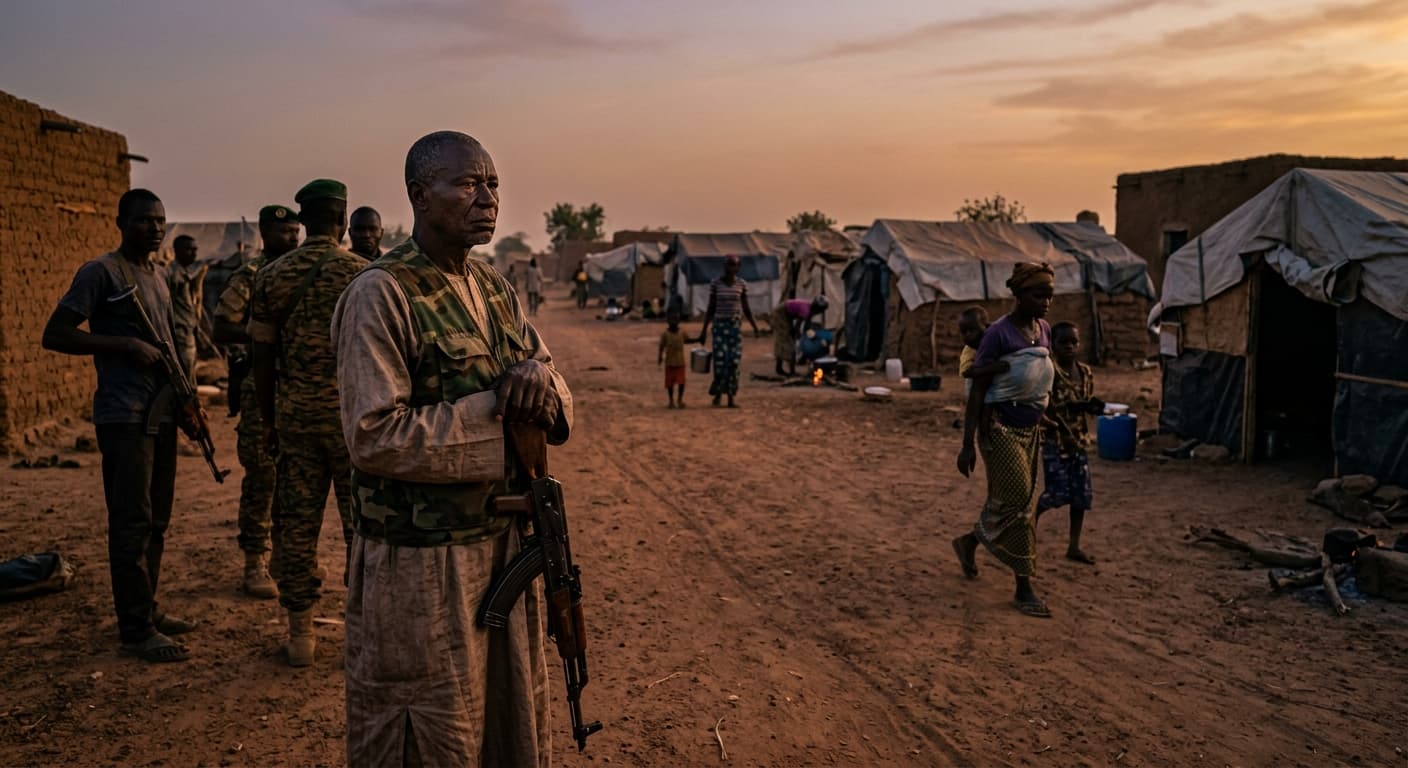
Burkina Faso attack: 22 dead as Traoré's Sahel war tilts north
A weekend of coordinated JNIM strikes at Di, Solhan and Seguenega killed at least 22 — a snapshot of the world's worst jihadist crisis and a stalling junta response.
At least 22 Burkinabè soldiers and civilian militiamen were killed between July 4 and July 5 in three coordinated jihadist assaults on military positions at Di near Dédougou, at Solhan, and at Seguenega near Kaya, security sources told AFP, as reported by The Punch. The tally is small by Burkinabè standards — but the geography is the point. All three targets sit inside the Boucle du Mouhoun and Nord regions that have overtaken northern Mali as the operational center of gravity for al-Qaeda's Sahel franchise. The Traoré junta's four-year bet — expel the French, arm tens of thousands of volunteers, hire Russians, and lock in five more years of military rule — has produced the deadliest terrorism environment on earth, not an exit from it.
The weekend in detail
Around 14 soldiers and seven Volunteers for the Defence of the Homeland (VDP) were killed at a military base in Di on Saturday morning; a second assault hit Solhan the same day; and a third struck a military post at Seguenega, north of Kaya, on Sunday, according to security sources cited by The Punch. A police source described the strikes as "carefully coordinated to inflict the greatest possible losses," while the security response "neutralised several dozen terrorists" and recovered materiel. No jihadist group has publicly claimed responsibility, but the choice of sites — Di in Boucle du Mouhoun, Solhan in Yagha, and the Kaya–Seguenega axis in the Nord — matches the operational footprint of Jama'at Nusrat al-Islam wal-Muslimin (JNIM), al-Qaeda's Sahel affiliate, whose activity in exactly these regions is mapped in the January–June 2025 report by
CDD West Africa.
Solhan is not a random name. In June 2021, JNIM-linked gunmen killed at least 132 civilians in the same village — then the deadliest attack in the country's history, according to Al Jazeera. Five years and two coups later, the district is still being contested at gunpoint — a reminder that the junta's "reconquest" narrative operates on the same ground the previous, elected government lost.
Kaya matters even more. Barsalogho, where JNIM killed nearly 200 people in August 2024, sits along the same axis; the town, per Al Jazeera, "houses the last standing military force between JNIM fighters and the capital, Ouagadougou." An attack on Seguenega is a probe against the outer ring of that defensive belt.
The world's most terrorised country — by a widening margin
Burkina Faso now sits at number two on the Global Terrorism Index 2026, with terrorism-related deaths in its previous cycle up 68% year-on-year even as the total number of attacks fell 17% — a signal that fewer, larger, better-planned assaults are replacing the drip of small ambushes. Per the
Atlantic Council, one quarter of all extremist attacks worldwide, and nine of the world's twenty deadliest attacks, took place inside Burkina Faso in 2024.
The trajectory in 2025–26 confirms it. The CDD West Africa tracker counted 3,539 conflict deaths inside Burkina Faso in the first half of 2025 alone — 27.3% of all violent-conflict fatalities in West Africa — with JNIM alone responsible for an estimated 2,370. And an analysis by
BBC Afrique found JNIM's Sahel activity now visibly shifting back into Burkina Faso: the group claimed 146 fatalities inside the country in March 2026 — its highest single-month tally since mid-2025 — as attacks in Mali eased following JNIM's September 2025 fuel blockade there.
That shift is the story. As Chatham House noted in December 2025, JNIM in Mali has been focused on strangling Bamako's fuel supply — a strategic squeeze on the state. In Burkina Faso, by contrast, the group is doing the opposite: absorbing punishment to hold and expand rural terrain, then striking urban military targets in coordinated waves. The Titao attack of February 2026, in which "hundreds" of jihadists overran one of the army's best-equipped bases and killed at least 20 people including Ghanaian traders, is the template, per
BBC News. Two days earlier, JNIM had seized the town of Bilanga in the east, killing 18 soldiers. The July 4–5 attacks fit inside that pattern, not outside it.
The junta's tools are the same tools that are failing
Captain Ibrahim Traoré's counter-insurgency rests on three pillars: mass mobilisation of civilian VDP volunteers, replacement of French with Russian security assistance, and indefinite postponement of elections. All three are now visibly under strain.
The VDP was expanded to a claimed 90,000 recruits after Traoré's 2022 coup, with a further 50,000 announced, per a policy brief from SWP Berlin. Traoré himself, the brief notes, has described the volunteers as "our own Wagners." But the model has two documented failure modes. First, VDP units bear a disproportionate share of casualties — as the Di attack again illustrates, with a third of the dead being volunteers rather than trained soldiers. Second, arming ethnically homogeneous militias in a conflict with strong ethnic overtones has driven the very radicalisation it was supposed to contain:
Human Rights Watch, in its April 2026 report, documented the ethnic cleansing of Fulani communities by Burkinabè military and VDP forces between 2023 and 2025, finding that Traoré and six commanders "may be liable as a matter of command responsibility" for war crimes.
The Russian pillar looks similarly thin. Africa Corps deployed a first contingent of roughly 100 fighters to Ouagadougou in January 2024, with 200 more expected, according to OSW Warsaw. A subsequent
RAND assessment confirmed the presence of a paramilitary unit dubbed "Brigade Bear" providing security for the junta leadership. But per the South African Institute of International Affairs' March 2026
occasional paper, Africa Corps operations in Burkina Faso, Niger and Equatorial Guinea "now favour smaller, restrained missions focused on training, protection and intelligence" — regime survival, not counter-insurgency at scale. The 400 French troops Traoré ejected in 2023 have not been replaced by a comparable Russian expeditionary force. They have been replaced by a bodyguard.
The regional pillar — the Alliance of Sahel States (AES) Unified Force headquartered in Niamey — was launched in December 2025 with a projected strength of 6,000 troops. The Institute for Security Studies notes the force is the third such attempt in a decade after the stillborn 2017 Liptako-Gourma initiative and the collapsed G5 Sahel Joint Force, and that its financing rests on a 0.5% import levy agreed in March 2025 — a slim base for a war that killed more than 3,500 people in six months in Burkina Faso alone. The
Valdai Club, a Kremlin-adjacent think tank, reports the AES Committee of Chiefs of General Staff has since talked about scaling the force to 15,000 — an aspiration, not a deployment, and one issued after coordinated jihadist and Tuareg assaults on Bamako, Gao, Kati, Kidal and Sévaré in April 2026 killed Mali's own defence minister.
The humanitarian ledger, and who is quietly winning
Behind the security-force casualty counts is a displacement crisis that has stopped improving. According to OCHA, 4.5 million Burkinabè need humanitarian assistance in 2026, against a US$658.5 million appeal that as of mid-year was only 15.4% funded. IOM's
Displacement Tracking Matrix puts Burkinabè internal displacement at 2,062,534 as of April 2026 — unchanged since April 2025 — while Beninese and Ghanaian border regions have absorbed a surge of Burkinabè refugees, with Benin's IDP figures up 239% year-on-year. The crisis is now a regional export, not a bounded national emergency.
Two constituencies are quietly winning from the status quo. JNIM is the operational winner: as its Sahel activity migrates from Mali back into Burkina Faso, it is consolidating rural governance, taxing gold-mining sites and blockading towns — a slow-strangulation model the US Congressional Research Service describes as leveraging Burkinabè strongholds to press southward into Benin and Togo. Russia is the strategic winner: Ouagadougou awarded a mining licence to sanctioned Russian firm Nordgold in April 2025, per the same
CRS brief, while Africa Corps embeds itself as regime bodyguard. The losers are Burkinabè Fulani communities, the coastal ECOWAS states now absorbing spillover, and — as
HRW reported on July 2, 2026, five days before the Di attack — the United Nations itself, after the junta forced the closure of the OHCHR office in Ouagadougou.
What to watch
- JNIM claim of responsibility. If, as with Mansila in 2024 and Titao in 2026, JNIM claims the Di–Solhan–Seguenega strikes within 5–10 days with video and captured-weapons footage, the group is signalling escalation, not opportunism.
- AES Unified Force deployment. The next Committee of Chiefs of General Staff meeting is the moment to see whether the 6,000-troop force has moved from headquarters staffing to field battalions inside Burkina Faso's Boucle du Mouhoun.
- HRW/ICC referral. HRW has formally called on the
International Criminal Court to open a preliminary investigation into abuses since September 2022. Any move by the OTP would test whether the junta's diplomatic isolation has costs beyond rhetoric.
Diplomat View
The Di–Solhan–Seguenega weekend is not an aberration; it is the shape of the war Burkina Faso is now losing. The evidence — a GTI number-two ranking, 3,539 conflict deaths in six months, IDP figures frozen at two million, an under-resourced AES force, and a Russian contingent optimised for palace-guard duty — points to a junta that has traded away Western logistical, intelligence and airpower assets without acquiring functional substitutes. The forecast: through 2026, expect more Titao-scale set-piece attacks on secondary garrisons, continued southward spillover into Benin and Togo, and further postponement of the transition timeline Traoré extended in July 2024. The condition that would change this forecast is narrow and specific — a credible AES ground deployment of at least brigade strength into Boucle du Mouhoun, backed by air support Russia has so far declined to provide. Absent that, the coordination on display last weekend is the new baseline, not the ceiling.
The bottom line: Burkina Faso's July 4–5 attacks are the operational proof that JNIM's Sahel war has re-centred on Ouagadougou's northern belt, and that Captain Traoré's Russian-backed, volunteer-heavy, election-free counter-insurgency is producing the world's worst terrorism statistics rather than reversing them. Until the AES Unified Force fields more than a headquarters, the pattern of coordinated, multi-site assaults on military bases will continue — and the coastal states of West Africa, not the junta, will bear the next round of costs.
Discover more

US Politics
SNAP Food Assistance Faces Legal Challenges
In 2026, SNAP faces stricter eligibility rules and mounting legal challenges, threatening food assistance for the millions of Americans who rely on the program.
US Politics
House Ethics Committee Pushes Sexual Miscond.
The House Ethics Committee has shifted responsibility for sexual harassment settlement records to the Office of Congressional Workplace Rights, complicating disclosure efforts.
US Politics
Congress Targets AI Chatbot Access for Terror
The House passed the Generative AI Terrorism Risk Assessment Act, focusing on AI's role in terrorism and potential surveillance implications.
Conflict & Security
Guatemala: El Niño 2026–27 becomes regional security test
UNICEF: 25.8M children face El Niño risks in Latin America; Guatemala maps 188 municipalities for drought and food insecurity amid regional security test.