Britain's Multilateral Defence Mechanism
A new defence fund to bypass EU restrictions
Model Diplomat8 min readEurope
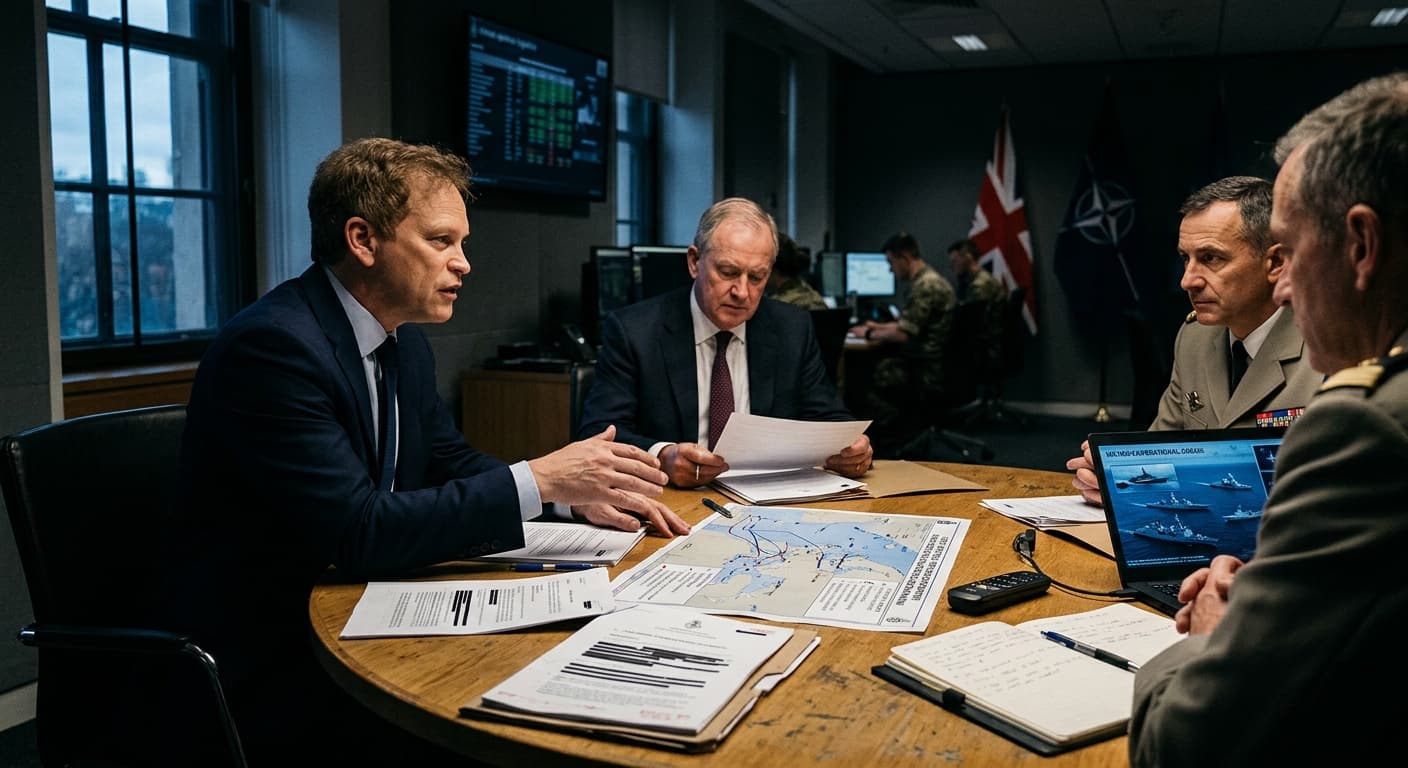
Britain's Workaround: Inside the Multilateral Defence Mechanism
The UK, Netherlands, Finland and Poland unveiled the Multilateral Defence Mechanism on July 6, 2026 — an ESM-style defence fund built to outflank the EU's SAFE programme before the Ankara NATO summit.
The four-nation Multilateral Defence Mechanism (MDM) unveiled on July 6, 2026 is less a NATO initiative than a workaround: it is Britain's escape hatch from the €150 billion EU defence fund it was locked out of last November, dressed as a coalition of the willing that Warsaw, The Hague and Helsinki have every reason to join. According to the joint statement published by HM Treasury, the four allies aim to open formal treaty negotiations "quickly" and stand up the mechanism by 2027 — a timeline that puts it in the water just as SAFE's first lending round is exhausted and NATO's 5%-of-GDP spending pledge starts biting national budgets. That is the story Ankara will not tell out loud, but the one that reshapes European rearmament for the next decade.
What the MDM actually is
Strip away the communiqué language and the MDM is an intergovernmental treaty organisation modelled on the European Stability Mechanism (ESM), the euro-area rescue fund created in 2012. The Finnish Government release describes it as "an innovative new financing model intended to accelerate defence investment, stimulate joint procurement, and aggregate demand in critical defence capabilities." In practice, that means a capitalised institution that can borrow on markets, place aggregated orders with defence primes, potentially own strategic enablers such as air-defence systems or ISR satellites, and bill members through user fees or delivery payments.
The intellectual scaffolding is not a mystery. Bruegel's April 2025 blueprint proposed exactly this: an ESM-like body outside EU treaties, open to non-EU democracies, that issues bonds to pre-finance joint procurement and enforces non-discrimination among member defence industries. The reasoning was legal, not merely economic: Article 346 of the Treaty on the Functioning of the European Union exempts defence from single-market rules, and unpicking it would require unanimity no EU capital will grant. An intergovernmental treaty — as
CEPR analysts argued in a follow-up column — is the only route that "circumvents the unanimity requirement" and lets a coalition of the willing move at speed.
The MDM's four founding capitals are that coalition. Chancellor Rachel Reeves, whose Treasury owns the file in London, put the case plainly in the government statement: "Defence procurement in Europe is too fragmented, expensive and slow." Analysis by Chatham House has quantified the waste —
between €24.5 billion and €75.5 billion a year lost to duplication and fragmentation across European defence budgets. Even the low end is roughly Denmark's entire annual military spend.
Why now: SAFE shut Britain out, and Britain built its own
The MDM is being sold as a complement to NATO. It is more accurately a compensation for a very specific November 2025 defeat. According to Chatham House's post-mortem, UK–EU talks over British access to SAFE — the EU's €150 billion defence loan facility — collapsed on November 28, 2025, after Paris insisted on strict conditions and an access fee "initially upwards of €6 billion." London judged the price prohibitive; French defence-industrial interests judged British participation an inhibitor of a genuinely European industrial base.
The consequences arrived quickly. Between February and April 2026, the Council of the EU cleared SAFE loans for 18 member states, and by early 2026 Warsaw had secured a loan agreement of up to
€43.7 billion under Regulation (EU) 2025/1106, with a €6.56 billion pre-financing tranche. Poland — a NATO frontline state with the highest defence-to-GDP ratio in the alliance — is thus simultaneously the largest SAFE beneficiary and a founding member of a competing mechanism designed with the UK. That double-hatting tells you what Warsaw thinks of relying on any single financing pipeline.
For Britain, the MDM is the vehicle that turns exclusion into a founder's stake. It restores UK primes — BAE Systems, Babcock, Rolls-Royce — to the top table of European aggregated procurement without requiring London to accept EU jurisdiction or single-market obligations. For The Hague and Helsinki, both deeply exposed to Russia's northern and Baltic pressure, it is a hedge: if SAFE proves slow or politically encumbered, an intergovernmental vehicle they help govern is a second string. Dutch Defence Minister Dilan Yesilgoz used the Ankara run-up to announce over €3 billion in new defence commitments, including joint projects with the UK on naval ships — precisely the kind of programme an MDM would eventually aggregate.
The Ankara backdrop: pressure, not consensus
The summit's public choreography is about delivery. NATO's official preview has Secretary-General Mark Rutte demanding "clear, concrete and credible plans" from every ally to reach the 5%-of-GDP target agreed last year in The Hague — 3.5% on core defence, 1.5% on defence-related expenditure. Rutte will note that European allies and Canada are already investing "around 4% of their GDP in defence and security," and NATO expects to announce, in his phrase, "tens of billions in new contracts."
The private choreography is harder. The Congressional Research Service briefing R49018 written for U.S. lawmakers ahead of Ankara flags that allied leaders "are expected to address President Donald J. Trump's criticisms of NATO and concerns from some NATO members about the impact on NATO political cohesion and alliance credibility." Defense Secretary Pete Hegseth's announcement of a six-month U.S. force-posture review, and the administration's push for a "NATO 3.0" that shifts more of Europe's conventional defence to Europeans, have not been welcomed inside the alliance so much as absorbed. The MDM is what absorption looks like when it has a balance sheet.
Two structural facts shape the pressure. First, Poland is already spending 4.48% of GDP on defence and aims for 4.8% in 2026, according to European Parliament research service data. Second, per the same
EPRS briefing on the Ankara summit, reaching the 3.5% core target alone would push EU defence expenditure from €381 billion in 2025 to roughly €635 billion — a €254 billion annual step-change that no single national budget can absorb without either debt issuance, joint borrowing, or joint procurement savings. The MDM is aimed squarely at that gap.
The winners, the losers, and the quiet sceptics
Winners first. The UK Ministry of Defence and the Treasury reclaim strategic relevance in European procurement without conceding on Brexit red lines. Polish defence primes — PGZ chief among them — gain access to a demand-aggregation mechanism that dwarfs anything Warsaw could organise bilaterally. Finland, which fast-tracked NATO membership in 2023, cements itself as a rule-writer of European defence rather than a rule-taker. And, less obviously, the ESM's Luxembourg-based technical staff — whose expertise in sovereign borrowing was gently plugged by Bruegel's July 2026 paper on defence debt — become a potential subcontractor for the new mechanism's bond issuance.
Losers are quieter but real. France, which spent 2025 shaping SAFE's "buy-European" preferences to advantage French primes, now faces a parallel mechanism it does not control and in which British and, plausibly, American components will circulate. The European Commission's DG DEFIS loses monopoly gatekeeping over the largest new pool of European defence financing. And Spain — which endorsed the 5% target with public reservations, and which Al Jazeera reported as insisting it could meet capability requirements without hitting the number — finds itself further outside the vanguard of European rearmament.
The historical parallel is not coincidence. The ESM was itself built outside the EU treaties in 2012 because eurozone crisis politics could not tolerate unanimity votes. Later, as CEPR analysts noted, its structure enabled off-balance-sheet borrowing capacity that "is off member-state balance sheets — a key advantage given fiscal constraints and NATO commitments." Read carefully, that sentence is the MDM's fiscal argument in one line: allies committed to 5% of GDP need instruments that let them buy capability without loading the full cost onto sovereign debt stocks the moment orders are placed.

What the mechanism does not yet answer
Three technical questions remain unresolved and will define whether the MDM becomes a serious institution or a communiqué footnote.
The first is capital structure. Bruegel's blueprint envisages members paying in capital in proportion to shares, and the mechanism issuing bonds to bridge procurement until delivery payment. The July 6 statement is silent on capital keys — the single most politically explosive detail. Poland spends far more of its GDP on defence than the UK, but the UK's absolute economy is roughly three times Poland's. Whether shares reflect GDP, defence spending, or a bespoke political formula will decide who holds voting weight.
The second is the perimeter of "joint procurement." Bruegel's proposal specifies that treaty signatories give up national procurement in named categories — artillery, drones, air defence, satellites — in exchange for collective purchasing power. That is a genuine sovereignty concession, and the four capitals have not disclosed which categories they will submit. Without a hard perimeter, the MDM risks replicating the European Defence Agency's polite ineffectiveness, since the EDA has coordinated defence cooperation for two decades without dislodging home bias.
The third is interoperability with SAFE, NATO's Defence Production Action Plan, and any successor EU instrument. The joint statement commits to "ensure that emerging approaches to international defence financing are aligned and complementary." That is diplomatic filler. In practice, France will resist any arrangement that lets UK components circulate freely inside SAFE-financed procurement, and the U.S. — whose ambassador Matt Whitaker has been publicly pressing allies to spend faster — will resist any European mechanism that quietly excludes American primes from top-tier programmes.
Forward look
- Autumn 2026: The four capitals move to "the next phase of mechanism design and development with subscribed partners," per the
Finnish government statement. Watch for capital key and category-perimeter drafts.
- Before end-2026: Expected accession decisions from at least one further NATO ally. Germany, Sweden, Denmark and Norway are the plausible candidates; Berlin's stance is the swing vote.
- 2027: Target date for treaty entry into force, subject to national ratification — which for the UK means a Commons vote and for Finland an Eduskunta supermajority on international commitments.
Diplomat View
The MDM is not what its communiqué says it is. It is not a technical financing tweak; it is the institutional expression of a strategic bet: that European defence integration will be built by a coalition of the willing outside the EU treaties, with Britain inside, rather than by the Commission with Britain outside. If treaty text emerges by mid-2027 with hard categories and a workable capital key, expect Germany and Sweden to join within a year and SAFE to be quietly repositioned as the EU-domestic pillar of a two-track system. If, instead, the four capitals fail to agree on procurement perimeters by spring 2027, or if a Trump-brokered Ukraine settlement collapses the sense of Russian threat, the MDM will drift into the same twilight the European Defence Agency has occupied for two decades. The revision trigger is specific: watch the autumn 2026 design phase for any published capital-share proposal. If the number appears, the mechanism is real. If it does not, Ankara will have been theatre.
The Bottom Line
The Multilateral Defence Mechanism is Britain's post-Brexit answer to being locked out of the EU's €150 billion SAFE fund — and Poland's, the Netherlands' and Finland's hedge against relying on any single financing pipeline for a €254 billion-a-year rearmament bill. If the treaty is signed by 2027 with a real capital key and hard procurement categories, it becomes the most consequential new European security institution since the ESM itself. If it isn't, Ankara will be remembered as the summit where the alliance mistook a press release for a plan.
Discover more

US Politics
SNAP Food Assistance Faces Legal Challenges
In 2026, SNAP faces stricter eligibility rules and mounting legal challenges, threatening food assistance for the millions of Americans who rely on the program.
US Politics
Congress Targets AI Chatbot Access for Terror
The House passed the Generative AI Terrorism Risk Assessment Act, focusing on AI's role in terrorism and potential surveillance implications.
Global Politics
Trump's Conflicting Messages on Iran War
Trump's mixed messages on Iran reflect a strategy of audience management, benefiting Tehran amid a complex geopolitical landscape.

Economics
Fed's Amex AML order puts correspondent banking on notice
Federal Reserve's Amex AML order requires board-level controls and a 90-day plan; OCC fined the bank $350 million over enterprise-wide deficiencies.