Brazil's Military Intelligence Sounds the 754
General Barbosa da Costa reveals 754B cyber intrusions and R$50B drug trade converging
Model Diplomat7 min readSouth America
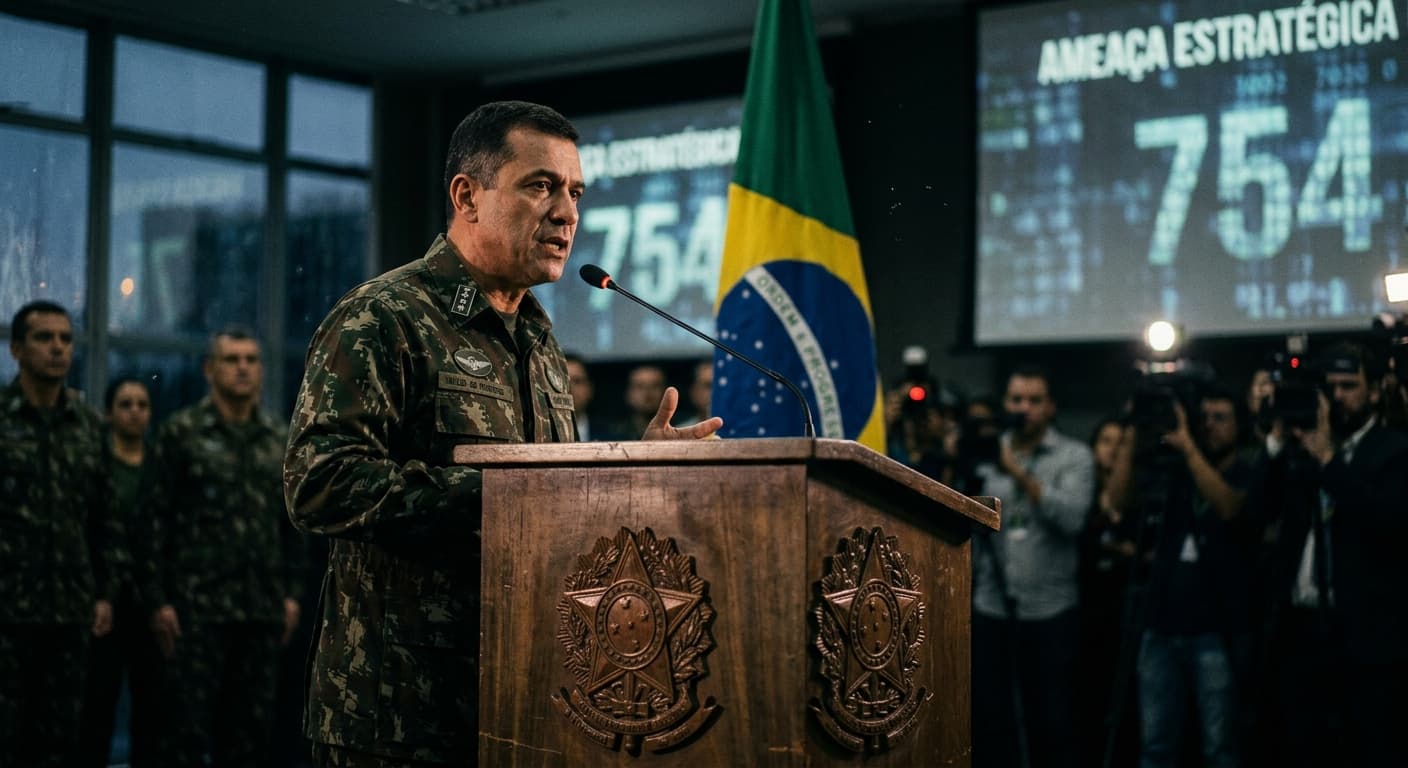
Brazil’s Military Intelligence Sounds the Alarm: 754 Billion Cyber Intrusions and a R$50 Billion Drug Economy Are Converging
General Carlos Eduardo Barbosa da Costa, chief of the Brazilian Army’s Intelligence Center, breaks a taboo in a rare public briefing — narcotics revenues and state-sponsored hacking are merging into a single strategic threat, and Brazil’s institutional defenses are not keeping pace.
On July 20, 2026, General Carlos Eduardo Barbosa da Costa, commander of the Brazilian Army’s Intelligence Center (CIE), did something unusual: he stood before an audience at Army headquarters in Brasília and disclosed the precise scale of two threats that had long been discussed in closed-door sessions. The breach of the civilian-security barrier was deliberate. In a 20-minute presentation, the general laid out what he called attacks on Brazil — and the numbers he unveiled amount to the most detailed public accounting ever offered by a senior intelligence official of the country’s mounting vulnerability.
The two headline figures tell a story of asymmetric convergence. Brazilian networks absorbed 754 billion intrusion attempts in 2025, many of them successful, Barbosa da Costa told the room, “because of the fragility of institutions, including public ones.” Estadão Meanwhile, the narcotics trade that transits Brazilian territory generates gross revenue of roughly R$50 billion per year — R$30 billion from domestic consumption alone — with at least 250 tons of cocaine exported annually, primarily to Europe, Asia, Africa, and Oceania.
Estadão
The briefing was not merely a transparency exercise. It was a signal from the military’s intelligence arm that the traditional conceptual firewall between drug-trafficking and cyber-espionage is no longer operative. The same criminal organizations that move cocaine through the Amazon are buying drones and hiring hackers, while state-backed advanced persistent threat (APT) groups use the same digital infrastructure that organized crime targets for money laundering.
The Narcotics Economy: R$50 Billion and a Territory Under Dispute
Barbosa da Costa framed the drug trade in structural terms. Brazil, he noted, is encircled by the three largest cocaine producers in the world — Colombia, Peru, and Bolivia — and by the largest marijuana producer, Paraguay. “Therefore, Brazil is an entrepôt country. We are exactly inside the flow of the logistical chain,” he said. Estadão
That geography is being exploited with growing sophistication. The Primeiro Comando da Capital (PCC) dominates the Rota Caipira, linking Brazilian markets to production zones in Peru and Bolivia, while the Comando Vermelho (CV) controls the Solimões route and has deepened its ties with Colombian GAORs — armed residual groups formed by FARC dissidents who rejected the 2016 peace accord. Brookings These groups have moved beyond simple smuggling. In the Cabeça do Cachorro region of the Amazon, three Colombian groups working with the CV now extract revenue from illegal mining and systematic extortion on Brazilian soil — activities that, in the general’s words, “threaten our sovereignty.”
Estadão
The internal market is equally lucrative. The UK Home Office, drawing on field interviews with Brazilian law enforcement, noted that one dose of cocaine costs roughly R$10 — a price that has remained stable for a decade despite massive seizures, indicating a supply chain resilient to interdiction. UK Home Office fact-finding report
The Cyber Deluge: From 400,000 Incidents to 754 Billion Attempts
The intelligence chief’s cyber numbers are staggering, not only for their volume but for what they imply about the shift in threat actors. In 2011, Brazil’s national computer emergency response team (CERT) recorded roughly 400,000 cyber incidents. BBC Brasil By 2025, the CIE registered 754 billion intrusion attempts — a six-order-of-magnitude increase over 14 years — and the general conceded that “many of them were successful.”
Estadão
The Brazilian government’s own cyber incident center, CTIR Gov, tracks a narrower set of metrics — notifications from federal agencies — and lacks the bandwidth to monitor the full attack surface. A 2023 IISS assessment concluded that Brazil possesses cyber offensive capabilities, though they are “likely to be small, not as well-resourced as in most G20 countries, and directed mostly at political operations.” IISS The asymmetry is acute: the attackers include state-financed APTs, while Brazil’s defensive architecture remains fragmented between the military’s CDCiber, the Institutional Security Cabinet, the Federal Police, and an under-resourced civilian agency structure that the CFR has described as a “mismatch that could have damaging consequences.”
CFR
Barbosa da Costa underscored the dual character of the threat: “Who is behind a hacker group? We know there are several APPs, and these APPs, these technological threats, have state actors behind them who are financing this.” Estadão
The follow-up presentation by General Jacy Barbosa Júnior, commander of Cyber Defense, exposed the operational strain: it takes roughly five years and R$300,000 (about $55,000) to train a single cyber operator. With a defense budget that, while rising to R$142 billion in 2026, still allocates over 74% to personnel costs, the math for scaling a cyber force is punishing. Janes
The Convergence: Drones, Terrorist Designations, and the New Battlefield
The merger of narcotics and cyber operations is already visible at the tactical level. On October 28, 2025, CV members used first-person-view (FPV) drones to drop explosives on police during Operation Contenção in Rio de Janeiro — a method previously associated with Mexican cartels, which carried out 77 drone bombings in 2024, up from 35 in 2023. BBC Brasil The same gangs that control drug-smuggling routes through the Amazon are now acquiring drones from commercial markets and adapting them for combat, exploiting a regulatory gap that the Chamber of Deputies only began to close in September 2025 through a bill updating the Penal Code.
BBC Brasil
The geopolitical overlay has intensified. On May 29, 2026, the Trump administration designated both the PCC and the CV as Foreign Terrorist Organizations — a move triggered partly by pressure from former president Jair Bolsonaro, who met with Trump at the White House that week. Al Jazeera The designation blocks US assets and, more consequentially, creates legal exposure for any third party — including financial institutions and victims paying extortion — that transacts with the groups. Celso Amorim, President Lula’s top foreign-policy adviser, warned that while international cooperation on money laundering and arms trafficking is welcome, “any pretext for intervention would be unacceptable.”
Al Jazeera
That warning is not hypothetical. In January 2026, the US carried out a military incursion into Venezuela — bombing targets and abducting President Nicolás Maduro for trial in New York — citing drug trafficking. Al Jazeera Brazil responded by closing its border and deploying the National Public Security Force to Roraima, where armed groups including Venezuelan colectivos, the PCC, and the Tren de Aragua operate with impunity.
Al Jazeera The designation of Brazilian gangs as terrorist entities on a similar logic, combined with the CIE’s characterization of the Amazon border as a zone of limited state control, sets the stage for a sovereignty confrontation that has already been sketched out in operational terms.
Diplomat View
General Barbosa da Costa’s briefing was not a plea for more troops. It was a deliberate reframing of the threat landscape for policymakers in Brasília and, by extension, for Washington and Brussels. The intelligence chief made clear that the military does not view itself as the primary responder to criminal organizations — “This does not mean we are the main elements that have to combat these groups” — but he also laid out a situation in which the state’s ability to enforce sovereign control over its territory and digital infrastructure is eroding from two directions at once. Estadão
The forecast is this: Brazil’s next government, to be elected in October 2026, will inherit a dual insurgency — digital and territorial — that cannot be addressed through budget increases alone. The R$50 billion annual narcotics revenue pool is larger than the entire discretionary investment budget of the Ministry of Defense. The cyber threat set is growing faster than the pipeline to train operators. And the US terrorist designation has introduced an external trigger that could convert a criminal-control problem into a sovereignty crisis if Washington decides to act unilaterally against the PCC or CV on Brazilian soil.
Three catalysts will test this thesis before the year ends:
- October 2026 presidential election: the campaign will force candidates to articulate how they would resist or accommodate US pressure to militarize anti-gang operations.
- The US Department of Treasury sanctions follow-up: any new designations of Brazilian financial intermediaries under the Foreign Terrorist Organization framework could freeze remittance corridors that legal and illegal businesses alike depend on.
- Brazil’s 2027 annual budget negotiations, beginning in November: the gap between the cyber command’s training-cost curve and the defense ministry’s personnel-heavy budget will expose whether the political system can reallocate resources toward digital defense at the speed the threat demands.
The bottom line: The CIE’s numbers are not a forecast of collapse. They are a baseline — and the general’s decision to make them public means the intelligence establishment has already concluded that the only way to mobilize a response is to let the outside world see the battlefield.
Discover more
US Politics
SNAP Food Assistance Faces Legal Challenges
In 2026, SNAP faces stricter eligibility rules and mounting legal challenges, threatening food assistance for the millions of Americans who rely on the program.

International Relations
Economist Impact Sustainability Week 2026
Economist Impact Sustainability Week 2026 spotlights the energy transition, AI in clean technology, and supply chain resilience as themes for global leaders.
India
Women’s Reservation Bill 2026
The Constitution (131st Amendment) Bill, 2026 was defeated in Lok Sabha, revealing deeper political conflicts over women's reservation and delimitation.

Economics
Fed's Amex AML order puts correspondent banking on notice
Federal Reserve's Amex AML order requires board-level controls and a 90-day plan; OCC fined the bank $350 million over enterprise-wide deficiencies.