Brazil Tariffs: US Targets Pix, Not Trade Def
Section 301 tariffs spare agribusiness, hit manufacturers in digital sovereignty fight
Model Diplomat9 min readAmericas
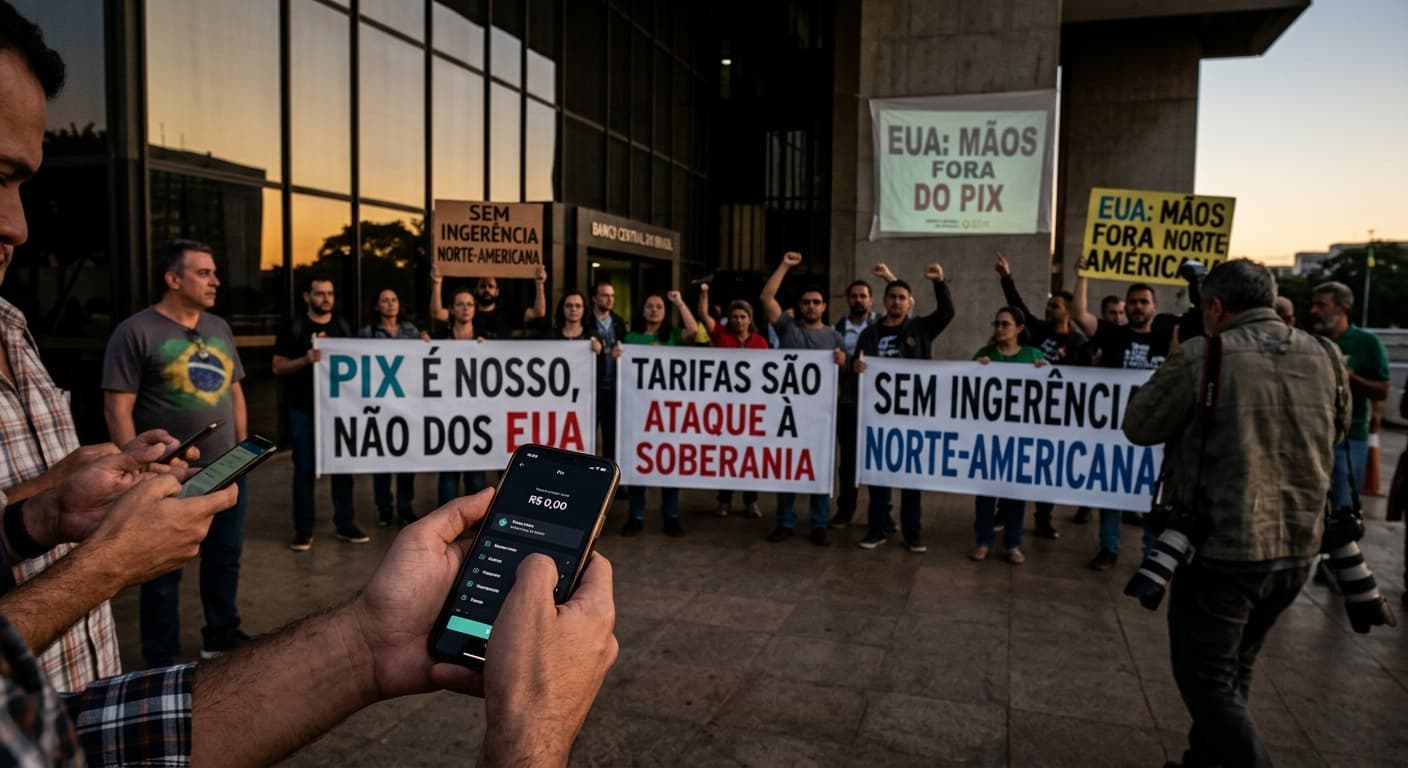
Brazil's Tariff Map Reveals Washington's Real Target: Not the Deficit, but Pix
The July 15 Section 301 tariffs spare Brazilian agribusiness and crush its manufacturers — exposing a fight over digital sovereignty, not trade balances, as Washington fires the first shot under its post-IEEPA legal order.
The Office of the US Trade Representative announced a 25% tariff on Brazilian imports under Section 301 of the Trade Act of 1974 on July 15, 2026, effective July 22 at 12:01 ET — and the carve-out list tells the real story. Coffee, beef, orange juice, aircraft parts, rare earths, and select energy products are exempt; sugar, steel, apparel, paper, agricultural machinery, and ethanol face the full duty. The structure is the tell: Washington is not punishing a trade deficit. It runs a $14.4bn surplus with Brazil. It is pressing a digital-sovereignty fight over Brazil's Pix payment system, and it has drawn the tariff line to spare the agricultural bloc aligned with Brasília's opposition while squeezing the manufacturing base that employs Lula's coalition.
The Legal Pivot: From IEEPA to Section 301
This is the first Section 301 tariff imposed since the US Supreme Court struck down President Donald Trump's sweeping global tariffs in February 2026. The Court ruled he lacked authority under the International Emergency Economic Powers Act (IEEPA) to impose them. That decision forced a recalibration. The administration fell back on Section 122 of the Trade Act for a temporary 10% global duty, then turned to Section 301, the statute used against China in 2018, for country-specific actions like this one. The Brazil investigation was initiated on July 15, 2025, ran for exactly a year, and concluded with USTR Ambassador Jamieson Greer's determination that Brazil's practices "are unreasonable and burden or restrict US commerce" across six areas: digital trade and electronic payments, preferential tariffs with Mexico and India, anti-corruption enforcement, intellectual property, ethanol market access, and illegal deforestation, as stated in the USTR press release.
The final Federal Register notice directs a 25% duty on all Brazilian goods with specified exemptions, effective July 22, 2026. For Brazil, the effective average US tariff has climbed from 1.19% at the end of the Biden administration to 14.42% — a jump of more than 13 percentage points in 18 months, according to St. Gallen Endowment data compiled by
BBC News Brasil.

The trajectory matters as much as the endpoint. The 18-month escalation from 1.19% to 14.42%, with a brief spike to 18.17% during the July 22–26 window when the expiring 10% Section 122 duty overlaps the new 25% Section 301 rate, makes Brazil the country whose US tariffs have risen most among the top 30 US trading partners since Trump's return to office. Brazil jumped 11 places in the global ranking of most-tariffed countries, overtaking Turkey, Indonesia, Vietnam, Thailand, Japan, South Korea, Germany, India, Austria, Sweden, and Italy, per the same BBC News Brasil analysis.
The Carve-Out Geometry: Who Gets Spared, Who Gets Squeezed
The exemption list is where the political economy lives. The USTR fact sheet specifies four exemption categories: raw materials whose taxation would cause domestic supply unavailability, products that would cause economy wide disruptions, products not producible in sufficient US quantities, and articles where tariffs would not materially contribute to eliminating the practices at issue. In practice, this shields coffee, beef, orange juice, certain ethanol, aircraft and aerospace parts, rare earths, and select oil and gas products. Sugar, steel, apparel, paper, footwear, agricultural machinery, and most ethanol face the full 25%, as confirmed by both
Agência Brasil and
Al Jazeera.
According to Valor International, the exemption list expanded to 1,231 HS codes, but only about 758 items Brazil actually exported to the US in 2024 are covered — meaning roughly 40.2% of Brazilian exports to the US will face the duty, down from an initial proposal of 45.8%. The
Atlantic Council's trade dashboard analysis finds that even with the Section 301 tariffs, just over 50% of Brazilian exports remain exempt — but the tariff pressure (tariffs charged as a ratio of total trade value) rises significantly because roughly a third of exports currently at 10% move to 25%.
The sectoral split is stark. Brazil's agribusiness — coffee, beef, orange juice, soy complex — largely escapes. Its manufacturing and industrial inputs — steel, chemicals, wood and pulp, leather, apparel, machinery — absorbs the hit. The Atlantic Council's analysis of US imports by Broad Economic Categories shows the sharpest decline has been in intermediate products, particularly "elaborated industrial inputs" (metals, chemicals, wood, pulp, leather), which represented nearly 50% of the total net weight of US imports from Brazil before "Liberation Day" in April 2025 and fell 5.7% in the year that followed. The tariffs are hitting manufacturing supply chains, not consumer-facing agriculture.
This carve-out geometry has a domestic political valence inside Brazil. The exempted agricultural sectors (coffee, beef, citrus) overlap heavily with the agribusiness caucus in the Brazilian Congress, a bloc that has historically aligned with the center-right and with former President Jair Bolsonaro's base. The exposed manufacturing sectors (steel, textiles, machinery) sit in São Paulo and the industrial south, core constituencies of Lula's Workers' Party. Whether by design or by the mechanical logic of the USTR's exemption criteria — agricultural products the US cannot produce domestically get spared; manufactured goods with US competitors get tariffed — the tariff structure lands harder on Lula's industrial base and lighter on the agribusiness opposition. Secretary of State Marco Rubio made the political dimension explicit, stating that Lula "priorizou seu próprio ego em detrimento de um acordo" — prioritized his own ego over a deal — and that the tariffs are "o preço a pagar por isso," the price to pay, as reported by BBC News Brasil.
The Pix Fight: The Real Battleground
The USTR's determination lists six areas of Brazilian "unreasonable" practices. Five are traditional trade frictions — preferential tariffs with Mexico and India, ethanol access, IP protection, anti-corruption enforcement, deforestation. The sixth is the outlier and the load-bearing one: digital trade and electronic payment services. The target is Pix.
Pix is Brazil's instant payment system, launched by the Central Bank of Brazil in 2020 and now used by over 140 million Brazilians. It is free, settles in seconds, and processes tens of millions of transactions daily. It has also displaced US payment card networks — Visa and Mastercard — from a significant share of Brazil's retail payments, a market the US firms had dominated. The USTR's investigation alleges Pix discriminates against US payment companies and facilitates illicit financial flows. The Brazilian government refuses to alter it.
According to BBC News Brasil's reporting on the negotiations, the Lula administration rejected as "politically or juridically unacceptable" US demands including changes to Pix — framing the system as a sovereign digital-public-infrastructure achievement on par with India's UPI. Brasília's position, per
New Kerala citing Brazil 247, is that the tariffs "lack economic justification" and that the Section 301 process is a lever to force Brazil to dismantle a successful public payments platform that inconveniences US card networks. Brazilian Finance Minister Dario Durigan told journalists on July 14 that the government would likely resume its Reciprocity Law process once consulted by President Lula.
The Surplus Paradox and Brazil's Response
The tariff arrives against a bilateral trade balance that cuts against the conventional tariff logic. The US ran a $14.4bn goods trade surplus with Brazil in 2025, up from $7.7bn in 2024, according to US Census Bureau foreign trade data and confirmed by the
USTR's country page. Brazil imported over $45bn in US products in 2025, up 11% year-on-year, while Brazilian exports to the US fell nearly 7%, with crude oil representing 12.5% of the export basket. The US is Brazil's second-largest trading partner and one of the few major economies with which Brazil runs a deficit. The tariffs are landing on a country that already buys more from America than it sells to it.
Brazil's government responded on July 15 with a formal note calling the date "um marco lastimável" — a deplorable milestone — in bilateral relations and announcing two parallel tracks. First, it will initiate procedures under the Economic Reciprocity Law (Lei de Reciprocidade Econômica), passed by the Brazilian Congress in April 2025 and sanctioned by Lula in July 2025 — the same week Trump first announced 50% tariffs on Brazil. Second, Brazil will take the case to the World Trade Organization. Brazil already filed a WTO request for consultations in 2025 (document WT/DS579/1), challenging the reciprocal tariffs and the country-specific 40-50% duties as inconsistent with GATT 1994 obligations. The document notes that the US President's July 9, 2025 letter to Brazil's president cited the trial of former President Bolsonaro and Supreme Court orders against US social media companies as rationale — grounds Brazil argues are "entirely unrelated to the economic relations" between the two countries.
The Reciprocity Law's implementing decree, per BBC News Brasil's analysis, stipulates that retaliation should "minimize impact on economic activity and avoid burdens and administrative costs" — a recognition that Brazilian manufacturers rely on US inputs and that indiscriminate retaliation would damage domestic supply chains. This tempers the likelihood of a rapid, symmetric response. Brasília's more probable first move is a targeted retaliation list on US goods with domestic substitutes in Brazil, paired with a WTO dispute that will take years to adjudicate but constrains US legal standing in the meantime.
Broader Implications: The China Wedge and the Global Signal
The tariff structure also accelerates a geopolitical realignment already underway. Brazil's trade with China reached record flows in 2025, while US-bound containerized exports from Brazil fell 34% year-on-year by early 2026, according to DatamarNews. China is now Brazil's top export destination by container volume at 40,275 TEUs, nearly double the US at 20,885 TEUs. The Section 301 tariffs will widen that gap further, pushing Brazilian industrial exporters to seek alternative markets and reinforcing the Beijing-Brasília trade axis at Washington's expense.
The Financial Times framed the tariffs as a deepening rupture in bilateral relations ahead of Brazil's next presidential election — a signal that the economic pressure is calibrated for domestic political effect inside both countries. For Trump, the tariffs demonstrate continuity of the America First trade doctrine under a new legal framework. For Lula, they provide a nationalist foil that can unify his coalition against an external adversary, even as the tariff structure disproportionately burdens his own industrial base.
The broader signal to other trading partners is unambiguous. The USTR noted that recent tariff measures have affected Argentina, Israel, and El Salvador alongside Brazil, suggesting a systemic shift rather than an isolated bilateral dispute. The Section 301 route — slower and more procedurally armored than IEEPA, requiring investigation, public hearings, and a determination of "actionability" — is now the administration's preferred instrument for sustained trade pressure. Countries with digital payment systems or regulatory frameworks that displace US firms should take note.
What to Watch
- July 22, 2026: Section 301 tariffs take effect at 12:01 ET. First day of market reaction; watch Brazilian real volatility and São Paulo steel/apparel sector stock movements.
- July 26, 2026: Section 122 10% global duty expires (pending appeal), creating the four-day 18.17% spike window. Effective average tariff on Brazilian goods drops to 14.42% thereafter.
- August–September 2026: Brazil's expected activation of the Economic Reciprocity Law. Watch for a targeted retaliation list — likely US goods with Brazilian substitutes (ethanol, certain agricultural products, pharmaceuticals) rather than across-the-board duties.
- Q4 2026: WTO dispute settlement panel request. The case will test whether Section 301 determinations survive WTO scrutiny post-IEEPA ruling — a precedent with implications for every US trading partner.
- October 2026: Brazil's presidential election cycle intensifies. Lula's response to the tariffs will be a defining campaign issue; watch whether the Reciprocity Law activation is timed for political effect.
Diplomat View
The July 15 tariffs are not a trade remedy. They are a pressure campaign dressed in legal procedure. The $14.4bn US surplus makes the deficit rationale incoherent; the carve-out structure makes the fairness rationale selective; the Pix investigation makes the digital-sovereignty rationale explicit. Washington is using Section 301 to defend US payment network incumbency against a Brazilian public-infrastructure alternative, and the tariff map is drawn to maximize political leverage inside Brazil, sparing the opposition's agribusiness base while squeezing the governing coalition's manufacturing base. The forecast: Brazil will activate the Reciprocity Law with targeted, WTO-compatible retaliation, not symmetric escalation, and will file a WTO dispute that constrains US legal standing regardless of outcome. The risk is miscalculation: if Brasília's retaliation is blunter than expected or if Trump escalates beyond Section 301 before the WTO process concludes. The most probable off-ramp is a bilateral mini-deal that trades ethanol access for tariff pauses before October 2026.
Discover more
US Politics
House Ethics Committee Pushes Sexual Miscond.
The House Ethics Committee has shifted responsibility for sexual harassment settlement records to the Office of Congressional Workplace Rights, complicating disclosure efforts.

International Relations
Pakistan's Key Role in US-Israel-Iran Meddle
Pakistan is seeking to mediate the US-Israel-Iran conflict, balancing high-stakes diplomacy against severe economic pressures and steep regional challenges.
India
Rajnath Singh's Durga Squad for 2026 Polls
Rajnath Singh's Durga Squad promised women's safety in Bengal but has since disappeared from the agenda, revealing BJP's true priorities.

Economics
Fed's Amex AML order puts correspondent banking on notice
Federal Reserve's Amex AML order requires board-level controls and a 90-day plan; OCC fined the bank $350 million over enterprise-wide deficiencies.