Bolivia's Silence Risks Larger Crisis
Paz's inaction invites turmoil in Bolivia's politics.
Model Diplomat9 min readLatin America
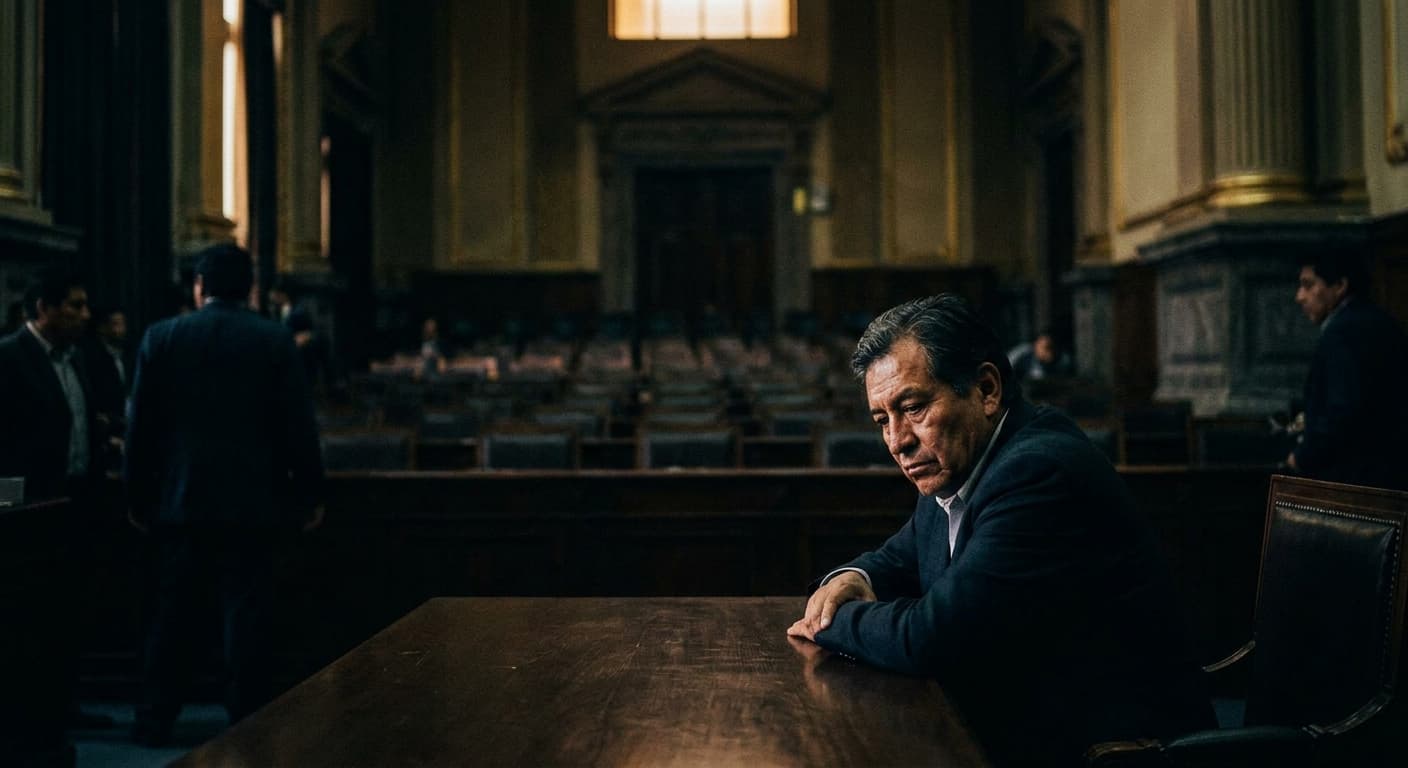
Bolivia's silence: Paz's stall risks a second, larger crisis
Seventeen days after Bolivia's state of emergency ended the blockades, President Rodrigo Paz has tabled no hydrocarbons, electricity or investment law — and the vacuum is the story.
Seventeen days after Bolivia's state of emergency broke seven weeks of road blockades, President Rodrigo Paz has produced no hydrocarbons bill, no electricity law, no investment framework and no national pact — and that silence, more than the blockades themselves, is the leading indicator that Bolivia's crisis is only pausing. The Urgentebo column that anchors this analysis calls it a "mal presagio" — a bad omen — and the reading from Washington, Geneva and the IMF's own board points the same way: a government that inherited a fiscal wreck, won a mandate to fix it, and is now visibly waiting for the crisis to fix itself. The stakes reach beyond La Paz. If Paz falls or is hollowed out, the beneficiaries are Evo Morales's cocalero networks, Beijing's lithium diplomacy and every regional actor betting that Latin America's centrist restoration is a mirage.
The vacuum at the centre
Paz decreed a 90-day state of "Conmoción Interna" on June 20, 2026 after unions, campesinos and Túpac Katari militants had strangled La Paz for 50 days. His own words that night, quoted by BBC News Mundo, promised a "gran acuerdo nacional que reunirá a líderes políticos, gobernadores, alcaldes, universidades, sectores productivos, trabajadores y organizaciones sociales." Seventeen days on, that convocation has not been issued. Urgentebo's Grover Yapura counts what is missing: "no hay servicio exterior renovado, no hay leyes estructurales para impulsar la economía," no signal of a governing consensus, and no reshuffle despite Paz himself flagging changes.
The gap is not merely rhetorical. Bolivia's blockades were costing an estimated $50 million a day in lost activity by early June, BBC News reported, and the country's ombudsman recorded at least 17 deaths linked to disruptions to medical care, according to
Al Jazeera. That is what the state of emergency ended. What it did not end is the pressure that generated it. Human Rights Watch, in a July 2, 2026 note titled bluntly
"Bolivia Cleared the Roads, but it Hasn't Cleared the Crisis", warned that the underlying "conditions that produced them remain unchanged" and that Bolivia's ombudsman calls his April and October protest waves "camel humps" — a seasonal certainty, not a shock.
The three-month window Paz bought himself, in other words, is the entire policy runway before the next hump arrives.
The numbers that make silence expensive
The macro backdrop makes the passivity harder to defend. In its 2025 Article IV report, the IMF's Executive Board found Bolivia's fiscal deficit above 10% of GDP for two consecutive years, public debt at roughly 95% of GDP, inflation at a decade-high, and international reserves "nearly exhausted." The
IMF's country page projects 2026 real GDP at −3.3% and consumer prices at +20.7%. Directors' language was unusually direct: inaction "could lead to a painful disorderly adjustment," and the peg to the US dollar plus depleted reserves demand "a decisive shift in the monetary policy framework."
In February 2026 the Paz government requested $3.3 billion in IMF assistance, as Al Jazeera reported after Bloomberg's first read. That request has not yet crystallised into a signed programme; Bolivian commentators writing in
Brújula Digital note that exchange-rate stability now depends on the government "consigu[iendo] firmar un acuerdo con el Fondo Monetario Internacional que destrabe los recursos obtenidos de otras fuentes internacionales." Every week of legislative silence is a week Paz's team must negotiate that programme from a weaker political base.
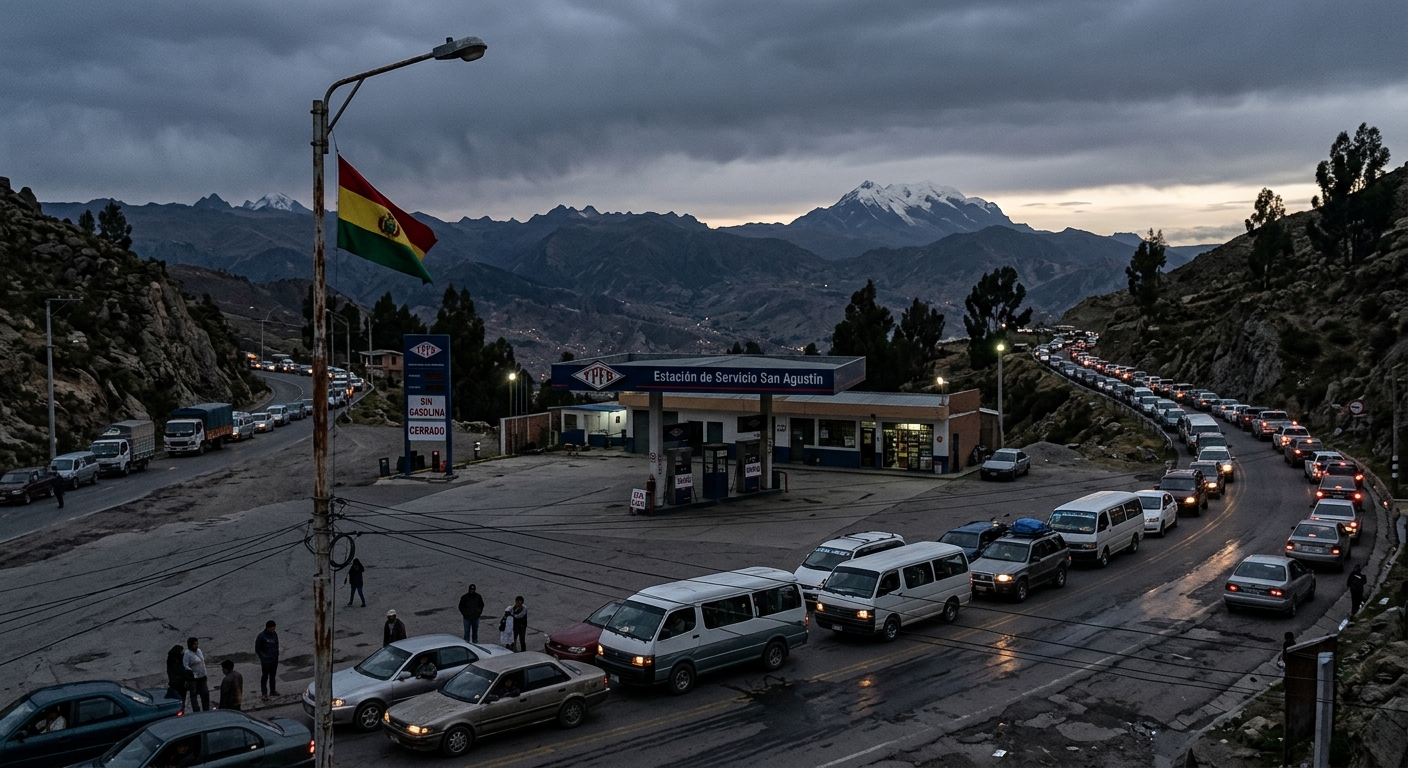
The domestic price of that delay is already visible in the fuel queues. When subsidies were removed, diesel jumped from 3.72 bolivianos per litre to 9.80 and premium petrol from 3.74 to 6.96, per Al Jazeera's breakdown. Twenty years of underinvestment in the gas sector — Bolivia's primary source of hard currency — is the true structural constraint, as
CSIS argues in its June 2026 assessment. Without a new hydrocarbons law, YPFB cannot credibly attract the private capital needed to reverse the production curve, and without that, the dollar shortage does not end.
The political architecture is more brittle than the streets suggest
Paz's parliamentary coalition never fully consolidated. His running mate Edmand Lara, a right-wing populist who was pivotal in the second-round win, publicly broke with the president within weeks of the November 8, 2025 inauguration — a rupture chronicled by Cuba's CIPI and confirmed by his continued attacks this week on the CEOs of BoA and Entel. Lara has not resigned. Under Bolivia's constitution he is first in line if Paz vacates. That single fact reframes every calculation Evo Morales's camp is making from the Chapare.
Morales, for his part, has "called, unconstitutionally, for new elections within 90 days as the solution to the crisis," according to CSIS, and CSIS's fieldwork in La Paz between May 20 and May 30 concluded that Morales and his cocalero allies were "the principal financiers and protagonists" behind the blockades' expansion. The Bolivian constitution has no democratic mechanism to remove a sitting president before the second half of the term. That means the opposition's theory of victory is not electoral; it is attritional. Provoke enough violence and economic damage to force resignation. Silence from the palace is not neutrality in that game — it is oxygen.
Meanwhile, MAS as a party has effectively collapsed, taking just 3% of the vote in 2025, Al Jazeera noted. But its social infrastructure — the Central Obrera Boliviana, the Túpac Katari federation, the cocalero unions — did not collapse with it. The Atlantic Council warned back in
October 2025 that "unlike the populist pendulum swings seen in neighbouring Argentina and El Salvador, Bolivians appear to have chosen a more centrist and reformist path" — but only if the new administration avoids "sudden shocks." Paz has delivered the shocks (subsidy cuts, land reform, IMF pivot) without delivering the political scaffolding to absorb them.
The judiciary is the other structural fault line. Only 12% of Bolivians trust the courts, Human Rights Watch reports; the Constitutional Court cannot currently rule on rights violations for lack of quorum; and 22,000 cases sit in the Court's basement. When institutions cannot resolve disputes, the streets do. That is a mechanical, not a rhetorical, driver of the blockade cycle — and no fiscal package fixes it.
Who wins from the silence
Name the beneficiaries and the vacuum stops looking accidental.
Evo Morales benefits directly. Every week Paz does not table a hydrocarbons or electricity law is a week the government cannot show its constituency — the informal-sector 80% referenced by CSIS — that the pain of subsidy removal has a payoff. Morales's incentive is to sustain the "camel hump" pattern until the October wave, and Paz's inaction guarantees the ammunition.
Beijing benefits. Bolivia sits on the Lithium Triangle, and as the Wilson Center's study of Bolivian lithium governance documents, Russian and Chinese firms are the ones with signed agreements on the ground, while Western capital waits for legal predictability that a stalled Congress cannot deliver. The
Peterson Institute notes that the EU-Mercosur agreement, provisionally applied from May 2026, is racing to lock in critical-minerals supply lines with Brazil and Argentina — but Bolivia is not a Mercosur member and every month it fails to legislate an investment code is a month the "greenshoring" capital flows around it, not through it.
The Trump administration loses. It folded Paz into its Shield of the Americas initiative and, as CSIS puts it, his fall "would be a significant symbolic setback." US Secretary of State Marco Rubio's October 19, 2025 statement, cited by the Atlantic Council, tied Washington explicitly to Paz's success on counter-narcotics and security. Bolivia has already revived DEA cooperation after an 18-year break. If Paz weakens, the reversion cost is high — and Washington's leverage to prevent it is limited by the fact that "it is generally off the radar for most of Washington," CSIS observes.
The losers are Bolivia's informal-sector households — the 80% of the workforce absorbing 20%+ inflation without the buffer of subsidised fuel, and without a coherent social safety net to replace it. The IMF has been explicit that adjustment must be paired with "improved targeting of the social safety net." That targeting requires legislation. That legislation is not being drafted.
The historical parallel Paz should fear
Bolivian analyst Carlos Toranzo's framing in Brújula Digital is worth taking seriously: Bolivia is "el país del conflicto permanente," where conflicts "por nada" have historically detonated regime change. The 2003 Gas War toppled Gonzalo Sánchez de Lozada; the 2019 crisis toppled Evo Morales; the 2025 election toppled MAS itself. Each was preceded by exactly the pattern now visible — an economic adjustment imposed without political scaffolding, a fractured cabinet, a passive president, and a moment of apparent calm that observers mistook for resolution.
The pattern that broke Sánchez de Lozada is the most instructive. In September 2003 he too had "cleared the roads" after October's first wave; he too believed the crisis was cyclical rather than structural; he too underestimated how quickly a fuel-and-gas grievance could recompose itself around a different demand. He resigned within weeks. Paz's team, staffed heavily with technocrats and businesspeople rather than social-movement operators — a choice Paz defended with the line "¿dónde están el gas y el litio?" — has fewer antennae into that recomposition than any Bolivian government in a generation.
What to watch next
- The IMF programme. Whether the $3.3 billion request converts into a signed staff-level agreement in Q3 2026 will determine whether Paz has the dollars to keep the peg from breaking. Watch for the
IMF's Bolivia page for a Board announcement.
- The chofers' 48-hour ultimatum. Transport unions this week gave the government 48 hours to resolve the fuel shortage or face renewed pressure measures — a preview of the October hump arriving early.
- The "gran acuerdo nacional." Paz promised it in his June 20 televised address. If it is not convoked in July, HRW's warning — that the current calm is a breathing room, not a resolution — becomes the base case.
- Edmand Lara. The vice-president's next escalation is the constitutional pressure point. Any move by Congress to formalise a vacancy pathway would reset every actor's calculus.
Diplomat View
Paz will probably survive July. He will probably not survive 2026 intact unless he uses the next 60 days to do what he has visibly refused to do in the last 17 — table a hydrocarbons law, an electricity law and an investment framework, and convoke a genuine national pact with organised labour and the departmental governors. CSIS's assessment that he may be "greatly weakened" even if he survives is the correct base case; the tail risk is a Sánchez-de-Lozada-style rupture triggered not by the streets but by an internal cabinet collapse around Lara. The forecast changes only under two conditions: an IMF staff-level agreement announced before September, or a hydrocarbons bill introduced with cross-bench signatures. Absent both, the silence in La Paz is not caution. It is the sound of a government running out the clock on a crisis that is running faster than it is.
The Bottom Line
Bolivia's blockades ended on June 20, 2026, but its crisis did not. Rodrigo Paz's seventeen days of legislative silence since have handed the initiative to Evo Morales's movement and to Beijing's patient capital, while the IMF, Washington and Paz's own coalition wait for a governing plan that has not arrived. If the "gran acuerdo nacional" is not convoked by August, the October protest wave will find a weaker president, a fractured cabinet, and a constitutional vice-president waiting in line — and the region will discover that Latin America's centrist restoration was less a trend than a moment.
Discover more
Global Politics
Trump's Conflicting Messages on Iran War
Trump's mixed messages on Iran reflect a strategy of audience management, benefiting Tehran amid a complex geopolitical landscape.
US Politics
SNAP Food Assistance Faces Legal Challenges
In 2026, SNAP faces stricter eligibility rules and mounting legal challenges, threatening food assistance for the millions of Americans who rely on the program.
US Politics
House Ethics Committee Pushes Sexual Miscond.
The House Ethics Committee has shifted responsibility for sexual harassment settlement records to the Office of Congressional Workplace Rights, complicating disclosure efforts.

Conflict & Security
Drone Warfare Killing Aid Workers at Unprec
Over 1,000 humanitarian workers killed in three years as cheap armed drones collapse legal protections. Gaza, Sudan, Ukraine, and DRC see deliberate targeting of aid convoys and hospitals with zero prosecutions.