Bolivia's Inflation Crisis: 4.82% in H1 2026
Economic turmoil amid political unrest in Bolivia
Model Diplomat10 min readLatin America
Bolivia's 4.82% Half-Year Inflation Masks a Deeper Reckoning
Bolivia's inflation hit 4.82% in H1 2026 after 55 days of blockades against President Rodrigo Paz — the number understates what fuel-subsidy cuts and a shrinking economy will still deliver.
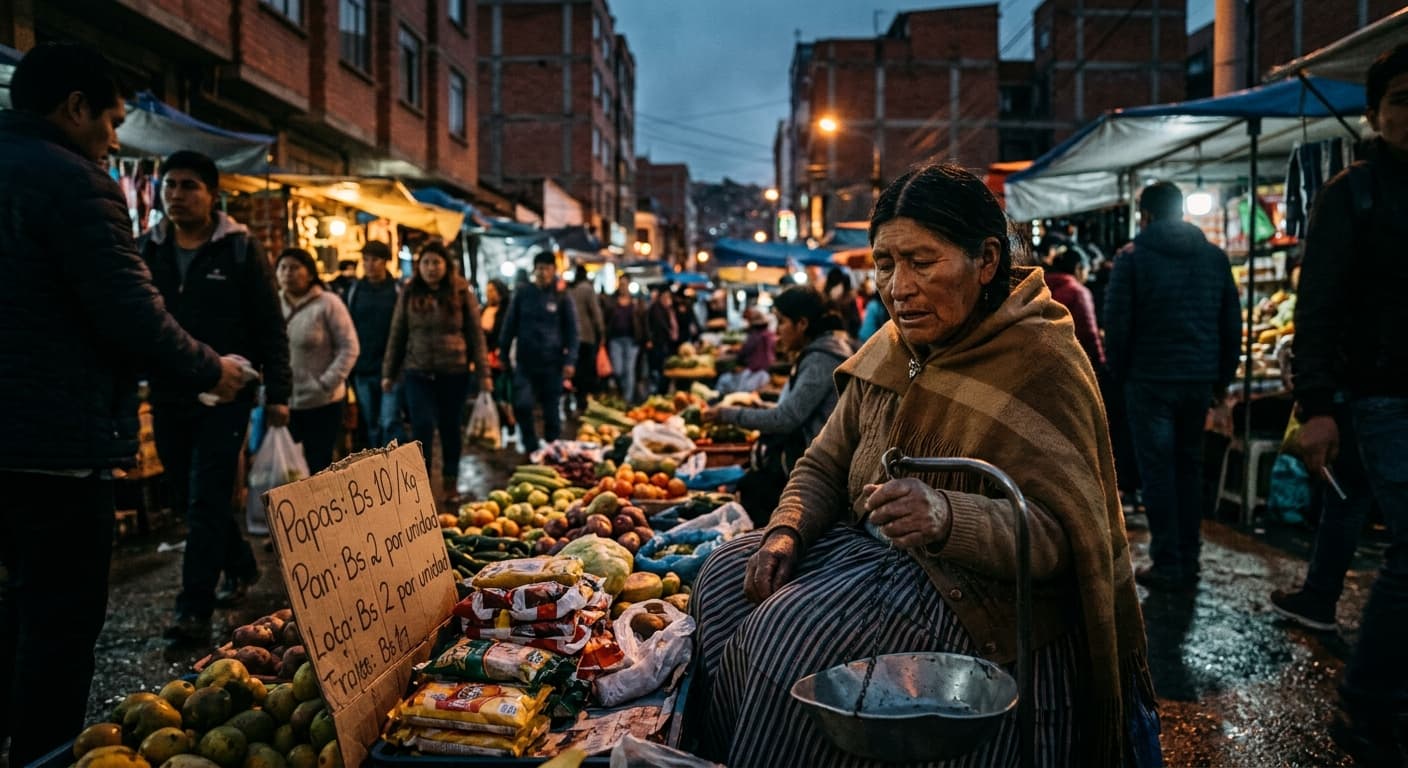
Bolivia's cumulative inflation reached 4.82% in the first half of 2026, with June alone printing at 2.15% and twelve-month inflation at 9.23%, according to the Instituto Nacional de Estadística. The number reads almost mild for a country that closed 2025 at 20.4% and where the IMF still projects 20.7% average consumer-price inflation for the full year. That gap — between the June print and the annual forecast — is the whole story. What Bolivia recorded in June is not the shock; it is the pause before Paz's stabilisation programme, an IMF-supported adjustment aimed at an overvalued peg and dry reserves, delivers its main pass-through into prices in the second half. The 55-day highway blockade that produced the June number was, in that sense, a preview of the political constraint on every subsequent policy move — and a warning shot to every centre-right government in the region attempting orthodox reform against organised social movements.
The number is real, but it is not the ceiling
The June spike is almost entirely a supply-side shock. INE's release identifies bananas, lunches out, boneless beef, chicken and tomatoes as the top contributors, with the largest monthly jumps in the blockaded highland departments — Oruro, Cochabamba, La Paz/El Alto and Potosí — while Santa Cruz, the eastern agro-export hub connected to Brazil and Argentina by unobstructed roads, actually posted a slight deflation of 0.02%. That regional split is the fingerprint of blockade-induced inflation rather than monetary overhang: prices rose where trucks could not move. Infobae's cumulative tally puts blockade-related economic damage above $3 billion, roughly 5% of GDP, and the BBC reported daily losses above $50 million at the peak.
But the underlying trajectory is not benign. In its 2025 Article IV concluded on May 2, 2025, the IMF described Bolivia's policy mix as "unsustainable," flagged a fiscal deficit above 10% of GDP, public debt near 95% of GDP, "critically low" reserves and an "untenable peg" to the dollar at 6.96 bolivianos. The Fund's current
country page projects real GDP to contract 3.3% in 2026 and average CPI at 20.7% — implying a second-half print several multiples of the 2.15% June figure once fuel and exchange-rate adjustments feed through. That is not a forecast the Bolivian authorities themselves signed onto: their own 2025 outlook, filed with the same
staff report, expected roughly 3.5% growth in 2025 and inflation contained. The gap between those two projections is the space Paz is now governing inside.
What actually triggered the blockades
The unrest was not a spontaneous cost-of-living revolt. On January 1, 2026, Paz's government scrapped decades-old fuel subsidies that had kept pump prices at 2006 levels; a Harvard Growth Lab paper by Ricardo Hausmann and co-authors calculates the reform raised diesel prices 163% and gasoline 86%. According to
Al Jazeera, a litre of diesel jumped from 3.72 bolivianos ($2.06 per gallon) to 9.80 bolivianos ($5.40 per gallon) once the subsidy came off. Retail fuel quality then collapsed as transporters bought adulterated substitutes, damaging thousands of engines and radicalising the transport unions before any political question was on the table.
The proximate trigger came in late April with a land-classification bill — Law 1720 — that small-farmer federations read as easing land concentration in favour of agribusiness. Paz repealed it within weeks, but by then, as Al Jazeera reported from Santa Cruz, roughly 20 simultaneous pickets a day were choking La Paz and El Alto. The government also offered a bonus for teachers, sped up compensation for damaged vehicles and named a negotiation council; each concession pacified one segment while emboldening the next. On May 11, prosecutors issued an arrest warrant against former president Evo Morales tied to a statutory-rape investigation; his highland base — the Ponchos Rojos, the Tupac Katari federation, coca-grower unions — folded into the blockade. Morales's supporters then completed a 190-kilometre march on the capital, according to a separate
Al Jazeera dispatch, with miners setting off dynamite outside government buildings.
On June 7, Bolivia's Chamber of Deputies repealed a 2020 law limiting the military's role in protests and granted soldiers a "presumption of legality" in conflict situations, according to Al Jazeera. On June 19 Paz signed an accord with the Bolivian Workers' Central (COB); the next morning he decreed a 90-day state of emergency that, per the government statement carried by
Al Jazeera, prohibits "blocking streets, avenues, roads and highways in ways that affect transportation and supplies" and orders the armed forces to support police "in restoring order, reopening roads and protecting the population."
"This is not a state of emergency to restrict people's lives. It is a state of emergency to give people back their freedom." — President Rodrigo Paz, televised address, June 20, 2026
By the next day, authorities reported no active blockades, per Al Jazeera. By the time the roads reopened, at least 17 people had died — most from disrupted medical care — 365 protesters had been arrested and 37 people injured.
Why 4.82% understates the pipeline
Three vectors will push the second-half print well above the first.
Exchange-rate realignment. The IMF has openly called for a "step devaluation" and a move to a crawling peg. Its published reform scenario in the 2025 Article IV staff report models CPI inflation at 16.0% in the first year of reform and 16.5% the following year, with the boliviano moving from 6.9 to roughly 15 per US dollar, and international reserves recovering only slowly toward $6.7 billion by the third year. The parallel rate is already there: BBC's reporting from the Peruvian border town of Desaguadero found bolivianos trading at 14 to 15 to the dollar in the run-up to the October 2025 election, and Bolivia's net international reserves stood at just $2.8 billion, down from $15.1 billion in 2014, per
BBC Mundo. A formal devaluation would import inflation instantly through fuel and food imports; a delay would keep bleeding reserves and pushing tax-paying exporters into the black market, as the Bolivian Institute of Foreign Trade's Gary Rodriguez has warned in interviews with
BBC News.
Reserve exhaustion. Growth Lab notes that even after the January reform, the untouched domestic gas subsidy cost Bolivia over $900 million in forgone export earnings in 2025, and the same paper documents a 54% collapse in natural-gas production from its 2014 peak — the fiscal engine that funded two decades of MAS-era social spending is gone. When Paz took office, Al Jazeera reported, total debt was 95% of GDP and liquid reserves covered less than one month of imports, citing analysis from the Finance for Development Lab. Bolivia sought roughly $3.3 billion in IMF financial assistance in February, per Bloomberg reporting cited by Al Jazeera; the
World Bank approved a $200 million loan on February 4 to fund the Programa Extraordinario de Protección y Equidad (PEPE), which is expected to reach eight million Bolivians. Neither package is large enough to defend the peg without a rate move; both explicitly buy political room for the adjustment the IMF wants.
Political concessions. To end the blockade, Paz reshuffled his cabinet, halved his own salary and — per the BBC — accepted at least partial rollbacks including the withdrawal of Law 1720. Each concession that raises spending or unwinds a price signal narrows the fiscal path already flagged by the IMF Executive Board, which warned that "inaction could lead to a painful disorderly adjustment." The World Bank's Vice President for Latin America, Susana Cordeiro Guerra, framed the PEPE loan as helping Bolivia "restore macroeconomic stability" — a diplomatic acknowledgement that macro stability has not yet been restored.
The regional read: the Milei playbook meets Bolivia's veto players
The story that will travel outside La Paz is not the CPI number. It is that a US-backed centre-right government tried textbook stabilisation — subsidy cuts, IMF talks, tax exemptions for large fortunes, agribusiness-friendly land rules, alignment with Washington and Jerusalem — and was besieged for eight weeks by the same social movements that carried Evo Morales to power for nearly two decades. Al Jazeera notes that MAS collapsed to just 3% of the vote in the 2025 elections, but the extra-parliamentary machinery it built — road blockades, federated unions, Indigenous confederations — proved fully intact.
That confrontation drew in the entire hemisphere. The US State Department labelled the protests a "humanitarian crisis" and the demonstrations "actions aimed at destabilising the democratically elected government of Rodrigo Paz," per BBC News Brasil. Defence Secretary Pete Hegseth compared the blockades to a government "overthrow" — striking language the Trump administration's "Shield of the Americas" coalition amplified in its own statement backing Paz's "democratic government as it fights back against attempts to drag Bolivia backwards." Argentina flew a military airlift of food and medicines at Paz's request. Brazil's Lula, in a call on May 25, offered humanitarian aid and — as
CSIS noted — Paz explicitly sought Lula's mediation because of the Brazilian president's known ties to Morales. Colombia's Gustavo Petro, by contrast, read the same events as a "popular uprising." Eight allied governments from Panama to Buenos Aires issued a joint statement rejecting "any action aimed at destabilizing the democratic order."
That alignment matters for two reasons.
First, the "regional stability" concern that dominates official statements is not primarily about Bolivian gas — production has fallen 54% since 2014, and Bolivia is now a net energy importer, per Growth Lab. It is about criminal geography. CSIS's Evan Ellis warns that a Paz collapse and a Morales-adjacent restoration would risk turning Bolivia from a "troubled host of narco-trafficking activities" into a full-blown transit sanctuary linked to Brazil's PCC (Primeiro Comando da Capital) and Comando Vermelho, with knock-on effects for Paraguay, northern Argentina and southern Peru. Uruguayan narco-trafficker Sebastián Marset was living openly in Santa Cruz's Las Palmas neighbourhood before his arrest, CSIS notes — a case that is doing more inside US and Brazilian security agencies than any inflation headline.
Second, it exposes how narrow Washington's toolkit is. The Shield of the Americas rhetoric offered Paz political cover but no fiscal firepower — the operative money came from the World Bank's $200 million loan and a still-unsigned IMF facility, both of which require the very reforms the streets are rejecting. In practice, that leaves Brazil's Lula as the swing actor: he supplies humanitarian relief without demanding the fiscal medicine, and his personal relationship with Morales gives him the only channel to demobilise the highland federations short of the military option Paz has now authorised.
The Morales factor and the constitutional trapdoor
The unspoken variable is Morales. Paz's government has blamed the former president for orchestrating unrest; Morales denies it but has openly demanded Paz's resignation and the suspension of judicial proceedings against him. As CSIS documents, Morales retains control of the Chapare coca-grower federations, and the strongest remaining blockade holdouts — the Ponchos Rojos, the Tupac Katari federation — sit inside his historical bloc. His mobilisation capacity survived his party's electoral collapse; that is the durable finding of May and June.
Human Rights Watch, in a July 2 assessment, warned that the state of emergency cleared roads without addressing the "underlying grievances" — dollar scarcity, fuel quality, exclusion of Indigenous voices from cabinet — and that the new "presumption of legality" for soldiers heightens the medium-term risk of a lethal-force incident that could reignite mobilisation. Al Jazeera's Santa Cruz reporting made the same point in structural terms: Paz appointed members of the business elite to his cabinet and no Indigenous figures to key positions, in a country where the highland majority remembers a president who looked like them.
That is why CSIS's Ellis makes an explicit call: Paz "will likely survive the current struggle but could be forced to resign before the end of 2026 as a product of political and economic pressure." The Atlantic Council convened a public session on July 1 titled "Restoring stability and governability in Bolivia," which is by itself a signal about how Washington's think-tank consensus reads the trajectory.
Diplomat View
Bolivia's 4.82% first-half print is a false floor. The June data is the last inflation number the government controls before the exchange-rate move the IMF has been demanding since 2024, and every credible reform path — the Fund's baseline, Hausmann's fuel-pricing formula, the World Bank's PEPE cash transfers — assumes a devaluation from 6.96 to roughly 15 bolivianos per dollar that would push twelve-month CPI back toward 16–20% by year-end. Paz's political capital, halved by 55 days of blockades and a state of emergency now shadowing every cabinet decision, is not large enough to absorb both a currency shock and a renewed highland mobilisation.
The falsifiable call: absent an IMF Extended Fund Facility signed before Bolivia's municipal cycle later this year, Paz either devalues by decree and faces a second blockade wave — or delays and lets reserves force a disorderly adjustment. What would revise the forecast: (a) a full IMF board-approved programme above $3 billion with front-loaded disbursements, (b) a formal Morales withdrawal from politics tied to a plea deal, or (c) a Santa Cruz–led congressional coalition that gives Paz supermajorities for the constitutional amendments now stalled.
What to watch
- August 2026 — expected IMF programme negotiation window; a Board decision on any Extended Fund Facility would test whether Paz can move ahead of the peg's collapse. Bolivia's next scheduled IMF payments — routine SDR charges on August 1, per the
Fund's payments schedule — will keep the relationship on the calendar even without a new facility.
- September 18, 2026 — the 90-day state of emergency expires unless renewed by Congress; a renewal without violence would signal stabilisation, a lapse without resolution the opposite.
- October–November 2026 — municipal contests and, per the IMF cycle, the next Article IV consultation, both of which will bracket any devaluation decision. A currency move announced between the two would be a governance red flag.
Bolivia is the first stress test of the Latin American centre-right's austerity playbook against organised Indigenous and labour veto players since Milei took office in Argentina. Paz cleared the roads. He has not cleared the crisis — and the second-half inflation number, when it lands, will make that plain.
Discover more

US Politics
SNAP Food Assistance Faces Legal Challenges
In 2026, SNAP faces stricter eligibility rules and mounting legal challenges, threatening food assistance for the millions of Americans who rely on the program.
India
BJP Congress Clash Over MP Bill Defeat
The BJP's defeat of the women's quota amendment sparks a political narrative war with Congress, impacting future elections.
India
Women’s Reservation in India
India's 33% women's reservation law is enacted but won't take effect until after 2029 due to political setbacks and census delays.

Conflict & Security
Drone Warfare Killing Aid Workers at Unprec
Over 1,000 humanitarian workers killed in three years as cheap armed drones collapse legal protections. Gaza, Sudan, Ukraine, and DRC see deliberate targeting of aid convoys and hospitals with zero prosecutions.