Bolivia's Fragile Truce Buys Paz Time
Emergency decree clears roadblocks but not crisis
Model Diplomat8 min readLatin America
Bolivia's Fragile Truce Buys Paz Time — Not Stability
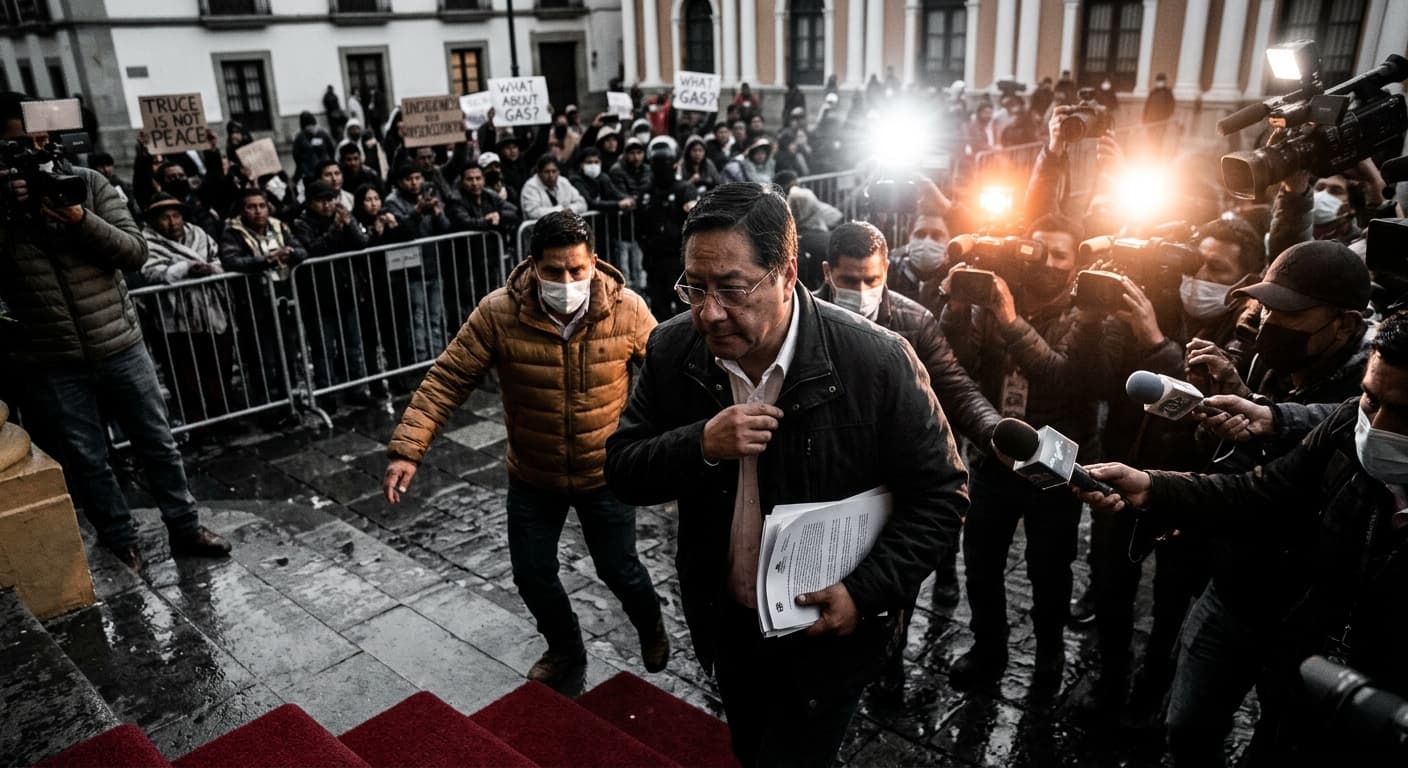
Rodrigo Paz's June 20 emergency decree cleared the roadblocks but not the crisis. What comes next will test the region's centrist bet.
Bolivia's seven-week uprising ended not with a settlement but with an armistice. On June 20, 2026, President Rodrigo Paz signed a pact with the Central Obrera Boliviana (COB) hours before decreeing a 90-day state of emergency, and within 24 hours the national highway authority reported no active blockades. The deal preserves Paz — and with him, the regional wager that a centrist, pro-U.S. government can survive an IMF-style adjustment in the Andes without losing the streets. If that bet fails before December, the consequences run well beyond La Paz: Evo Morales's return to relevance, a symbolic defeat for Washington's "Shield of the Americas" coalition, and a reopening of Chinese and Russian lithium contracts Paz had promised to review.
What the agreement actually says — and what it doesn't
The pact with the COB, signed on the evening of June 19, committed Paz to a "gran acuerdo nacional" convening governors, mayors, universities, productive sectors, and social organisations — with a special commission for La Paz department where blockades were densest. It followed weeks of piecemeal concessions: Paz repealed the land reform that triggered the unrest in late April, offered teachers a wage bonus, cut his own salary and his ministers' by half, and promised compensation for transporters whose engines were damaged by low-quality post-subsidy fuel, according to BBC Mundo.
The state-of-emergency decree, invoked under the "Conmoción Interna" clause, authorised the armed forces to reopen roads and "support the police in restoring order," according to Al Jazeera, and the Legislative Assembly approved it within the 72 hours required. It may run up to 90 days but can be lifted earlier if "violence and threats against the population come to an end." By dawn on June 21,
Al Jazeera reported officials and protest leaders in Santa Cruz had signed a separate accord to lift the critical San Julián blockade, and the Túpac Katari federation had announced a pause in La Paz — while insisting they had not abandoned their demands.
That last clause is the story. Two of the most radical blocs — the Túpac Katari peasant federation and the evistas aligned with former president Evo Morales — publicly rejected the COB accord even as their blockades came down. What ended was the tactic, not the confrontation. Paz's own presidency minister, José Luis Lupo, framed the government's approach candidly during the peak of the unrest: "dialogue for the legitimate sectors and the full force of the law against those who are attacking democracy," he told Al Jazeera. That is not a peace formula; it is a triage.
The cost of the seven weeks
Bolivia's Ombudsman's Office (Defensoría del Pueblo) and human rights organisations put the death toll at at least 17 by June 20, most linked to blocked ambulances and hospital supply cutoffs. Authorities recorded 365 arrests and 37 injuries in clashes between demonstrators and riot police. Daily economic losses exceeded US$50 million nationwide during the peak of the blockades, according to the BBC. Bolivia's foreign ministry disclosed that Chile, Peru, Brazil and Paraguay had jointly channelled 39.1 tonnes of emergency food aid to affected families, in a rare regional humanitarian airlift chronicled by the
Bolivian Chancellery on June 11.
The macroeconomic backdrop is severe. The IMF's 2025 Article IV consultation, published on April 16, 2025, reported that Bolivian public debt had reached 95% of GDP, the fiscal deficit had exceeded 10% of GDP for two consecutive years, and end-2024 inflation hit 10% — the highest in over a decade. The Fund's April 2026 projections, published on its
country page, forecast a real GDP contraction of 3.3% and consumer-price inflation of 20.7% for 2026. Fuel subsidies alone cost 3.9% of GDP in 2024, per the IMF, which is precisely why Paz eliminated them — and why the streets erupted.
The scrapped subsidy had held petrol prices at 2006 levels. Diesel jumped from 3.72 bolivianos per litre to 9.80, and premium petrol from 3.74 to 6.96, according to Al Jazeera. Transport workers said the low-quality substitute fuels wrecked their engines — a granular grievance that plugged directly into a broader collapse in living standards. A working paper by Aliaga Lordemann and Bhattacharyya for the Institute for Advanced Development Studies models the arithmetic: if the U.S.–Iran conflict persists,
Bolivia's gasoline import parity could rise 13% to 60% by June and diesel by up to 53%, turning any restored subsidy into a fiscal time bomb. Paz cannot roll back the cut without triggering the very reserves collapse the reform was meant to stop.
Who benefits, who loses
The clearest winner of June 20 is Paz himself. The Center for Strategic and International Studies, in a July 2026 analysis, judged that "the dissipation of the crisis during the end of June 2026" confirmed the expert consensus he would survive — but warned he "will survive the year" only if he confronts the "fundamental challenge posed by Morales" and shows decisive progress on the economy. Paz's constitutional protection is real: Bolivia's charter has no removal mechanism short of a recall referendum, which only becomes available in the second half of the term he has just begun.
The second winner is Washington. Bolivia is a founding member of the Trump administration's "Shield of the Americas" coalition, and the alliance issued an unusual public defence of Paz on June 7 as the military-deployment law passed, Al Jazeera reported. CSIS put the stakes plainly: Paz's fall "would be a significant symbolic setback to President Trump's agenda," because Morales holds "well-established ties to Cuba, Iran, China, and Russia." The Atlantic Council's post-election
analysis frames the same equation as opportunity: Paz has said he will review the opaque lithium contracts signed by Luis Arce's government with Chinese consortium CBC, Citic Guoan and Russia's Uranium One — potentially opening the world's largest lithium reserves to Western partners for the first time in a generation.
The losers are the Túpac Katari federation, the evistas, and Morales personally. Morales's call for elections within 90 days is unconstitutional, and a Tarija court has declared him in contempt over the statutory-rape case, issuing a fresh arrest warrant, per BBC Mundo. Bolivian analyst Carlos Toranzo told the BBC that Morales "has the power of the street," but sociologist María Teresa Zegada countered that his mobilisation is limited by his ineligibility to run and by "a very strong social sanction" over the sexual-abuse case. What the June 20 truce demonstrated is that the COB — the traditional labour spine of Bolivian politics — is willing to cut a deal without him.
There is a subtler loser: the Bolivian judiciary. Human Rights Watch, in a July 2 dispatch, argues the country's recurring wave protests reflect a "deeper crisis" of governance in which only about 12% of Bolivians trust the courts, the Constitutional Tribunal cannot muster quorum to rule on rights cases, and roughly 22,000 constitutional files sit pending in its basement. HRW's president of the Constitutional Court, Paola Prudencio, said her predecessors — five self-extending judges finally removed in November 2025 — had left more than 2,000 dossiers stashed in office drawers, some six years old. When institutions do not resolve disputes, the road is the last available forum. That is why the Túpac Katari federation could paralyse the capital, and why nothing about the accord prevents them from doing it again.
The regional dimension
Latin American governments closed ranks around Paz with unusual speed. Eight governments from Argentina to Panama had already signed a joint statement in mid-May rejecting "any action aimed at destabilizing the democratic order," and Argentina launched a week-long humanitarian airlift. On June 25, the Organization of American States General Assembly, meeting in Panama, approved by consensus of all 35 member states a resolution titled "Situation of the Plurinational State of Bolivia" — the only country-specific resolution of the session. According to the
Bolivian Chancellery, the text authorises "the deployment of a high-level international mission to accompany the democratically-elected government" and explicitly separates the right to peaceful protest from "acts of violence" and "interruption of essential services."
Consensus at the OAS on any Latin American matter is rare; consensus that endorses a right-of-centre government's use of emergency powers is close to unprecedented in the post-Morales era. It signals that the regional appetite for another Bolivian rupture — after the contested 2019 election, the 2020 restoration of MAS, and the June 2024 "self-coup" that RUSI documented — is exhausted. But consensus is not capacity. The International Crisis Group has warned in past assessments of Bolivia's cyclical instability that regional diplomatic backing rarely translates into the fiscal firepower a genuine adjustment requires.
The historical parallel worth watching is not 2019 but 2003, when Gonzalo Sánchez de Lozada's fuel-and-gas reform triggered the "Gas War," produced dozens of deaths and forced his resignation — clearing the path for Morales's first presidential run three years later. Paz has now attempted a version of the same reform, with a considerably larger fiscal hole and a smaller political mandate. He has, so far, survived it. That distinguishes his moment from Sánchez de Lozada's — but only by a matter of weeks.
What to watch next
- September 18, 2026: The 90-day expiry window of the state-of-emergency decree. Extension or renewal would signal that the "gran acuerdo nacional" has failed to produce a durable political settlement.
- July 6 onward: Bolivia's Supreme Court has
threatened a judicial strike starting July 6 unless the government appropriates 5% of the budget to the justice system, up from 0.46% in 2024 — a second-front institutional confrontation while the emergency is still active.
- The OAS high-level mission: Its composition and terms of reference, when published, will indicate whether hemispheric backing translates into political cover or into monitoring of the government's own conduct.
- Morales's legal status: Any escalation in the Tarija proceedings — or, conversely, any negotiated pause — will reshape the evista mobilisation calculus.
- The next IMF disbursement decision. Bolivia sought a $3.3 billion package in February 2026, per
Al Jazeera. Any Fund conditionality that touches the fuel subsidy or the exchange rate will land in the same terrain that produced the seven-week uprising.
The Bottom Line
The June 20 accord did not resolve Bolivia's crisis — it transferred it from the roads to the calendar. Paz has bought himself a window measured in months, at the price of the military-deployment law, an emergency decree, and a de facto U.S. and OAS security guarantee. If the "gran acuerdo nacional" produces distributive concessions before inflation lands its next blow, the centrist experiment in the Andes survives. If it does not, the next mobilisation will find the same institutional voids — and the same 12% who trust the courts.
Read today's full |
Discover more
US Politics
Virginia's Redistricting Referendum
Virginia's redistricting referendum is drawing a flood of dark money, shaping future elections and the fight for congressional control amid party stakes.
Global Politics
Trump's Conflicting Messages on Iran War
Trump's mixed messages on Iran reflect a strategy of audience management, benefiting Tehran amid a complex geopolitical landscape.

US Politics
Virginia GOP Rallies Rural Voters Against Red
Virginia Republicans are mobilizing rural voters against a Democratic-led redistricting referendum, a fight seen as pivotal to control in the 2026 midterms.

Economics
Fed's Amex AML order puts correspondent banking on notice
Federal Reserve's Amex AML order requires board-level controls and a 90-day plan; OCC fined the bank $350 million over enterprise-wide deficiencies.