Bolivia ends dollar peg: new flexible rate
Bolivia shifts to a managed float for its currency.
Model Diplomat9 min readLatin America
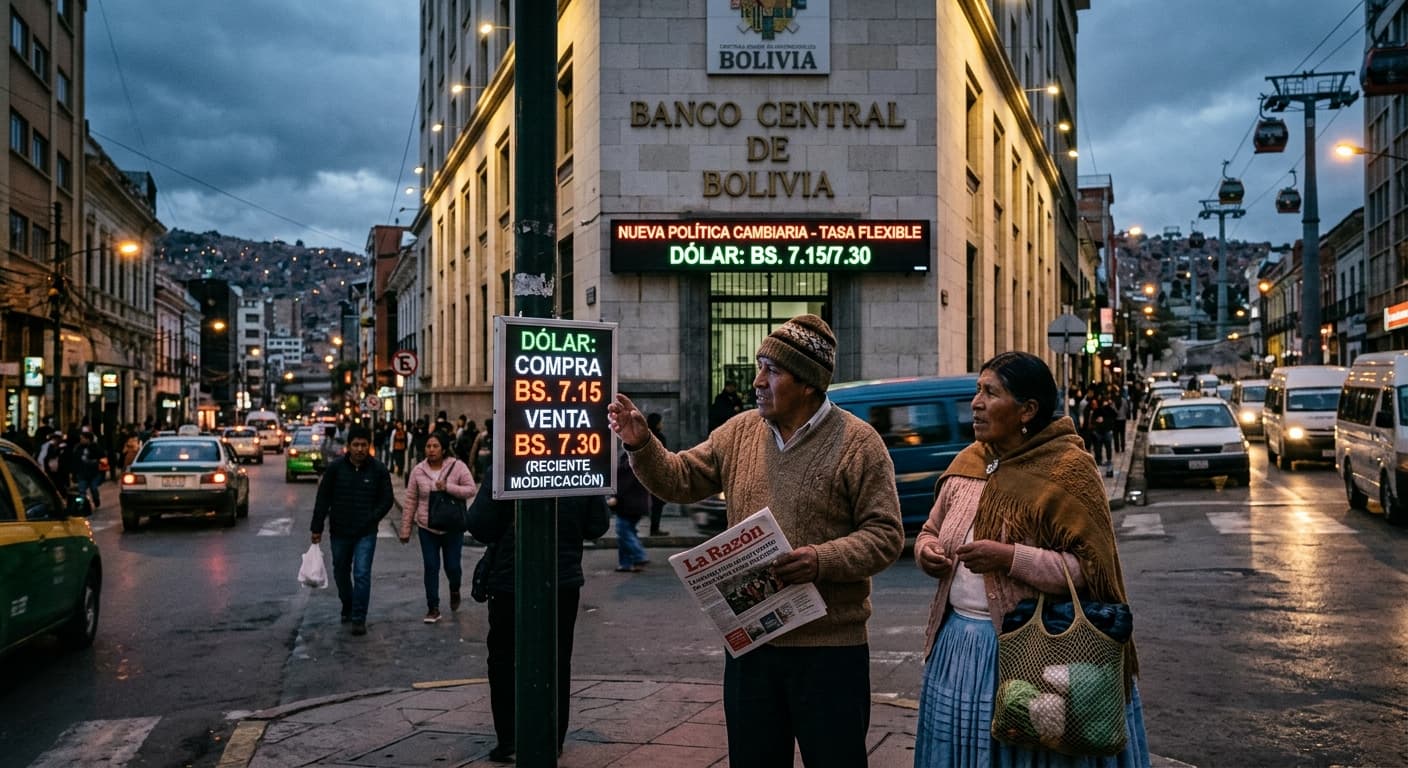
Bolivia ends dollar peg: how the new "flexible" rate really works
Bolivia scrapped its 15-year dollar peg on June 29, 2026, moving to a managed float that has closed most — but not all — of the gap with the parallel market.
Bolivia's central bank did not so much devalue the boliviano on June 29 as ratify what the black market had already decided. The official rate jumped overnight from 6.96 to 9.73 bolivianos per dollar — a 41% devaluation in a single session — and settled at 9.83 by July 6, within pennies of the parallel quote. This is the largest exchange-rate policy shift in Bolivia in a generation, and its real significance is not domestic: it re-prices every cross-border trade with Peru, Argentina, Brazil and Chile that had been arbitraged through Bolivia's overvalued peg, and it sets the terms on which President Rodrigo Paz will — eventually — have to knock on the IMF's door. The winners are Bolivia's exporters and its Andean neighbours' formal traders; the losers are the smuggling networks that made a living off the gap, the importers holding dollar-denominated debt, and a MAS-era social contract built on cheap fuel.
What actually changed on June 29
Under Resolution of Directorate No. 088/2026 and Ministerial Resolution No. 245, the Banco Central de Bolivia (BCB) abandoned the fixed 6.96 boliviano parity and adopted what its own communiqués call a "flexible" — in practice, tightly managed — floating regime, according to a summary by Bolivian law firm BDA Abogados. The Official Exchange Rate (TCO) is now calculated daily from the weighted average of dollar purchases banks execute with their clients; commercial banks may sell dollars up to that reference plus 0.10 boliviano, and the BCB publishes the quotation Monday–Friday at 20:00, as
El Deber has detailed in its explainer.
This is not a free float. It is a benchmark drawn from a regulated slice of the market — bank sales to clients — deliberately excluding the informal parallel where most Bolivians actually transact. The BCB has been staging the shift since December 2025, when it started publishing a "Valor Referencial del Dólar" as a transparency indicator, according to a BCB press release that logged 2.18 million cross-border operations worth $13.76 billion in 2025 as the underlying dataset. By April 2026 the BCB had aligned that indicator with IOSCO reference-rate standards, framing the June 29 devaluation as the technical culmination — not a rupture — of a transition
publicly telegraphed for six months.
The first week's price action bears out the design. According to Red Uno, the TCO moved from 9.73 on Monday June 29 to 9.80 on Friday July 3, a cumulative 0.7% appreciation of the dollar, and stood at 9.83 on Monday July 6 with the parallel at 10.00 buy / 9.96 sell. For the first time since 2023, the gap between official and street rates is under 2%. The critical view — and it is not marginal — is that the BCB has effectively delegated price discovery to a small group of licensed banks and their largest corporate clients: exporters, importers and the industrial associations that lobbied for the change. Bolivian outlet
Contacto Sur has argued the reform "privatised" the determination of the dollar's value in favour of large exporters. That reading matters because it identifies who now has leverage over the rate: soy, mining and hydrocarbon exporters, not households.
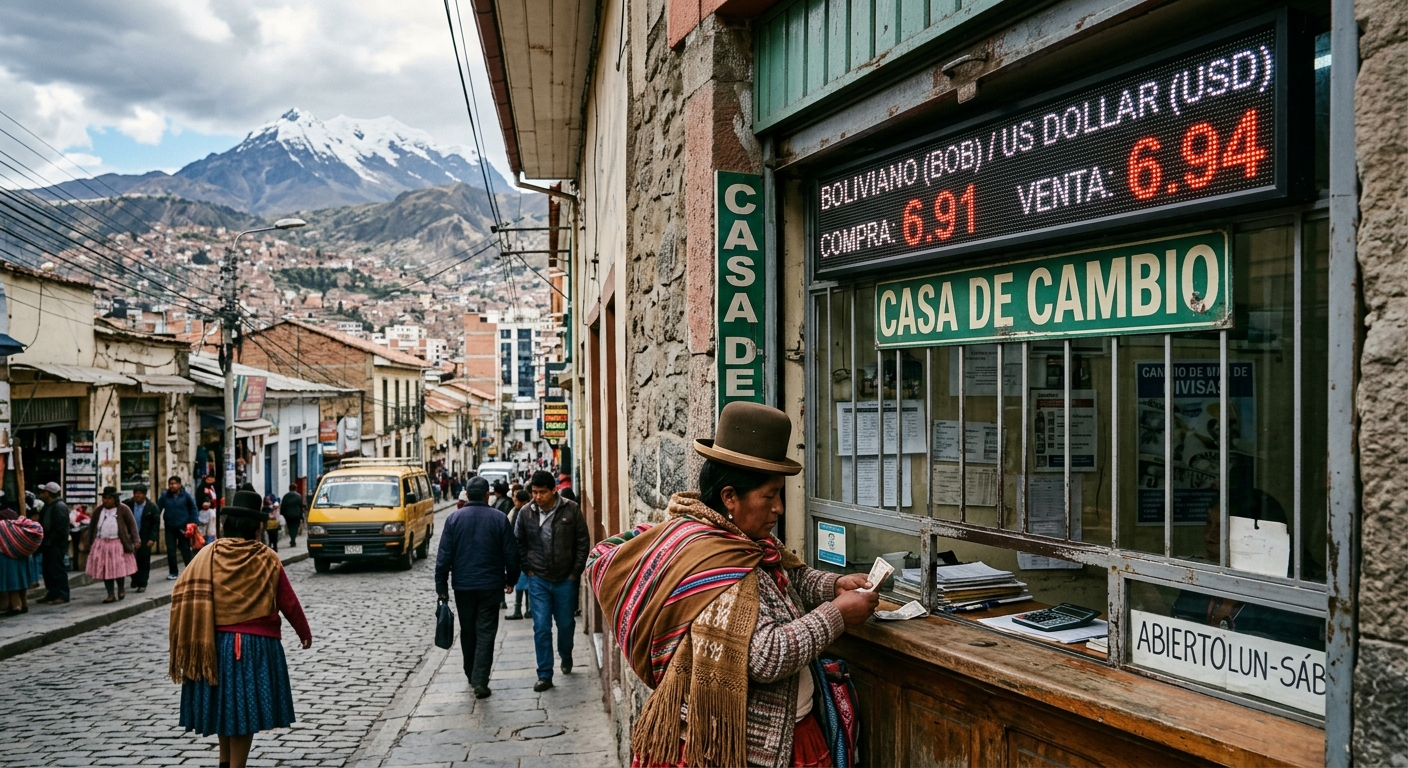
Why now — the fiscal arithmetic behind the switch
The proximate cause is that Bolivia had run out of dollars to defend the peg. The IMF's 2025 Article IV — the primary document on which any assessment of the regime change must anchor — was blunt: "the untenable peg to the U.S. dollar and depleted international reserves call for a decisive shift in the monetary policy framework." The Fund's staff report noted that usable FX reserves were expected "to remain close to zero" even after liquefying gold, with the fiscal deficit above 10% of GDP in 2023–24 and public debt at 95% of GDP. In the Fund's
Article IV press release, Executive Directors warned that "inaction could lead to a painful disorderly adjustment" — code, in Fund register, for uncontrolled devaluation and default.
That is the number that gutted the peg. When the BCB had $15.1 billion in reserves in 2014, it could sell dollars into the market to hold 6.96. With reserves at roughly $1.9 billion at the start of 2025 — only $153 million of it in actual foreign currency, the rest in gold, according to BBC Mundo — it could not. The parallel market did the devaluation the government refused to do: the gap between the official 6.96 and the street rate peaked at 166% in May 2025, according to the BCB's own
2026 monetary report. That report also concedes that measures introduced in early 2023 — an "exportador" dollar, higher transfer fees, restrictions on card use abroad — "distorted the functioning of the foreign-exchange market" and consolidated the black-market circuit.
| Indicator | 2014 | End-2024 | 2026 (latest) |
|---|---|---|---|
| BCB net international reserves | $15.1 bn | ≈$1.9 bn | Rising via sovereign bond issuance |
| Official rate (Bs/USD) | 6.96 | 6.96 | 9.83 (Jul 6) |
| Parallel-market gap | 0% | ~96% (Aug 2024) | <2% (Jul 6) |
| Fiscal deficit (% GDP) | -3.4 | >10 | IMF projects wide deficit |
| Public debt (% GDP) | 38 | 95 | n/a |
| CPI inflation (y/y) | 5.2 | 10.0 | IMF projects 20.7% for 2026 |
| Fuel-subsidy cost (% GDP) | n/a | 3.9 direct; 5.2 with opp. cost | Being phased out |
| The politics finally caught up in October 2025. Centrist senator Rodrigo Paz won the runoff with 54%, ending 20 years of MAS rule, on an explicit platform to "end Bolivia's fixed exchange rate, phase out generous fuel subsidies and reduce hefty public investment," as |
Second-order effects: the neighbours' problem
The IMF's 2025 Article IV projections for Bolivia — real GDP contracting 3.3% and inflation of 20.7% in 2026, per the country page — describe an adjustment recession, not a soft landing. But the more overlooked story is what a boliviano trading near 10 does to the arbitrage machine that had grown along Bolivia's four land borders.
At the old 6.96, subsidised Bolivian gasoline cost about $0.54 per litre, versus above $1.05 in Peru, according to Peru's energy regulator cited by BBC Mundo from the Desaguadero border crossing. The Arce government estimated that roughly 30% of subsidised fuel was being siphoned out to neighbours — "contrabando a la inversa," or reverse smuggling. Meanwhile, Bolivian food producers were smuggling soy, sugar and meat out of the country to capture parallel-market dollars in Peru, hollowing out domestic supply and driving food inflation past 31%. Devaluing the boliviano by 41% and cutting fuel subsidies simultaneously — Paz has been eliminating them since May 2026, sparking the blockades that forced him to declare a
state of emergency on June 20 — collapses both arbitrages at once.
The regional beneficiaries are the formal traders in Puno, Tacna, Iquique and the Argentine north who lose informal Bolivian competition. The losers are the smuggling economies of Desaguadero and Villazón, and the ~80% of Bolivians in the informal sector who, as CSIS notes in its analysis of the Paz crisis, were "particularly affected" by fuel-price shocks tied to global oil markets. For Mercosur partners, the spillover is muted: an IMF working paper on regional trade linkages found that "a real effective exchange-rate shock in Brazil does not have statistically significant effects on output in the smaller neighbouring economies," and the reverse — Bolivia devaluing against Brazil — is even smaller in the Southern Cone gravity structure, per
Adler and Sosa (2012). The real transmission channel is not GDP but migration and remittances: a weaker boliviano makes Bolivian labour in Argentina, Chile and Brazil more competitive, and every peso or real sent home is worth 41% more in local currency than it was in June.
The historical parallel — and where it breaks
The obvious comparison is Argentina. Bolivia's peg collapsed for the same reason Argentina's convertibility collapsed in 2001: a fixed rate defended with vanishing reserves against a widening fiscal deficit. The difference is decisive. Argentina broke its peg with $14 billion in reserves and a full-blown banking crisis; Bolivia broke its peg with the parallel market having done most of the pricing work already, and with banks that — per the BCB's May 2026 monetary programme — showed "scarce demand for dollar withdrawal" under the retail withdrawal window opened for depositors with under $1,000 balances.
That is the non-obvious win for Paz. Because the transition was staged — reference rate in December 2025, IOSCO-aligned methodology in April 2026, elimination of Chapter VII of the FX regulation in June — there was no bank run on day one. The BCB's own May programme document boasts that time-deposit flows turned positive in early 2026, reversing the 2025 outflows. If that holds, Bolivia will have executed the rarest thing in Latin American monetary history: an orderly exit from a two-decade peg with reserves at essentially zero, without hyperinflation and without a banking crisis. The IMF's own 2021 Article IV had estimated the welfare gain from moving to inflation targeting at "around 3 percent of total consumption" — a figure that presupposed exactly this kind of managed transition, not a disorderly break.
The parallel breaks, however, on politics. Argentina's 2001 exit brought down the government; Paz's exit is happening while the government is still standing but under siege, with a state of emergency in force and Evo Morales's cocalero base blockading roads. The BCB is projecting 15.8% inflation at year-end 2026 in its April monetary minutes — a figure the IMF thinks is too optimistic by roughly five points. If the pass-through from the 41% devaluation is faster than the BCB assumes, inflation could re-accelerate through late 2026, and every wage-negotiation cycle from teachers to transport unions becomes another political detonator.
Diplomat View
The float will hold through Q3 2026. The BCB has enough tools — the 0.10-boliviano band, the bank-sales reference methodology, the sovereign-bond issuance now feeding reserves — to keep the TCO tracking the parallel within a narrow spread, and Paz has enough political runway to absorb the inflation shock so long as fuel supply normalises. The forecast changes if two things happen: if reserves stop rising because sovereign-bond appetite dries up (watch spreads on the 2028 and 2030 issues), or if a second wave of blockades in August–September forces Paz to reverse fuel liberalisation. In either scenario, the "flexible" rate would become a de facto crawling depreciation, and Bolivia would be back at the IMF's door by early 2027 — the outcome Paz was elected to prevent, but the one his fiscal arithmetic still points toward. The single number to watch is not the TCO. It is BCB usable reserves: below $500 million, the float becomes fiction.
What to watch
- BCB reserve disclosures (weekly, July–September 2026): whether sovereign-bond proceeds are net-adding to usable FX or merely refinancing.
- August inflation print: the first clean read on pass-through from the 41% devaluation and the fuel-subsidy phase-out.
- Fuel-subsidy legislation in Congress (Q3 2026): stalled reforms, per
BBC, remain the single biggest test of the Paz coalition.
- State-of-emergency renewal decision (mid-September 2026): the 90-day decree issued June 20 expires; renewal would signal the political cost of the adjustment is still rising.
Read today's full |
Discover more

US Politics
SNAP Food Assistance Faces Legal Challenges
In 2026, SNAP faces stricter eligibility rules and mounting legal challenges, threatening food assistance for the millions of Americans who rely on the program.
Global Politics
Trump's Conflicting Messages on Iran War
Trump's mixed messages on Iran reflect a strategy of audience management, benefiting Tehran amid a complex geopolitical landscape.
US Politics
House Ethics Committee Pushes Sexual Miscond.
The House Ethics Committee has shifted responsibility for sexual harassment settlement records to the Office of Congressional Workplace Rights, complicating disclosure efforts.

Conflict & Security
Drone Warfare Killing Aid Workers at Unprec
Over 1,000 humanitarian workers killed in three years as cheap armed drones collapse legal protections. Gaza, Sudan, Ukraine, and DRC see deliberate targeting of aid convoys and hospitals with zero prosecutions.

