BoG Burns $2bn to Rescue Cedi in 2026
Ghana's central bank intervenes to stabilize currency
Model Diplomat8 min readAfrica
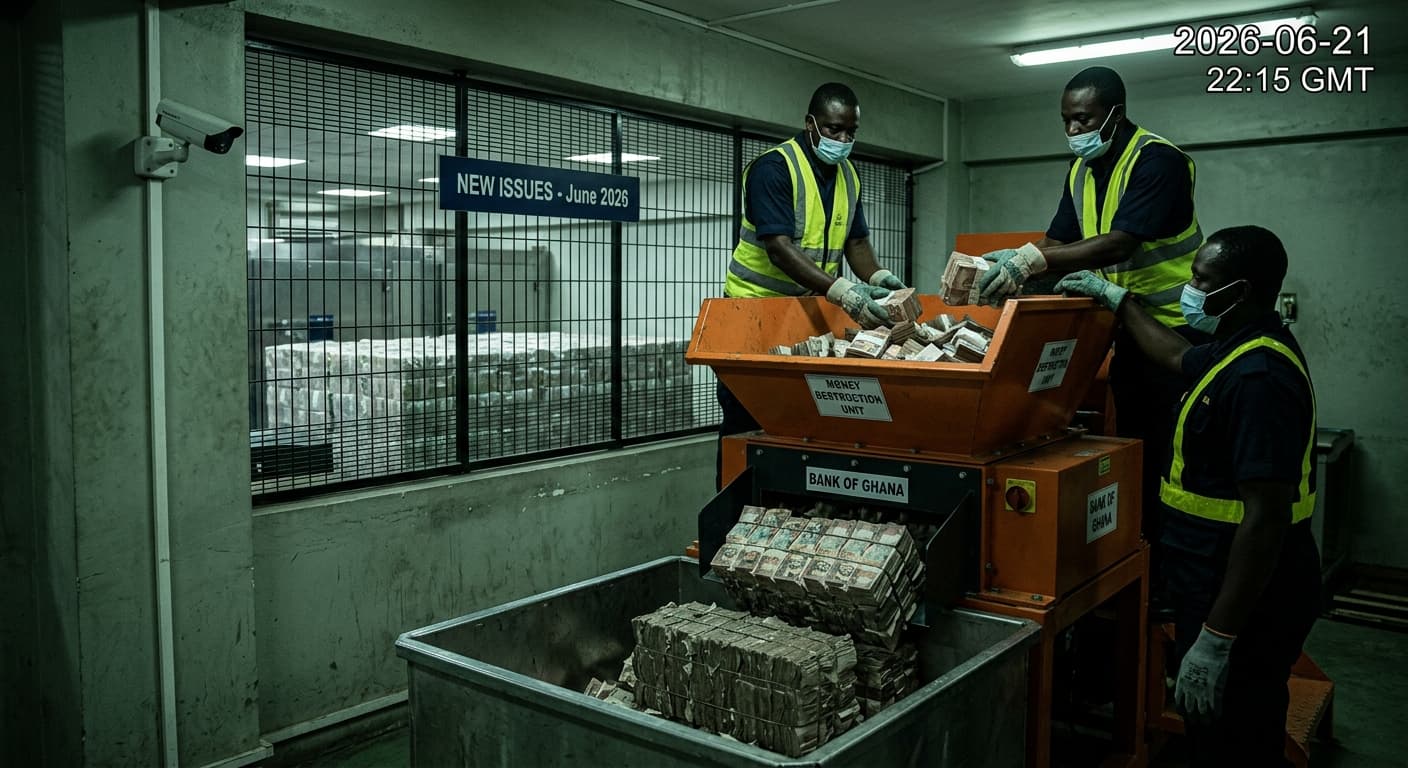
BoG Burns $2bn to Rescue Cedi as 2026 Slide Halts
Ghana's central bank sold $2.01 billion into the FX market in June 2026 to arrest a 7.9% year-to-date cedi slide — the tell is that bids still outran supply by $3.4bn.
The Bank of Ghana's $2.01 billion June intervention — its largest single month of 2026 — bought the cedi a 3.3% monthly gain and a headline that reads like victory. It is not. Demand at the June auctions overshot supply by roughly $3.4 billion, according to reporting from MyJoyOnline, and the retail cedi still sold at GH¢12.30 to the dollar on July 2 while the interbank window cleared at GH¢11.36. The BoG is not managing a float; it is running a two-tier fix on borrowed time, and the meter is the Domestic Gold Purchase Programme's ability to keep replenishing what Accra is selling.
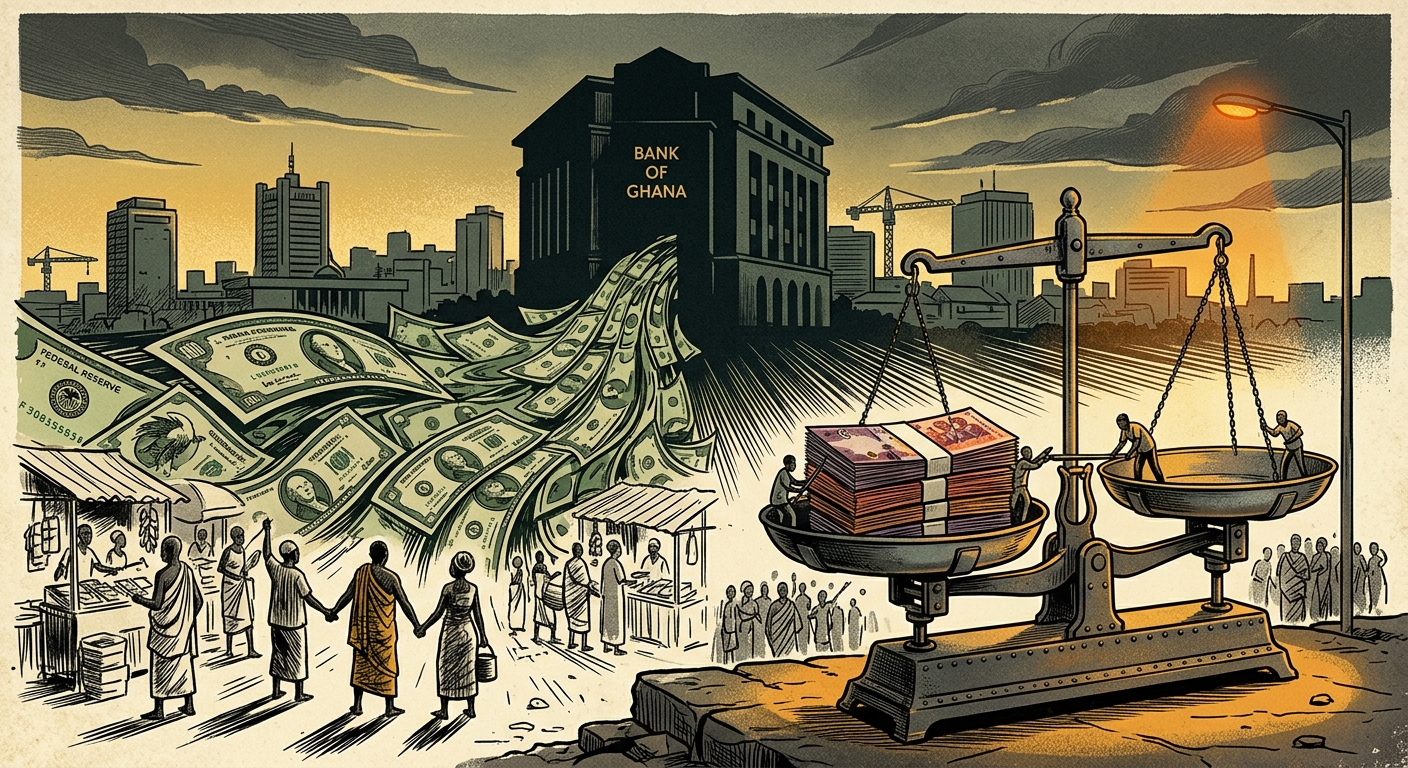
What actually happened in June
The intervention broke into two tranches. The BoG sold $1.2 billion through the Forex Intermediation Programme (FIP) via two weekly auctions — up from $1 billion in May — and an additional $811 million through its FX Intervention Programme aimed at bulk oil distributors and specific import obligations, according to Ghana News Online. The result: the cedi appreciated 3.3% against the dollar for the month, its first monthly gain of 2026, even as it remained 7.9% weaker year-to-date.
Two weeks earlier, Citinewsroom reported the cedi's year-to-date losses narrowing from nearly 11% to about 6% inside a fortnight — a move it attributed squarely to BoG supply, not to a shift in fundamentals. That is the key qualifier. The June rally is an intervention rally.
The demand side is unforgiving. Bids at the FIP auctions ran roughly $3.42 billion above what the central bank was willing to sell, per JoyBusiness data cited by Spirit FM Online. That gap reflects import obligations, inventory rebuilding by manufacturers who ran down stocks earlier in the year, and — as
Modern Ghana noted on June 24, when the retail dollar first punched through GH¢12.30 — a market where FX demand was running "nearly 4× BoG supply" at points in the month.
The 2025 sugar high and the 2026 hangover
To understand today's spend, look at last year's rally. The IMF's fifth ECF review, completed on December 17, 2025, disbursed about $385 million and lauded a program that had, on paper, worked. Ghana's
IMF Country Report No. 25/002 records the mechanics: the cedi appreciated 36% year-to-date against the dollar by end-October 2025, gross international reserves reached $9 billion (3.5 months of imports), and the current account swung to a 3% of GDP surplus on record gold and cocoa receipts.
That appreciation was not primarily earned in the market. The same report shows the BoG sold "about US$9 billion in FX" through 2025 — a footprint the Fund characterised euphemistically as the central bank taking "an increasingly active role as an intermediary." Under cover of the rally, the Monetary Policy Committee cut the policy rate by a cumulative 1,000 basis points from July 2025 to 18.0% by end-December, according to the same IMF staff report.
That is the setup for 2026. A currency that ran 36% too rich, real rates that fell fast, and importers who — rationally — front-loaded orders while the cedi was strong. By April, when IMF staff completed the 2026 Article IV consultation and reached staff-level agreement on the sixth ECF review, the language shifted. The Fund praised "improved confidence in the cedi" — past tense — and pivoted engagement toward a non-financing 36-month Policy Coordination Instrument focused on "enhancing the monetary and exchange-rate policy framework" and, pointedly, on "protect[ing] the Bank of Ghana's balance sheet from DGPP-related quasi-fiscal risks."
Translation: the IMF wants Governor Johnson Pandit Asiama to intervene less, not more.
The gold engine — and its limits
Ghana's FX firepower in this cycle has one dominant source: gold bought domestically in cedis and monetised abroad. The Domestic Gold Purchase Programme grossed over $3.6 billion in 2024, accounting for nearly a third of BoG's FX inflows, and BoG gold holdings still exceed one-third of gross reserves.
The government doubled down in April 2025 by creating the Ghana Gold Board (GoldBod) and, as the BBC reported, banning foreigners from the local gold trade by 30 April 2025, giving the state body a monopsony on artisanal small-scale mining output. GoldBod is meant to purchase and export at least three tonnes of gold per week; Finance Minister Cassiel Ato Forson framed it explicitly as a currency-stabilisation tool.
The strategy has real merit while gold prices hold. Al Jazeera reported on June 27, 2026 that Ghana had further expanded the share of locally produced gold routed through the central bank — part of a broader continental push, alongside Tanzania and Guinea, to capture more value from the metal.
But the model has three cracks the June numbers expose. First, the IMF's May 2026 statement warned that DGPP has been generating "losses" and "quasi-fiscal" costs on the BoG's balance sheet — the price of buying gold in freshly issued cedis and selling it for dollars when the exchange rate moves against the trade. Second, gold-related short-term outflows have blunted reserve accumulation, with the IMF noting that "H1 short-term outflows related to the gold trade have been elevated, slowing potential faster reserve accumulation." Third, GoldBod's monopsony has drawn pushback from bullion traders, and the Chamber of Bullion Traders Ghana chairman Kwaku Effah Asuahene has publicly questioned whether the state can fund all mandated purchases, per the BBC.
The June intervention was, in effect, the DGPP engine running hard to fund a defensive FX operation — not to build buffers.
Who wins, who pays
The immediate winners are Ghana's bulk oil distributors and manufacturers with hard-currency payables: the $811 million FX Intervention Programme window is essentially targeted subsidy for their dollar needs. Commercial banks come next — they cleared FIP auction allocations at the interbank rate near GH¢11.36 into a retail market pricing dollars at GH¢12.30, per Modern Ghana's July 2 rate roundup. That ~8% spread is a policy-created margin.
The losers are less visible but larger. The BoG absorbs the DGPP's cedi liabilities and the valuation losses when it sells dollars cheaper than the retail market prices them — the balance-sheet erosion the IMF flagged. Exporters not in the gold or cocoa nexus lose competitiveness every time the intervention props the cedi above its market-clearing rate. And the fiscal side eventually pays: IMF Country Report No. 25/002 already flagged that "over US$800 million" of the 2025 reserves increase came not from earned inflows but from a technical shift making Cash Reserve Ratio compliance on FX deposits payable in foreign currency.
Academic work reinforces the point. Research in the Journal of African Economies by Bleaney, Morozumi and Mumuni found the BoG's monetary policy reaction functions look textbook — the problem is transmission in a high-debt environment. A related study in the
African Development Review by Iddrisu and Alagidede found that once Ghana's debt-to-GDP crosses roughly 35%, the BoG's response to inflation shocks becomes "woefully disproportionate" — a classic fiscal-dominance signature. Ghana's debt ratio, even post-restructuring, sits well above that threshold. The FX book is doing work the policy rate cannot.
The forecast: not a crisis, not stability
The immediate outlook is stabilisation, not stability. Ghana News Online reports analyst expectations that July FIP auctions will fall to roughly $1 billion, on the view that inventory rebuilding is largely done and June's overshoot reflected pent-up demand. That is plausible: seasonal Q3 gold inflows and continued cocoa receipts should ease pressure. Gross reserves at 3.4 months of imports coverage by end-2025, per the IMF, give Asiama room to run this play for several more months.
But three risks are stacked against the trade. Gold prices are the entire buffer — a 15% correction from current levels would gut the DGPP arithmetic. The IMF's PCI, which will replace the ECF once the sixth review is Board-approved, is explicitly designed to force BoG's FX footprint down, not up — meaning the tool being used now is the one being taken away. And the parallel-market spread — GH¢12.30 versus GH¢11.36 — is the classic early signal that intervention is bending the price rather than clearing the market.
What to watch
- BoG Monetary Policy Committee, next scheduled meeting (July 2026). With the MPC typically meeting bi-monthly per the
April 2026 IMF technical report, Governor Asiama's next rate call will signal whether easing continues at 18% or halts to defend the cedi. A pause would confirm FX pressure is trumping the disinflation narrative.
- IMF Executive Board vote on the sixth and final ECF review (expected mid-2026, following the May 15 staff-level agreement). Approval releases the final ECF tranche and formalises the PCI's tighter constraints on FX intervention.
- July FIP auction volumes. If the BoG actually cuts to ~$1 billion and the cedi holds, the market has absorbed the excess demand. If auctions stay near $2 billion, June was not a peak — it was a floor.
- Global gold price and GoldBod weekly export volumes. The three-tonne-per-week target is the leading indicator of DGPP capacity, and thus of the BoG's ammunition for the second half.
Diplomat View
The Bank of Ghana's June intervention is best read not as a rescue but as the operating cost of last year's political rally. Accra spent about $9 billion in 2025 to engineer a 36% cedi appreciation that flattered a debt-restructuring election-year narrative, and it is now spending down that gain in $2-billion monthly instalments to keep the retreat orderly. This is a manageable posture — Ghana is not Egypt or Nigeria — but it is not a durable one. Our call: the cedi ends 2026 between GH¢12.50 and GH¢13.50 to the dollar, roughly 10–15% weaker year-to-date, with the BoG's gross FX sales for 2026 landing between $12 billion and $14 billion. Revise upward on any of three triggers: a sub-$3,000/oz gold print sustained for a quarter, an IMF Board delay on the sixth review past September, or a widening of the retail-interbank spread beyond 12%. The story worth writing in Q4 is not whether the cedi held — it is what the BoG's balance sheet looks like once the DGPP's quasi-fiscal tab is settled in the 2027 budget.
The Bottom Line
Ghana's $2 billion June intervention halted the 2026 cedi slide but did not reverse it — bids still overshot supply by $3.4 billion, and a parallel-market spread of nearly 8% signals the BoG is capping the price, not clearing the market. The real story is that Accra is spending down a gold-financed war chest to defend a currency that its own IMF program says should trade weaker, and the Fund's incoming Policy Coordination Instrument is designed to take that tool away. Watch the July auction and Asiama's next rate call: they will tell you whether June was a turning point or a peak.
Discover more
International Relations
Economist Impact Sustainability Week 2026
Economist Impact Sustainability Week 2026 spotlights the energy transition, AI in clean technology, and supply chain resilience as themes for global leaders.
India
Modi's Women’s Convention in Varanasi
Modi's Varanasi rally frames women's reservation as a national mission, targeting the 2027 Uttar Pradesh elections with a strategic narrative.
India
Rajnath Singh's Durga Squad for 2026 Polls
Rajnath Singh's Durga Squad promised women's safety in Bengal but has since disappeared from the agenda, revealing BJP's true priorities.

Economics
Fed's Amex AML order puts correspondent banking on notice
Federal Reserve's Amex AML order requires board-level controls and a 90-day plan; OCC fined the bank $350 million over enterprise-wide deficiencies.