BNM Holds OPR at 2.75% Amid Tariff and Oil Sh
Bank Negara Malaysia maintains rate amid external pressures.
Model Diplomat7 min readAsia
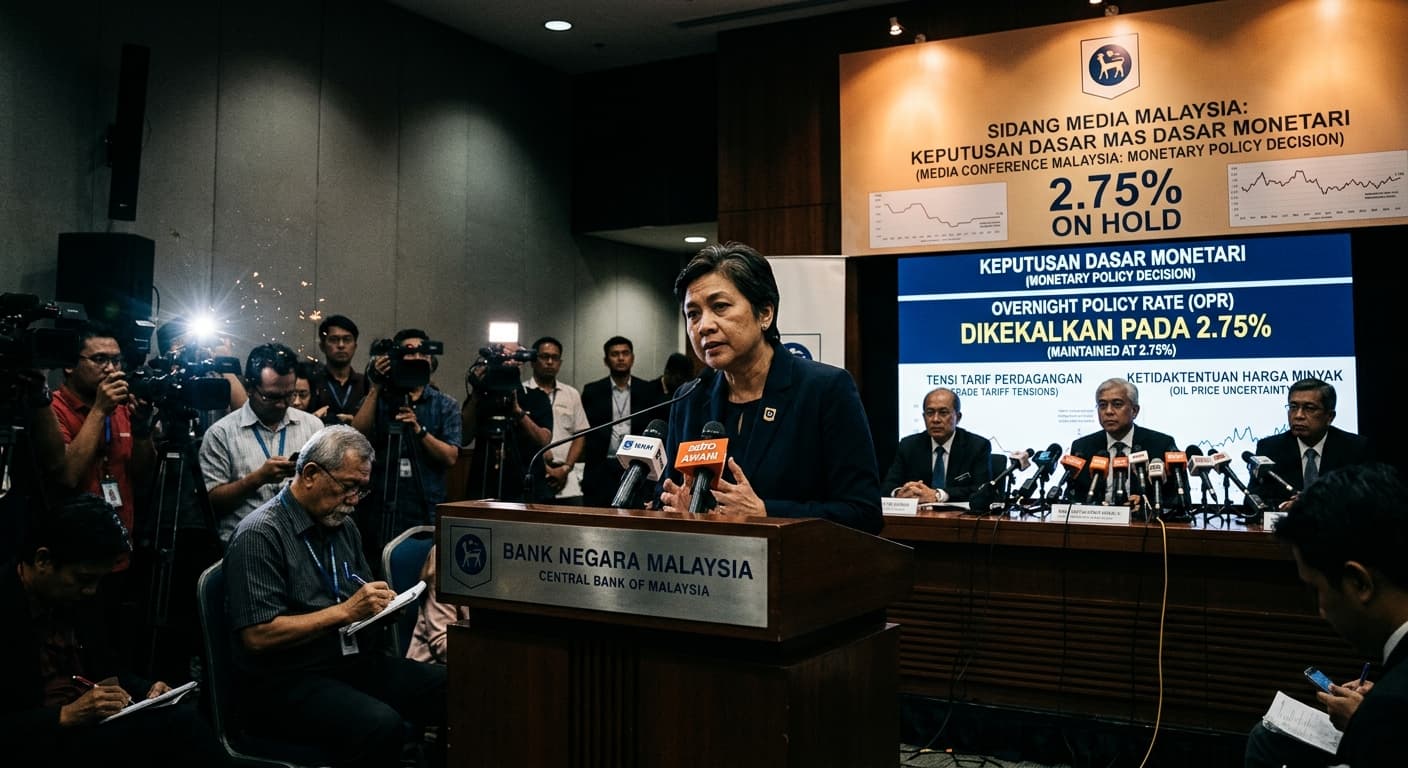
BNM to Hold OPR at 2.75% as Tariffs and Oil Test Malaysia
Bank Negara Malaysia is expected to keep the Overnight Policy Rate at 2.75% on July 9, 2026 — a deliberate pause that trades a weaker ringgit for shelter from a US tariff and oil shock.
Bank Negara Malaysia (BNM) will almost certainly leave the Overnight Policy Rate (OPR) at 2.75% when its Monetary Policy Committee (MPC) meets on July 9, 2026 — a fifth consecutive hold that is less about domestic calm than about a deliberate choice: absorb a weaker ringgit and thinner rate buffer in exchange for insulating growth from a 19% US tariff wall and a Middle-East oil shock the government cannot afford to pass through. According to Bernama, BNM is now expected to hold 2.75% through 2026; the risk that matters is not a hike, but whether Governor Abdul Rasheed Ghaffour still has room to cut if the tariff drag bites harder in the second half.
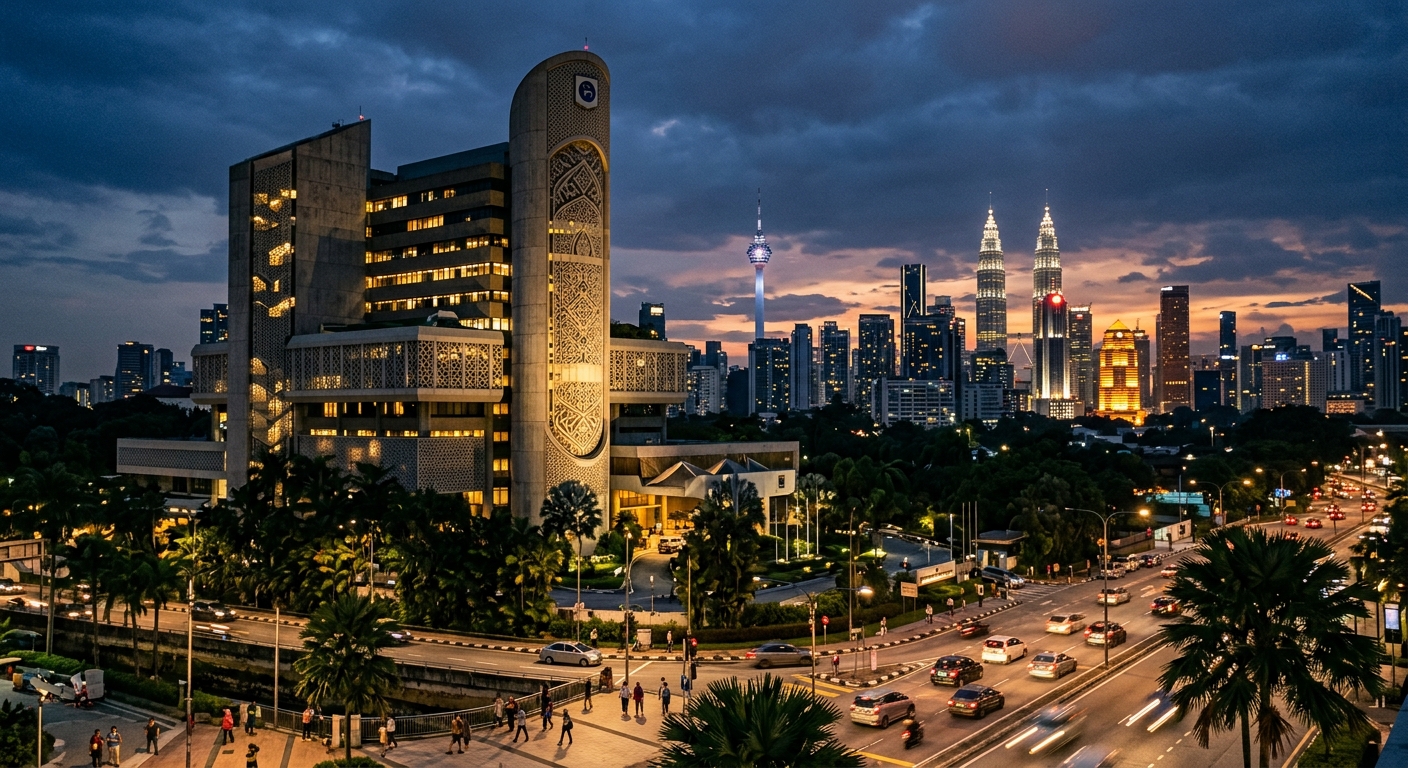
The decision Kuala Lumpur has already made
The July 9 meeting is the fifth since BNM cut the OPR by 25 basis points in July 2025 — its first move in more than three years, and the only one in the current cycle. RTTNews, citing the MPC statement, noted that "the Monetary Policy Committee of Bank Negara Malaysia maintained its Overnight Policy Rate at 2.75 percent" at the May 7 meeting, with the ceiling and floor of the corridor at 3.00% and 2.50% respectively, per Trading Charts. BNM's own
Financial Markets portal confirms the rate has been unchanged since 7 May 2026, with the corridor mechanics that anchor interbank pricing set 25 bp either side of the OPR.
The economist consensus into July 9 is unusually tight. HSBC's ASEAN senior economist Yun Liu told the New Straits Times that "Malaysia's economic conditions" argue for a hold even as regional peers in Indonesia and the Philippines lean toward tightening on rupiah and peso pressure. BMI, the Fitch Solutions unit, told
Media Selangor in May that contained inflation would keep BNM parked at 2.75% through the July meeting. MIDF Research and Kenanga see the same, with a residual, low-probability path to a 25 bp hike to 3.00% only if oil-driven inflation proves sticky or growth surprises above 5%.
Why the hold is really a hedge on Washington and Tehran
The macro numbers look calm. Headline CPI averaged 1.4% between January and October 2025, and IMF staff projected inflation to drift back to the 2% long-run average, "gradually," in a December 18, 2025 statement concluding the 2026 Article IV mission. The Fund also cut its 2026 growth projection to 4.3%, "mainly reflecting the impact of higher U.S. tariffs on Malaysia." The World Bank's
June 2026 Malaysia Economic Monitor put growth at 4.4%, flagging "trade policy uncertainty amid the ongoing conflict in the Middle East" as the dominant upside risk to import prices.
Two external shocks explain the hold better than any domestic indicator. First, the Joint Statement on United States-Malaysia Agreement on Reciprocal Trade, signed in October 2025, locked in a 19% US reciprocal tariff on Malaysian goods — down from an initial 24% under Executive Order 14257, but still a permanent tax on a country whose US-bound exports hit RM120 billion in electrical and electronics alone. RSIS's
ISAS analysis called the outcome a diplomatic win for Prime Minister Anwar Ibrahim; ISEAS was less sanguine, noting in
ISEAS Perspective 2026/37 that Articles 5.1 and 5.2 of the Agreement bind Malaysia to mirror US export controls, "a significant shift that directly erodes Malaysia's neutrality in the ongoing US-China tech war."
Second, the Iran war has pushed unsubsidised RON95 petrol to RM4.27 per litre against a subsidised pump price of RM1.99, per ISEAS. Second Finance Minister Amir Hamzah Azizan has publicly warned the RON95 subsidy bill has ballooned from RM700 million to RM3.2 billion per month. The fiscal absorber is doing the disinflation job monetary policy would otherwise have to do — which is precisely what lets BNM sit still.
What the market is quietly pricing
The ringgit tells the sub-plot. BNM's reference rate closed at 4.0665 per US dollar on July 3, 2026, per its Financial Markets data page — roughly 14% stronger than the near-4.72 lows of early 2025, when the Fed's higher-for-longer stance still dominated Asian FX. The 10-year Malaysian Government Securities yield sits at 3.62%, well inside the 4%+ range it traded at through 2024, with daily FX turnover of USD 19 billion signalling deep, functional markets rather than a defensive posture.
That external buffer is what buys BNM the luxury of decoupling. The Edge reported the May 7 statement kept "a close eye on the ongoing geopolitical conflict in the Middle East," in its coverage of that decision. The subtext is that the Governor has already used his one insurance cut in July 2025, at 2.75%, before the tariff regime hardened. Cutting again now, with the Federal Reserve still restrictive and the ringgit its main anchor for imported inflation, would risk a repeat of the 2022–2023 currency slide that forced pre-emptive hikes.
There is a live academic debate about how much room BNM actually has. An IMF working paper by Kodjovi Eklou, The Anatomy of Monetary Policy Transmission in an Emerging Market, found that Malaysian monetary policy transmission is "amplified" when global central banks tighten in sync — and "weakened" in high-inflation regimes. With inflation at 1.4% and the Fed on pause, BNM's tools work well. Which means a hold today is not passivity; it is the most efficient point on the policy curve.
Who wins and who pays
The clearest beneficiary is Anwar Ibrahim's Unity Government. Fiscal consolidation is on track to narrow the deficit to a 3.5% of GDP target for 2026, according to ISEAS, and the Institute of Strategic and International Studies'
Budget 2026 brief confirmed the government has maintained the consolidation path despite lower petroleum revenue. A stable OPR keeps sovereign debt service costs contained ahead of state elections and a general election due before February 2028.
The semiconductor and electronics complex is the second winner — for now. Malaysia's chip sector accounts for roughly 13% of global semiconductor assembly and testing, contributes about 6% of GDP and 26% of exports, per ISIS Malaysia's March 2026 note citing analyst Jaideep Singh. E&E exports drove the current-account surplus that gives BNM its FX cushion. Holding the OPR keeps borrowing cheap for the RM6.5 billion in private R&D financing the government is trying to catalyse under the National Semiconductor Strategy.
The losers are Malaysian households and the mid-tier services sector. Real wage growth is stable but soft; the unemployment rate has ticked up marginally; and BUDI95 subsidies mask, rather than solve, imported inflation. ISEAS's Lim Kok-Tiong has warned that up to 680,000 services jobs could be exposed to Agentic-AI displacement, which would test BNM's Taylor-rule assumptions if labour slack widens quickly.
The historical parallel that reframes it
BNM has been here before, and it lost. In 2022, the same 2.75% rate marked the peak of a hiking cycle driven by Federal Reserve tightening; BNM then held at 3.00% from May 2023 until July 2025. The 2025 cut was the pivot — a pre-emptive move against the Trump-era tariff shock that ISIS Malaysia estimated at a trade-weighted average duty of roughly 14% on Malaysian US-bound exports even after semiconductor carve-outs.
That single cut is BNM's insurance. If the tariff drag proves worse than the IMF's 4.3% growth projection, or if the AI capex cycle rolls over, the next MPC move is more likely down than up — but the Governor will not spend that bullet until he has to.
What to watch next
- July 9, 2026 — MPC statement. Watch the language on private consumption and export orders; a shift from "resilient" to "moderate" pre-signals an October cut.
- August 2026 — Q2 GDP release. A print below 4% would put a rate cut back on the table for the September or November MPC.
- September–October 2026 — RON95 subsidy rationalisation update. Any pass-through of unsubsidised petrol prices would force a hawkish tilt.
- Fed September 2026 meeting — a Fed cut would ease ringgit pressure and hand BNM room; a hold locks in the status quo.
Diplomat View
BNM's July 9 hold is the most consequential decision it will not make. The Governor is running a barbell: fiscal policy absorbs the oil shock via BUDI95, trade diplomacy absorbs the tariff shock via the ART, and monetary policy holds the middle at 2.75% to protect the ringgit. That configuration works only if two conditions hold — Fed pause, and no second Middle-East escalation that lifts Brent above USD 100. If either breaks, expect a 25 bp cut in the September or November MPC rather than a hike; the domestic disinflation trend and the growth downgrade point that way, and BNM has demonstrated in July 2025 it will move pre-emptively. The forecast reverses only if headline CPI clears 3% for two consecutive prints, or if the ringgit breaks 4.30 to the dollar on capital outflows — either would force the Governor to defend the currency, not growth. For Malaysia, the story is no longer about the rate. It is about how long the fiscal and diplomatic buffers hold before monetary policy has to move again.
The Bottom Line
The bottom line: BNM's expected hold at 2.75% on July 9, 2026 is not a vote of confidence — it is the last stable point on a policy curve where fiscal subsidies and a trade deal with Washington are doing the heavy lifting. If either buffer cracks, the next move is a cut, not a hike. Malaysia has quietly become the ASEAN test case for how a small, open economy manages a US tariff regime, a Middle East oil shock, and a domestic election cycle without touching the policy rate.
Discover more
US Politics
SNAP Food Assistance Faces Legal Challenges
In 2026, SNAP faces stricter eligibility rules and mounting legal challenges, threatening food assistance for the millions of Americans who rely on the program.
India
Women’s Reservation Bill 2026
The Constitution (131st Amendment) Bill, 2026 was defeated in Lok Sabha, revealing deeper political conflicts over women's reservation and delimitation.
India
Rajnath Singh's Durga Squad for 2026 Polls
Rajnath Singh's Durga Squad promised women's safety in Bengal but has since disappeared from the agenda, revealing BJP's true priorities.

Conflict & Security
Drone Warfare Killing Aid Workers at Unprec
Over 1,000 humanitarian workers killed in three years as cheap armed drones collapse legal protections. Gaza, Sudan, Ukraine, and DRC see deliberate targeting of aid convoys and hospitals with zero prosecutions.